Ten days that shook my world

Preface 

I wrote what follows in July 1990 immediately after returning from a two week trip to Moscow. I was part of a group with the now sadly departed Institute for a Democratic Alternative for South Africa (Idasa). The original was published in Democracy In Action, the institute’s monthly newsletter. I had looked for a copy for years and Paul Graham the last executive director of  Idasa, and a man for whom I have the highest regard, went to considerable trouble to find the article for me as he was closing up shop. I am republishing it here exactly as it originally appeared, although I have to sit on my hands to stop myself stripping out much of the sentiment and youthful taking-of-oneself-too-seriously – and thereby cutting two thirds of the length. (I would also quite like not to admit to some of the things I once believed which I admit to in the article … and I would love to add a bit of irony … but it is all too late for that now.)

Why am I bothering – I am not unaware that this was not exactly seminal?  No special reason, except my desire that it form ‘part of the record’. I wanted it “out there” in the electronic universe to remind myself of the precise moment I stopped being a confused socialist and carried on with being just confused, an altogether less satisfying state than I had experienced previously. It was  bitter-sweet for me, this moment, and I have never entirely resolved the conflicted feelings that it evokes in me. I don’t promise that what follows will be madly interesting to anyone but myself and perhaps some others directly involved in the events I describe. So, if for no other reasons than the much vaunted record, complete and unexpurgated, here is:

Ten days that shook my world

Standing on the Leningradsky Prospect – the “straight way” to Leningrad – just outside Moscow I was filled with an unhappy mixture of dismay and despair.

I had reached an unbearably poignant shrine. In heroic proportions and cut deep into huge blocks of concrete was the visage of the Soviet version of the Unknown Soldier. The young interpreter translated the script alongside that  haunting face in hushed tones. “It says that, ‘the defenders of Moscow defend here forever’. Here they fought an important battle in the Great Patriotic War. Many people died. But for us this is very sad.”

Twenty million Soviet citizens died in that war. more than all the other deaths put together. The German army failed to take Moscow or Leningrad and eventually broke its back on a bitterly defended Stalingrad and the even more bitter Soviet winter.

Standing at that memorial I felt dismay at the enormity of suffering the people of this country had experienced in the last 100 years. I felt despair because by that stage of the trip I already sensed than another tragedy was befalling this oft punished country.

How do  you record a credible impression of a country with 290  million inhabitant and more mutually unintelligible languages than anywhere else in the world after a brief two weeks spent in one city – albeit Moscow?

The answer is you probably can’t.

It was sunny mid-June and I was part of an Idasa delegation of “young researchers” on a fact-finding mission hosted by a group called the Committee of Youth Organisations. For me personally the visit was of particular importance.

The Soviet Union was the land of milk and honey for many of us who grew up politically in the student movement in the late 70s and early 80s. This was the flagship of a growing fleet that would rid our world of the uncaring and greedy imperative of profiteering capitalism and the misery it had brought our country.

We could quote chapter and verse of statistics that demonstrated the availability of basic goods and services to all Soviet people. We could parade the achievements of Eastern bloc socialism – in the production of iron and steel, in the eradication of illiteracy, in culture, the arts and in sports.

In response to perestroika and glasnost we had all reformulated our ideas and I wanted to discover two things: the soul of the Soviet people and  whether the red flag was still flying. We were not able to answer any of these questions conclusively and were left with a series of often unconnected impressions.

I was quite unprepared for what I found in Moscow.

We sat in a meeting with the editor of the Moscow Communist Youth Organisation (Komsomol) daily newspaper. The paper has a subscriber list of one and a half million and is delivered daily. This man was a political appointee yet he harangued us for over an hour about the evils and absolute unworkability of socialism.

We didn’t understand. Here was a powerful and influential communist, picking up a glass on the table and asking, “Who does this belong to? To the state, or the people, or some vague body? I don’t care about this glass,” and he made as if to throw it out of the window.

In an intense and growing fury he took a Parker pen from the inside pocket of his coat. “This is my pen! If this man (pointing at his second in command) breaks this pen, I will beat him,” he said, shaking his fist angrily.

Reaching some kind of climax, the editor rose to his feet and shouted pointing out of the window at the inevitable queue at a shop across the road: “Those people are queuing for children’s slippers. This is not how people should live! This is not even how animals should live!”

The sentiments behind these ragings were expressed by everyone we met – more cautiously only by the most senior members of the Communist Party.

The economy has clearly failed to meet the requirements of the population and the list of reasons they give reads like a tirade from the New Right.

Here is a selection of rough quotes as I jotted them down in my notebook or remember them now:

“The authoritarian, bureaucratic, administrative command system has created impossibly skewed production priorities.”

“Why work hard, or with any care and attention to detail if you are going to get your 300 roubles a month no matter what and anyway, you are not going to be able to buy anything with it? We have created workers who don’t know how to work.”

“Goods are expensive and if they are made here they are of inferior quality. It is very difficult to get imported goods and usually these are impossibly expensive.”

“I have lived here all my life. Now it is worse than anyone can remember. There are just no goods in the shops and for the first time we are really worried about hunger.”

Almost without exception the people we spoke to blamed socialism for their ills. When those of us with deep philosophical and political roots in the South African socialist movement protested that it wasn’t socialism per se that was the problem, but rather the errors committed in the building of the society and economy of the Soviet Union specifically, we were laughed out of court.

“It is the ideas themselves. 1917 was a disaster for us. We need the market economy,” was the refrain we heard time and again.

There seems no doubt that there is a developing  consensus amongst the intelligentsia in Moscow at any rate, that the “free market” is the panacea to many of their ills. It would have been impossible, and extremely presumptuous of us to lecture them on the evils of rampant capitalism. They want it and they want it now.

When Germany and Japan start buying up state enterprises for a pittance and fill the shops with goods that only a few can afford; when unemployment and lack of housing becomes a problem for the previously protected underclass and when access to a whole lot of goods ans services becomes determined by income, they may change their minds, but I wouldn’t bet my life on it.

The citizens of Moscow (a relatively wealthy city) are struggling, increasingly despairingly, to survive. At first I was tempted to argue that they are better off than the unemployed in the First World, but it just doesn’t appear to be true, especially as far as countries with social welfare systems are concerned.

The problem, of course, is that the capitalism that will be built in the Soviet Union will be a mean and half-starved animal.

The Soviet people look at the highly developed capitalist economies of the West for a vision of their own future. The truth is that they can expect only the vicious and exploitative versions of the system that exist on the periphery in the Third World.  The creation of that system is going to be extremely painful.

The other element of the unfolding drama in the Soviet Union is the collapse of the political entity itself.

The republics are finally starting to be flung off the edges of the vortex of rapid political change. Long repressed nationalism, often highly chauvinistic, is emerging everywhere and Gorbachev is finding it almost impossible to hold the show on the road.

The dark spectre of the Soviet Union’s collapse into 15 disgruntled, warring, potentially economically unviable Third World states with terrifying military resources at their disposal is starting to haunt the wold.

And what about the Russian people?

We were all astounded at the depth of education and cultural and philosophical literacy in the wide cross-section of people we met. A deep abhorrence of war and commitment to peaceful change was the characteristic feature. In response to the question “what do you want, or see as an alternative?”, the most common phrase was, “respect for universal human values.”.

We asked many young people if they were proud of any of their national achievements – the beautiful, cheap and efficient Moscow underground, the low price and ready availability of books and records and the level of literacy and education.

We were told (variously): “The Soviet Union is not a country, we have no national achievements”; “how can we be proud if it takes all our effort and time just to buy a loaf of bread in a shop”.

Almost every young person we met had a burning desire to leave the country. The most popular movie on the circuit is a “documentary” comparison of life in the Soviet Union versus life in the West.

Apparently this films looks at the worst of Soviet life compared to the best in the West. It sounds like the worst kind of anti-communist, American ultra-right chauvinism –  except it was made by a Soviet film producer. What is more, the public swallow every last detail in an orgy of masochistic self-hatred.

Media freedom

One thing we found interesting and encouraging was freedom and vibrancy of the media.

Organised political opposition to the Communist Party is weak (outside of the national movements in the republics) and many of the new parties have no real experience at mobilising the population. However, the press and television are filled with debate and exploration of new ideas and harsh examinations of social problems ranging from alcoholism through to child abuse.

By the end of the 10 days, the six of us were punch-drunk and exhausted. We spoke together for hours trying, unsuccessfully, to draw out the essence of the experience. We all had the sense of being in an important place at an important time. This was the exact point where a grand enterprise had come off the rails.

The resounding shock waves of that catastrophe have changed the whole world, not least of all our own country. We struggled with the enormity of it and the sense of hopelessness we were left with.

As the last day of the visit dawned, I spoke to a wise and gentle man about my confusion and disappointment. He said: “Yes, this is a tragedy of unimaginable proportions, but you are wrong to say our people are hopeless or despairing. They have spirit and humanity. We will win through in some way.”

(I was accompanied on that trip by Ian Liebenberg, Hermien Kotze, Zorah Ebrahim, Khehla Shubane and Mark Swilling – and I wish them well wherever they may be.)

Freedom day good news, the bargaining season, Vavi and other matters

Herewith is an extract from my weekly news summary/analysis of what I thought was important in the main weeklies.

Freedom Day, April 27 – nineteen years on from the first democratic election … a good story by-and-large

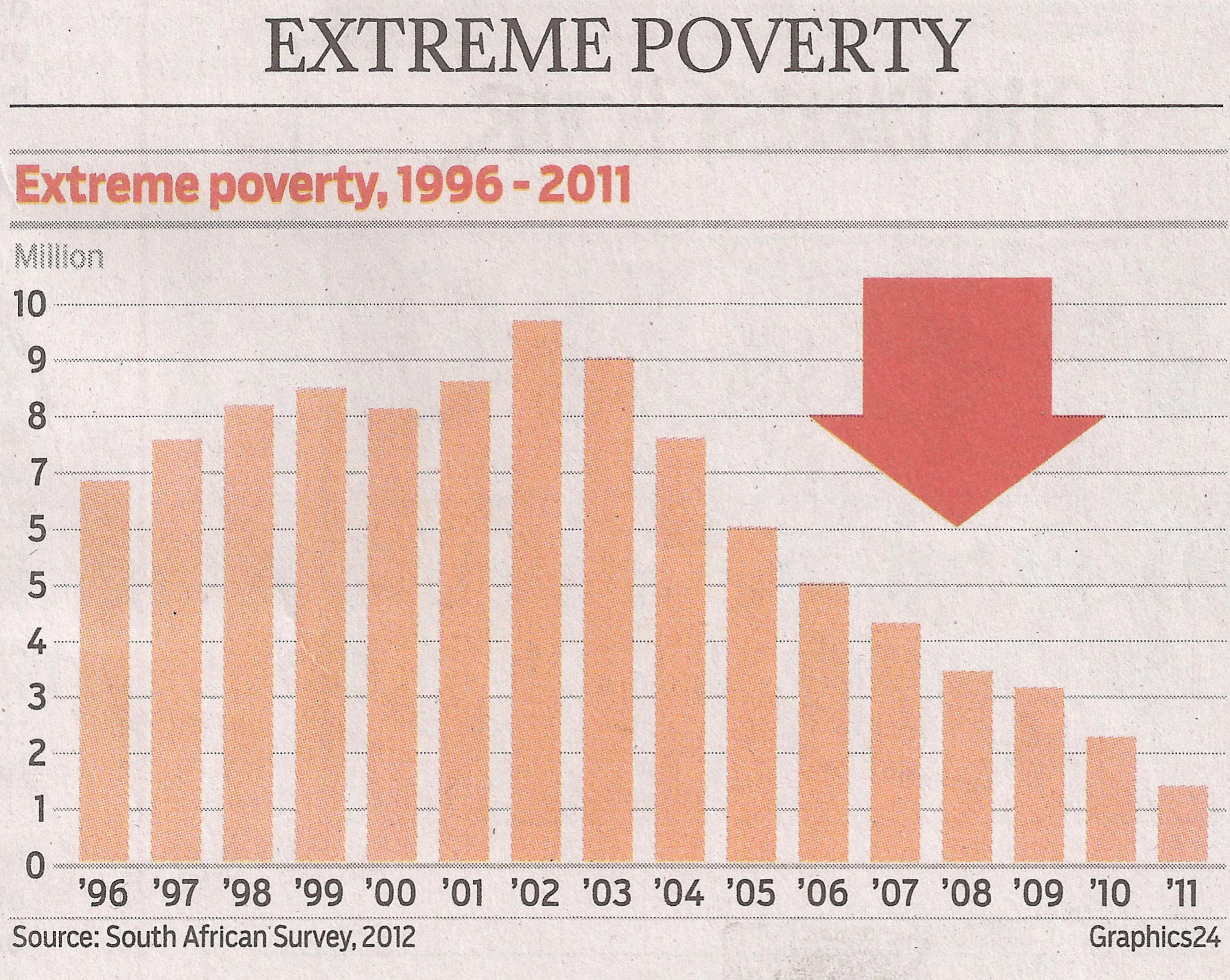
City Press has a useful op-ed page by the always excellent Ferial Haffajee (who is also the editor) based on the South African Institute of Race Relations (SAIRR) handbook 2012. Interestingly, while SAIRR has become an ever stronger critic of the ANC, CEO Frans Cronje acknowledges that “the last 20 years have seen a revolutionary improvement for all South Africans” – a fact that is apparent from the graphic representations (each one manually scanned from the City Press … so apologies for the quality) below.

Graph above – number of people living on less than $2 a day
Graph above – the (not so gradual) roll-back of Bantu Education – the number of Blacks passing matric grows more in response to changing economic requirement of the labour force.
Graph above – enrolment in tertiary education – significant changes but a long way to go. Notice the growth in African share.
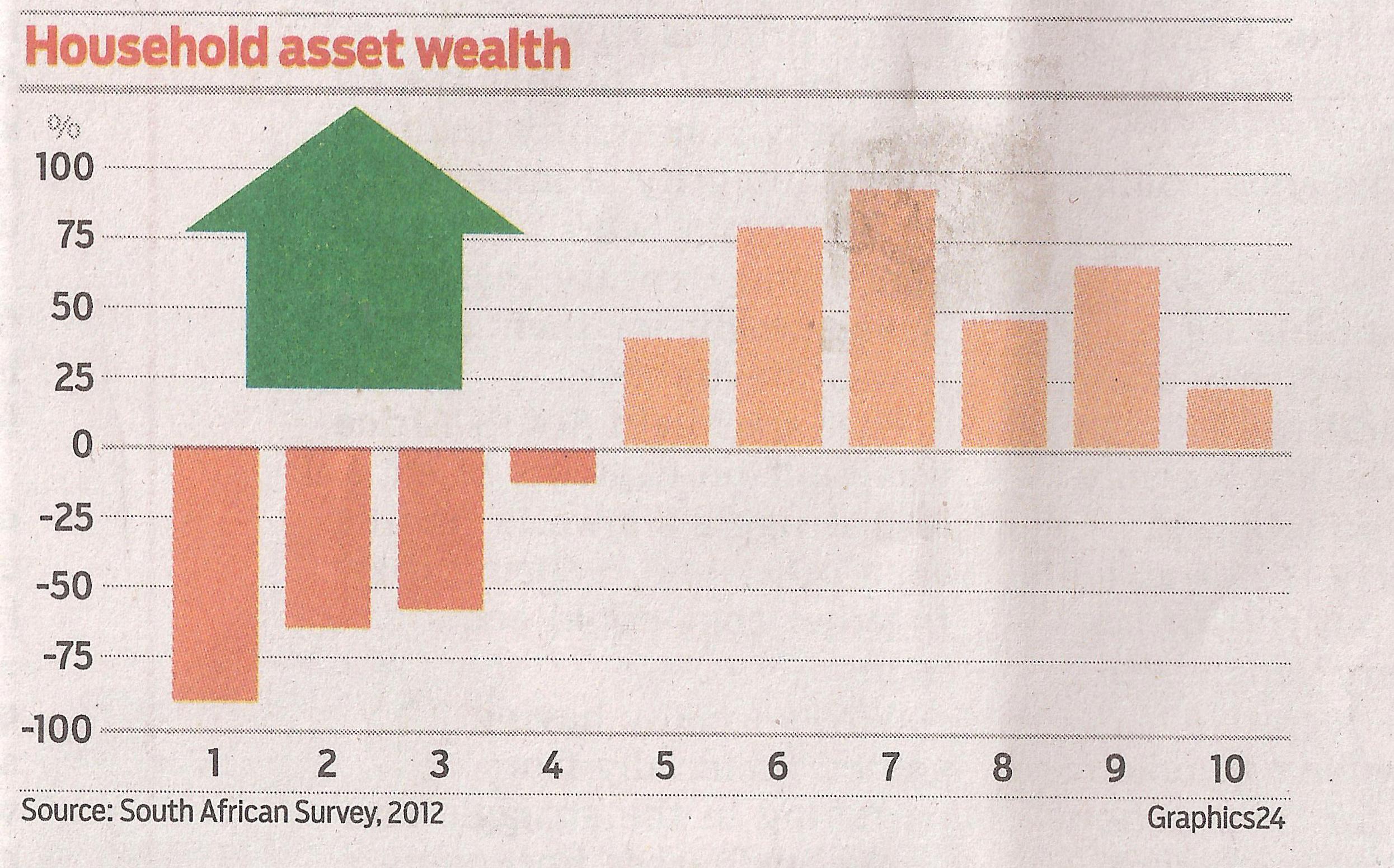
Graph above shows wealth distribution patterns – everyone getting wealthier, although demographics have a strong (even reinforced) apartheid structure
Graph above – the middle class has grown (as far as I can make out from the poorly phrased explanation, this is LSMs 1-10 and how they have fared (grown or shrunk) since 1994 – indicating growth of middle class: bars six and seven.
Graph above – the middle class has grown (as far as I can make out from the explanation, this is LSMs 1-10 and how they have fared (grown or shrunk) since 1994 – indicating growth of middle class: bars six and seven.

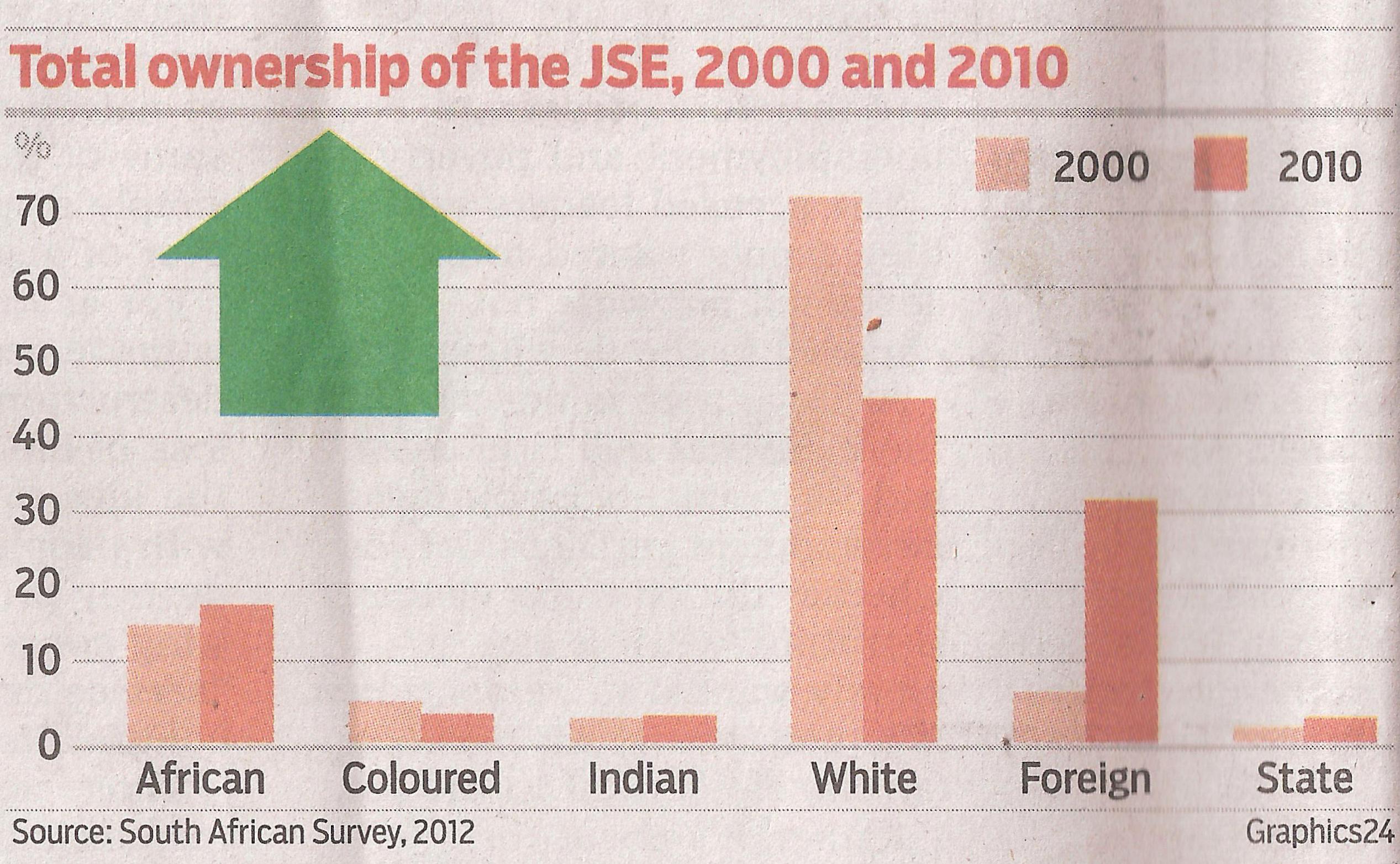
Graph above: the demographics of wealth ownership improve as everyone gets richer – whites still streets ahead in the stakes and foreign ownership is an interesting outlier.

So what

Worries about an Arab spring, and social unrest are often based on the assumption of intractable negative social trends. Haffajee, a strong social and political critic of government herself, says: “Over the years of covering South Africa’s freedom, I’ve come to learn this about us: We don’t count our lucky stars often enough, nor do we give ourselves credit for the things we do well. Why this is, I am not sure. But the answer probably lies inherent in the way power was peacefully transferred, but not decisively won.” These graphs run counter to popular wisdom in a number of ways, perhaps the most important one to point out for domestic consumption is that the idea that whites are the new oppressed, and the losers in the last 19 years (as argued in powerful sections of the media and Solidarity trade union, for example) is obviously, even elaborately, wrong.

Businesses unanimous in condemning draft Licensing of Business Bill

A proposed bill will force small businesses and traders to register with, and be licenced by, local councils and municipalities (“every greengrocer, car dealer, pharmacy, and livestock seller … it includes every service provider, from lawyers to hospitals and hotels, car parks, airports, freight carriers and advertising agencies” – Free Market Foundation quoted in Business Report, the Sunday Independent’s business section). The report links the bill to the latest Global Entrepreneurship Monitor that shows SA entrepreneurship levels to be the lowest in sub-Saharan Africa.

So what?

The entrepreneurship survey is deeply disturbing – although not wholly surprising and we agree with Business Unity South Africa when it says (as quoted in the same story) that the bill “will … retard the growth and development of SMEs and further harm a sector which is presently struggling with a high business failure rate.” However, we understand the real target of the Department of Trade and Industry which is floating the legislation is to restrict illegal hawking, particularly of the flood of cheap, illegally imported manufactured goods. Legislation often has unintended consequences, which is the reasons there is extensive public consultation before laws are placed on the statue books. The DTI’s instincts are to fiddle in the economy, but its intention here is undoubtedly correct, it just needs to find the best mechanism.

Wage bargaining and the strikes season is upon us

The City Press business section says “major wage talks scheduled for the mining, motor manufacturing and chemical industries haven’t even begun properly.”

“A full blown teachers’ strike is now on the cards after teachers’ union Sadtu last week presented President Jacob Zuma with a 21-page mix of labour and political demands” – City Press (those demands include the removal of Basic Education Minister Angie Motshekga and her director-general Bobby Soobrayan.

The Motor Industry Bargaining Council (MIBC), where Numsa dominates sets wages for 160 000 workers in the sector and this year will open with a demand for a 20% across-the-board increase, an industry wide minimum of R6000.00 a month and a ban on labour brokers – later this week.

The Chemical Industry also starts next week (sectors involved are “fast moving consumer goods, glass, industrial chemicals and pharmaceuticals” – City Press.)

The most widely anticipated talks are those coming up in the Chamber of Mines for the gold mining industry (and concurrently in the coal sector) – the first since illegal strikes rearranged the labour landscape and ushered in a plethora of worker committees refusing to work through unions. “The handsome increases some of the mining strikes won last year, by bypassing the formal system, will exercise the minds of everyone at the table …” City Press.

The article also says “the Chamber of Mines is meeting with Amcu again this week to try and arrange its place in the forum … where Amcu will have to share Num’s mandate for the populous lower bands.”

“The plan for a new platinum forum echoing the gold and coal forums at the chamber has not made any progress. This while mining companies will see their standing wage agreements expire this year” – City Press.

So what?

South Africa has a predictable strike season, the timing of which coincides with the expiration of bargaining chamber agreements in different sectors of the economy. Every year it appears that a wave of strikes is enveloping the country, but at some time during the gloom, journalists twig to the fact that this happens every year – much of the flurry in normal and predictable. Strike action during these times can appear to cascade through the economy and we need to be clear what is ‘normal’ and what is ‘abnormal’.  The platinum and agriculture strikes last year were abnormal and have, to an important degree, contributed to destabilising the system – by creating unrealistic base expectations and by encouraging workers to bargain outside of the unions and structures of the central bargaining system. This does lay the grounds for serious uncertainty this year. Adding to the tension is the apparent attempt of Zuma and his strategist and allies in Cosatu to get rid of popular Secretary General Zwelinzima Vavi. As we discuss below, this could contribute to serious disturbance in industrial relations this year – disturbances that are distinctly not part of the normal cycle.

The growing tension in the ruling alliance is putting Cosatu under intense strain

The Sunday Times says it has seen and analysed Cosatu’s schedule of rallies and official speakers for May 1 and argues: “May Day celebrations will once again expose the deep division in Cosatu” – a significant part of the tension concerns Num leaders refusing to address rallies in the Eastern Cape, an important labour sending area for platinum mines and likely strongholds of Amcu where Jacob Zuma’s Num allies are might to be embarrassed, heckled or driven from the stage.

City Press attempted to tote up the “for and against Vavi” unions indicating membership numbers – using figures drawn from the Cosatu 2012 national conference official ‘organisation report’- and it’s own insights into which groups of union leaders are Zuma allies/Vavi critics. It is not an extremely useful exercise because each union has for-and-against sections, with only Numsa and Num being large and significant unions with more clearly defined “for and against” positions. However the forces against Vavi appear to have the numbers if they need them, although it is not clear that this translates directly into votes in the forum that will make the decision.

Pro-Vavi

Membership Numbers

Anti-Vavi

Membership Numbers

Unclear

Membership Numbers

Numsa

291025

Ceppwawu

80658

CWU

18666

Fawu

126930

Num

310382

Sama

7758

Denosa

74

Nehawu

260738

Pawusa

17146

Popcru

149339

Sadnu

8655

Satawu

159626

Safpu

593

Sadtu

251276

Sasawu

67402

Sasbo

7074

Sactwu

85025

Total members

418029


820979


212319

So what?

This morning an opinion column written by this analyst exploring attempts by the Zuma allies to get rid of Zwelinzima Vavi will be published in the online newspaper The Daily Maverick. Here is an extract that contains the most salient “so what?” for financial markets:

 “Shafting Vavi could conceivably split Cosatu – and even lead to the formation of a new left or worker-based political party. Take Numsa, all the other trade unions and bits of trade unions that support Vavi and add the individuals and organisations Vavi has been accused of flirting with (in the National Anti-Corruption Forum and earlier in the Civil Society Conference – October 27 2010) and dig out all those leftists long ago alienated from the ANC (think the brilliant and creative Zackie Achmat and those connected to him); go wild and add Amcu and some not yet indiscernible political formation emerging around Amcu or even around Agang … and you have the grounds for a real and serious challenge to the ANC. At the very least shafting of Vavi might not equal clearing Cosatu of his influence. It might equal clearing the ruling alliance of Cosatu … leaving Zuma Incorporated clinging to a fading Num and a few cronies.… it is a risky game. One of the by-products could be another catastrophic year on the industrial relations front. If Cosatu splits, it won’t be a neat division between different unions … the fault lines will run through individual unions and the disturbances generated by the Amcu/Num contest could become a model for the whole economy.”

The SACP joins criticism of the National Planning Commission – final nails in Trevor Manuel’s coffin

To add to the general factional confusion in the Ruling Alliance, close Zuma allies, the SACP has published a discussion paper that has a “sharp, pointed and nuanced interrogation” of the NPC (which produced the much vaunted, in financial markets and by business, National Development Plan).  “We cannot have a free-floating NPC, with an apparent presidential endorsement and using the budget of the presidency” says the SACP discussion document.

So what?

Actually, to my surprise, I agree with the main SACP criticism: the plan “does not have a strong organic link into government and its diverse planning apparatuses and processes.” Without such links, the NDP was always going to be a fig-leaf covering up the paucity of any actually strategy for economic development in the Zuma administration. The SACP can’t hide the fact that what it mostly dislikes about the NPC or the NDP is business’ participation in the formulation of the ideas and that Cosatu is starting to come out ever more critical of the document. I expect the NDP to go the way of a myriad similar (although never quite as thoroughly and carefully wrought) such plans from South Africa’s recent past.

Bits and pieces

  • City Press spent a day in the DRC’s Eastern Region with the M23 guerrilla movement, meeting them in Bunagana on the Rwanda border. The UN is deploying a brigade as a result of UN resolution 2008, which accuses the M23 and other rebels of mass rape, murder sprees and of recruiting child soldiers. The M23 insisted to City Press that Khulubuse Zuma (a nephew of the president) won valuable oil concession on the shores of Lake Edward and in exchange Jacob Zuma has committed “elite troops and top-drawer fire power to the UN force to smash M23.” The M23 guerrilla movement is trying to play into South African politics by accusing Zuma – sounds like one group of wolves trying to accuse another to cover up their own predatory behaviour. I have seen no evidence to back the idea that the troops are being sent to protect the Zuma family’s interests.
  • The Dina Pule saga continues to become ever more deeply incomprehensible. City Press claims Dina Pule  has alleged that famous soccer club owner Jomo Sono is behind a smear campaign against her to attempt to blackmail her into awarding his (Sono’s) company a the multi-billion rand set-top-box decoder contract. Pule is due to appear before Parliaments ethics and member’s interests committee on Thursday or Friday and the sooner political clarity comes to the telecommunications sector, the better.
  • Regional leaders are expected to hold a summit soon to discuss Zimbabwe’s readiness to hold elections, amid warnings that time is running out to ensure the poll is free, fair and credible – Sunday Independent. Lindiwe Zulu, President Jacob Zuma’s foreign policy adviser and a key member of his facilitation team in Zimbabwe confirmed that Zanu-PF had recently thrown up obstacles to ‘proper monitoring’ of the Zimbabwe negotiations. “But she said her team had persuaded Zanu-PF that as SADC was supervising negotiations, it had the right and obligation to attend whatever Jomic (Joint Monitoring and Implementation Committee) meeting it chose to. Zanu-PF conceded the point” – Sunday Independent.
  • Senior managers at PetroSA have been accused in the Mail & Guardian of conspiring to loot billions from the national oil company. It is a big story, dense with details and looks extremely damaging to those who stand accused. I will be monitoring the implications.

Cosatu’s splitting headache, the ANC and DA try on new party dresses and those awful Mandelas

In high anxiety at my failure to publish here for several weeks (what with 12 days visiting fund managers in the UK and Europe and new commitments to the Daily Maverick – see here and here for the first two of those) I have decided to again post a modified version of my usually bespoke  ‘SA Political news commentary’ … to show willing; to demonstrate that I am not entirely unembarrassed that my last post, which was also a news commentary, was on March 18.

Perhaps I am edging towards closing down this blog … but I am not quite done yet, and for those who have stuck with me this long, I thank you.

So here,  written to a deadline of 06h30 yesterday, slightly modified for my hanging-by-a-thread website:

SA Political News update 23/04/2013

Cosatu and the ruling alliance: corruption claims and counterclaims

According to the Mail & Guardian (April 19-25), the battle for control of Cosatu is becoming ever more vicious. The article states that behind the noise is an apparent attempt by the ANC to close down a powerful left faction in Cosatu that has been critical of both corruption and the alleged adoption of ‘pro-business’ policies by the ANC and government. The main issues over which the battle is playing out are:

  • Allegations made (according to the M&G) by “an informal caucus … of senior leaders from Nehawu, the NUM, Popcru, Sadtu, Cepawu [they mean CEPPWAWU, I think – ed], the SACP and the ANC[1]” that Zwelinzima Vavi, the popular Cosatu Secretary General, has engaged in corrupt activity and is disloyal to the ANC-led alliance, including by failing to adequately support Jacob Zuma for re-election at Mangaung.
  • A flood of accusations made through the Cosatu linked NGO Corruption Watch that many of the leaders of unions involved in attacking Vavi are themselves corrupt – Mail & Guardian in a story that works more by insinuation rather than actual content – see here  for the story that was later denied by Corruption watch here).
  • The proposal made by Fawu (Food and Allied Workers Union) for a special Cosatu congress to resolve this issue, opposed by the group named in the first bullet, but supported by Numsa, Samwu and several smaller unions[2].
  • Support for and against the National Development Plan.

So what?

Business might be tempted to fold its arms and sit back and delight that the old ‘thorn in the side’ Cosatu is being riven by tension. However, it is worth recalling that some industrial relations consultants also delighted in the emergence of Amcu in the platinum sector as a counter to Num for similar reasons – and look how that played out. The serious political conflict in Cosatu could as easily result in higher levels of labour unrest, with higher levels of unpredictability, in a wide variety of industries than in a generally more compliant labour movement. Several multi-year wage agreements are coming up for review before the end of this year (including in the automobile, chemical, gold mining, coal mining, retail motor industry and tyre sectors – which historically have been trendsetters – Business Times). Add to this my uncertainty as to whether the tight three-year public sector wage agreement set last year will hold under strain caused by a combination of:

  • the (welcome) reforming zeal of Public Service and Administration Minister Lindiwe Sisulu,
  • government’s apparent attempt to roll back the power of the South African Democratic Teachers Union, and
  • the generally difficult economic circumstances for union members,
  • the successes of the wildcat strikes, particularly in the platinum sector last year, perhaps having established a new baseline for increase expectation throughout the economy

and it is not inconceivable that we could have another year of potentially devastating labour unrest.

If the government’s (and the ANC’s) intention was to have a showdown with organised labour over economic growth and stability that would be one thing. But I suspect that the evident intervention in Cosatu is based on the sectarian interests at the ruling faction of the alliance rather than in any real desire to pursue the national good. If that faction faction successfully expels Vavi they might precipitate a split in Cosatu and the long awaited formation of a new ‘left’ political formation … and just by the act of pushing, through what appears to be a dirty tricks campaign, for this outcome the ruling faction risks rapidly escalating labour unrest.

The DA and the ANC try on their best dresses (or maybe not)  for Election 2014

The DA has launched a campaign attempting to burnish its anti-apartheid credentials, including publishing a pamphlet with a picture of Nelson Mandela embracing deceased party stalwart Helen Suzman under the caption: “We played our part in opposing apartheid”.

At the same time, the Mail & Guardian has published excerpts of what it calls ‘draft DA election material’ which explicitly compares the ANC to the National Party. The M&G’s quotes from the draft document include the arguments that under Zuma’s ANC there is a “rise of Zulu nationalism and racist rhetoric” and “as was the case with apartheid, the ANC is using the police to suppress criticism of its government”.

In the City Press and Sunday Independent, the ANC secretary general Gwede Mantashe has separate opinion pieces that argue that the DA’s attempt to appropriate Nelson Mandela is “an abuse of the human and humble character of this icon”. He adds that the DA “remains a brazen advocate for white domination and privilege, and for elaborate schemes for its retention in the guise of liberal policies”.

So what?

The general election next year is likely to be messy and disruptive – sustaining the apparently endless flow of unsettling news coming out of South Africa. From this far out it appears possible that the ANC will be arguing that the electoral issues are essentially identical to what they were in 1994 (white domination and the legacy of apartheid) and that the DA will be arguing that that is just an excuse for delivery failure – it would be difficult to conjure up a more divisive and unhelpful framing of the issues 20 years after the first democratic election.

The unravelling of the Mandela legacy

The weeklies have a flood of stories that pick away at the fabric of the Mandela story. A reality TV show “Being Mandela” is reviewed in the Sunday Times under the heading “Opening up the canned Mandelas – comic kugels[3] help deflate the myth”. The show “unveils the vacuous, pampered lives of two of Nelson Mandela’s grand-daughters, Zaziwe Dlamini-Manaway and Swati Dlamini” – Sunday Times.

The Sunday Independent leads with a review of “struggle stalwart” Amina Cachalia’s new book “When Hope and History Rhyme” in which, among many other matters, she reveals aspects of her own alleged romantic relationship with Nelson Mandela post his marriage to Graça Machel.

All of this comes as a bitter fight among Mandela’s children (with, among others, Nelson Mandela nominees George Bizos and Tokyo Sexwale) for control of various trusts that Nelson Mandela set up on his children’s behalf comes to a head in the Johannesburg High Court – The Sunday Tribune.

So what?

There may be some inherent advantages to the exposing of myths and legends as … myths and legends – but there really appears to be no upside to this depressing deflation. None of these stories changes the reality of the 94 year old South African former president’s contribution to the South African democracy and state-craft in general, but the incessant exposure does add to the gathering gloom around the South African story.

Bits and pieces

  • The Youth Employment Accord has finally been signed after three years of squabbling in the National Economic Development and Labour council (Nedlac). Not unexpectedly, it does not include a youth wage subsidy in the form of a tax-break for companies employing first time youth workers. Frankly, at first glance, the accord, as reported in the Sunday Independent, Sunday Times and City Press appears vague enough to leave some confusion as to how it might result in its proposed creation of 5 million jobs for youth by 2020. No real surprises there.
  • The weeklies were full of scholarly – and not so scholarly – debate about the resignation of Judicial Services Council member Izak Smuts. The debate boils down to whether there is a tension between the quality of judicial appointments and the need to make the judiciary more demographically representative. This is an intrinsically South African debate that cuts across every sector of society and will likely be with us for many years to come – for better or for worse.
  • ANC MP, Ben Turok, explains in the Sunday Times the terms of reference and limitation of the nine member “inquisitorial” panel appointed by parliament to investigate the “ethical conduct and conflicts of interest, potential or otherwise” of Communications Minister Dina Pule with regard to the various allegations that she has allowed her romantic partner to make significant capital out of her ministerial post. That parliament is investigating this matter can only be a good – albeit long overdue – thing.

[1] In order in which it appears in the quote, and supposedly constituting an anti-Vavi, pro-NDP, pro Zuma  faction: the National Education Health and Allied Workers’ Union, the National Union of Mineworkers, the Police and Prison Civil Rights Union, the Chemical Energy Paper Printing Wood and Allied Workers Union, the South African Communist Party and the African National Congress

[2] And this group, supposedly constituting the pro-Vavi, anti-NDP faction, anti Zuma faction: National Union of Metal Workers of South Africa and the South African Municipal Workers Union (plus a host of smaller unions including the Food and Allied Workers union).

(Note for both footnotes 1 and 2 – it is undoubtedly more complicated than this, but we need to start somewhere to attempt to make sense of the chaos.)

[3] Wikipedia (accessed 22/04/2013) explains the use of this term in South African slang as follows: “Amongst South African Jews, the word “kugel” was used by the elder generation as a term for a young Jewish woman who forsook traditional Jewish dress values in favour of those of the ostentatiously wealthy, becoming overly materialistic and over groomed, the kugel being a plain pudding garnished as a delicacy. The women thus described made light of the term and it has since become an amusing rather than derogatory slang term in South African English, referring to a materialistic young woman.”

Zuma’s brittle grip tightens

Early on Monday mornings I send my clients a review of the previous week’s political news which might be of relevance to financial markets.

This morning I thought the issues were of more general interest.

Thus …

Summary:

It is difficult not to see the main items in this review as connected:

  • The ANC yesterday disbanded its Youth League’s executive and the executive of its Limpopo provincial structure – both epicentres of the unsuccessful campaign against Zuma in the lead up to Mangaung;
  • An investigation into Cosatu secretary general Zwelinzima Vavi’s affairs and political loyalties deepens and widens – although, just because it is a stitch-up doesn’t mean there is no fire within the smoke;
  • Zuma’s approval rating among city dwellers drops to an all-time low and disapproval ratings rises to an all-time high.

Main body text:

ANC disbands its Youth League executive soon after axing its Limpopo Provincial Executive Committee

Yesterday, it was reported that at its 4 day legotla [1], the ANC National Executive Committee disbanded, as expected, the Provincial Executive Committee of the party in Limpopo. More surprisingly the NEC of the ANC then went on to axe the NEC of the ANC Youth League – which most observers had thought abased itself adequately to Jacob Zuma after failing to unseat him at the Mangaung national conference. (Note I am reliant on news reports for this … the ANC NEC is due to hold a press conference at 12h00 today where it will give a fuller report.)

So what

The Limpopo ANC and the ANC Youth League were the launching pads of the challenge against Jacob Zuma that had been led by Julius Malema. Disguising itself behind the ‘nationalisation of mines’ call and funding itself through tender abuse in Limpopo the challenge peaked in mid-to-late 2011, just before Julius Malema was suspended. While the leaders of the ANC Youth League were clearly surprised by their axing yesterday, they can probably count themselves lucky that they are not being taken down the same path as their erstwhile leader Julius Malema, which might well end in prison for corruption charges.

While the Limpopo ANC, and to a lesser degree the ANC Youth League NEC, were riddled with corruption, it would be a very generous interpretation of what happened yesterday to see it as a “clean-up” of the ruling party. The  more appropriate prism would be to understand this as an attempt to get rid of centres of resistance to the leadership of Jacob Zuma and the faction he represents. In a less jaundiced view, it is also an attempt to establish a basic degree of coherence in the party before the national elections which will be held midyear 2014.

Cosatu – 3 commissions to investigate Vavi

Zwelinzima Vavi is facing 3 simultaneous commissions into aspects of the criticism that members of Cosatu’s national executive committee made against him two weeks ago – including that he has been involved in corrupt activity and that he is disloyal to the ANC. This comes against the backdrop of ANC secretary general, Gwede Mantashe, attacking Cosatu for failing to defend the ANC against “a neoliberal agenda” and he has warned that anarchy is taking root in Cosatu: “my conclusion is that Cosatu is on a dangerous downward slope” – (Mail & Guardian March 15). (This added after publication – Carol Paton, in her excellent article in Business Day about this matter a few hours ago said: “One of the most distasteful dimensions of Cosatu’s internal fight has been the partial role played by several journalists, who have published information from parties to the conflict designed to smear Vavi. For example, allegations have appeared in the press to the effect that Vavi sold Cosatu’s former headquarters for R10m less than the market price. But such a direct allegation has not been made in a Cosatu meeting.

So what?

The answer is best provided by a quote from “a senior Cosatu leader” in the same article: “All this is a smoke screen. The main cause of divisions in Cosatu is ANC and SACP politics. The two organisations are trying hard to capture Cosatu, but Vavi is the obstacle. He is the only one prepared to defend the interest of workers. Dealing with him will ensure that they capture the federation.”

Not unlike the decision by the ANC NEC to close down internal opposition in Limpopo and in the Youth League, at least part of what is happening in Cosatu is an attempt to close down criticism of Zuma (especially after Vavi called for an investigation into the R230 million state spending on Zuma’s home in Nkandla) and criticism of the ANC more generally. This is the Nkandla faction crushing the last vestiges of the attempts to unseat Zuma at Mangaung – as well as an attempt to establish coherency in the ruling alliance in the lead-up to national elections next year.

(The allegations against Vavi – aside from ‘collusion with opposition’ parties – includes that he sold Cosatu’s old head-office for R10 million less than its market value and that he awarded a tender to a company at which his stepdaughter was employed. Just because there are other agendas at play, says nothing of the veracity or otherwise of these charges. Vavi himself has welcomed the commissions, stating that he believes they will clear him of all charges – although, interestingly, he attempted, unsuccessfully, to have ANC stalwart Pallo Jordan and Minister of Economic Development, Ebrahim Patel as commission leaders.)

(This added after publication: Carol Paton writing in Business Day argued a few hours ago as follows: “One of the most distasteful dimensions of Cosatu’s internal fight has been the partial role played by several journalists, who have published information from parties to the conflict designed to smear Vavi. For example, allegations have appeared in the press to the effect that Vavi sold Cosatu’s former headquarters for R10m less than the market price. But such a direct allegation has not been made in a Cosatu meeting.” I wish I had put that  in earlier.)


Zuma approval rating among city dwellers drops to all time low

The Sunday Times reports that President Jacob Zuma’s approval rating among urban dwellers is lower than ever and his disapproval ratings are at their highest – and, in general, views are firming up on this matter.

%

Apr

‘09

Jun

‘09

Sep

‘09

Nov

‘09

Feb

‘10

May

‘10

Sep

‘10

Nov

‘10

Feb

‘11

Mar

‘11

Sep

‘11

O/N

‘11

Feb

‘12

Apr

‘12

Aug

‘12

Feb

‘13

Approve

52

57

53

58

43

51

42

49

49

48

45

55

55

46

48

41

Disapprove

29

13

19

23

41

33

44

34

35

38

41

38

35

46

44

51

Don’t know

19

31

28

12

17

16

15

17

16

14

14

14

10

8

8

9

Net positives

+23

+24

+34

+35

+2

+18

+2

+18

+2

+15

+14

+1

+20

0

+4

-10

Zuma’s approval ratings amongst city dwellers over time (TNS Research)

TNS conducted home interviews with “1290 blacks, 385 whites, 240 coloureds and 115 Indians and Asians.”[2]  54% of black people were still happy with Zuma’s performance, but only 13% of whites. The president still has 64% of the vote from “younger Zulu-speaking adults, of whom 64% – down from 71% in August last year – were happy with his work” (Sunday Times).

An important indicator comes near the end of the story: “Zuma’s biggest drop in approval was recorded in Soweto, where the figure of 42% was the lowest since he assumed office. The Port Elizabeth figure of 22% was also an all-time low.”

So what?

National general elections must be held some time between April and July in 2014. For the first time “born frees” (young people born after 1994) will be eligible to vote. This first wave of born frees will consist of approximately 6 million people, “using the 76% turnout of the 2009 elections, these new voters could make up more than 20% of the vote by 2014 … for context, the Democratic Alliance won 17% of the vote in 2009. From 2014 onward, the born-frees will come in waves of just over 5-million each national election until they make up nearly half of the voting population by 2029” –  (Osiame Molefe in the online news source Daily Maverick).

There is growing excitement that, perhaps, this category of voter, and urban African voters more generally, might be open to political choices unthinkable only a few years ago. Much of the growing expectation in the Democratic Alliance and the energy behind Agang comes from this source. Could younger and urban voters (especially Africans) vote for a party other than the ANC in 2014?

Jacob Zuma has established a rigid hold on the ANC, but the TNS and other market research could indicate that it is precisely this victory that makes the ANC a less appetising choice for younger and urban voters. If Jacob Zuma leads the ANC in an election in which the ruling party gets much less than 60 % of the vote, his hard but brittle hold on the party could shatter.

ANC strategists are seriously worried about both the Eastern Cape (especially, but by no means exclusively, the Nelson Mandela Bay metropolitan area) and the Northern Cape. The idea of whole of the Cape (Western Cape is already in Democratic Alliance hands) in opposition hands and a party the equivalent to the Movement for Democratic Change in Zimbabwe giving the ANC a run for its money in urban areas throughout the country is a nightmare scenario.

Analysts have consistently been surprised at how well the ANC has performed in national elections (62.65% in April 1994, 66.35% in June 1999, 69.69% in April 2004 and 65.90% in April 2009) so treat any wild predictions with a degree of scepticism. However, the TNS survey of Jacob Zuma’s ratings is an indicator that shifts are in progress .

Bits and pieces

  • Business Times quotes a succinct put-down by Finance Minister Pravin Gordhan of the ratings agencies: “[You must] understand that we in South Africa did not create this crisis …when … the financial sector began to create … derivatives, based on sub-prime mortgages … [they] had an AAA rating given to them by the same agencies.” Last week S&P affirmed South Africa’s foreign currency sovereign credit rating at BBB and kept the outlook negative, arguing that external imbalances and underlying social problems remain.
  • All the major weeklies expressed deep levels of concern about what they see as out-of-control police violence in the country – most obviously evinced in the killing of Mozambican taxi driver Emidio Macia in Daveyton, but also brought into public focus by police commissioner Riah Phiyega’s spoon-fed testimony to the Markikana commission on Thursday last week. Police minister Nathi Mthethwa is one of Zuma’s closest allies and his department is, truly, in a parlous and dangerous state.

[1] A word in South African English borrowed from Sesotho, usually meaning a consultation or community meeting with government and the community or within a political party

[2] Categories and language routinely used in South Africa where the racial categorisation of the past is correctly understood to have a significant influence in the present and is routinely used in the media and academic analysis.

Against a dark backround … an occasional beam of light

I am struggling to make up my mind whether there really is a small accumulation of good news, clearly visible against the looming night … or if I am just desperate. Today’s Business Day story by the always interesting Carol Paton looking at Manuel and Sisulu on a stern clean up the public service drive must be positive, surely?

… and several points in my take on the political news in the English language weeklies from last week are postive:

Cabinet reshuffle

The Sunday Times says Jacob Zuma is planning to axe Dina Pule, Minister of Communications and Lulu Xingwana, Minister of Women, Children and People with Disabilities. Pule’s tenure has “limped from one scandal to another – including the questionable millions paid to her boyfriend from sponsorship money meant for the ICT Indaba last year” – Sunday Times.

So what?

The Department of Communications has failed to unbundle the local loop, missed innumerable opportunities with Telkom, under-resourced the regulator Icasa and generally failed to appoint/settle/keep senior management … and has had three ministers in 3 years. Fixing this is a priority area in the National Development Plan and one of the key ‘bottlenecks’ or ‘obstacles to economic growth’ that need to be removed. So Pule’s removal has (if it actually happens) to be seen as a good thing.

(Interesting – to me – speculation on the side is that Zuma might move Thulas Nxesi (Public Works) to replace Angie Motshekga (Basic Education) and have Motshekga replace Xingwana. This means that Jeremy Cronin (deputy minister in Public Works) might then replace Nxesi. But, as the Sunday Times says “there are concerns in the Zuma camp about whether he (Cronin) can be relied on to protect the president from the repercussions over the controversial R206-milliion Nkandla upgrade.”

Public service

Lindiwe Sisulu (Minister of Public Service and Administration) is quoted in the Sunday times about planned amendments to the Public Service Act setting in place ways of stopping senior administrators benefiting from government contracts. She also promised a “super-director-general’ who would ensure that all heads of department adhere to performances linked reward systems.

So what?

Cosatu’s Zwelinzima Vavi lauded Sisulu plans, saying this would stop the “looting” of public funds by government employees. “We can only say halala (congratulations) to that!” he is quoted in the Sunday Times. I have to agree with Vavi. The biggest political failure that is actually in control of government in South Africa is the poor performance and monitoring systems – and therefore delivery failure and corruption – in government and public sector institutions. Sisulu’s intentions are to be welcomed – and she probably has the steel to follow through. So another plus.

Ramphele wanted DA to be dissolved

The Sunday Times quoted several DA members essentially claiming that Mamphela Ramphele almost joined forces with the DA, but wanted the party to be dissolved first and for her to have an equal share of a new institution. “She wanted a new political party and not to join the DA … she came with nothing but wanted an equal share” said one unnamed source.

So What?

The week has been beset with rumours about the impending announcement by the respected academic and business person Mamphela Ramphele that she is to set up a new opposition party. Speculation reached a climax when it was announced that she had resigned as Chairperson of Goldfieds on Wednesday last week. Ramphele would make an excellent addition to opposition parliamentary politics in South Africa – but the idea that one person, with no party structure or obvious constituency in hand, will change the South African game is hopeful at best. However, on the balance, this is undoubtedly another positive. (That’s three in a row for those who are counting.)

Zimbabwe referendum

Several of the weeklies reported that Zimbabwe’s President Robert Mugabe issued an official proclamation on Friday setting March 16 as the date for a referendum on a draft constitution. Most expressed concern that local activists felt that that gave very little time to explain the draft constitution (it took 3 years of bickering to cobble together) to voters and that the draconian Public Order and Security Act would need to be suspended or repealed before campaigning for a ‘Yes’ or a ‘No’ vote could take place. All opposition parties have  called for a referendum ‘Yes’ vote to allow the constitution to be accepted and signed into law without any further changes.

So What?

Zimbabwe’s stability and growth prospects impact on South Africa in a myriad ways, for example in the floods of economic refugees and the shifting size of the export and investment markets in Zimbabwe. An interesting story in the Sunday Times by senior editor Mondli Makhanya argued that Zanu-PF is likely to benefit from opposition disarray and an improving economy. “With the elections just months away, Zanu-PF is smiling and looking forward to strolling to victory. After having brazenly stolen four parliamentary and presidential elections between 2000 and 2008 Zanu-PF will not have to resort to violence and skulduggery this time.” If Makhanya is correct (which he may well be) it is going to stick in a lot of craws that through a combination of looting, patronage networks, repression and the chasing of the urban poor into the arms of the South African informal economy and welfare system, Zanu-PF might remain in power.

New Iran claims hit MTN

The jailing of Iranian born US citizen Mohammad Hajian for supplying “sensitive and potentially dangerous equipment to MTN’s mobile network in Iran” (Mail & Guardian) deepens MTN’s woes in relation to its Iranian operations.

So what?                             

“The conviction is damning for the South African mobile giant, as it provides judicial corroboration that the company used sanctions-busting networks to beef up its technical infrastructure in Iran” (M&G).

State of the Nation Assessment

Most reviews pointed to the key absence of any binding theme in Jacob Zuma’s State of the Nation Address.

City Press probably had the best coverage.

  • It (CP) correctly points out that there was a specific “shift on land reform” –  with a move from “willing buyer, willing seller” to a “just and equitable” formulation.  This refers to the establishment of a “valuer-general who intervenes on behalf of the state … who then oversees land valuation …to keep the price … affordable for the state to redress” – CP quotes Gugile Nkwinti (Minister of Rural Development and Land Reform).
  • It argues that the youth wage subsidy has been swept aside and that government, business and labour in negotiations through Nedlac will announce a plan soon whereby “growth industries with young workforces will attract state support to hire the young and jobless … unskilled young people will also be offered a second chance to write their matric exams”. So no across-the-board subsidy … but a directed one, only in selected industries.
  • It picks away at the infrastructure programme and the various roles that will be played by Malusi Gigaba (Minister of Public Enterprises) and Ebrahim Patel (Minister of Economic Development). City Press interviewed the ‘up-and-coming’ Gigaba and asked him if Ebrahim Patel had left him much of a role to play. Gigaba replied: ““Economic Development is responsible for a broader plan. My department is responsible for three big infrastructure projects: the roll out of broadband, electricity infrastructure and logistics like rail. Other departments are responsible for roads, transport and dams.”

So What?

The State of the Nation address is always over-anticipated and usually bitterly lamented as not having been specific or visionary enough. This year, not unexpectedly, Zuma enumerated the successes of government and hyped the plans.  Much of what Zuma and his government will do and say in the next while will be focused on the national election in 2014 – and expectations likely to be disappointed.

Bits and Pieces

  • City Press reports that the department of fisheries, headed by Tina Joemat Pettersson is in “total free fall” – raising serious concerns about government’s ability to conduct research required to determine quotas of ‘allowable catch’ for key species.
  • Sunday Times business section reports that industrial unrest and violence at the Medupi construction site make the “chances of the R91bn power station feeding power into South Africa’s overstretched grid by the end of this year … slim”.
  • Sunday Times reports Harmony Gold made history by making individual workers at its Kusasulethu mine sign a treaty with the company in order to lock individual workers into a contract with the company. “This is quite a revolutionary move … (it) means that individual workers can now be taken to task when stepping over the line” says Peter Major, Cadiz mining analyst. Major argues, according to the report, that if similar agreements had been put in place a year ago when trouble first started brewing on the mines at Impala Platinum, a “Marikana” might have been prevented.

(Added as an afterthought: I realise I haven’t made any kind of conclusion given that the opening paragraph suggests I was going to indicate either that I am more positive than negative or vice versa. Frankly, I can’t make up my mind. Which probably makes me a fairly bog standard South African.)

That lingering odour …

In the 1980’s I unwittingly employed an apartheid police informer, Mark Behr, to work in the Institute for a Democratic Alternative for South Africa (of which I was a regional director).

Behr had a serious talent – and zest – for self-promotion. But he was also bright, ambitious and charismatic and I naively believed that all those characteristics together, could be harnessed for the good of the organisation, and ‘the struggle’ (I know. We really called it that.)

As it turned out he was already in the employ of the Dark Side …  and those who got the benefits of that self-promotion and ambition were the opposition to the anti-apartheid team.

Mark Behr was a lightweight apartheid agent and there is a part of me that wishes I could just put him and the sheer awfulness and banality of the apartheid security state machinery, and his role in it, behind me.

But unfortunately for me, someone pointed out last week that there is a Wikipedia entry on Behr that, when I accessed it on Friday (13/02/2013) said (without any cautionary remarks):

“Undergoing a process of political radicalization himself, he later turned double agent and spied on the South African government on behalf of the African National Congress

… and further:

“Professor Behr is a well respected and acknowledged international author and experienced double agent that left South Africa for a safer lifestyle in the USA.”

The gradual sanitising of Apartheid and the security machine that maintained it is disturbing to me for too many reasons to name here.

But that is less the issue for me in this particular story.

No matter how slow the historical fabrication happens, how tiny the incremental changes made to the record, there is no version of the truth in which Behr underwent “a process of political radicalization” or “turned double agent and spied on the South African government on behalf of the African National Congress” – or any similar heroic, tragic nonsense.

I know this because I was connected to the underground structures that dealt with Behr, heard his original confession and sent him home safely – a neutralised enemy agent; but also a narcissist and fantasist who, precisely for these reasons, could not be trusted to report back to the movement.

(I mean, please … Behr, in an attempt to have his credentials as an anti-apartheid activist improved, used a gun – and instructions – he got from his police handlers to shoot through an outside window into his room at his university home. He then ran back inside, and later, suitably disheveled and shocked, managed to convince the student body and administration that he was the victim of an apartheid hit-squad assassination  attempt … a little story he managed to leave out of his confession that I cover below – probably because of its obvious buffoonery and because thousands of people still remembered how convincing was his feigned shock and ‘injured victim’ status at the time … and by the way – – this as an added afterthought – he also managed to leave out of his 1996 confession – see below – that he had been a “double agent”.)

Why am I bothering with this, all these years later?

Because Behr knows the truth … as do I. I am no longer certain anyone else remembers or cares. Behr could easily have corrected the hagiographic Wikipedia entry – but he has allowed this distorted tale, in which he is the dashing hero, and of which he is undoubtedly the author, to become the official version of a minor – but important to me – slice of our history.

In 1996 Behr made a dramatic and self-aggrandising (and unauthorised by the ANC) public confession at a writers conference in South Africa.

This is what I said at the time (published in the Mail & Guardian here) … I no longer have that condemnatory certainty, but as an antidote to the Wikipedia entry I cut-and-pasted above, I wouldn’t change a word.

Thus, purely for the record:

The Smell of Rotten Apples

PEOPLE who worked secretly or otherwise to undermine the movement against apartheid should be given every encouragement to say what they did and why. I am all for listening to them and forgiving those who are genuinely contrite.

Unfortunately the sincerity of Mark Behr’s confession is doubtful.

Even before one looks at the text it is difficult to believe that Behr is not engaged in another act of self-promotion. The initial signs are:

  • He flew in from Norway, delivered his confession and fled back overseas without facing those on whom he had spied;
  •  He addressed himself to a conference of people interested in writing, where he was the star speaker, rather than to the ex-Stellenbosch students he had betrayed and the anti-apartheid activists on whom he had informed;
  • He revealed to close friends he was only coming clean because he was going to be named as a spy by a witness at the Truth and Reconciliation Commission;
  • He is publishing a book dealing with spying and betrayal early next year. One must assume his high-profile confession is part of an advance publicity campaign.

To grasp just how unlikely is Behr’s sincerity, we need to examine the text of the 4 000-word confession and apology.

A number of things are missing from the text. He never mentions the arm of the state he spied for, who his handler was, how much he was paid or what information he passed on. If Behr really wanted to redress some of the harm he did -—a crucial aspect of confession and forgiveness—- then these were the questions he should have answered. Instead of dealing with the details of what he did and for whom, Behr spends the overwhelming majority of his words worrying about how he will be judged. The repeated lament is: “I have always suspected that the only voice people will hear from that moment on … is the voice that cannot be trusted, that is incapable of the truth.”

Aside from his exasperating self-absorption the problem with Behr’s words is their totalitarian thoroughness. Behr constructs his defence as a monolith. On reading the document we are left with the impression that there is nothing more to say except to forgive the poor chap, he is suffering enough already. There is no chink in the words for us to enter and engage with him. He has pre-empted any possible criticism by exhaustively criticising himself. He apologises for the betrayals, for his motivation, for his lack of moral courage; he apologises for apologising; and then, in an infinite regress, he apologises for apologising for apologising.

This is called “shutout”. We are left unable to engage with the truth. We can do nothing but acquiesce or reject him outright. If we reject him we place ourselves with those who deny perpetrators the right to change heart; to seek a language to express their grief and regret.

But to what are we being asked to acquiesce? If it was just forgiveness it would be easy. You have to listen to the rhythms of the text, the cadence of Behr ‘s voice to understand the enormity of what he wants from us. “It is with the profoundest imaginable regret …”, “I soon believed in the moral correctness of this struggle I was reporting on …”, “… this might be … yet another reinterpretation geared for justification …”, “I lacked the moral fortitude to face the consequences of my treason …”, “I … would like to capitulate into silence … there is also truth in silence as there might be in ceasing to live.”

Imagine a young version of the Reverend Jim Bakker – remember him? Then listen carefully to Mark Behr and you will hear something akin to the tearful televangelist minister who got caught sleeping with a prostitute – again. He is beating his breast, calling down the wrath of God on his sinner’s head, begging us to join the Lord in forgiving him. The individuals in the congregation are crying with him, wishing they could be the ones to embrace him, to soothe away the contradiction at the heart of this flawed titan of a man. Behr’s confession is a number of things. It is also an audacious attempt at seduction.

The Truth and Reconciliation Commission has begun bringing the painful stories of victims on to the centre stage of our history. As that process begins to take effect we are presented with Behr claiming to have been the victim: “… one is born into, loved into, violated into discrimination”. Behr claims to be the victim of propaganda, of Christian National Education, of his family, of history, of fate, of his own moral weakness. With all due respect! This is a man who spied for the apartheid police in exchange for money. He apparently didn’t even support apartheid. Ten minutes listening to the truth commission will clear the heads of anyone seduced into believing Behr is the tragic hero at the centre of our national drama.

I do believe there is something fragile and sacred in our process of confession and absolution. We all probably know white men who were, as conscripts, engaged in atrocities in Angola and Mozambique. We have watched them writhe in the terrible privacy of their own fear and shame. These men cannot even imagine words to describe where they have been and what they have done. We have all known someone among them who has descended into the hell of drug addiction or suicide.

Behr had the unique combination of talent and opportunity to examine how young whites became culpable. His confession could have begun giving them a voice.

But he misses his one chance at salvation. In an orgy of self-pity and self-promotion he abandons the only people who really needed him to speak with sincerity.

I hear that Behr’s confession was warmly received by many. Behr has consistently traded on his anti-apartheid credentials. I am appalled at the possibility that he will now get away with trading on his credentials as the contrite perpetrator, as the prodigal son.

Behr phrases his confession in the literary context of the limitations of memory and language to describe truth. He has extensive access to platforms that propagate his vision of the truth and a unique ability to manipulate language to do so efficiently. Behr is the fast-food chain in the market of truth. Perhaps in the neighbourhoods where they consume mediocrity three meals a day his version of himself and history will prevail.

Behr could be forgiven for spying on the anti-apartheid movement, even if it was for thrills and extra ready cash. But, quite simply, he would have to be sorry first. Not sorry for himself. Sorry for what he has done.

Nic Borain was secretary general of Nusas in 1985, and established a Nusas branch at Stellenbosch. He was regional director of Idasa Western Cape from 1988 to 1990, and during this time employed Mark Behr

SA political risks for investors

I was looking for a shorthand way of summarising what I thought were the main political risks that are in the minds of investors in South African financial markets.

Note that the emphasis here (in what appears below) is what I think is an appropriate prism for investors in financial markets, and specifically those with an horizon of a maximum of 5-7 years.

If I was looking at broader security issues, particularly with regard to the stability of the state and ruling party, I would have had a significantly different emphasis – and have aspects that are both more negative and more positive than that which appears below. Hopefully, at some time in the future, I will post here a more general threat or risk analysis that would be of more specific relevance to South Africans who hope to live and work here.

Finally, before I get on with it, I do not explore the potential for an upside suprise here … but there does appear to me to be a slight accumulation of good news, albeit against a dark background.

SA Politics and financial markets – 3 risks

  • Unpredictable and/or negative government economic policy interventions: Medium seriousness. Medium likelihood. Short- and medium-term duration (next few months to five years);
  • Escalating social unrest – perhaps leading to “Arab Spring” type event: Very serious. Very unlikely. Medium- to-long duration (five to seven years);
  • Ratings downgrades and tension between ambitious government plans and narrowing fiscal space: Serious risk. Medium likelihood. Short- and medium-term duration (one to three years).

Unpredictable and/or negative government economic policy interventions

Medium seriousness. Medium likelihood. Short- and medium-term duration (next few months to five years)

What it’s about: Most obvious are new interventions in the mineral and exploration sectors (including new taxes, price setting, beneficiation requirements, export restrictions, uncertainty about licence conditions and significantly increased ministerial discretion via the Mineral and Petroleum Resources Amendment Bill), but there are comparable interventions across the economy, as indicated in the ANC’s Mangaung Resolution and in a range of proposed regulatory and legislative changes, including those relating to telecommunications, liquid fuels,  the labour market, employment equity and Black Economic Empowerment (to name just a few).

My view: Since 1994, it has generally been the case that markets consistently overestimate the risk that the ANC and its government will take significantly populist policy measures. The best example of this was in July 2002, when exaggerated targets for black equity participation in the mining sector where leaked and R52b left the JSE resources sector in 72 hours – a buying opportunity of note. However, the traction Julius Malema was able to achieve with disaffected youth post-2009 and the implicit defection from the ANC and its allies in the platinum strikes last year have catapulted the ANC into something of a policy scrabble. While nationalisation is off the agenda, it has been replaced by a policy push that hopes to deploy private companies, through regulation and other forms of pressure, to achieve government (and party) targets of employment, revenue generation, service delivery to local communities and infrastructure build. Increases in the tax take look likely – it’s purely a question of ‘how much the market can bear’.

Government intervention, per se, is less the issue here but rather the confused, generalised and uncertain nature and intent of the interventions. If the interventions do not have the desired results (growth, employment and equality), the risk is that government does not reassess the wisdom of the intervention, but instead uses a heavier hand.

Financial markets: Policy uncertainty puts downward pressure on investment, employment and output in all sectors. In South Africa, these negative impacts will be felt most keenly by companies most exposed to government licencing and regulatory power, or most exposed to government’s political prioritisation. Resources, telecommunications and agriculture all fall into one, or both, of these categories.

Escalating social unrest – perhaps leading to “Arab Spring” type event

Very serious. Very unlikely. Medium-to-long duration (five to seven years).

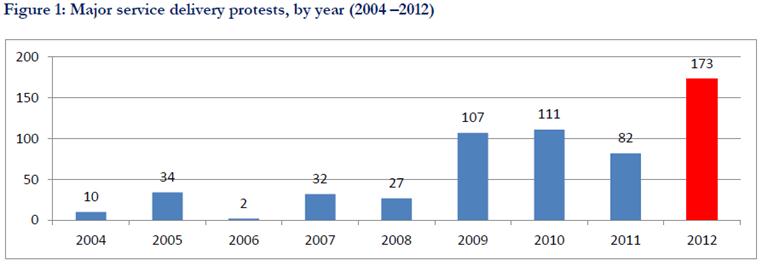
What it’s about: Significant and consistent (apparently linear) growth in service delivery protests, combined with growing levels of industrial unrest (in 2012, anyway) seem to imply that such unrest could continue to escalate until it reaches a point of ‘phase state change’ (as in thermodynamics, referring to changing states of matter – to/from solid, liquid and gas). Thus, the risk is of a sudden systemic shift from unstable to revolutionary/insurrectionary.

My view: Increasing protest and industrial unrest are normal – and fairly consistent – features of South African political life and have been since at least the mid-1970s. Even before 1994 there was no real expectation that unrest would lead naturally to insurrection. A rapid phase state change, like an Arab-spring type event, requires (perhaps indirectly) contesting political formations and ideologies as well as the widespread failure – or absence – of social institutions (parliaments, courts) that direct, mediate and give expression to grievances and/or conflicting group interests. South Africa is rich in such institutions and there is no evidence that large groups of dissenting voices have permanently failed to find expression in society’s normal processes and institutions – even when some of those processes include robust forms of public dispute. However, South Africa does have some comparable features to countries that have had ‘Tunisia-moments’ – including high and growing youth unemployment, high  levels of visible inequality and serious government corruption – so we would keep an eye on the escalating ‘service delivery protest’ trends, as evidenced in graphs from Municipal IQ below.

Municipal IQ
Municipal IQ

Industrial relations unrest is slightly different from – and more negative than – the question of social unrest as a whole. Trade unions are strong and growing in South Africa, and contestation between them is vigorous, even violent – as we saw in the platinum sector in 2012. Trade unions are businesses with an enticing annuity income flow – and this will drive their contestation. The collective bargaining system in South Africa is functioning sub-optimally for a number of reasons – including inappropriately high levels at which automatic recognition kicks in – and the disarray in the system also drives unrest. This conjunction of subjective and objective conditions means I am less sanguine about industrial relations stability (than about stability per se) and expect this to remain a negative investment feature for the next several years. I am specifically negative on public sector industrial relations stability for 2013.

Thus, I do not think unrest and social discord will lead to any radical policy or political discontinuities, but will remain a constant drain on confidence. I also think this phenomenon will tempt government into keeping spending (on the public sector wage bill and on social grants) at above-inflation levels – helping to feed uncertainty and unpredictability in state finances, inflation, the currency and the bond markets.

Additionally, I think labour unrest will remain a seriously destabilising factor of production – including via disruption of services in public sector strikes.

Financial markets:

Resources, agriculture and construction are most exposed through their reliance on large, aggregated and often low-skilled/low-pay labour forces. The financial services and retail are less exposed to (but not immune to) the negative effects of industrial action.

Ratings downgrades and tension between ambitious government plans and narrowing fiscal space

Serious risk. Medium-likelihood. Short- and medium-term duration (one to three years).

What it’s about: The ruling party is facing something of its own ‘fiscal cliff’. The ANC feels itself in danger of losing some support because of failure to deliver employment growth or adequate reductions in poverty and inequality. Foreign investors agree this is a risk, but will not necessarily agree to fund the gap. This tension is among the reasons that all three major rating agencies (Moody’s, Fitch and S&P) downgraded SA’s sovereign rating in 2012 (Fitch in January this year) and both Moody’s and S&P put SA on watch list for future downgrades. The ANC secures political support, at least in part, through spending on the public sector wage bill and on social grants – which together now make up more than half of annual non-interest government spending. Additionally, the ANC has occasionally shown itself hostage to the views of its alliance partners or popular opinion in its spending and revenue plans (Gauteng toll-roads, youth wage subsidy). The ratings agencies don’t like the tension and I expect the bond markets won’t either.

My view: South Africa maintains respectable debt-to-GDP ratios, although these grew to 39% of GDP by end-2012, substantially higher than the 34% for emerging and developing economies as a whole. When Fitch downgraded SA earlier this year, it specifically mentioned concerns about SA’s rising debt-to-GDP ratio, given that the ratio is higher (and rising at a faster pace) than the country’s peers.

South Africa is uniquely (eg in relation to its BRICS peers) exposed to foreign investor sentiment through the deficit on the current account combined with liquid and deep fixed interest markets. SA’s widening deficit on the current account is a specific factor that concerns the rating agencies and is one of the metrics the agencies will use to assess SA’s sovereign risk in the near future. Further downgrades are the risk – potentially driven by foreign investor sentiment about political risks. Non-investment grade (junk bond status) is not an inconceivable future rating.

Financial markets: A significant sell-off in the rand, coupled with persistent currency volatility and reduced foreign capital inflows. Traditionally this scenario would mean investors look for rand hedges and attempt to get exposure to export-orientated sectors, including manufacturing – and to stay out of the bond market. Offshore borrowing costs will be raised for domestic companies – as well as for the country as a whole.  This risk has an internal feedback loop (downgrades make debt more difficult to pay, leading to further downgrades) and naturally feeds other political risks, including in relation to taxation, clumsy government intervention, social stability and property rights.

Fluff

Enthusiasm is a quality I value.

It’s especially endearing in children and dogs. But in human adults beyond the blush of youth it is nothing short of heroic.

However, when enthusiasm is both sentimental and irrational it is decidedly less attractive.

Which brings me to Mamphela Ramphele, Cyril Ramaphosa and the National Development Plan – severally and apart.

When Ramphele resigned yesterday as Chairperson of Goldfields an anticipatory shudder went through the local and international intelligentsia (from the well known Russian word интеллигенция, and defined in Wikipedia as “people engaged in complex mental labour aimed at disseminating culture”).

Yes Ramphele:

  • is tough, principled, intelligent, successful, well organised and has experience at running large organisations;
  • has a degree of “struggle credibility” having been involved in the Black Consciousness Movement 70s;
  • and is unlikely to have made her move without adequate capital backing and other promises of support by significant others …

… and yes we all assume, undoubtedly correctly, that there is a significant (and growing) urban, African, middle-class electoral constituency that is increasingly unrepresented by an ANC that is tending, under Jacob Zuma,  to drift towards a  rural, chauvinist, patronage driven complacency.

The point, for the интеллигенция, is that this constituency is ripe-for-the-plucking by an opposition party lead by Ramphele … a constituency that feels unable to support the Democratic Alliance for historical, ethnic, cultural, policy reasons.

What is it with us looking for a saviour to rise from these streets?

In the recent months it has been Cyril Ramaphosa who will save the ANC from itself and us all from Zuma’s government.

And if that fails we have the National Development Plan that will fix everything.

Like Ramphele and Ramaphosa, the National Development Plan is great.

It might be my own pessimism, but in my opinion these are, all three, not (powerfully) shapers of historical outcomes … they are effects, not causes.

The NDP is just a piece of paper, an adequate diagnosis and a bundle of good intentions.

Ramaphosa is embedded in something much more powerful, and scarier, than he will ever be.

Ramphele is a single person with no established political constituency, no party machinery and a reputation for humiliating her senior managers in public (… aside from all those good things I mentioned earlier).

Sure, we can hope that she will sweep the ANC’s patronage networks aside and replace it with a meritocracy pure as the driven snow.

But I wouldn’t hold my breath.

Political risk and the weeklies

Sunday’s newspapers were more interesting from a political risk and investment point of views than normal.

This is what I thought mattered, as far as financial markets were concerned, in last week’s Mail & Guardian, the Sunday Times, Sunday Independent and City Press:

Construction industry – possible prosecution and fines for fraud and racketeering

Government and the national prosecuting authority are reported to be facing a dilemma: managers in at least 20 major constructions firms might be guilty of serious criminal practices relating to may years of in-industry collusion, but a successful prosecution of the guilty parties would rip the whole management level out of up to 20 top companies and thereby sink government’s infrastructure plans – Mail and Guardian.

The stories are covered in the Mail & Guardian and the City Press – both drawing their details from a series of leaked 2011 affidavits apparently produced by individual managers at Sefanutti Stocks when they (Stafanutti) realised that despite co-operating with a Competition Commission investigation, individual managers were likely to be liable for criminal prosecution (by the Hawks and the NPA) and that the punishment could include imprisonment.

Paul Ramaloko, Hawks spokesperson said “This case is bigger than people think. We are going to take our time and do a thorough investigation” (Mail & Guardian), but in City Press he says the investigation was in its “early stages” and that he would only comment once it had “matured”.

So What? Sounds like a political dilemma. The NPA and the Hawks are not (entirely) governed by the political priorities of government (despite apparently decisive co-ordination between the Hawks, SARS and the Public Protector in the Julius Malema fraud, money laundering and tax evasion investigation). However, government is likely to do what it can to make sure the companies survive intact – albeit compliantly chastened and grateful for leniency. Of course, the NPA and the Hawks might, alternatively, feel these managers would make good examples of how ‘old-order’ and ‘untransformed’ individuals and companies are as important sources of corruption as the ANC, its leaders, supports and structures.

Either way, the reputation and coherency of the companies concerned could be seriously impacted. However it is not clear from the news reports that there is any differentiation between, “winners and losers” … no-one appears more or less guilty than anyone else – which rather suggests the sector as a whole is risky, with no safe havens.

Gupta TV

Key Jacob Zuma allies Atul and Rajesh Gupta (using family vehicle Oakbay Investments) are reported to be on the verge of adding a 24-hour continent-wide news channel to their media portfolio (which includes New Age newspaper) in partnership with Essel Media and an unnamed black empowerment firm. Multichoice will likely be providing the platform but purely on a commercial basis and is not expected to be partner in the venture (Mail & Guardian).

So What?

Well, one of the Guptas’ current empowerment partners is President Zuma’s son Duduzane and the Guptas themselves have become key ANC funders and power players in South African politics.  The Mail & Guardian has a picture of Atul and Rajesh Gupta (who came to the country from India in the early 90’s) ensconced at the ANC’s elective conference in Mangaung in December. Obviously, the more the merrier on the news diversity front – and who says government and the ANC shouldn’t spend more money in the space? South Africa has a free and open media culture – to the point of government and ANC leadership spending a considerable amount of their time denying allegations and defending government policy against feisty attacks. It is unlikely to be harmful if government and the ANC strengthen their ability to put their point of view. Influence trading is always a feature of politics and is no worse or better in South Africa than it is in many countries across the world.

Telecommunications – new political upheavals on the cards

All the weeklies report that Communications Minister Dina Pule is about to be removed from her post in a cabinet reshuffle. At least part of the reason is because she is accused of “routing large sums of money to her alleged lover” – Sunday Independent.  So many individuals are touted as possible replacements, but the one person who comes up time and against is Lindiwe Zulu. This is what the Mail and Guardian has to say about this close Zuma confidant: “Zulu has just been appointed head of the ANC’s communications and her star has been rising under Zuma. A government source said Zuma trusted her opinions. She is his adviser on international relations. ‘He likes her bravery. The way she’s handling the Zimbabwe issue in a fearless manner has impressed him.’ She is one of Zuma’s three envoys on that country.”

So what? Pule will be the third minister to exit this portfolio in four years and instability in the department has raised fears that SA will continue to wander in the policy wilderness as far as migration to digital TV, Telkom’s business plan chaos, spectrum allocation and unbundling of the local loop (to name but a few pressing policy mattings) are concerned.

Mining Indaba – policy confusion as rife as ever

The Business Times has a depressing few pages about the Mining Indaba that implied that if anything the industry is more concerned than ever about policy uncertainty. On the proposed Mineral and Petroleum Resources Development Amendment Bill: “The move has again flooded the country’s struggling mining sector with uncertainty” – Loni Prinsloo.

“On the exploration side” said Magnus Ericsson, Chairman of Raw Material Group, in the lead story, “I think it’s a general hesitation … if you find something in South Africa, what will be the BEE requirements? What are the other requirements? For some foreign investors they are seen as difficult”.

The same series of articles argues that the pressure to “quarantine” SA assets is becoming fierce. “A valuation by AngloGold Ashanti’s biggest shareholder, Paulson & Co, indicated that South Africa’s biggest gold miner could boost its share price by as much as 68% if it split out it local assets.” Elsewhere on the front page of the Business Times, the paper argues: “The true investor sentiment will be measured tomorrow (now yesterday– ed) when Sibanye (Gold Fields’ local assets – ed) lists separately.”

So what? To my mind regulatory uncertainty, especially in the minerals sector, remains the key politically driven investment risk in South Africa. The risk is being driven by pressures (felt by the ANC and government) to improve delivery and redistribution. These pressures will increase going forward and the increased regulatory burdens government is placing on private mining companies is unlikely to achieve any of government’s objectives … in fact, the reverse is more likely to be true. This is an unhappy environment for those searching for policy certainty.

Bits and pieces

  • The brutal rape, torture and murder of Anene Booysen in Bredasdorp filled many column inches in all four weeklies – hoping to stimulate the kind of outrage against rape that swept India recently. Many of the stories point out that South Africa has the highest incidence of rape in the world.
  • Ramphele – will she or wont she? The press is full of speculation about whether Mamphela Ramphele (former anti-apartheid activists and close friend of Steve Biko, a doctor, academic,  successful businesswoman, a former director at the World Bank and former Vice-Chancellor at the University of Cape Town) will set up a political party and that that party will capture a significant percentage of urban black support. I think she might, but I doubt whether the party will make a dent on South Africa’s politics. The most likely scenario, to my mind, is Ramphele ends up in the Democratic Alliance.
  • There was much speculation about what President Zuma might say in his State of the Nation address this Thursday – with a generally excited consensus emerging that Zuma is less beholden to special interest groups (post his decisive victory at Mangaung) than he was previously. I am not convinced this will lead to bold new steps.  I am watching for tension between this speech and the National Budget on the 27th of February.  I expect the political plans in Zuma’s State of the Nation to be at odds with Pravin Gordhan’s plans to balance the books … but I expect that tension to be hidden.
  • The Mail & Guardian gave a list of who it thought is in Zuma’s inner circle: (Lakela Kaunda, Lindiwe Zulu, Mac Maharaj, Collins Shabane, Gwede Mantashe, Nathi Mthethwa and Batandwa Siswana), but then spoiled any special insight that might have given us by adding :

“Those privy to Zuma’s kitchen Cabinets say the president also has a high regard for Economic Development Minister Ebrahim Patel, National Planning Commission Minister Trevor Manuel and Justice and Constitutional Development Min­ister Jeff Radebe. Other key confidants include Rural Development Minister Gugile Nkwinti, Intelligence Minister Siyabonga Cwele, Cosatu president S’dumo Dlamini, Public Enterprises Minister Malusi Gigaba, KwaZulu-Natal Premier Zweli Mkhize, Finance Minister Pravin Gordhan and, to some extent, Higher Education Minister Blade Nzimande. People outside government who are in the president’s good books include businessperson Sandile Zungu, film producer Duma ka Ndlovu and  businessperson Deebo Mzobe, widely considered the man behind the building of “Zumaville”, the town surrounding the president’s homestead.”

… hmmm, must have a pretty big kitchen.

Mangaung – takes, outtakes and takeouts

Various commentators, politicians and analysts have attempted to characterise Mangaung, to define the moment’s essential nature. Below are two takes I found interesting with some words from me on why I found them thus. After that I include a more general summary of what happened with the voting results for the Top Six and the National Executive Committee.

M&G:  will the scandal prone authoritarian traditionalist and the constitutionalist businessman lick the platter clean together?

Nic Dawes – editor of the doughty Mail & Guardian suggested (on December 21 2012) that Zuma has moved the ANC “dangerously away” from the urban and middle classes and is starting to overtly exhibit rural, patriarchal and authoritarian values inimical to the middle classes. He suggests that Cyril Ramaphosa’s election at Mangaung is (ultimately) an attempt to woo urban and middle class voters back to the ANC – with Zuma having secured traditional and rural support. But, asks Dawes, “can the constitutionalist businessperson avoid contamination by association with a scandal prone, authoritarian traditionalist?”

Good question … except that I am starting to realise that Zuma would never have appointed Ramaphosa if he posed a potential threat in any way at any stage no matter how far they (the Zuma camp) are looking into the future. Ramaphosa is in the house … the Nkandla house … it’s too late for decontamination.

Dawes also makes the useful formulation that Motlanthe’s challenge was a principled attempt to “confront the ANC with the enormity of its Jacob Zuma problem”. I think Dawes is right – or at least that the Motlanthe strategists he spoke to had this conception of what they were up to. However the whole Motlanthe endeavour feels much more like the foolish (but strangely attractive) arrogance of Don Quixote tilting at windmills, or, more tragically, this stupid and noble rush onto heavily defended enemy positions:

Half a league, half a league,
Half a league onward,
All in the valley of Death
Rode the six hundred.

Read the brilliant, awful, manipulative (in my admittedly limited estimation) Tennyson poem and its glorification of cruel and stupid military and administrative incompetence here – ok, glorification of those acting as a result of such incompetence . (You will see from voting patterns at the end of this post that it was closer to 1000 than 600, but aside from that I thought the Tennyson metaphor held up rather well?)

The nationalists, anti-nonracial, populist versus the … who?

If I was on one of those TV or radio programmes that specialise in asking stupid questions right at the end, and I was asked: which South African political analyst do you rate highest? Then “Steven Friedman” is the answer that would most likely trip off my tongue.

With that disclaimer, I am forced to take issue with an aspect of his characterisation of what happened at Mangaung (published in the Business Day – 27/12/12 – here for that link).

Friedman characterises the Anyone But Zuma or Forces For Change (that is the defeated faction at Mangaung) as “the nationalist group, which wants a bigger black share of business … and whose members use radical-sounding language to pursue that goal.” No quibble from me there.

But then Friedman goes on to characterise the group that opposed ‘the nationalists’, that is the group that was victorious at Mangaung, as “a loose alliance stretching from the left to centrist business people who believe the nationalists threaten the ANC’s commitment to nonracialism and are corrupting the movement because they are too close to the wealthy.”

The implicit injunction, one I believe we should resist, is: choose a better devil.

Break it down (and I paraphrase what I imagine the argument would have to entail – and I am taking this much further than is implicit in Friedman’s article, but his argument leads inevitably to this point):

We support both Jacob Zuma (the patriarchal and authoritarian traditionalist with rigid and ruthless control of the security establishment and the ANC – and we support him despite his family and friends having become fabulously wealthy since his winning to high office) and Cyril Ramaphosa (the billionaire ex-unionist who has effectively used the black economic empowerment imperative to accumulate his wealth and will occupy his office with zero power and purely at the beck and call of the Nkandla Crew).

… because …

… they are a whole lot better than the nationalist, anti-nonracial Julius Malema, Tokyo Sexwale, Mathews Phosa, Fikile Mbalula and ANC Youth League?

I think not.

Extract from my summary as of last week

The expected

  1. The leadership and policy results of the African National Congress National Conference was a strongly status quo outcome and a victory for the incumbents (the Zuma camp) and their political and economic policies
  2. The leadership challenge to Zuma (with Kgalema Motlanthe the unwilling champion of that challenge) was routed, as was the policy platform most closely associated with the challengers (the nationalisation of mines). The extent of the victory is clearly and accurately revealed in the leadership election results detailed in Addendum 1.
  3. Cyril Ramaphosa’s election as deputy president has been heralded in much of the financial and popular press as a market-friendly outcome and, in some versions, a salvation of the ANC. It should be pointed out, however, that whatever qualities Ramaphosa possesses (and in my experience he possesses many excellent qualities) these will be exercised as the deputy to an extremely confident and powerful (in party and state terms) president, a president at whose behest Ramaphosa will serve and as a result of whose political influence Ramaphosa was elected. To further dampen any untoward enthusiasm it should be pointed out that Ramaphosa has no base in any constituency within the ANC or within the ruling alliance.
  4. Because the National Conference of the ANC is not the kind of forum in which decisive interventions or radical new directions can be formulated (it takes place over 5 days, has a long and complex agenda, entails many rounds of voting by 4000-plus branch delegates who are often unskilled in policy matters and who are generally organised into large voting blocks by contending factions for leadership) there were no such interventions and (no unexpectedly) new policy directions.
  5. However, the full policy platform of the incumbents, which does entail significant new state intervention in the economy (described and assessed by me in interminable detail elsewhere) was accepted in full (but in a very broad, vague, poorly attended and poorly discussed commission process at the conference.) The ANC is yet to publish the full policy resolution of the conference and I expect it to be a carefully phrased call for more state intervention, but in a language unlikely to alarm financial markets. The details here are important  but I will have to postpone further analysis until the ANC decides it has crafted the resolution carefully enough.

The less expected

  1. Mangaung did only confirm policy and political trends that were already extant – and widely known. However the extent of the dominance of the Zuma camp and the weakness of the challengers took some commentators by surprise – see Addendum 1 for the details of the election results.
  2. The total failure of the political factions aligned to the ANC Youth League to make any impact on the conference policy-making process did come as a surprise to me – I would have thought there would be a rear-guard action around the ‘nationalisation of mines’ call, but none appeared (to me, anyway).
  3. It would have been politic for the Zuma camp to allow some of those who challenged for the top six positions (and their allies) to be represented on the 80 person National Executive Committee. It seems that either the desire to demonstrate total dominance won the day, or the Zuma strategists lost control of the popular mobilisation against the challengers. Either way it leaves a huge internal constituency of the ANC (roughly 25%) without representation at any leadership level within the party – an obviously destabilising outcome. However the Zuma camp is likely to invite some of the excluded individuals back into leadership positions, on terms satisfactory to the victors.

(Post Scrip reminder:  outstanding is the ANC National Conference resolution on policy. The resolution that emerged out of the June Policy Conference took several months to formulate and be published. I do not expect the Mangaung Resolution to take things much further than the resolution from the policy conference. Much of the detail will be dealt with in the New Year and largely in Cabinet and government departments, rather than in party structures.)

Addendum 1

… the results below are culled from various news sources and people who attended the conference (I found the full NEC results at Politicsweb).

A – Voting and results for the top six

(Interesting things to note: Zuma got the least votes of all contested positions and Gwede Mantashe the most – an observation I borrowed from Steven Friedman’s previously discussed Business Day article.)

  • President – Jacob re-elected with 2983 votes to Kgalema Motlanthe’s 991 votes.
  • Deputy President – Cyril Ramaphosa elected with 3018 votes to Mathews Phosa’s 470 and Tokyo Sexwale’s 463.
  • Secretary General – Gwede Mantashe re-elected with 3058 votes to Fikile Mbalula’s 901.
  • Deputy Secretary General – Jessie Duarte elected unopposed.
  • Chairperson – Baleka Mbete re-elected with 3010 votes to Thandi Modise’s 939.
  • Treasurer General – Zweli Mkhize elected with 2988 votes to Paul M Mashatile’s 961.

B – Voting and results for the National Executive Committee

(Note that no challenger to the Zuma camp in the top six election was elected to the National Executive Committee. Note, as well, that the only prominent member of the anti-Zuma camp, Winnie Mandela, just scraped onto the list, having topped the poll for the NEC election at Polokwane in 2007.)

Rank Name Sex Votes
1 Dlamini-Zuma, Nkosazana Clarice F 2921
2 Gigaba, Malusi M 2669
3 Sisulu, Lindiwe F 2658
4 Chabane, Collins M 2585
5 Radebe, Jeff M 2570
6 Pandor, Naledi F 2517
7 Hanekom, Derek M 2497
8 Gordhan, Pravin M 2465
9 Mboweni, Tito M 2463
10 Mthethwa, Nathi M 2450
11 Sisulu, Max Vuyisile M 2442
12 Dlamini, Bathabile Olive F 2423
13 Jordan, Zweledinga Pallo M 2407
14 Nzimande, Blade M 2406
15 Mthembu, Jackson M 2387
16 Ndebele, Joel Sibusiso M 2379
17 Mapisa-Nqakula, Nosiviwe F 2353
18 Motsoaledi, Aaron M 2339
19 Godongwana, Enoch M 2334
20 Kodwa, Zizi M 2306
21 Ebrahim Ebrahim M 2303
22 Dlodlo, Ayanda F 2300
23 Brown, Lynne F 2293
24 Cwele, Siyabonga C M 2245
25 Mokonyane, Nomvula Paula F 2240
26 Mfeketo, Nomaindia F 2228
27 Dlamini, Sidumo Mbongeni M 2213
28 Nxesi, Thulas M 2202
29 Bhengu, Nozabelo Ruth F 2195
30 Nkoana-Mashabane, Maite M 2169
31 Bapela, Obed M 2167
32 Masetlha, Billy Lesedi M 2161
33 Ramatlhodi, Ngoako Abel M 2156
34 Davies, Rob M 2151
35 Motshekga, Angie F 2146
36 Zulu, Lindiwe F 2142
37 Netshitenze, Joel M 2138
38 Nkwinti, Gugile M 2100
39 Joemat-Petterson, Tina F 2076
40 Mabhudafhasi, Rejoice F 2042
41 Shabangu, Susan F 2036
42 Oliphant, Mildred N F 2019
43 van der Merwe, Sue F 1992
44 Capa-Langa, Zoleka Rosemary F 1984
45 Mthembi-Mahanyele, Sankie Dolly F 1930
46 Phaahla, Joe M 1916
47 Skwatsha, Mcebisi M 1888
48 Xasa, Fikile D M 1881
49 Majola, Fikile (Slovo) M 1872
50 Mashamba, Joyce F 1868
51 Tshwete, Pam F 1849
52 Mabe, Sisi F 1823
53 Sizani, Stone M 1803
54 Cele, Bhekokwakhe Hamilton (Bheki) M 1736
55 Magadzi, Dikeledi F 1732
56 Tolashe, Sisisi F 1715
57 Gcabashe, Lungi F 1695
58 Mmemezi, Humphrey M Z M 1679
59 Dlulane, Beauty N F 1674
60 Moloi, Pinky F 1664
61 Mokoto, Pinky F 1644
62 Mashinini, Sam M 1643
63 Zokwana, Senzeni M 1600
64 Mabe, Pule M 1586
65 Yengeni. Tony Sithembiso M 1570
66 Mafu, Nocawe F 1549
67 Mahlobo, David M 1495
68 Mapulane, Philly M 1462
69 Maphatsoe, Kebby M 1456
70 Ntwanambi Nosipho, Dorothy F 1450
71 Semenya, Machwene Rosinah F 1449
72 Segabutla, Miriam F 1403
73 Moloi- Moropa, Joyce C F 1396
74 Molewa, Ednah F 1361
75 Ntombela, Sefora Hixsonia (Sisi) F 1348
76 Manganye, Jane F 1276
77 Letsatsi-Duba, Dipuo F 1057
78 Mtintso, Thenjiwe F 875
79 Mandela, Nomzamo Winfred (Winnie) F 841
80 Didiza, Thoko F 817

Talking head, the kept politician, Mangaung, Ramaphosa, Motlanthe and other matters

I was interviewed on eCNA by the excellent Gareth Edwards yesterday about some matters relating to Mangaung, policy and succession. Catch that here.

… and here is a part of my weekly news summary from Monday morning:

  • Nelson Mandela hospitalised on the eve of Mangaung conference;
  • A leaked KPMG audit conducted for Zuma’s corruption trial indicates serious money from some surprising sources has flowed into the bank accounts and bonds of what Mail & Guardian is calling the “kept politician”;
  • Mangaung is going to be all about economic policy – and ANC leaders are very directly signalling this, so that what is ultimately decided won’t come as too much of a shock… it is best to sit up and take notice now;
  • With the presidential leadership contest all but resolved, the only interesting story is the choice between Motlanthe and Ramaphosa;

Nelson Mandela hospitalised

It only just made the Sunday papers, but: “President Jacob Zuma wishes to advise that former President Nelson Mandela has today, 8 December 2012, been admitted in hospital in Pretoria to undergo tests… As said before, former President Mandela will receive medical attention from time to time which is consistent with his age” – presidential spokesman, Mac Maharaj.

So what?

There is no direct financial market implication of Nelson Mandela’s health (he has long since stopped playing any role in relation to South African politics or policy). However, the financial markets do not list the price of every important thing. At the level of sentiment, it will be impossible to separate the growing unease about many aspects of South African politics (see below) from the failing health of the universally loved founding father of the country.

Secret audit reveals how millions flowed to President Zuma

The Mail & Guardian has placed on its website a secret September 2006 KPMG audit of fund flows into Jacob Zuma’s accounts – it is still there this morning. According to the Mail & Guardian: “The report exposes the president as a ‘kept politician’ – a financial freeloader who accepted money and favours on a routine and increasingly extravagant basis not only from his so-called financial adviser, Schabir Shaik, but also from other benefactors, including Nelson Mandela.” The report was prepared for Zuma’s now cancelled corruption trial, and has thus never been contested in court. Mac Maharaj, spokesman for Mr Zuma, said: “Much of the information that is being headlined seems to have been in the public arena already, from the Schabir Shaik trial. I’m finding it strange that it is coming up now, in this fashion.” Here for M&G report and here for the full 490 page report.

So what?

The report should not derail Zuma’s re-election at Mangaung because, as Maharaj so clearly points out, only a few details within the 400-page document are ‘new’. The ANC elected Zuma as its president at Polokwane in December 2007 at the height of public interest in the details of the recently withdrawn corruption charges against him. These details did not stop the ANC then and are unlikely to influence the Mangaung outcome now. The report does add to the gloom around the apparently out of control cronyism at the heart of the ruling party – leaving us with low levels of confidence that Zuma and his government might be able to address the serious challenges facing the country and the economy.

Economic policy is where Mangaung action is – and most of that will be about resources

You had to be watching carefully, but the top ANC leadership signalled over the weekend that economic policy will shift at Mangaung and, further, that too much attention on the leadership struggle will cause observers to miss what’s important. In the Sunday Times, Gwede Mantashe argued the toss in a story headed “Mangaung is all about the economy”; in the Sunday Independent, Jesse Duarte did the same under a headline “Mangaung will clear all confusion over ANC policy”; and in the Mail & Guardian, Jeff Radebe wrote “Mangaung turns on economics”.

In all of these stories (coordinated in line, length, content and ordering, but presenting themselves as independent pieces by these top ANC leaders), it is argued that the National Development Plan co-ordinated with the New Growth Path is central to what “needs to be done”, that state intervention is the key to job rich and equitable growth, that mineral policy is the central area of change that can be expected at Mangaung, that BEE needs review, that land reform needs radical intervention, and that the ANC must be rebuilt to guide these processes.

City Press looked more closely at the State Involvement in the Mining sector document and pointed out that private sector companies were lobbying hard against the ANC’s intention to add a resource rent tax and to control the price of mineral inputs into the domestic economy – but that they (private sector companies) are unlikely to stop or significantly curtail the ANC’s plans.

So what? As we have stated (perhaps repetitively), the ANC is likely to recommend a rise in taxes in mining (or rather a shift to a resource rent tax regime that will have the same impact) and it (the ANC) is likely to decide on taxes on “unbeneficiated” mineral exports to secure supplies for domestic manufacturing combined with price controls as a stimulus to domestic manufacturing. And this is just in relation to the mineral sector. There are plans for state intervention across several sectors and we believe these will have serious impacts on investment in South Africa – many negative, some positive, but generally different across sectors.


Cyril Ramaphosa versus Kgalema Motlanthe

All the newspapers reviewed here (and several online sources) discussed in detail the fact that the Zuma camp has essentially nominated Cyril Ramaphosa for deputy president – making him a dead certainty for president in 2017 (if it plays that way).

So what? The Mangaung presidency issue is settled and the only interesting bit (as far as the electoral process is concerned) is the election of the deputy president.

The Zuma camp is entirely in control of the president/deputy choice, so when we analyse what might happen we have to ask: what is the imperative of the Zuma camp?

Well, that’s an easy one: to ensure that the corruption charges do not return and that the candidate and his continued ownership of his (and his camp’s/family’s) acquired assets remains secure even after Zuma has left office.

So which deputy choice could better ensure this outcome?

Would a President Ramaphosa eventually, following the logic of the Constitution and the law, and impelled by some hope for his own legacy, end up allowing Zuma to be charged for the original corruption charges?

Would Motlanthe?

I think Ramaphosa might, although I would not feel entirely confident that the Zuma camp could not construct a deal that keeps him (Ramaphosa) beholden long enough to ensure the achievement of the imperative stated above.

And Motlanthe?

I don’t think Motlanthe would pursue the corruption charges. He is a man who hates having to take decisions that “divide the house”. Taking down Nkandla is going to require something even more invasive and destructive than taking down Polokwane. I cannot see Motlanthe as the author of such a story.

As things stand, the nominations indicate that Ramaphosa will be elected as Zuma’s deputy. However, a last-minute ‘unity’ compromise might easily allow the Zuma camp to appoint the probably more pliable Motlanthe as deputy.

Mandela and Mangaung – the fearful symmetry

(A quick and lightweight aside on a Sunday morning … not part of the ‘deep blue’ series, but bleak enough – I wouldn’t want to disappoint anybody.)

Mandela ailing in the last few days before Mangaung?

Perhaps the universe does have a sense of humour; one that delights in casual cruelties, sneering irony and a deep, dark and impenetrable sarcasm.

Are we facing the death of the universally beloved founder of the (now) great teetering edifice of the South African democracy just as the ANC elects Jacob Zuma for a second term as president?

Just because it is chance and random does not mean that we are not compelled, by out basic humanity, to seek hidden connections and meanings in such coincidence … or rather such impending coincidences.

When the gods smite the earth with earthquakes and floods and drought (as they are regularly wont to do), representatives of those gods have forever and always said through their thin lips: “Well, what do you think? If you behave like this of course he is going to be furious. Bring me a virgin and sharp knife, quickly!”

I can imagine the voluptuaries in the halls  of the African National Congress (or at least those halls that the hoi polloi don’t get to see – where real power is bought and sold and bought again), wiping their plump, greasy hands as they push suddenly away from the laden centenary celebration tables, their sweaty faces shocked, goose liver shiny lips pursed in a meaty sphincter: “oh …. my … god!”

(Yes, yes, I know that in amongst the many thousands of Nkandla beneficiaries (and friends and family), assassins, warlords, desperately confused hoi polloi, drivers of large gleaming cars, meeting-chair-breakers, confused little old ladies who had meant to go to the church next door,  rent-a-crowd members  … and those who are only there for the tshirts and braai, there are several good people fighting the good fight, making famous last stands and that sort of thing. So I obviously don’t mean you have any goose fat to wipe off your faces or that you have plump, grasping little hands … that’s those others, at the top-table – who have spent more on liposuction in the last 5 years than you will earn in your lifetime – no, don’t get up, we know who you are. Glad to have cleared that up.)

The point is that it is going to be impossible not to think of Mandela’s death as some kind of inevitable yin to Mangaung’s yang (it works the other way around too.)

A slaughter of a whole reed dance of virgins will not appease these gods (which are nothing more than our ape brain need to impute narrative to randomness) but might make a few supporters of the Traditional Courts Bill feel pious.

To ridiculously (and messily) extend the religious metaphor: what god would pop snake or stones into our trusting mouths, open to receive meat and bread?

The trickster/Pan/Loki would do precisely that, just as he/she would take Mandela with the one hand and give us the Nkandla legacy cast in military grade bunker cement with the other.

Okay, now I am ready to read the Sunday papers.

A few (more) deep blue thoughts as we rush towards Mangaung – Part 2

By the way “deep blue” in the headline was not meant to be a riff on IBM’s chess playing supercomputer.

Rereading Part 1  I can see how someone might accuse me of being a little too certain about the shape of the future.  I am not running “deep blue” regressions and algorithms, modelling South Africa and the world, generating predictions x of y % accuracy with z % error margins … South … Africa … will … be … peachy … in …2021 … bidledeebidledee beep.

I have no real idea of what is going to happen in the future – and only the bare bones of an idea of the internal processes I go through to develop the views I advance here.

From time to time I investigate how we predict outcomes, and how we asses risks. I am interested in how our evolved systems (honed against sabre-toothed tigers and uncertain rainfall patterns, for example) apply in the kind of technology driven mega-societies we now inhabit – or, specifically, don’t apply i.e. that our ‘instinctive systems’ need to be suppressed or countermanded if we hope to get it right in certain situations. But that is not what I am doing in these quick pre-Mangaung notes.

The “deep blue” of the headline was actually a reference to being bleak, sad, cold and lonely.

Which leads me to:

Who are the demagogic populist, proto-fascists* now?

DancingANC

The ANC will (initially) combat the threat of losing support by becoming more ‘demagogic populist’, rural conservative and based in the lumpen classes – basically, by drifting to the right

In December 2010 I wrote an article in GQ Magazine under the headline: “Can you hear the drums?” with a concluding paragraph that read:

In the year 2010, anger and resentment … bubbled over  … The winners still have their stuff, but they are clutching it more tightly to their chests, and for the first time in 16 years they are straining for the hint, a sound or a smell, of what might be coming for them out of the night.

Read the whole story here.

Two ‘crises’ (or warnings) that occured this year are the equivalent of the scary sound of drums in the night for the incumbent ANC elite. The first warning is Marikana and the second, linked, warning is the traction Julius Malema’s manipulative populism was able to achieve amongst some sections of the disenfranchised youth.

I made some of these links in my coverage of Marikana here.

I think the ANC will ride out the gradually escalating social and industrial unrest by becoming the “proto-fascist” and “demogogic populist” movement that Zuma’s SACP ally accuses Malema of representing (here for the context of that). This ANC, under this president is being drawn inexorably, by the logic of its own politics, into the territory of rural patriarchy with its natural links to the fear and hatred of education and any form of gender equality. (I am not going to argue this out here … just take a glance at the saga around The Spear, the Traditional Leaders Courts Bill and various comments about women and about “clever blacks” and appeals to African ways of doing things over foreign ways of the same – see TrustLaw’s Katy Migiro’s excellent takes here  and here.)

Thus (forgive the leap) the ANC begins to lose the urban industrial working class (on the road to becoming much more like a classic middle class and deeply opposed to the looting of the state),  the professional classes (already at that destination), the productive and rule based businesses, local and global, and it eventually begins to lose the pirates looking to launder their money and ‘go straight’ (as I argued in Part 1).

This leaves the ANC with the rural poor, the marginalised unemployed, a bureaucratic elite within the state (those last three dependent on state spending through the public sector wage bill and social grants) and global resource privateers who powerfully thrive in countries like this with leaders like these.

Initially the ANC might get even higher turnout at its rallies (especially with free food and t-shirts and sexy young people dancing between the rabble-rousing and the singing of Umshini wami). But eventually the class and demographic changes of the society impact upon the party – reformat it, split it, renew it … change the political ecology in which it moves and feeds.

You will see from my next post that I do not only think the ANC is a useless bubble of foul smelling gas buffeted on the sea of history. The ANC, in my analysis, has become a most significant and material influence for and against my upbeat scenario … a sort of deranged midwife at the happy birth.

* The term “demagogic populists, proto-fascist” is from various SACP documents and was code for Julius Malema (and, I suspect, in slightly early versions, a code for Tokyo Sexwale). This is what the SACP had to say about it:

The “new tendency”

It was the SACP at the 2009 Special National Congress that first identified clearly the ideological and underlying class character of what we called the “new tendency”. We described it as a populist, bourgeois nationalist ideological tendency, with deeply worrying demagogic, proto-fascist features. It was the SACP that pointed out the connections between the public face and pseudo-militant rhetoric of this tendency and its behind-the-scenes class backing. It was a tendency funded and resourced by narrow BEE elements still involved in a rabid primitive accumulation process, based on a parasitic access to state power. It was a bourgeois nationalist tendency that sought to mobilize a populist mass base, particularly amongst a disaffected youth, to act as the shock troops to advance personal accumulation agendas.

The SACP must feel free to pat itself on the back, but the reality is that party took on the straw man of  Kebble/Malema/Sexwale and backed – to the hilt – the real demagogic, proto-fascist tendency – the one with real power … and the one with real patronage to dispense. (That last bit explaining why this SACP has backed the Nkandla Crew)

That SACP quote is from here. For my explanation of how that all fits together with the nationalisation of mines call and host of other issues here (again) .

A few deep blue thoughts as we rush towards Mangaung – Part 1

Annus horribilis

This has undoubtedly been the worst year for South Africa – at too many levels to name – since 1994. There is much I have wanted to say here but couldn’t find the time.  So I am going to rapidly fire off a series of posts, as my professional duties tail off towards the end of the year.

That probably means potential readers will soon be on holiday and lounging on a beach somewhere.

So let me be cheery to start:

I am positive about South Africa in the medium to long-term … but it’s complicated

My first-case long-term view on South Africa is somewhere between hopeful and good. I don’t think societal outcomes are primarily about the choices made by politicians and their parties – if they (societal outcomes) were (dependent on the choices made by politicians), my view would be significantly more negative.

Instead I think societies change in response to shifts of deep structural features – in themselves and in the ‘global world’ within which the society and country exists. South  Africa – its institutions, politics and economy – is being buffeted by the flood emanating from the unwinding of the distortions of the past, interacting with the ‘flooding-in’ of elements of the global society and economy previously locked out … or previously just less ‘globalised’  as was the case in the world of the 80’s and before.

The most obvious domestic feature of this is the rapid growth of a class of South Africans who have ‘emerged’, settled and accumulated assets. They have done this because they can i.e. as a result of the removal of political and legislative obstacles created by Apartheid. Alternatively they have emerged because such settled and skilled groups are a requirement of newly globally integrated labour and consumer goods’ markets. It works both ways – one as a push the other as a pull. Either way the black middle class is growing and on the move to become the prime determinant of much of what lies ahead for South Africa.

The overwhelming numeric majority of this class is a normal middle-class (public and private sector workers, teachers, artisans, skilled workers and other professionals) previously denied by law and repression the chance of improving their lot (to accumulate assets and get ahead). But along with this classic middle-class has come a slurry of individuals and groups who have more specifically seized the opportunities to extract a rent, opportunities created by the legal and political imperative to transform patterns of ownership and control.  Again, most of these are rational individuals who have seized the legal opportunities that the imperatives for transition have presented them with. However, and this is the important bit, a very large (in terms of accumulated assets and power) part of this group includes those who have successfully harnessed political power with the specific intentions of diverting public resources and/or other resources available for redistribution (the assets of private companies, for example) into their own hands.

The point of all of this is that once through the door, once securely established, that elite, its children, its family networks will attempt to re-establish the basic economic rules that allow for the formal and ordered regulation of property, the appropriate separation between the public and the private and the establishment of the rule of law – an imperative that already characterises the ‘classic middle-class’ that has emerged alongside this elite. In short, once inside the enclosure, the new elite will attempt to lock the door and secure the perimeters. It’s part of normal capitalist development and we will get through it in about 10 – 20 years. Meanwhile we are going through what Karl Marx would have called a form of “primitive accumulation” – with all the attendant threat and chaos.

Once this class has formed, emerged and assumed its central place in South African society – and Census 2012 suggests this is in process – our politics, parties, structures of governance will be forced to adapt to the imperatives of the new underlying configuration. This is the kind of tectonic force that effortlessly shuffles and cuts and pastes our politics and our parties to suit itself.

In 12 years’ time we are going to look around and remark at how surprising it is that South Africa has settled down and become such a productive and cooking hub, that corruption and nepotism has retreated so far and so quickly, that the political certainties of the past have so quickly and radically changed for the better.

Or that’s the outcome I have bet my meager resources on …. and before you follow my lead, remember; there is a reason those resources are as meager as they are.

I am positive about South Africa (or at least about reduced volatility) in the immediate post-Mangaung period

Once the political contest for the presidency is resolved and once the platinum sector strikes settle, the deep uncertainties driven by these interacting cycles will recede.

But that is enough sunshine for now  … because what has driven the intensity of those cycles is still very much present and will feature prominently in the South African investment and operating environment in the next 5 – 10 years, revealing itself in crises at least as serious and awful as the Marikana Massacre and the Mangaung contest. (Much of this will be the subject of the next few “deep blue thoughts” posts.)

Motlanthe or Ramaphosa?

At Mangaung the presidency issue is settled and the only interesting bit (as far as the electoral process is concerned) is the election of the deputy presidency and in the general balance that is achieved within the NEC.

I will leave the NEC for a later discussion.

I think the Zuma camp is entirely in control of the president/deputy choice, so when we analyse what might happen we have to ask: what is the imperative of the Zuma camp?

Well, that’s an easy one: stay out of prison after you have left office and keep your loot forever. That’s the thing and the whole of the thing.

So which deputy choice could better ensure this outcome?

Would a President Ramaphosa eventually, following the logic of the Constitution and the law, and impelled by some hope for his own legacy, end up allowing Zuma to be sent to prison?

Would Motlanthe?

I think Ramaphosa might. I would have trusted the younger version to do the right thing a lot more than I do this older one. This man has done a lot of complex dealing with “the cold realities”, he has supped with with a Dark Lord or two along the way  … and I would not feel entirely confident that the Zuma camp could not construct a deal that keeps him (Ramaphosa) beholden until long after Nkandla Incorporated has broken free of the threat of justice and been laundered till it shines like a blue chip.

And Motlanthe?  I am grinding my way through “Kgalema Motlanthe: A Political Biography” by Ebrahim Harvey (there’s more than one medicine measure of hagiography in there, but despite that I am starting to believe that KM might just be a seriously good person). However, I don’t think that means he would send Zuma to jail. He seems like a man who hates having to take decisions that “divide the house”. Taking down Nkandla is going to require something even more invasive and destructive than Polokwane. I cannot see Motlanthe as the author of such a story.

It would be a relatively easy matter for the Zuma camp to claim the imperative of unity, and decide to accept Motlanthe back into the fold – instead of Ramaphosa – and therefore as the successor president in 2017.

Enough for now.

The connection between violent ANC contest and the piles of Nkandla treasure

I am not encouraged, in my professional life, to be too colourful in what I write or say.

This morning I reviewed the weeklies – as I do before 06h30 every Monday morning – and found myself having to strip more metaphor and vitriol than usual from what I had to say.

For example – still right here in my clipboard, recently cut from the document I sent to clients – is this little piece of over-the-top contemptuous bitterness: “it paints a picture of an engorged elite sitting atop piles of treasure they will defend at all and any cost.”

I remember vaguely from 04h00 this morning a picture lurking somewhere in my head: there are about fifty fat dragons uncomfortably sprawled over their separate piles of loot in a disgusting, dank cave somewhere far below the smoking and ravaged surface. These beasts are  dangerously fanged in a mean, cowardly way and entirely without the pretty iridescence of most dragons I have encountered – and they hate and fear each other and anyone else who might take their stuff …

… but obviously I never went down that route.

Last Friday’s Mail & Guardian had particularly excellent – and depressing – stories about the the Nkandla looting. See here for the memorable editorial that sums up the ugly story; here for the alleged Maharaj arms deal link, here for the Gupta’s further bankrolling of the Zumas’ excessive domestic costs … and here, from the Sunday Times, a clear view of how significant public funds were diverted to the Zuma coffers and asset base, but also that much of that money did not actually arrive because it was creamed off by cronies before it even got spent on the Zuma friends and family.

The point, I think, is that the African National Congress is fast resembling sets of competing patronage networks – and little else. This is revealed in the violence and vigour in its internal contests for position. There is zero evidence of ideological division; all claims to the contrary, to my mind, are, sadly, often revealed to be false fronts: sheep’s clothing for wolves trying to sneak up on their prey.

Anyway, if it is all too exhausting and depressing to read in the original here is an extract from my morning summary:

  • The ANC nomination process draws to a chaotic and sometimes violent close – with Jacob Zuma achieving something of a Pyrrhic victory
  • Out of this might come one result welcomed by financial markets: the election of Cyril Ramaphosa as Zuma’s deputy and, hence, his (almost) automatic rise to the presidency in 2017
  • The body of the news commentary was a painful forensic tracking of the corrosive flood of money pouring over the ruling family from some worrying sources
  • The Gold Fields’ unbundling was portrayed as a straightforward vote of no-confidence in the country and its leadership – despite the clear and coherent denials by the company itself
  • The death of two much loved and respected South Africans seemed to increase the anxiety about the present and the future

ANC nominations close

City Press counts 2,256 implied votes for Zuma (slightly more than 2,251 he needs to win at Mangaung) emerging out of the nomination process. Table 1 below is what we get as a running total,  including the Leagues. (Note: the votes are ‘implicit’ from the nominations;  where branches-nominated candidates at the provincial conferences we have made the fairly safe assumption that most of these branches would vote for that candidate at the National Conference in December.)

Table 1: Zuma has it – and the 986 outstanding from Limpopo, Western Cape and Northwest is not enough to make a difference

Province/League Zuma Motlanthe
Eastern Cape 392 211
Northern Cape 160 23
Limpopo Conference delayed – violence etc.
Western Cape Conference delayed – disputes etc.
Mpumalanga 427 17
Free State 249 0
Northwest Conference delayed – shots fired etc.
Gauteng 173 238
KwazuluNatal 856 0
Women’s League 45 0
Youth League 45
Veterans league 45 0
  2307 538

So what?

Nothing much. It is going as expected – ever since the Julius Malema campaign was defanged with him (Malema) facing gradually escalating criminal charges related to his alleged ‘tenderpreneurial’ activities it was all over for the Anything But Zumas (ABZs). The interesting dynamics are in the side-lines, with the Zuma camp having backed Cyril Ramaphosa for deputy – partly because their first choice, Kgalema Motlanthe, refused to say he wouldn’t stand against Zuma for president and refused to campaign as part of any slate. Motlanthe’s meticulously principled position may get its just rewards in the fullness of time, but for now he seems to have abandoned the field to those with no qualms  about the tactics they use to secure the ever richer prizes that come with controlling the ANC patronage network.


Nkandla, Gupta, Duduzane, arms deal, Maharaj, Mrs Bongi  Ngema-Zuma and Baroda Bank

If anyone was wondering why the ANC battle for power is so intense and bloody, at least one major set of explanations can be found in the incredibly complex (and rich) web of transactions between those at the centre of power and various groups and companies that flood money towards them – presumably because they are such a good investment.

Headlines like: “Zuma’s Home Economics 2 – Guptas ‘bankroll’ wife’s mansion”, “Did arms firm pay Mac’s bill?” ,  “Living in the lap of luxury”, “Bankrolling their way to the top” and “Private deals that demand scrutiny” (Mail and Guardian); “Nkandla: who will take the fall?”, “Joemat-Pettersson flew back for Zuma’s wedding (at R400 000 cost to taxpayer)” (City Press); “Millions stolen from ANC Elders’ (Sunday Independent)  … and just too many more to list here.

So What? The fact that weekly, the tone and intensity of the popular press is becoming more explicitly accusatory of those within the financial web around the Zuma family, and that there has been no significant attempt by those accused of very considerable impropriety to defend themselves has, to my mind, two possible explanations. The first is that the accusations are so overblown, inaccurate and sensationalist that the Zuma family, the presidency, the Gupta family and Mac Maharaj (among a host of implicated others) expect the accusers to choke on their own excess and overstatement. The other possibility is the Zuma camp learned during its effective defence against a myriad corruption, bribery and money laundering allegations that if they can hold out long enough the prosecuting authority will eventually be forced to back off – or be replaced by new prosecutors.

“Gold Fields: who is next?” (Business Times) versus “We will not follow split” (Business Report)

The weeklies were full of anxiety about Gold Fields’ unbundling of some of its local assets – and concern that this might be the start of a wave of similar unbundling and ring-fencing. More importantly, the press was unanimous in rejecting Gold Fields’ denial that this was a vote of no-confidence in South Africa: “…it is one of the strongest votes of no-confidence in domestic investment to date. Its share price jumped 7% after Thursday’s announcement …” (Business Times).

Peter Major (Cadiz Corporate Solutions) is quoted in Business Report as saying “Soon shareholders will tell companies like AngloGold, Ashanti and Harmony Gold that if they don’t unbundle they’ll sell their interests.”

So What? The Sunday Times ran its main editorial on this issue. Saying it is clear why Gold Fields has done what it has done. “The company’s output dropped by 11% in the third quarter as the strikes took their toll. Its managers have been buffeted by unrest, uncertainty and the ever-shifting sands of policy pronouncements. On the horizon is some form of nationalisation of ‘strategic’ resources and more labour unrest as the government fails to lead the country back to the sanity of proper collective bargaining.” We can’t really fault that, although Gold Fields may have had a host of others issues to consider when it made the decision it did.

Changing the guard

The deaths of two respected South Africans who played important roles in the transition away from apartheid and towards democracy continue to raise anxiety about other impending deaths of great South African leaders and about the quality of the incumbent crew. Professor Jakes Gerwel (18 Jan 1946- 28 Nov 2012), Nelson Mandela’s first Director General (among a myriad other achievements) and Arthur Chaskelson (24 Nov 1931-1 Dec 2012) former Chief Justice and architect of much of the South Africa’s judicial system were mourned in all of the weeklies.

So what? Nelson Mandela appointed both of these men to play the crucial roles they did in the young South African democracy in the mid-1990s. It is inevitable that the popular press will hold leaders like these up against the individuals and processes overwhelming the ANC and government as we write this. As Nelson Mandela’s death moves ever closer, the anxiety about the Nkandla improprieties and the violence in the ANC’s internal contests in the lead-up to Mangaung are held up to a (perhaps) mythical standard of the past. The comparisons, fair or not, sentimental or realistic, makes the tone of much of the news and commentary in the weeklies angry, fearful and condemnatory.