Because I thought it might brighten your day

Our leaders dancing for our votes reminds me of a poem Michael Ondaatje wrote called The Elimination Dance. A version of this dance appears in cultures and countries around the world.

The rules are that a caller shouts out particular categories of people or people who have undergone a particular experience. When you are called  you must leave the dance floor immediately.

There is no hidden political message – apart from the last line … and the silly part of myself that wishes they would all get off the stage –  it was just an excuse to use the composite picture I just made and because I thought the poem might charm and delight some of you.

The quotes in the beginning are placed by Ondaatje himself in the original poem:

Elimination Dance (an intermission) by Michael Ondaatje

‘Nothing I’d read prepared me for a body this unfair’
JOHN NEWLOVE

‘Toll we be roten, kan we not rypen’
GEOFFREY CHAUCER

Those who are allergic to the sea

Those who have resisted depravity

Men who shave off beards in stages, pausing to take photographs

American rock stars who wear Toronto Maple Leaf hockey sweaters

Those who (while visiting a foreign country) have lost the end of a Q-tip in their ear and have been unable to explain their problem

Gentlemen who have placed a microphone beside a naked woman’s stomach after lunch and later, after slowing down the sound considerably, have sold these noises on the open market as whale songs

All actors and poets who spit into the first row while they perform

Men who fear to use an electric lawn-mower feeling they could drowse off and be dragged by it into a swimming pool

Any dinner guest who has consumed the host’s missing contact lens along with the dessert

Any person who has had the following dream. You are in a subway station of a major city. At the far end you see a coffee machine. You put in two coins. The Holy Grail drops down. Then blood pours into the chalice.

Any person who has lost a urine sample in the mail

All those belle-lettrists who feel that should have been ‘an urine sample’

Anyone who has had to step into an elevator with all of the Irish Rovers

Those who have filled in a bilingual and confidential pig survey from Statistics Canada. (Une enquệte sur les porcs, strictement confidentielle)

Those who have written to the age old brotherhood of Rosicrucians for a free copy of their book ‘The Mastery of Life’ in order to release the inner consciousness and to experience (in the privacy of the home) momentary flights of consciousness

Those who have accidentally stapled themselves

Anyone who has been penetrated by a mountie

Any university professor who has danced with a life-sized cardboard cut-out of Jean Genet

Those who have unintentionally locked themselves within a sleeping bag at a camping goods store

Any woman whose i.u.d. has set off an alarm system at the airport

Those who, after a swim, find the sensation of water dribbling out of their ears erotic

Men who have never touched a whippet

Women who gave up the accordian because of pinched breasts

Those who have pissed out of the back of moving trucks

Those who have woken to find the wet footprints of a peacock across their kitchen floor

Anyone whose knees have been ruined as a result of performing sexual acts in elevators

Those who have so much as contemplated the possibility of creeping up to one’s enemy with two Bic lighters, pressing simultaneously the butane switches— one into each nostril— and so gassing him to death

Literary critics who have swum the Hellespont

Anyone who has been hired as a ‘professional beater’ and frightened grouse in the direction of the Queen Mother

Any lover who has gone into a flower shop on Valentine’s Day and asked for clitoris when he meant clematis

Those who have come across their own telephone numbers underneath terse insults or compliments in the washroom of the Bay Street Bus Terminal

Those who have used the following techniques of seduction:
-small talk at a falconry convention
-entering a spa town disguised as Ford Madox Ford
-making erotic rotations of the pelvis, backstage, during the storm scene of King Lear
-underlining suggestive phrases in the prefaces of Joseph Conrad

Anyone who has testified as a character witness for a dog in a court of law

Any writer who has been photographed for the jacket of a book in one of the following poses: sitting in the back of a 1956 Dodge with two roosters; in a tuxedo with the Sydney Opera House in the distance; studying the vanishing point on a jar of Dutch Cleanser; against a gravestone with dramatic back lighting; with a false nose on; in the vicinity of Macchu Pichu; or sitting in a study and looking intensely at one’s own book

The person who borrowed my Martin Beck thriller, read it in a sauna which melted the glue off the spine so the pages drifted to the floor, stapled them together and returned the book, thinking I wouldn’t notice

Any person who has burst into tears at the Liquor Control Board

Anyone with pain

The forces for and against a South African revolt

Some of the things we think we know about revolts and revolutions – but that do not always apply:

  • Where there are adequate elective processes dissatisfied people believe they can influence outcomes through voting and therefore are unlikely to make the sacrifices required of a revolution.
  • Revolts are generally lead and organised by the middle classes – a degree of education is required – thus where the middle class is linked to the ruling elite through patronage or ethnicity, its members are less likely to lead a revolution.
  • Societies where a middle class is non-existent (where the division in the society is a simple one between the rulers and the people) can be surprisingly stable and enduring.
  • Poverty and unemployment tend, on their own, not to be strong predictors of unrest and revolt – it is often a necessary condition that these two social ills exists alongside visible inequality.
  • Ethnic exclusion from government or the economy is a powerful driver of unrest and revolt – colonialists loved to place favoured ethnic minorities to rule over less favoured ethnic majorities – a recipe for revolt and, depending on the relative size of the groups, civil war.
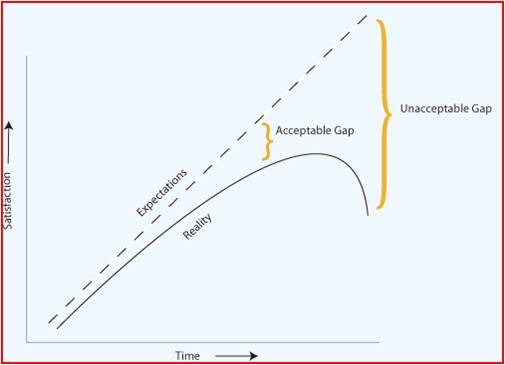
  • Revolts tend not to happen in situations or countries where the condition is continuously and steadfastly awful. Revolts happen when expectations begin to rise amongst “the people” – in response to improving social, economic, political or cultural conditions.  US sociologist James C Davies turned the simple observation that expectations rise faster than improvements in the underlying conditions and further that the system can cope with the disconnect only until conditions continue to improve (the Davies J-curve). I discuss the usefulness of this formulation in relation to South Africa’s ongoing service delivery protests here, a blog post that could have been written … almost word for word … today, but was, in fact, written in March last year.

With those meagre points acting as a theoretical background here then are my thoughts on the forces working for and against revolt in the South African context. It is not as simple a matter as putting some things in one column and others in another. Many of the protective factors are also depth charges seeding our future with hazards, but I will do my best to make it as simple as possible.

Why we are less revolting than we might be

  1. The first and most obvious reason is unlike many of the Middle East North Africa countries (from now on written as MENA, following a financial market convention) South Africa is a fully functional democracy where citizens have several opportunities to vote for and against parties that run their lives at a local, provincial and national level.
  2. The Ruling ANC is still seen by much of the electorate as the party led and staffed and supported by those who fought apartheid and those whose lives have improved because of that system’s demise. Whatever it might be in the future, right now the ANC still has enormous reserves of goodwill based on the fact that it is the premier liberation movement (still) led by the heroes of the struggle.
  3. The ANC government pays just under 40 percent of consolidated non-interest expenditure (that’s  R314 billion up from R156 billion five years ago) on the public sector wage bill and a further 20 percent to the poorest South Africans in the form of social grants. These are crucial constituencies to get to buy into stability – and a large part of the nation’s wealth is doing just that:  providing jobs for the emerging middle classes and  poverty alleviation for those who would otherwise be without hope.
  4. Add into the stability mix the fact that the ANC has managed to dispense a huge degree of patronage to the most aspirant and powerful of its leaders, members and constituents through the legal and regulatory regime of Black Economic Empowerment and the application of employment equity laws especially in the parastatals.
  5. Finally, whatever the criticisms, this government has built more houses for the poor, paved township roads, established sewerage and water connections, and provided the poorest South Africans with private and public goods on a scale unimagined under the previous dispensation of the Apartheid rulers.

Why we might be more revolting than we think

  1. Firstly, the obvious threat to stability is fiscal. Can we afford to meet the ever growing needs of the poorest as well as the growing middle class? At some impossible to predict moment in the future a force (a Maggie Thatcher type force) will arise within government and attempt to get our financial house in order. The first cuts will be in the fattest areas: social grants and public sector wage bill. I have no doubt an even slightly popular government could weather the resulting storm, but it will be a weather phenomenon that will be spoken of for many years.
  2. Secondly, failure to meet the fiscal challenge has its own terrifying dangers. In fact, this is precisely what happened in Zimbabwe. The leaders of Zanu-PF ransacked the war veterans pension fund which caused ex-combatants to begin militantly to threaten Mugabe and Zanu-PF.  The pension fund was recapitalised to the tune of $2bn in the late 90’s and the rest, as some are wont to say, is history. Spending $2bn they didn’t have led directly to hyperinflation, food riots and the formation of the MDC. With no largesse left to dispense the white owned farms were next on Zanu-PF’s attempts to stave off revolt and the last titbits of that economy are currently being pissed up against the wall with the same objective but in the name of “indiginisation”. Of course, Zimbabwe hasn’t revolted, but the price the politicians have made that country pay for stability has left Zimbabweans worse off than even the most cataclysmic revolution might have done.
  3. If  a greedy, rent seeking, corrupt, politically powerful and unaccountable elite is what fuelled revolt in MENA, then we are in all kinds of trouble. “Elite Theory” is a branch of sociology that argues that the economic and political elite make up an informal network that is the actual source and exercise of power – not “the people” through elections and parliament.  At an obvious level the theory applies to us: a publicly unaccountable elite within the ANC deploys loyalists to key institutions throughout the state and economy so as better to control the shape and direction of society. But with such a dominant and popular ruling party, such practices are unlikely to lead directly to revolt. However, beyond the formal exercise of the policy of “cadre deployment” we have an elite almost identical to those in Tunisia, Egypt, Libya and a host other MENA countries. These are the grand political families that thrive on tenders won from the state and bribes won from global corporates attempting to secure lucrative deals here. These are the groups and individuals that have turned some of our provinces, town and cities into gangster fiefdoms ruled by fear, patronage and manipulation.

On Balance?

We are still well within the safety zone and the system seems to have the flexibility and resources to withstand firm assaults in the future.

The obvious danger is the parasitic elite that honeycombs the upper echelons of our politics and economy. Many who participated in the Polokwane Putsch understood themselves to be cleansing the ANC and government of such an elite.

Unfortunately they failed to notice that their principal allies were the second -rankers and blatant criminals that Mbeki had managed to keep away from the trough.

If this elite manages (as it constantly strives to do) to divert the resources our society has available for economic growth, employment, poverty alleviation, infrastructure development, public health and education (you name the social good, it is threatened by the elite’s rent seeking activities) then we will have to reassess.

While people like  Willie Hofmeyr are still loyal ANC members and in place as senior state officials there is hope. Yes it is horrifying that he estimates that his Special Investigative Unit will scrutinise R20bn of tender fraud in this financial year (read about that here) but the real trouble arrives when people like him throw up their hands in disgust and head for the private sector.

How revolting could we get?

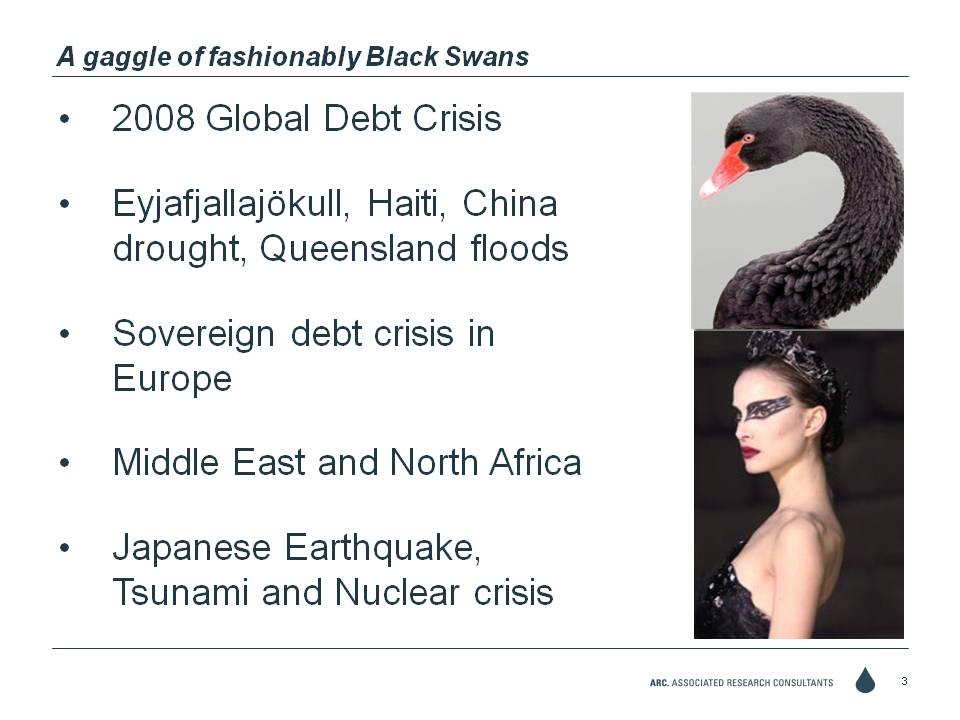
Black Swans are loose upon the world:

The 2008 global debt crisis, Eyjafjallajökull (pronunciation fun here), Haiti and New Zealand Earthquake, China drought, Queensland floods the political crises in Middle East and North Africa (MENA) and the Japanese earthquake/tsunami/nuclear disasters seem to prove that it is not the mundane everyday that shapes the world but rather high impact and extremely rare events.

The moment has rather given credence to Nicholas Taleb’s assertion in his book  The Black Swan: The Impact of the Highly Improbable that outlier probabilities are what shape our world and not the day-to-day numbers.

The point about black swan events is that they are highly unpredictable. Sitting there in January we did have a sense that we were in the midst of shocks and the consequences of shocks: we were finally recovering from the mortgage linked debt crises and appeared be entering a new and threatening terrain associated with sovereign debt worries in Europe – and beyond.

That wasn’t all good, but it was part of the “known known” and we had a general sense of where to look for the things we didn’t know (the known unknowns – for a useful breakdown of Donald Rumsfeld’s discussion about certainty and unpredictability and Slavoj Žižek’s caustic reply see here.)

Two months later the world is a markedly different place and I have found it useful to use the Japanese earthquake and linked disasters as well as the political instability in MENA (Middle East North Africa) to ask the big and scary questions about South Africa.

Usefully, Moeletsi Mbeki has written an article predicting South Africa’s Tunisia Day for some time in about 2020.

Catch the Business Day article here and see my review of his book Architects of Poverty on which that Business Day article is extensively based here. (Afterthought note: the Business Day article is “extensively based” on Architects of Poverty not on my review.)

The long and the short of Mbeki’s argument is that the primary resource intensive phase of Chinese growth will be concluded by 2020 (and therefore the commodity supercycle will come to an end) and the ANC government will run out of money to keep paying the social grants bribe to the poorest South Africans – which in turn will lead to revolt and rebellion.

He takes it a lot further – instead of growing our competitive advantage while the commodity bonanza is with us, the ANC has instituted another system of bribes to its own leaders and supporters (Black Economic Empowerment) which consists of getting wodges of the non-essential parts of existing business and turning those into consumption fuel. Thus fat cat politicians and their families act as representatives of the cheap-labour and primary-resource-addicted conglomerates in exchange for the mess of pottage and extreme ostentatious consumption.

And waiting in their future, according to Mbeki’s argument, is a Tunisia style revolt.

So that’s the layout of the argument.

I think it is timely and provocative and interesting, but I do not think it is meant – or should be taken seriously  – as a real prediction. It is polemic that warns about the excesses the new elite is indulging in.

I am in the middle of a road show where I ask the big questions about South Africa’s future stability.

I finish this evening and will then be in a position to summarise my own view; looking at the factors that lead towards instability and revolt and the factors that act to keep them at bay, asking how these balance in South Africa today.

The one thing the last few weeks have taught us is that the world is complex and interlinked in ways that make it extremely difficult to predict outcomes. With this proviso, I do not think we realistically can suggest that there are processes operative in our society that lead, in a linear fashion, to a Tunisia Day in the next ten years of our history … but it is a close call and I will examine some of that tonight and tomorrow morning.

Where blame lies

The raging race debate forces me to think about how we become culpable.

I came across an obscene argument the other day. Perhaps you have seen something similar?

It went like this: the Japanese are reaping what they have sown; the earthquake, the tsunamis, the nuclear threat and the unseasonal blizzards in the north are a karmic balancing for the killing of whales and the popularity of whale meat amongst the Japanese citizenry.

Think about this.

But first control for the sentimentalised ranking of some mammals over others in the general lovability stakes.

So consider countries that kill and eat stinky old cows (instead of noble and graceful whales) in the mass-produced beef industry.

Would anyone suggest that tragedies involving suffering and death of the citizens in countries that eat a lot of McDonald’s hamburgers (we could have spun this differently and made it KFC’s horrifyingly produced raw material) are somehow the just desserts of those people who form part of the relevant consumer demographic?

The idea is outrageous and its reasoning as deeply flawed as it is repulsive.

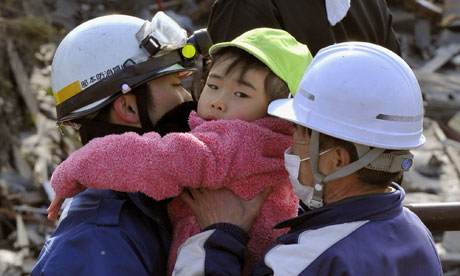
There are extraordinary and moving photographs of stoic Japanese citizens being rescued or tested for radiation as they are being evacuated from near Fukushima. Here’s one – and I hesitate to do this – and not only because it is not my property. The main reason is I do not want to be too manipulative:


I could have used this one, but I thought it might be pushing the bounds of good taste:

I do not want to go further down this path.

Only those whose lives revolve around sinister religious fairytales could believe any version of the idea that what has happened in Japan is some form of divine retribution.

I am more interested in the underlying fallacy that is much more common and certainly prevalent in our political discourse: collective guilt and the appropriateness of collective punishment – or at least collective responsibility.

Are whites the culpable beneficiaries of Apartheid? Do their children inherit this culpability and therefore the responsibility for redress? Are blacks (and, to a lesser degree) Coloureds and Indians victims of Apartheid? Are their children the inheritors of this disadvantage?

These issues are deeply unresolved in our political life – and, I believe, they are deeply unresolved in our law and in our minds.

Race you to the bottom

Two startling contributions to the raging race debate – from below and slightly behind, so to speak.

White (male) drivers

The first is a letter to the editor of the increasingly excellent Business Day from one Oscar Mosito in Rosslyn

His issue is with white male drivers.

What is most endearing about Mr Mosito’s letter is his calm restraint that profoundly fails to hide his seething stew of road rage with a racial twist (or perhaps race rage on the twisted road – or twisted rage in the race … no, that’s enough … sorry.)

“For years since the dawn of democracy,” Oscar calmly begins “I have observed the behaviour of white (male) drivers on our roads, particularly on the freeway.”

“I am not sure if I should call it frustration by white people and their difficulty in accepting that black people are in power,” he continues “… or whether it is caused by the fact the Democratic Alliance is not opposition enough to defeat the African National Congress in elections, but there is a lot of frustration in most white male drivers. It is directed towards taxi drivers or our leaders …”

There follows a delightfully unconscious diatribe against white male (drivers) not respecting black political leadership, driving in the yellow line to prevent noble taxi drivers getting past on the inside lane (?) and continuously showing disrespect to “ministers, MECs, the deputy president or the president himself.”

Heaven forbid!

I have even noticed that every time they see a black person driving a luxury car, they give him a certain kind of look, but when the same black person is in a taxi, they hardly look. So, it is my plea for all white drivers who do not want to accept change to respect our leaders, whether on the road, boardroom or in sports. It’s time you accepted change … I just hope that next time you see a convoy of BMWs, you give way and know that those are your leaders …  Please set a good example for your innocent children.

Oh Joy!

It is so perfect I fear to say anything more in case I break its spell. Let’s just point out the innocence of the “convoy of BMWs” … which made me think for a while that it was a DA hoax, but then the rest convinced me otherwise … but maybe it’s still a hoax … I dunno? Maybe I am naive, maybe I am too hopeful …

In the hope that this is not a hoax (and that Oscar is a real black man and not a clever white racist trying to cause trouble) I would just like to take this opportunity to agree with him.

The white male drivers that I encounter on the roads of Cape Town are ignorant, unreasonable, arrogant, entitled oafs that I feel deeply homicidal towards.

But then so are the white women.

And the coloured men? Don’t even start me.

Oh, yeah and the black men and the coloured women and the black women … I told you, don’t get me started!

And the occasional Indians – of all genders – that mistakenly find their way here … where did they buy their licences, I ask you?

Okay, there – I feel better now.

Cape Town drivers are enough to get the blood pumping. They are a wonderful example of multi-ethnic unity – they all drive like Oscar’s very own vision of white males.

Catch the full text of Oscar’s spirited letter here.

The other example is even more delightful.

“Do not be friends with white people – they will Satinise you”

(My spell check keeps trying to change that to “Sanitise” – which is a racist little wordplay joke in itself.)

But anyway …

Stalwart Sadtu (South African Democratic Teachers Union) Chairperson Moss Senye who is also the principal of Meadowlands High, addressing 1000 teachers in Soweto in the lead-up to his trial for assaulting a 17 year old pupil said (and I pull it all out of this Sowetan article but I indicate how I have stitched it together with the dot … dot … dot):

Whether Barbara (Creecy) likes it or not, we will have our meetings. Despite Barbara, we will vote for the ANC during the elections and they will remove her. Let us not embrace satanic people. Down with Satanism. You cannot be friends with white people, they will Satanise you …The bank called and asked when I would pay for my car. I cannot pay and I do not care. They can repossess it. We must show strength as a region. Barbara is trying to destroy us. Angie (Motshekga tried and now she is gone. Mary (Metcalfe) tried and now she has vanished. People have tried to destroy the union and failed. At no stage should you be friends with white people, they will satanise you … Our region has 10,000 members and only 75 of them are white. This is a non-racial union. We welcome everyone. We have never had a problem with Indian teachers. They have always been our members. There are two white learners at Meadowlands High. Barbara is not happy about this. She wants them to go to Parktown and other schools in the suburbs.

Again, what could I add to that that would make it any more hilarious and horrifying than it already is?

New WordPress email subscription button for Nic Borain

Apologies for this  purely administrative post … and I will probably be mentioning this again in general posts over the next few weeks.

We all used to love google because it was sparky and feisty and seemed to be fighting the deathly old Goliath Microsoft.

Well that was then.

The new Goliath google has messed up the details on my feedburner (email subscription) application and despite going to the ends of the Earth (and lots of begging and pleading) there seems to be no way for me to access the account and administer (or even have any knowledge of) the list of subscribers to my blog.

I have therefore decided to change to the WordPress feedburner widget which will now appear on the left of the headline on the front page of my blog looking like this:

I am sure Empire Google will be thrown into a state of shock and awe by my actions, but I see no other way to proceed.

If you are receiving my blog  by email – and want to continue doing so – please subscribe using the new WordPress email subscription button and not the google subscription button that will still appear immediately below the new button and will look like this:

After subscribing by clicking the new, and unfortunately perky: “Sign me up!” button you will get an email from WordPress asking you to confirm that you want to subscribe and when and how often you would like to receive updates from the blog.

After a while and if all goes according to plan you will notice that you are receiving two emails from my blog with the same content, one from “noreply+feedproxy@google.com” and one from “no-reply@wordpress.com”.

When this starts to bother you ask to be usubscribed from the google feed.

If everything continues to go according to plan I should then have a subscription list that I can monitor and control and you can specify when and what sorts of updates (including updates of comments) you want to receive from my blog.

If you choose not to do anything I am not certain you will continue to get the email from my blog after I delete the google email feedburner…

… I don’t know why it’s called that either.

Thank you for your patience.

Kind regards

Nic Borain

Complex, unstable and unpredictable

We are the ape with the pattern recognition dial cranked up high and this has served us well over our evolutionary history.

But when we assess risk in systems as complex as the global economy our instinctive wariness at the sudden silence in the Palaeolithic forest is not necessarily useful – and might be part of a warning system directly implicated in us getting things wrong in the complex and networked world in which we live and act.

The billions of tons of grinding debris in the violent waters surging over Japan’s eastern coast seem part of a flood of dangerous chaos and instability stretching from the sovereign debt markets through the shifting front lines in Libya to the meltdown at the Fukushima  nuclear power facility.

Two months ago the theatre of the world seemed to be playing to a comforting old script we all knew.

Today it feels like anything might happen – and it probably will.

Let me not pretend to expertise on plate tectonics, but the clearest and most current metaphor that best explains how we should think about the world and the global economy is the state of the earth’s crust east of Japan just before Friday’s quake.

The Japanese main island of Honshu is unique in the world in that it is at the meeting point of four of the Earth’s fourteen major tectonic plates.

Plates driven by convection in the plastic rock below (in the asthenosphere) meet each other with a gradual build up of complex pressure and stresses, which are, in truth, continent smashing in their power and potential.

After sometimes extended periods of apparent stability the stresses reach a point at which they are suddenly released and one or more plate(s) move(s) violently – in this case the Pacific Plate jerks in the direction it has been pushing all along: deep underneath Honshu.

And then follows a sequence that might, with the benefit of hind site, look like tumbling dominoes in one of those endlessly complicated but strangely compelling set piece knock downs (only click here if you have the patience and bandwidth for watching endlessly toppling supermarket products – the Balkan juice  boxes are the most mysterious.)

First the quake: 8.9 on the Richter Scale, making it the 5th most powerful earthquake ever recorded. Then the seabed buckles over hundreds of square kilometres displacing a huge volume of water that sends a whole series of giant waves travelling at over 600 km/h in every direction, giving the Japanese authorities less than 15 minutes to react.

Then consider if you will the extended shuddering cascade of triggers and causality that will travel into the future – think of it as a wave that unlocks energy, destructive or otherwise, inherent in the situations and objects it encounters, rather than the cause of what happens.

Beyond the immediate human tragedies of loss, displacement, suffering and death there is long-term infrastructure damage, economic catastrophe in the already stretched insurance industry, political turmoil from a populous that will accuse the politicians of not having prepared adequately, an unfolding nuclear crisis and sundry other effects and consequences that we can all speculate about, but will likely be a surprise anyway.

The point is that while we can attempt to model such systems, beyond a certain level of complexity there is almost nothing we can say with certainty about how things will unfold.

While you consider these waves spreading out from the disaster that has struck Japan,  bursting other bubbles, causing other wound up instabilities to suddenly unwind, consider the ripples of this earthquake meeting the ripples of the oil supply shock rooted in the political turmoil in North Africa and the gathering force of the the sovereign debt crisis in Europe and elsewhere.

“Why” is not the question

When tragedy strikes us, particularly the personal, catastrophic and traumatic kind – a fatal car accident, a murder or the unexpected suicide of a family member – our first self-protective act is to grasp for an explanation.

Our initial need is for something simple, some prime cause that can give us the limited comfort of being able to say to ourselves: “This is why it happened”.

Fredrick Nietzsche {here quoted from”Ubiquity: The Science of History – or Why the World is Simpler Than We Think” by Mark Buchanan (Crown 2000) – it’s heavy going but well worth the effort} said:

To trace something unknown back to something known is alleviating, soothing, gratifying and moreover a feeling of power. Danger, disquiet, anxiety attend the unknown – the first instinct is to eliminate these distressing states. First principle: any explanation is better than none…The cause-creating drive is thus conditioned and excited by the feeling of fear….

In the world in which we live, no explanation is almost always better than an incorrect one. At least then you know you don’t know – which is a slight protection in itself.

There is no new tide of chaos sweeping the world. This is the world as it has always been: interconnected in dizzyingly complex ways and apparently both deeply unstable and unpredictable.

But we have never lived the world at this level before. When twitter and Facebook and Al Jazeera TV and immediate images of the terrifying dark swirling waters engulfing the Japanese coast are brought together in our sensory universe in the same moment our evolved risk assessment tools are inadequate.

We are seeing the world not at the human scale of the hunter in the suddenly quieted forest. This is the world from a perspective that humans previously imagined was only available to their gods.

As individuals we are still essentially the same animal as that palaeolithic hunter in the primal forest.

But collectively we have recently gained the technology to see – if not fully understand – what is happening way beyond the forest, way beyond the world.

It will be a collective endeavour (through states and various other forms of human organisation) to make that information useful to us – as such forms of organisations have imperfectly striven to do in the past.*

Already Tsunami Warning Systems have saved hundreds, perhaps thousands of lives over the last few days and Twitter and Facebook have kept millions of Japanese families in touch with the world and each other.

But we are only at the very beginning of the journey towards the kingdom where our collective ability to generate and harness vast streams of data will become meaningful and intelligible to us as individuals.

For now it is enough to say: when dealing with the world in all its complexity, don’t trust your instincts.

Luckily for us “pattern recognition” is not the only reason we have survived as we have.

“Adaptability” is this primate’s main strength and with the finger pressed firmly on the fast forward button of technological advancement we are going to need every edge we can get.

*The struggle between ourselves as individuals and the collective elites, governments and national secret agencies that previously attempted to monopolise this information and act on it to further their own interests – as often as not incompetently and mistakenly – is the subject of another discussion, although an important and linked one.

Manyi – when Race meets Class

Jimmy Manyi – “Especially Africans” … doing quite well out of the transition, thank you

I’ve been itching to get in my two cents worth about Jimmy Manyi’s various comments concerning ethnic minorities (here for his original statement on YouTube, here for Trevor Manuel’s robust criticism, here for the ANCYL’s counter-attack on Manuel  and defence of Manyi, here for ANC Secretary General Gwede Mantashe’s implicit criticism of Manuel … “we won’t get in the mud with him”. Here‘s Cosatu joining the attack on Manyi and here‘s the SACP criticising Manyi but warning not to become part of the agenda of Afriforum and Solidarity – probably implying that Manuel has become part of that agenda.)

So much for curating the spat …  now I want to say something about it.

I’ve written about Jimmy Manyi and the various endeavours by both the Black Management Forum and the ANC Youth League to gouge economic advantage out of transformation – catch that here and here for how that agenda was expressed as support for Eskom’s Jacob Maroga.

Jimmy Manyi’s comments about Coloured people must be understood in the context of the interests of the constituency he represents.

Jimmy Manyi is the quintessential spokesman of those who have got rich (or hope to get rich) through Black Economic Empowerment – including racially weighted tendering procedures – and Employment Equity regulations.

Those who define themselves as the beneficiaries of these processes are encouraged to express themselves in ever more racially chauvinistic and exclusive terms.

These Black Management Forum and the ANC Youth League leaders increasingly draw a distinction between themselves and any other ethnic group that also might have suffered under Apartheid i.e. they need to argue that they suffered the most, that everyone else was a relative beneficiary of the oppression of Africans.

The moral high ground of “non-racialism” was built and defended at great cost and effort by the ANC and its allies during  the struggle against Apartheid. Apartheid planners and architects did everything they could to emphasise  differences and spread fear and hatred betwixt and between as many ethnic identities as possible. This is one of the most important keys to understanding how and why that system worked and survived as long as it did.

Which is precisely why the ANC always understood its main ideological task as combating these attempts.

This is the reason Trever Manuel quotes that famous and moving last paragraph of Mandela’s speech from the dock in 1964:

During my lifetime I have dedicated myself to this struggle of the African people. I have fought against white domination, and I have fought against black domination. I have cherished the ideal of a democratic and free society in which all persons live together in harmony and with equal opportunities. It is an ideal which I hope to live for and to achieve. But if needs be, it is an ideal for which I am prepared to die.

The Jimmy Manyi’s and Julius Malema’s are a post 1994 phenomenon not contemplated by the great men and women who sacrificed so much in the struggle against Aparthied.

They are parasites of transformation, emphasising and nurturing an exclusive African racial identity because it benefits their imperative to extract a rent out of the economy.

The centre holds – for now

A guest post from my friend and colleague Sandra Gordon. Sandra is a respected financial market economist and we increasingly present work as a team in what is often called “a dog and pony show” … although in our case there is some disagreement over who will be the dog and who will be the pony. Sandra is an excellent market commentator and I have known and respected her views since she was my client on the “buy side” at Nedcor Investment Bank Asset Management (Nibam) in the mid-90s.

My friend, colleague and author of this post on the National Budget, Sandra Gordon

Over to Sandra:

If there was one message from this year’s budget it is that, despite all the hype that economic transformation has finally arrived (the dreaded “shift to the left” which tends to give the financial market types sleepless nights), it’s actually probably more of a case of business as usual.

In the wake of the global financial crisis, there was serious debate worldwide about the merits of various economic growth models. In the 2010/11 Budget, Minister Gordhan noted: “The recent crisis and its aftermath have led to a serious introspection and rethinking of what were thought to be robust and superior economic models.” With the Washington Consensus in disgrace, South Africa was able to signal its intention of shifting towards a “developmental state” (essentially a more active role for government in the economy).

So it seemed South Africa was headed for a developmental state and real economic transformation. The new model was finally outlined by the New Growth Path (NGP), which was released by Minister Patel late last year. The primary aim of the NGP was the creation of five million new jobs by 2020.

This theme was echoed in the recent State of the Nation address, in which President Zuma announced a range of measures to encourage job creation.

Yet, despite all the talk of economic transformation – and the ongoing tsunami of change in the global environment – this year’s budget is essentially unchanged from the previous. The critical issues facing our economy were again identified as the twin evils of unemployment and poverty, while the best way to address them is to focus on job creation and encouraging growth in those sectors most likely to generate employment.

Admittedly this year’s budget had a greater focus on jobs than last year – with a grocery list of programmes and measures totalling R150 billion over the next three years. A key difference was also the absence of any mention of the “developmental state” – with government’s role limited to the provision of incentives and the creation of an environment conducive to growth – such as the easing of transport and logistic bottlenecks etc. Other than that, the key measures were familiar – more social spending to support the poor, huge sums for investment in infrastructure and a focus on skills development and training.

Essentially the budget delivered on the priorities laid out by the NGP – with one glaring exception: demands for a weaker rand. Minister Gordhan neatly sidestepped this particularly contentious issue by noting that government had already responded to excessive rand strength by easing exchange controls and accelerating the accumulation of foreign exchange reserves in October last year. Beyond those measures, Treasury will be “monitoring” the measures adopted by other countries – including Brazil and Thailand – which have had similar struggles with massive capital inflows and excessive currency strength. So effectively, “we’re looking into it.”

The other political hot potato that was neatly avoided in the budget was the issue of the National Health Insurance. This year’s budget included measures which “lay the foundations” for NHI. The implementation progress is going to take time – but things are undoubtedly going to get more interesting when the debate shifts to how the NHI is to be funded. Gordhan listed a range of possible funding sources including a VAT hike, a surcharge on personal income or a payroll tax. None of those options are likely to be particularly well received.

Essentially then, Gordhan was able to address all the priorities outlined in the NGP (barring rand weakness), while maintaining an element of fiscal discipline. With the deficit remaining at 5.3% of GDP in the new fiscal year – in line with the previous fiscal year but above expectations – debt servicing is now the fastest growing spending category.

While we are in a far better position than countries like America, the UK and various European economies which are slashing government spending and raising taxes, it could well be that this is our last chance to really get the economy moving. If the measures in this year’s budget deliver growth, tax revenues will ultimately rise and fiscal discipline will be maintained.

If, however, growth stagnates – perhaps due to a deterioration in the external environment – the state may find its finances stressed, providing less scope for social spending and job creation initiatives. As one analyst put it in the press this morning, this could be “the last throw of the dice”.

And it is on this front that the news is a little less reassuring.

It is positive that – amidst the global turmoil – the centre is holding and our basic economic policies remain on course. But our key weakness has always been not our policies but our inability to implement those measures. So for all the good news in this year’s budget regarding measures to encourage job creation and infrastructure investment, there have been no developments which would lead one to think that there is going to be any significant improvement in implementation and delivery.

In an increasingly unstable global environment, it is becoming ever more important that we finally start making significant progress on reducing our unemployment rate and pervasive poverty. We have the money, for now, but the ability to implement and deliver is becoming ever more critical.

With so much at stake, it looks set to be another interesting year.

How to look at the budget

The budget is the spending, taxation and borrowing plans of government.

Don’t just think of it as a series of  hefty documents (the national budget review, the estimate of national expenditure, the appropriations bill and the division of revenue bill) – hundreds of pages and millions of calculations, graphs and tables.

It is more than just the grand plan to tax and borrow and divide the money between central , provincial government and municipal governments as well as between a thousand different priorities.

It is, in theory and in a functioning democracy at any rate, how the will of the people is exercised in the world; the full process of planning and execution by the elected government.

Obviously elected governments are not always perfect translations of “the popular will”, and “the popular will” itself is not always something more noble than a self serving and ugly little collection of prejudices, fear and greed.

But anyway, the questions I was asking of the budget were:

  • Is the Treasury still the guiding hand in macro-economic policy – in the sense that it remains able to force prudence and fiscal rectitude on the rest of government?
  • The New Growth Path calls for measures to make the currency more competitive: more restrained fiscal stance combined with more active monetary policy, accumulation of reserves, a sovereign wealth fund and possible controls on short term capital inflows. Does the Budget 2011 confirm these commitments?
  • How much money will be allocated to removing infrastructural, skills and administrative bottlenecks in the economy? Is there the promised Marshall Plan type urgency to increase the economy’s capacity for growth?
  • Are there measures to encourage domestic savings: compulsory retirement savings, discouraging high debt levels, increasing corporate savings by discouraging dividend payments and development bonds … and horror of horrors the return of a strong version of ‘directed investments’? Depending on how this is phrased it could spook investors and generally indicate hostility to open markets.
  • Were the supportive measures in the State of the Nation address (in particular the R20bn to manufacturing subsides) something new or actually measures that had been announced before?
  • Did the mention of a 9 billion rand jobs fund in the State of the National address refer to the long missing subsidy for first time youth workers? This is significant because it will show government preparedness to take on Cosatu over the labour market.
  • Shifts in the over-all allocation of state money between priority areas as different as policing, housing, water and sewerage can indicate changing strategies as well as changing prioritisation.  But in general we will be looking for the meat on the bones of the statement that government wishes to be a “developmental” not a “welfare” state.
  • How close are we to a National Health Insurance scheme and how aggressive will that scheme be to the private sector?
  • Is the allocation for the civil servants wage bill set to endlessly increase or does it look like government might, at some stage, dig in its heals and face down the public sector unions.
  • What measure are in place or likely to be put in place to control corruption and cronyism within government departments and in the allocation of state contracts?

If that was where I was looking for the signs of where we are going, my next post will look at what the budget revealed with regard to these questions.

Egypt, my Egypt

I am clicking “Publish” in a rush … I suspect I will come to regret this later.

Anyway:

The popular mobilisations in Tunisia, Egypt and a swath of authoritarian North African and Middle Eastern states are interesting and important for more reasons than can be named, let alone examined, here.

But the aspects that have fascinated me are the over excited “I told you so!” claims of pundits, politicians and much of the Twitterati.

And not just the assertion that they had this right all along, but that they somehow understand the clattering Nasserite dominoes better than anyone and would just like to point out that it’s coming to get you. Yes, you (insert name of political opponent here), the revolution is coming for you.

There are literally hundreds of “takes on the crisis” I would like to poke fun at and take to task over this absurd conceit, but there is one I will look at (only slightly) more seriously.

Blunt Blade’s Bollocks

Blade Nzimande takes George Galloway’s excellent communist tirade in his column in the Morning Star (read it, it is also bollocks and brutal and crass but has enough thought and truth in it to warrant a second look) and turns it into the obscure and rambling  “Tunisia and Egypt: The deepening crisis of US imperialism and neo-liberalism“.

Where are the South African communists of yore who could always be relied upon to lift the veil, expose the skull beneath the skin and see the ape within the man? Oh yes, they are all dead or helping run the Department of Transport or become  bloated and insecure plutocrats … hmm, is that everyone?

Blade has it that Tunisia and Egypt are manifestations of a series of crises in capitalism “and its contemporary neo-liberal ideology”.

In short (in as far as I can understand Nzimande) the USA as the global representative of the corporate/capitalist machine has fostered dictatorships in the Arab world because they have agreed to leave the USA’s good friend Israel in peace.

So far so good, but then things start to unravel. Political upheaval in these Arab and North African countries sets back the USA’s task to reproduce the conditions of capitalist accumulation – through an amazingly complex web of dialectical causality. Thusly, the selling of upsized McDonald’s meals to the American guest workers rebuilding (if they work for Haliburton) and de/restabilising (if they work for Blackwater USA) any countries the US has recently invaded is threatened, because democratic governments are more likely to take a hard line on Israel … eh … oh goodness, there goes the thread.

You cannot successfully characterise Tunisia and Egypt as “crises of capitalism” unless you take an amazingly complex and interlinked world and reduce it to a childish little model that even the crudest Marxists would reject as ‘reductive’ and ‘over-deterministic’.

If  the term “capitalism” means the totality of international relations between states, global trade, the activities of local and international corporations and the shaping effects of culture, history and technology, then it is less than useless to characterise Tunisia and Egypt as “crises of capitalism”.

If the term “capitalism” refers (as I suspect it does, when used by Nzimande) to the secret set of rules in a secret club of greedy Americans who seek to control the world to protect and deepen their wealth, then I am sorry, but you can’t really be expected to be engaged with.

There are powerful and organised interests at play in North Africa and the Middle East and only a fool would not look to the USA for the sources of some of those forces. But there is also chaotic human activity and chance and rapidly unwinding and reforming complex systems that are part of what is happening and the blunt scalpel of Blade Nzimande’s theory takes us nowhere.

I would still recommend Galloway’s piece (as more insightful and the source of any interesting thoughts in Nzimande’s words on the subject) because part of what is happening in the Middle-East and North Africa is the unravelling of another mystifying US strategy to define, protect and advance its “national interests”.

What I wish the communists would give more attention to is not the greedy and rapacious aspects of US imperialism, but rather how it is often profoundly misconceived and poorly executed.

In my view human society should not be conceived of as “shaped” by particular forces or of being set on a certain “trajectory”. The totality of human existence is not an object (plastic and/or in motion). The totality of human existence – including the bits of it in Tunisia and Egypt – must be conceived of as a system so complex that making predictive statements is not hugely useful. Also, attempting to reduce the complexity to make it more understandable is a worthwhile endeavour only if undertaken with extreme caution and care.  Cooking it up as proof that your side is winning adds no real value.

In as far as the statement: “what is happening in the Arab world is a failure of US imperialism” is true, I suspect the reason is that successive US administrations have misconceived both the nature of history (as has Nzimande) and the nature of their own interests – not an error Nzimande appears obviously to have made.

The State of the Zuma Nation

‘Not as bad as I feared; perhaps even better than I hoped’ – is my reply to the question implicit in the title.

I have been flat-out covering the event for paying clients and I was at parliament in the gracious hands of the lovely people from Radio 2000 – where I commented for about an hour. Hence me only scribbling these short notes at this late stage in proceedings.

View from before

This is what I had to say before the event:

It is a ceremonial occasion; Jacob Zuma is there in his capacity as Head of State (not only head of government); it’s a joint sitting of the National Assembly and the National Council of Provinces; the Executive, the Legislature and the Judiciary is in formal attendance; there’s a red carpet, a twenty-one gun salute and a public gallery packed with ordinary people, senior representatives of the governing alliance and foreign and local dignitaries … this is just not a place where policy decisions, especially the various nettles Jacob Zuma will be required to grasp, could be spoken of in the clear and forthright terms that will, ultimately, be required.

View from the moment

I was initially very positive.

After a ten minute glance at the document I said to Reuters:

With surprising fluency Jacob Zuma managed to sound like a head of state dealing with an emergency – the crisis of unemployment.  He didn’t  grasp the nettle of the regulations that are strangling the labour market, but he placed more emphasis than expected on the private sector – especially manufacturing. There was also more detail than expected – and a confirmation that the interventionist aspects of the NGP will be issues to be dealt with this year.

I was impressed by the details namely:

  • The nugget at the core of the speech: the proposed R20 billion in tax breaks for manufacturing investments above R200 million for new projects and R30 million for expansions and upgrades – I do not expect the ANC’s trade union allies to be charmed by this idea (money in the hands of the bosses!) even if they will be amongst the ultimate beneficiaries.
  • Significant (and part of the New Growth Path’s underlying strategy of fiscal constraint and monetary easing) he foregrounded the statement that: “The Budget deficit is set to decline from the current 6.7% to between 3 and 4% by 2013. Concerns about the exchange rate have been taken to heart”.
  • The R9 billion by 2013 “jobs fund” – what is interesting about this is apparently Helen Zille interpreted this on an SAFM interview as the long-lost subsidy for first time youth workers … Cosatu is also going to hate that implicit segmentation of the labour market. ’

View from today?

I’m still positive. There was lots of ra! ra! in there, but that is to be expected in an election year and, quite frankly, every victory he claimed he said how far we still have to go.

He also spoke surprisingly like a statesman and he made the drive for jobs sound like a clarion call to mobilise the nation for war … which this campaign is or should be.

Finally, he mentioned that the Municipal elections will take place before the end of May. That will be enough grist for me mill … heady times to be a political analyst in this country.

The labour market is not a charity auction

Capitalism, at its most basic and unbridled, is a system that says: okay, the king is dead and therefore no longer owns all this stuff; take what you can … if you can hold onto it, it’s yours. Oh yeah, and you can pay the people who don’t manage to hang onto any stuff to work yours … because if they don’t they will starve.

On your marks, get set … go!

The system is extraordinarily productive, driven as it is by those gargantuan twin-thrust engines: human greed and human fear (you can keep what you can take/failure means death).

One of the great political achievements of the last 300 years has been the refining, softening and regulating of this system so that it maximises the good it can produce for as many as possible.

But note this: it can’t produce the same amount of good for everybody – because its fundamental driver is that it allows the hungriest, cleverest, most creative and most intelligent to keep what they can take. That’s why those people build the enterprise. So they can keep what they can get out of it. That’s the creative heart of the system.

(One of the many flaws of capitalism is it also allows those who have become powerful for reasons other than those listed in the last sentence to “keep what they can take”. Thus both Apartheid apparatchiks and New Elite cronies are (still) living high on the hog for reasons that have nothing to do with the unleashing of their creative spirit and more to do with their ability to cheat and steal. But that is another story.)

The point I wanted to make, is that in its most basic and unregulated form capitalism will allow the owner of the factory or mine to extract the last drop of blood from the worker – and the last drop of blood from his children, his old mum and his maiden aunt.  Without regulation the only thing that will stop the capitalist working the worker to death is the need to have him come to work tomorrow and for his children to come to work in ten years time. The history of capitalism has demonstrated this unfortunate truth about humans time and time again.

Thus we have labour market regulations: minimum wages, basic working conditions, rights to dignity, rights to organise and strike. These are amongst our greatest achievements – and they are all there on the law books of the new South Africa.

But there is a line over which we must not cross.

When the law, in effect, demands that the capitalist share equally the profits of the enterprise with the workers, the enterprise is over.

If local regulation means the capitalist can’t make sufficient profit here he (or she) will go elsewhere or will spend his or her time doing something else. That’s it; end of factory, end of jobs and end of story.

Michael Spicer, as CEO of Business Leadership South Africa, is the perfect person to listen to if you want to get an average signal of what South African capitalists are feeling.

His comment in today’s Business Day about the conflict between the flood of proposed changes to labour and employment equity laws and government’s job creation agenda is well worth a read. Catch it here.

It seems to me we are carelessly testing for the “tipping point”, the point beyond which the capitalists mechanise their plants or leave.

Raw fish served on a bed of … human sweat?

I love that scene in the Bucket List where the poor but proud Morgan Freeman character quietly points out to the rich and arrogant Jack Nicholson that the coffee he brews in a silver pot and savours from Dresden china is made from beans shat out by a lemur in South America – well that’s how I remember it, anyway.

You shouldn’t sneer at Kenny, Julius, Noleen, Hlelo, Ntando, Gayton and their 4000 best friends at the opening of the ZAR in cape town on Saturday night – after the Met, of course Darling.

Previously, under Apartheid, many of them were disadvantaged. Looking at them now, a more miraculous transformation seems impossible to imagine.

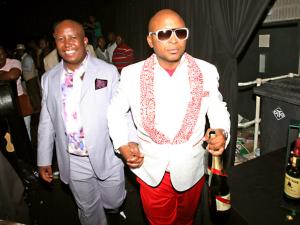
Future and ex-con Julius and Kenny having fun, fun fun … pic from IOL

The nouveau riche always feels it has something to prove; always embarrasses itself in the eyes of its better educated children.  But South Africa’s new elite seems … almost Russian … in its consumption of the tasteless and conspicuous.

Picture the model dressed in a black S&M bikini. She is lying, anxious under the blazing lights and sweating under the make-up. Kenny Kunene’s peculiarly round head is leaning over her, his moist lips pouting in an “oh” reaching down to her belly and the rice and raw fish that is lying there, slimy as the evening drags on …

And the morally disadvantaged new elite roars its satisfied approval at this witty, sexy exercise of power – take back the night, we didn’t struggle to be poor …

Thank heavens for the increasingly twinkly and cantankerous – in equal measures –  Gwede Mantashe (and, it must be said, his ‘desperately-clinging-to-the-high-ground’ organisation).

This is what they had to say:

The ANC distances itself from owning a nightclub

31 January 2011

The African National Congress (ANC) distances itself from sentiments allegedly attributed to the ANC Youth League President, Cde Julius Malema that, “Helen Zille is trying to close all the clubs in Cape Town, but this one belongs to the ANC”, as contained in today’s (31 January 2011), media reports.

The ANC would like to state it categorically clear that it has no interest in running a nightclub or in endorsing its owners. The ANC is not into nightclubs or partying, but it is a revolutionary movement.

We furthermore reiterate our condemnation to the act of serving sushi on a woman`s body, as this act is anti-ANC and anti-revolutionary. This act is defamatory, insensitive and undermining of woman`s integrity.

We therefore appeal to all those involved in this act to immediately disengage from it.

Issued by:
Gwede Mantashe
ANC Secretary General
African National Congress

You go Gwede Mantashe, may your voice ever be raised above the grunting and bellowing around you.

Nelson Mandela and the financial markets

The frenzied symphony of incompetence, pomposity, imperiousness and hysteria that the press, the Mandela family, Graça Machel and the Nelson Mandela Trust managed to produce around the mobile sickbed of the former president gives a small hint of things to come. (I personally enjoyed Peter Bruce’s comments – catch those here.)

Clearly when the Old Man finally goes, as he must, this country will initially be bathed in a blinding light and then buried in mountains of obscuring verbiage taller and wider than those that cover the September 11 attacks on the World Trade Centre, the US invasions of Iraq and Global Warming combined.

It is only the usually skittish financial markets that seemed to take the old man’s health with equanimity.

Here is my Thursday last week’s comment. (This from a piece destined for a paying client but which never made it, but also based on a previous post of mine discussing the “meaning” of the old man’s 91st birthday).

The price of one man’s health

For those who comment on South African financial markets, the national concerns about Nelson Mandela’s health – and his actual health – should be considered “investment neutral”.

But all that shows is that financial markets do not list the price of everything.

Nelson Mandela is the last symbolic link to the full ambit of the struggle of all Africans, but black South Africans in particular, to free themselves from colonialism and Apartheid.

Crucially, he is also the symbolic representative of the compromises and tolerance that characterised the negotiations from 1990 and the election in 1994.

If that was not enough for the symbol to carry, Nelson Mandela’s 27 years in prison and his calm forbearance have come to represent for many throughout the world the manifestation of the human spirit in its best possible form.

With each passing moment Mandela’s death is closer and this gives focus to anxiety about South Africa’s future – but also to anxieties about the world, about the predation of humans on each other and on the planet.

Our feelings about the lives and deaths of “great” men and women allow us an emotional link to the grand scope of the history we live in and through.

The death of Pope John Paul II and of Diana Spencer gave a sense of how, in the age of celebrity, the so-called ‘general public’ becomes emotionally connected to the grand human drama that can usually only be understood a long time afterwards and at many degrees of abstraction.

Nelson Mandela’s death will be such a moment for humanity, because it will represent the drawing together of important threads of the last several hundred years of human history.

The point, however, for the investment specialist in South African financial markets is that little will change in South Africa with the passing of the man. The real running of the country and the dealing in the compromises between the old South Africa and the new, has long moved on from Nelson Mandela.

It has now become a truism that even in his last years as president Nelson Mandela was already more important as a symbol than as a politician and statesman.

When he dies there will be real and visceral grief from comrades, friends and citizens who have participated with him in the struggles for African liberation. I imagine too, that throughout the world there will be an unprecedented outpouring of emotion that will elevate the symbol even higher than the man.

South Africa, for one last time, will be bathed in light and the centre of puzzled global attention – as it often has been since the formal beginnings of Grand Apartheid in the late 40’s and early 50’s.

It is impossible to say whether the current bout of ill-health will lead immediately to the death of Nelson Rolihlahla  Mandela.

But when he does die, which is only a matter of time, the South African financial markets – the currency, the equities, the bonds and products that derive from these – are unlikely to falter.

But that only tells us one thing: that the ticker tape does not list the price of every important thing.