Top ranked political analyst in FM survey

There are not many medals of honour, accolades, gold stars and trophies in the political analysis business (and quite right too), but I achieved an acknowledgement last week of which I am particularly proud.

Once a year the Financial Mail commissions a poll of the top 30 or so South African asset managers (life assurers, retirement and pension funds, private client investment managers and hedge funds).

This year the polled group had a total of about R3.7 trillion assets under management,  a significant portion of which is the savings and pensions of ordinary South Africans.

How this business (from which I derive a significant portion of my income) works is JSE member firms (basically stock brokers) employ or contract specialists to produce research that somehow aids the fund manager in making the best investment decisions. If the research added value to the fund manager’s decision the broker would be paid either directly or in the form of a commission of some kind.

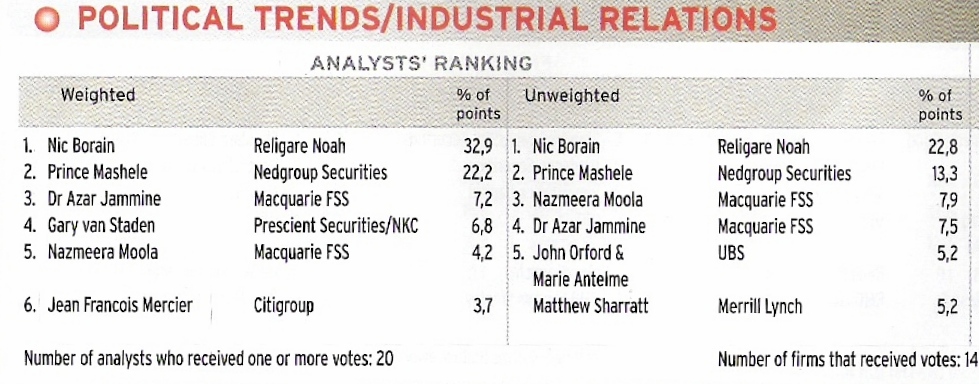
For the past year I have been lucky enough to have had a contract with Religare Noah Capital Markets to provide analysis of political trends and industrial relations to that firm’s fund manager clients. My name was thus in the pot when the fund managers voted and this is how it turned out:

I am particularly pleased to receive this award – and not only because  it comes with a nicely framed scroll that, if I ever again get an office, will look quite handsome on the wall.

The main reason for my appreciation  is that the ranking is based on a vote by investment professionals, who in one way or another, have to pay for the analysis.

I am about to move my main contract to a new firm, BNP Paribas Cadiz Securities which combines the strengths of powerful French investment bank BNP Paribas and Cadiz Securities, a South African-based specialist equity derivatives broking and research company.

So I thought I would use this moment and forum to thank Religare Noah Capital Markets for the work they have given me over the last year – I appreciate the support and opportunity and wish you all well in the future.

(Note:  There are several names below mine on the scoreboard up there of excellent economists, strategists and other species of financial analyst who would not see themselves primarily as “political analysts” – so the fact that I have outscored them is no reflection of the value they add to the fund managers … and, in fact, several of them were highly ranked in other categories.)

Cosatu, the Democratic Alliance and the middle classes – is it love, actually?

Think of the various interests of classes and groups in our society as constituting an ecology in which political parties and organisations find niches to graze, hunt and be sustained.

The system can change and niches shift, narrow or broaden –  and in response the denizens that live in each niche must adapt or become extinct.

Alternatively, major fauna can begin to change for other systemic (or extra-systemic?) reasons and new spaces and niches close or open in response.

And a shockwave goes through the ecosystem and a number of species appear and/or rabidly (oops) rapidly evolve, while others disappear.

Like all metaphors this one is going to break down the closer it gets to the real world, but I think something like this is happening to our political ecosystem – as the ANC’s DNA drifts towards the lumbering, complacent and patronage-networked side of the spectrum.

The gaps that are opening are in the middle classes, in the cities and amongst urban professionals – niches which (that?) are being vacated by the ANC as it settles its rump into the comfort of a sort of conservative, patriarchal, kleptocratic, bureaucratic and ethnic politico-ecological pouf-cushion.

I make  this observation as I watch (on eNews channel) the DA marching on Cosatu’s head-office in Johannesburg in a historical reversal of roles that I am struggling to get my head around.

I saw a Twitter post from Ranjeni Munusamy last night in which she said: “After the #DAmarch tomorrow, maybe nuclear powers will march to Greenpeace offices. Will make just as much sense”.

I get her dismay completely, but I suspect that is just my old assumptions about the shape of our political ecology dominating my brain.

Why shouldn’t the DA be going up directly against Cosatu?

They are, increasingly, competing for exactly the same constituency – the constituency recently, in effect, vacated by the ANC.

That is what all this business about Zille attempting to recruit Vavi into the DA has been about.

They have been flirting – because they feel how close they are to each other – and now they are fighting, for exactly the same reasons.

On Sunday Ferial Haffajee wrote an extremely interesting piece in her City Press, pointing out that Cosatu is increasingly dominated by public sector unions  – and therefore increasingly represents “a middle”, rather than “a working” class.

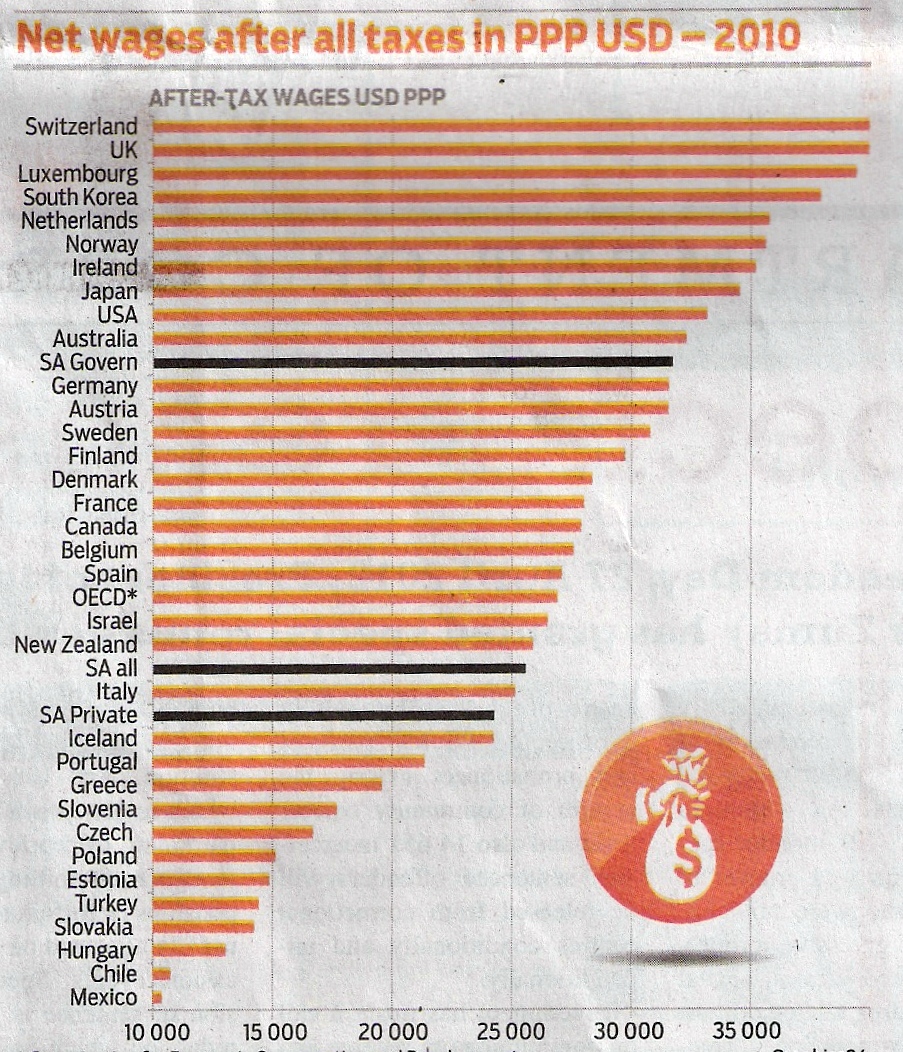
The story uses this graphic:

… which I think comes from a Uasa Federation study by economist Mike Schussler that points out that the employed in south Africa enjoy relatively good living conditions with an average salary of R13 200 and further that public sector workers are significantly better off than their private sector counterparts.

Haffajee writes:

Cosatu has created a middle class where one did not exist in the 18 years of democracy. That it is funded by the public purse (funded in turn by you and I, the taxpayers) is neither here nor there. What is remarkable is how a federation that started as decidedly blue collar has altered the identity and social position of its members so quickly and so effectively that it could turn the public policy of tolling on its head.

So what is happening right now?

There is an inevitable frisson in the relationship between Cosatu and the DA.

Cosatu and the Democratic Alliance border the niches vacated by the ANC, namely the unemployed and the middle classes. (The unemployed and the middle classes, perhaps more than any other groups, have  the most to lose from the ANC’s, at best squandering, at worst looting, of societal resources available for growth and relief.)

As the opposing crowds gather in the streets of Johannesburg, the blue DA marchers versus the red Cosatu defenders – those for the youth wage subsidy and those against it – we might be expected to conclude that these are bitter class enemies.

I still think not – to my eyes I cannot distinguish them ethnically or class-wise … (but I accept that I might just not have cracked those codes).

The ANC – as well as agents of the state, I think – will strive mightily to prevent Cosatu from finding the DA – and vice versa.

As romantic literature suggests, love and hate lie alongside each other like geological strata – always in the process of metamorphosing, one into the other.

(Note – I think my various metaphors here don’t adequately take account of the differences in Cosatu – and ultimately break down on that point. I do think the public sector side of the federation is more middle-class and the private sector side more radical and competitive. However it is easier for the ANC to keep the public sector unions – the DA’s natural allies in class terms – on side because, ultimately, those unions are dependent on the state budget over which the ANC has control. Obviously there is a cost involved in the ANC buying off those middle class unions, and it is a cost ultimately borne by the unemployed … but that is an argument for another post. I am not sure if the DA will be able to capitalise on this contradiction, but it is not impossible that is precisely what the party is trying to do in Johannesburg as I write this.)

Content removed

A few days ago I published a link here to an e-tolling interview I did on CNBC Africa that someone put on YouTube.

The post received several interesting comments about an aside I made on more than one occasion during the interview that I thought users paying directly for infrastructure  is probably a more efficient method than taking the funding out of the tax pool – with a long list of exceptions that had to do with social solidarity and making sure those who couldn’t pay were subsidised in some way.

I received several interesting comments and dragged myself out of bed early this morning to respond to those … but found, to my horror, my browser (Chrome) refused to visit my wordpress page, saying it contained “suspicious content”, perhaps even “malware” from something called “oulitnet.co.za”. Chrome further informed me that it had alerted the said site to the problem.

I decided to delete my last entry (to the YouTube link) and the problem seems to be gone.

I think “oulitnet.co.za” is a religious site of some kind and I have no idea why its content should have been connected to the YouTube video.

So instead of trying to work that all out I have just dumped the link and will, at some stage, return to the question of the most efficient way of paying for infrastructure … which I know is not a breathlessly exciting subject, but is probably important enough to warrant another post at some stage.

So apologies to anyone who attempted to visit that post and got the same scary warnings to stay away that I got this morning … they are gone now and it is safe to return to to the water …

Therefore send not to know for whom the bell tolls – it tolls for free

I think the e-tolling saga is important precisely because my headline bastardising the denouement of John Donne’s famous poem is, in truth, wrong.

Gauteng’s road upgrade does not come for free.
The R20bn was borrowed by Sanral and lent by people and institutions (which) who assessed the risk attached to repayment on the basis that e-tolling was part of the deal.

This is a précis of what I told my clients about some of the political implications:

The North Gauteng High Court granted an urgent interdict on Saturday that will postpone the implementation of e-tolling until as late next year – and perhaps contribute to stopping it completely.

At this stage the court has ordered a full review of the process that will probably take at least two months to complete. If the court rules that e-tolling can go ahead the appeals process, all the way to the Constitutional Court, can take up to two years.

So what?

There are a number of significant risks associated with this decision .

The National Treasury itself, during the course of legal arguments, predicted dire consequences for South Africa’s sovereign risk rating and for public finances more generally.

I think they exaggerated but one could hardly blame them. The Treasury is the custodian of the public purse and its officials and political head carry the responsibility  if R20bn that will no longer be raised from tolling has to be dug out from somewhere.

But the ruling is important for a deeper reason. South Africa, according to President Zuma’s State of the Nation address (and confirmed by a number of government and ANC statements in the last few months) is engaged in an infrastructure programme that is expected to cost just short of R1 trillion over the next 8 years.

This is the biggest bet for anyone hoping to invest in the country for the next ten years. Will it happen or will it – again – fizzle?

At least part of the funding model for this infrastructure programme is the  ‘user pays’ system established in the planning of the Gauteng highway upgrade project. In general, I think a user pays system is a more efficient – and fairer – system of allocating capital than unwieldy central plans that draw on the central tax pile.

Further, private sector lenders funded the project on the basis of the collection of user fees – this is how they did their calculations and assessed their risk. The ruling effects government’s credibility as a borrower.

Chris Hart (economist at Investment Solutions) is reported to have dismissed this saying the delay is no big deal – less than 0.2% of planned government expenditure this year. Goolam Ballim (chief economist at Standard Bank) said if there was a contractual infringement impacting on Sanral’s ability to pay, it did not imply sovereign default risk and “will not compromise South Africa’s international credit standing in any way”.

Now those two economists are no slouches – and know more about our public finances and the basis that the rating agencies changes the investment grades of our government bonds than I ever will – but surely it is obvious that there is a degree of damage to government (and Sanral’s) credibility as a borrower? Perhaps not as much as the Treasury argued during the urgent application. But we are coming up for strike season, the Treasury has promised to hold the line on public sector wage increases, the budget is under immense pressure and R20bn is not a meaninglessly small amount.

The whole of the South African government looks weak – with the Treasury and the Department of Transport being the most obviously and immediately affected. Both are “studying the ruling” before making public statements. These issues might not swing Standard & Poor, Fitch or Moody’s against SA bonds, but there is no question that this ruling will be part of their assessment.

The risks are clearer when we look at the political back-story. There is a changed political configuration in the Ruling Alliance. The rise of Jacob Zuma was characterised by an already growing influence of Cosatu on policy making.  A Thabo Mbeki led ANC would have taken a much stronger line against Cosatu’s campaign against e-tolling and would have stood much more firmly behind the Treasury’s arguments in favour. I am not necessarily cheering for that side, but I do think the Zuma administration is beholden to Cosatu in a manner that limits its options in public finance – and that limitation is being set by a very narrow interest group.

Cosatu has – as is its wont at the moment – been tactically brilliant in this campaign. It has built a classic broad front, multi-class alliance against the e-tolls and has strengthened the group made up of Zwelinzima Vavi, Irvin Jim and Numsa on the one hand and weakened the group made up of Sdumo Dlamini (Cosatu President) Frans Baleni and Num on the other.  See here for more discussion on the relevant factional splits within Cosatu.

The gravitational centre of the Alliance is only weakly occupied by Zuma and “the left” in Cosatu has been able to shift the whole edifice towards itself. This is a trend that we will have to keep a close eye on during the lead-up to Mangaung, when the Zuma administration is likely to be at its most docile and weak.

And it is in this environment that Cosatu has taken on e-tolling as ‘privatisation by stealth’ and an infrastructure funding method that taps its constituency too directly. Cosatu is a sectional interest group … and is completely entitled to pursue the sectional interests of its employed worker members (employed, by definition, in ‘union jobs – and all strength and luck to them for that advantage’.)

The most important signifier issue will be how government deals with public sector wage demands over the next few months. It’s strike season, and I mentioned elsewhere, Gordhan’s budget only balanced because of the hard line he took against public sector wage increases.

To give you a sense of why that is important, this is what I said about the budget and public sector wages on February the 23rd:

Public sector wages: This is the area, to our (I wrote this with economist Sandra Gordon) mind, of least credibility with the most consequence:

Total Compensation % of total budget % yoy
2009/10 248558.0 31.8 17.7
2010/11 281619.2 33.6 13.3
2011/12 314907.2 33.9 11.8
2012/13 336959.4 33.5 7.0
2013/14 357168.2 32.7 6.0
2014/15 378148.7 32.1 5.9

Adjusted for inflation those figures in bold are heading towards zero – and remember we are talking about over 30% of the total. The public sector wage bill was R8,1bn more than budgeted for in 2011/12 and it is not an exaggeration to suggest that the whole edifice of the budget could crumble on this point.

So what? … Public sector unions set the tone for industrial bargaining throughout the economy. Our main scenario, in which 2012/13 becomes an industrial relations blood-bath, is looking ever more likely – although we await, with interest, Cosatu’s formal response to Budget 2012. This proposed spending shift – if Zuma’s ANC can hold the line – is also supportive of our construction and investment relative to consumer equity theme – with the consumer sector keeping a “look-in” by social grants increases from R105bn in 2012/2013 to R122bn 2014/15 and the promise to reassess if inflation rises further.   
.

So the e-tolling is an ongoing threat to public finances and it is an indicator issue of how beholden … and therefore weak … Zuma’s leadership is.

But there is an upside to this story. The ANC and Cosatu did agree to postpone e-tolling after their meeting last week – and announced that they had instructed government to do this (revealingly issuing a hastily retracted statement saying they would, in fact “request government to postpone”).

But the real upside is that it wasn’t, ultimately, political weakness or fiscal slippage that led to the cancelling of e-tolling. It was judicial sensitivity to popular opposition and an assertion of the principle of the rule of law.

You will be able to tell by reading between the lines that I think e-tolling was actually the right approach, but it is clear that an unaccountable system, that never bothered to consult the public properly and that, in addition, has badly damaged its own credibility in as far as corruption and maladministration is concerned, was defeated by a judge determined to uphold legal accountability and respect for popular discontent.

It might make the Treasury’s job more difficult and it might create uncertainties about funding infrastructure development, but it has got to be positive for the South African democracy as a whole.

What could derail Jacob Zuma at this late hour?

Well it is certainly not Julius.

Last night his expulsion from the ANC and the ANC Youth League was confirmed by the ruling party’s national disciplinary committee.

His ‘fixer’, secretary-general Sindiso Magaqa, was suspended for a year – making any attempt to ‘rule-by-wire’ difficult. The appeals committee chaired by Cyril Ramaphosa also confirmed the three-year suspension of the other key Malema ally,  Floyd Shivambu.

Malema is out of the game and I don’t expect to hear much from his traditional defenders, Tokyo Sexwale, Thandi Modise, Mathews Phosa, Fikile Mbalula, Winnie Madikizela-Mandela and Tony Yengeni. They are going to be exploring other strategies … more about that below.

Malema has been sunk by a combination of his own hubris and of bad luck. He might still be greeted like a rock star by striking Numsa workers, but he just doesn’t have the gravitas to coalesce a radical alternative to the ANC around himself.

I expect he is going to be busy trying to keep himself out of prison on tax evasion and corruption charges for the next several years. It’s a stitch-up, but he has made so many mistakes that it has been a relatively easy one.

The strategy of his core group is going to have to be to make as much noise in the lead-up to Mangaung as possible. They are good at this, earning their colours in the trashing of Mbeki in the lead-up to Polokwane. But that time around they were coached and backed by Zuma and his cronies and by the SACP and Cosatu … which makes the Nkandla Crew’s huffy outrage at his conduct a little difficult to swallow … this time Malema and friends are on their own and their backs are to the wall. I cannot see them achieving a momentum that could realistically effect the outcome of the Mangaung contest.

So what could threaten Zuma?

The word on the street is that with KZN and the Eastern Cape wrapped up Zuma is unassailable going into Mangaung.

But Mangaung is a long way away and the street is not always right. Our TV screens have been resplendent with the big-boned ladies cutting Zuma cakes and singing Zuma songs – but in our parochial soap opera version of Götterdämmerung the chubbier maiden hasn’t even started singing.  (Here is a discussion of  “it aint over till the fat lady sings”.)

I have assumed that the main threat to Zuma’s relection at Mangaung is the unlikely possibility of the National Prosecuting Authority reinstituting fraud and corruption charges against him.

This remains a threat, but a more serious and immediate one seems to be emerging around what appears to have been a widespread sacking by Zuma’s security chiefs of at least one secret fund allocated for clandestine anti-crime operations.

The tip of this iceberg is the accusation that crime intelligence boss and apparent Zuma ally Richard Mdluli had his children, wife and girl-friends listed as agents to be paid out of the fund.

The next layer of the iceberg sloshing at sea level is the accusation that police minister Nathi Mthethwa used the fund to pay for aspects of the renovation of his country home.

Below the surface is a looming mass of allegations that many, perhaps most, of the ANC security commissars – the closest of Zuma’s allies –  have been using this and similar funds as automatic teller machines.

It is the fact that Richard Mdluli has been reinstated – despite these serious corruption allegations and even more serious allegations that he murdered a love rival – that rings the really big red alarm bells. I think Jeremy Gordin hinted the loudest and the most eloquently that it is definitely worth considering that the protection is coming from the very top and must be motivated by the possibility that Mdluli has the goods on Zuma  … catch that story here.

There is no successful drawing of a link from this scandal directly to Zuma, but if I look at the renovation of his house and the character of the empire he is building in Nkandla I must wonder whether the proceeds of the looting of this intelligence fund – and of a host of other stores of cash dotted about the security establishment –  have flowed upwards and if they have, how high?

If Zuma is derailed – and I have this as a “Black Swan” possibility only* –  Kgalema Motlanthe is waiting in the wings. I am under the impression that the Motlanthe alternative is being deliberately kept alive and viable because of the real risks of the main candidate drowning in his own sleaze.

Of course there have been consistent attempts to flick dirt in the general direction of Motlanthe – and some of it has stuck … and some of that for good reason. He was central to efforts to secure oil allocations from Saddam Hussein for ANC donor Sandi Majali and ‘has never fully answered questions about his role in the Iraq/UN oil-for-food scandal as well as the Pamodzi loans,  hoax emails and Bell Helicopter parts for Iran scandals/disputes’. There is a useful ‘dusting off the alternative’ article on Motlanthe in last week’s Mail and Guardian … catch that here.

(Note: I realise from the comments section below that it is possible to think that I am suggesting that the transmission mechanism by which such a corruption crisis could bring down Zuma is via a court case. That is not what I meant .. anyway that would take too long to play out to impact upon the process. Such a crisis could bring Zuma down by motivating a broad coalition of groups and individuals within the ANC – specifically those who have been backing Motlanthe, but with new anti-corruption allies … and ANC patriots desperate to save their organisation  – to choose the alternative. I think there is much militating against this outcome, but I discuss that below.)

Julius ahead?

A Motlanthe alternative would be unlikely to risk its own credibility by treating Malema any differently from how he has been treated by the ANC disciplinary process.

The final line of appeal is to the National Executive Committee of the ANC – but there Malema’s potential allies need to concentrate on battles they can win … not on hopeless causes.

Looking towards a further horizon, perhaps 10 or 20 years on, no-one should be surprised to see Julius Malema – older, wiser and more dangerous – back in the game. His instinctive feel for the tactics of political mobilisation are unparalleled – it is his grasp of strategy and principle that have let him down this time around.

But for now the game moves on and our attention needs to shift away from the activities of those who wish the President harm and onto the harm he might do/have done to himself.

* A “Black Swan Event” is a metaphor developed by Nassim Nicholas Taleb in his 2007 book The Black Swan and refers to events with a disproportionately high-impact which are both hard-to-predict and rare.

African National Congress chasing its tail … and biting it

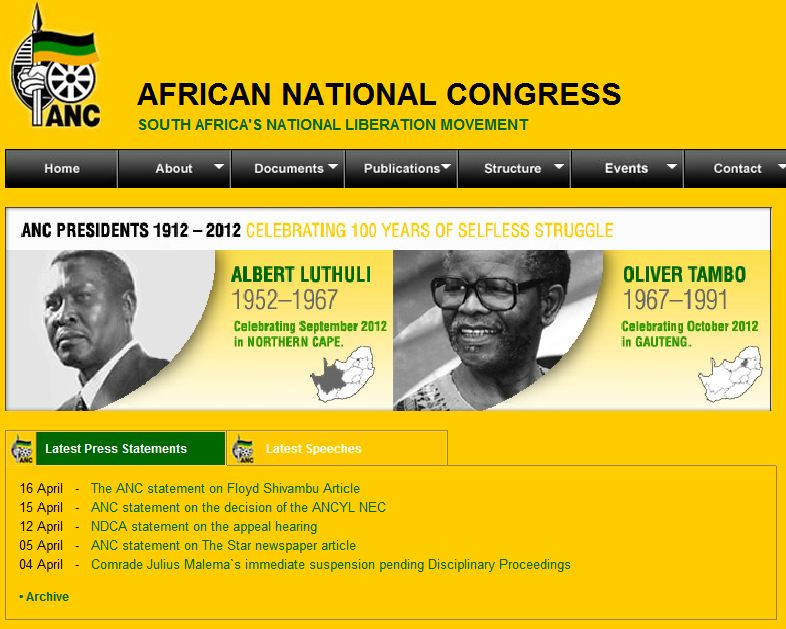
This is a screenshot from the front page of the ANC’s website accessed early this morning:

It’s those latest press statements I am interested in.

That’s the last five major releases from the Ruling Party, every one of which is exclusively concerned with the vicious battle taking place within the organisation.

Working backwards:

April 4 – Comrade Julius Malema’s immediate suspension pending Disciplinary Proceedings

This statement records the National Disciplinary Committee’s decision to suspend Malema immediately after he said “….It is under President Zuma that we have seen the youth of the ANC being traumatised, being expelled from their own home. It is under President Zuma we have seen a critical voice being suppressed We have seen under President Zuma, democracy being replaced with dictatorship.”

The statement further spells out in detail Malema’s exclusion from any and all structure related to the ANC and forbids him to make statements pertaining to the organisation.

April 5 – ANC statement on The Star newspaper article

This is a slightly confusing (partly because I don’t have access to the report it is criticising) attack on The Star for publishing an article alleging tension among members of the ANC top six over appropriate action to take against Malema and the Youth League. It concerns who met who, when and with what intention – and the statement is a disavowal of the allegation that Thandi Modise and Mathews Phosa were at odds with Gwede Mantashe over severity of action to take against the ANC Youth League.

April 12 – NDCA statement on appeal hearing

This one is purely an announcement by Cyril Ramaphosa in his capacity as head of the National Disciplinary Committee of Appeal that the application to postpone the appeal hearing of Julius Malema, Sindiso Magaqa and Floyd Shivambu had been turned down.

April 15 – ANC statement on the decision of the ANCYL NEC

This one is a strongly worded attack on the NEC of the ANCYL which that morning had decided to ignore the suspension of Julius Malema. “We would like to advise the ANCYL NEC that regrettably their decision to undermine and defy the decision of the NDC effectively defines the organisation outside of the ANC Constitutional parameters.”

April 16 – The ANC statement on Floyd Shivambu Article

Which brings us to yesterday: “The African National Congress is appalled at the crude, uncouth, disrespectful and insulting attack on Comrade Cyril Ramaphosa by Floyd Shivambu in the weekend newspapers” said Jackson Mthembu.

***

This is the moment that a parent attempting to make sense of a group of angry children crying well he started it!well he threw my dolly over the wall! … screams: ENOUGH – GO TO YOUR ROOM – ALL OF YOU – RIGHT NOW!

I suppose many citizens have been begging the ANC to clean its shop .. and in particular to close down the threatening thuggery in the ANCYL.

But I can’t help worrying that the only reason the leadership has acted is factional, and concerned with the power struggle leading up to Mangaung … and if its motivations are suspect, how it actually deals with the problem might leave things worse off than they were previously.

I, for one, will be watching with interest whether the ANC Youth League will attempt some form of mass mobilisation to put pressure on the processes of regional conferences mandating delegates towards Mangaung … and perhaps earlier at the June policy conference.

I am unsure of the League’s capacity. I suspect they are all wind and bluster … and that the central leadership of the mother body will keep them divided by offering inducements to elements less strongly tied to Malema and his cronies.

But they (the leaders of ANCYL) are clearly going to give it a whirl – which will make the next few months more interesting than they were going to be already.

There is a part of me that is delighted this ANC leadership is getting its comeuppance – through harvesting what it sowed in the lead-up to Polokwane.

But there is another part that is sickened by the spectacle of the crazed old dog madly chasing its tail and occasionally yelping in pain as it manages to get in a nip and tear out tufts of fur and bits of skin from its bleeding body.

Housekeeping, MTN, Iran, US secret power, Zimbabwe, Malema and the Interminable Mangaung

Right.

I have got to find a way of continuing to populate this website. The reasons posts are becoming infrequent and irregular is that almost every day I produce bespoke and paid for research. I have less time every week to write specifically for nicborain.wordpress.com … except the occasional philosophical musings, which probably have a … very specific? … readership.

I am going to continue the philosophical and theoretical musings. I am finishing the last few chapters of Jared Diamond’s extraordinary “Collapse – How Societies Choose to Fail or Survive” – Penguin 2005. As background reading to my professional work trying to make sense of politics and economics in the sub-continent (or anywhere in the world for that matter) it is seminal … I cannot recommend it highly enough.

So I will review it here. And I will keep raising issues associated with the epistemology of what I do – and other obscure matters of concern to me.

However, I will also start posting summaries of my recent views, interviews and perspectives … the first set of these below:

Iran, MTN and US secret power

The big issue of the week – in a lot of universes, but particularly the financial market’s – was  the $4.2-billion lawsuit launched against MTN last week by Turkcell in the United States District Court of Columbia in Washington DC. The Mail & Guardian had way the best coverage – see here  for a good backgrounder.

MTN investors took a serious bath on the news. The basic allegation of Turkcell is that MTN’s ‘Project Snooker’, driven by then CEO Phuthuma Nhleko (with some help) was a successful attempt to ‘buy’ (with cash, arms and South African diplomatic support) a preferential operating licence in Iran.

For me the link between this issue, the fact that the South African government had appeared to fold to US sanctions demands on oil imports from Iran (or at least to flip-flop confusingly) and the leaked documentation from close to Kgalema Motlanthe seeming to prove attempts to get government support for Bell Helicopter deliveries to Iran – potentially hurting his (Motlanthe’s) presidential ambitions – was a series of stories that raised the spectre of US secret power working it’s powerful and implacable will.

It looks like the Bell Helicopter with SA government support stuff was established:

 Through access to recordings and confidential documents – understood to have also been obtained and analysed by US intelligence agencies

according to the Sunday Times, but the documents that informed the Turkcell case appear to have been leaked by a disgruntled former MTN manager and South Africa’s flip-flop on oil could be based purely on the extreme nature of proposed US punishment for those who break sanctions against Iran.

So the sexy story of US spies fiddling in our politics doesn’t have a good evidential basis (although I have no doubt that US secret power is exercised every day throughout the world … perhaps not always with German-like efficiency and certainly with lots of unintended consequences.)

The MTN story … and South African oil imports … still has a way to run, so watch this space.

Malema summarily suspeded, Top Six unity press conference, Cyril for president and the interminable Mangaung contest.

I don’t know about you, but I am royally gatvol of press reports about ANC internecine struggles … during the course of the week this is what I had to say about various strands of this interminable story:

First I looked at City Press going out on a limb with contending ANC factional lists for Mangaung…  most interestingly putting Cyril Ramaphosa on both the pro-Zuma and the pro-Motlanthe lists … to become president of South Africa in 2014!

“You read right. Not ANC president, and not in 2012 … the Mangaung conference looks sewn up in favour of President Zuma, but even his supporters are starting to point to Ramaphosa as president, saying the billionaire businessman will do a better job of running the country” (from City Press).

I can’t assess the probability of a Ramaphosa presidency … but we can only hope.

I also had to comment to journalists over last weekend about a potential run by Mathews Phosa, essentially as a stalking horse and test marketing campaign for Kgalema Motlanthe. He (Phosa) has no prospects of slipping in himself, but both he and Motlanthe have been seen to be standing firm with their ANC Youth League allies over the last week and it is not inconceivable that they will have worked out a tag-team strategy between them.

Later in the week came the summary suspension of Julius Malema about which I said:

Julius Malema was yesterday suspended with immediate effect from the ANC and from participating in any way in the organisation’s activities or the activities of the Youth League. While this particular suspension is temporary, several different strands of disciplinary action against Malema make the implementation of a full suspension (lasting at least 3 years) inevitable.
In preparation for the Malema suspension the ‘Top Six’ of the ANC held a joint press conference to present a united front to condemn “bickering and negative lobbying” in the ruling party. Of particular concern was the recent incident in which Deputy President Kgalema Motlanthe was invited to address and ANCYL rally where he found himself “in compromising situations of being implicated in statements where ANC leadership is denigrated and insulted” (that all comes from official ANC press statements.)
Behind the show of unity are two broad camps, with President Jacob Zuma, Secretary General Gwede Mantashe and National Chairperson Baleka Mbete broadly backing Zuma’s re-election at Mangaumg in December; and Treasurer General Mathews Phosa, Deputy Secretary General Thandi Modise and Deputy President Kgalema Motlanthe having consistently been much closer to Julius Malema and long assumed to back a leadership slate that would be headed by Kgalema Motlanthe and might include Tokyo Sexwale.
I do not expect the noise generated by the internecine struggle to die down until Mangaung itself. At this stage the Zuma camp is in an extremely strong position and this is the light in which the suspension of Malema needs to be seen.

I did a whole lot more radio interviews and bits and pieces about all of this … but I am becoming unspeakably bored with the whole issue. I think the ANC Top Six press conference was an attempt to get the focus onto the policy discussion documents and away from the draining and fracturing internecine squabbles. Can’t help but feel that might be a good idea.

Zimbabwe and Eddie Cross

The most interesting story of my week came about as a result of the consulting work I do for Religare Noah Capital Markets (Pty) Ltd, which is a member of the JSE and an authorised Financial Services Provider. Religare Noah brings Eddie Cross (Zimbabwe member of parliament for Bulawayo South, economist and Movement for Democratic Change Policy Coordinator General) to speak to, especially, mining and metals investors about once a year and I had a chance to listen in on his input.

Basically Eddie Cross  reckons that by October this year Zimbabwe will have undergone a fundamental transformation and that our northern neighbour will be well on the path to recovery – politically and economically – by then.

It is a huge story, but obviously the details are bespoke to Noah Religare and its clients. From my perspective I have known Eddie Cross to err on the side of being too positive and upbeat about Zimbabwe (as I have been … consistently calling the bottom for almost ten years … embarrassing, I know) but I was convinced that a combination of SADC unanimity and strong G8 backing … and the fact that Zanu-PF is out of options and fatally riven with factions, means that change is more likely than it has been in years. An endless stalemate is still a possiblity and more catastrophic scenarios, with the continued assasination of central players (like that of General Solomon Majuru) are options … but there are grounds for cautioius optimism.

I hope you have a restful long weekend … and a really good Friday …

Notes on the relationship between Cosatu and the ANC

After last week’s Cosatu strike against labour brokers and e-tolling the question of the future of the relationship between the Cosatu and the ANC has again consumed public debate.

I have quickly jotted down some of the issues as I see them and how I think the situation might play out in the longer term (and apologies for scruffiness – I am under the whip):

It is necessary to understand what these organisations are and how they differ – before we think about what they might do

Cosatu is a federation of trade unions (trades union, actually … but that always sounds a little pompous) and therefore represents employed workers while the ANC is currently the ruling political party in this country and as such represents a much broader set of interests, especially, in this case, the unemployed and business – and is additionally obliged to balance these interests against each other.

It is obvious why Cosatu must oppose labour brokers. Cosatu has spent considerable energy in influencing the ANC to structure the labour market in a way that strengthens it’s cartel-like hold on the supply of labour. Labour brokers are a way in which the unemployed and potential employers can circumvent some of the strictures of the regulatory environment. Labour brokers have helped create a shadow duality in the market – and have thus caused Cosatu to lose some control over supply.

Another way of saying this …. If you have one set of workers that are employed with the full  protections and benefits afforded them by legal and regulatory structuring of the labour market and another set who are essentially desperate enough to work for less money and with less job security, then those who cannot find a place in the first set have the option of joining the second set – and employers who cannot afford to shop in the first set will shop in the second … meaning Cosatu loses control over supply.

Cosatu argues that if you make the existence of the ‘second set’ illegal it will force employers to shop in the ‘first set’ – thereby creating permanent ‘quality jobs’.

The eternal wrangle is that most economists and several ANC thinkers believe that what actually would happen (and is happening) is employers, at some difficult to determine point, decide that the costs and hassles of only having the ‘first set’ to shop in incentivises them to “shop elsewhere” – shift parts of the labour process to other countries where labour protections are less onerous on the employer, or they mechanise the labour process – hence the structural nature of our unemployment.

The ANC, on the other hand, is under the whip to create more employment – and that pressure comes directly from the unemployed. The youth wage subsidy scheme was correctly understood by Cosatu to be seen as a threatening – to its interests – attempt to create duality through the back door. The ANC agrees with Cosatu that many labour brokers are guilty of the worst excesses of free market exploitation, but propose to remedy the situation by regulating the labour brokers more carefully … not removing them completely from the market.

But what about the e-tolling?

Essentially the e-tolling issue was serendipitous timing for Cosatu. Completely separate disputes occurred in Nedlac over e-tolling and labour brokers so Cosatu had the right to declare protest strikes and marches under section 77 (1) (d) of the Labour Relations Act against either, neither or both issues – they did both. Essentially the melding of the actions allowed Cosatu to win a few class allies to its cause of opposing labour brokers. Not that e-tolling is not genuinely hated by Cosatu and the federation believes that its members will be worst effected … which should give you an insight into just who Cosatu’s members are and the difference between them and the marginalised and unemployed majority who would invariably use un-tolled public transport (mostly taxis) or travel on shank’s marewhich takes another kind of toll entirely.

Cosatu and Zuma

Cosatu clearly backed Zuma against Mbeki because it believed either that Zuma would be beholden to it and therefore allow it more policy access (which I think has essentially been true) … or just that Mbeki was a more dangerous enemy of Cosatu’s narrow agenda (something I also believe was true). There can be no argument that Zuma was more likely to hold ideological or policy agendas that were essentially closer to Cosatu’s. To my mind Cosatu was opportunistic and unprincipled – whichever way you spin it – in backing someone so clearly hell-bent on extending his control over patronage networks and making his family and friends fabulously wealthy.

One way to understand what is happening in Cosatu now is that one faction is trying to withdraw from the strategy because the Nkandla chickens are coming home to roosts, while the other faction is sticking to its guns.

I think, however, that both factions have realised that they have put too much energy into influencing national politics in the ANC and not enough energy into building up the federation’s grass-roots and factory-floor structures, membership and leadership. Trade unionism is on retreat globally – because of the globalisation of the labour market – and Cosatu is worried about not having stuck to its knitting (sorry for all the awful clichés here, but I am in something of a hurry.)

Cosatu has always had an ambiguous relationship with the ‘political movements’ – be those the United Democratic Front, Azapo or the ANC … perhaps even Inkatha should be included here. When Cosatu was established in 1985 out of the unions that had made up Fosatu (the Federation of South African Trade Unions) it immediately inherited the main debates and factions that had characterised trade unionism for years in South Africa.

The divisions centred around:

  1. whether to register and thereby co-operate with the Apartheid state
  2. whether white workers could be organised into progressive unions
  3. the desirability of general unions versus industry based unions
  4. ‘workerists’ versus ‘populists’ – which boiled down to a debate about whether unions should be involved in national politics and be in a formal relationship with the national political movements; whether they would be sucked into the agenda of those political movements and should therefore focus instead on ‘shop floor’ issues and maximum worker unity.

From the start the National Union of Mineworkers was a pro-ANC/SACP bastion within Cosatu and the National Union of Metal Workers of South Africa, formed out of at least 6 other unions, came to represent a position more cautious and suspicious of the political movements.

Thus we have an emerging consensus in the press that Zwelinzima Vavi, Irvin Jim and the National Union of Metalworkers of South Africa (Numsa) have upped the ante against Zuma and ‘corrupt ANC leaders” while an SACP aligned faction including Cosatu president Sidumo Dlamini and the powerful National Union of Mineworkers is firmly behind Zuma.

Currently Cosatu seems – to my mind – to have finessed an internal agreement between its factions to back Zuma for re-election at Mangaung in exchange for a more vigorous opposition to corruption generally in the ANC and to campaign for a more worker friendly ANC NEC to emerge out of Mangaung.

Ahead  … (remember ‘tomorrow’ is the country from which no-one has ever returned … so take this all with the appropriate pinch of salt):
  1. The struggle will continue. Cosatu has fought with the ANC since 1994 and strong suspicions existed between much of the trade union movement and the ANC before that. This is normal, natural and appropriate given the diverging interests of the people represented by each organisation. The relationship has always contained the seeds of its future breakdown.
  2. Zwelinzima Vavi’s faction is most similar to a combination of European social democrats, labour parties and green parties. It is radical and anti-capitalist, but it is also modern, deeply opposed to corruption and authoritarianism, has consistently taken the right line on Zimbabwe and HIV/AIDS, is protective of the constitution and freedom of speech and is most likely to seek alliances with anti-ANC ‘civil society’ groups over single issue campaigns (right to know, freedom of speech, corruption, HIV/AIDS etc.)
  3. The tension is inbuilt … the ANC will never give into Cosatu’s full set of demands – if anything it will go the other way – and Cosatu will  never stop making the demands, louder and louder.
  4. At some future time – probably way down the road –  the Numsa faction will ally itself with those attempting to organise the constituency the ANC Youth League aspires to represent and break out of the ruling alliance to form a new left opposition. For the foreseeable future (and remember none of the future is actually foreseeable) the advantages of staying in the alliance with the ANC outwieghs the losses and gains that would be realised by setting off on their own.
  5. The SACP will increasingly concern itself with trying to mediate the relationship between Cosatu and the ANC – which effectively means it will support the Num faction or tendency in Cosatu. This is not a basis upon which a political party can sustain itself. The SACP would have to split from the ANC and fight elections on its own – essentially capture the space that a Numsa/ANCYL type breakaway might have occupied – if it was to grow and prosper. I don’t think this will happen and therefore I think the SACP will be gradually squeezed into irrelevance.

Red Alert – communists unveil non-traditional weapon

I have been interviewed several times this week about the Cosatu strike.

Is this an irreparable breakdown between the ANC and Cosatu?

Does this have implications for Zuma’s bid for re-election at Mangaung?

How stable is the ANC/Cosatu alliance?

What do I think of Jackson Mthembu’s response to Vavi’s claim that the ANC says “Cosatu is exaggerating poverty of workers in South Africa”? (… or whatever … If you can’t follow the subjects and objects in that sentence check out the ANC statement here – or not.)

Where is the SACP in all of this … and is Cosatu split between its president and secretary general?

Where is all this leading … what is going to happen … what does it all mean?

I’ll give those of you who are interested a kind of answer to those questions in a separate post, but I first wanted to say:  it’s a peculiar business this being a ‘talking head’, someone whose views are sought on something as slippery as what’s really happening in our politics, where it’s all leading and why.

This is not (only) an idle existential question to while away a windy Cape Town Saturday morning … it is brought on by a perilous attempt at humour by that leading bastion of irony and satire, the South African Communist Party and their laugh-a-minute, Umsebenzi Online – and more particularly the March 8 “Red Alert” that you can catch here.

(Perhaps only start reading from the “Succession battles at leading newspaper” headline. That way you might still be open to that old Marxist quip: history repeats itself “first as tragedy, then as farce” – here for Wikipedia’s sketch of the source of that quote, Karl Marx’s excellent The Eighteenth Brumaire of Louis Napoleon – something I find it difficult to believe the writers of Umsebenzi Online have actually read or understood … but that is just by the by.)

Anyway …

The SACP’s satire is a teasing poke at … well, at people and institutions that do what I do for a living.

The premise is that Umsebenzi Online has come into possession of “dramatic new evidence” of a deep factional split at 195 Jan Smuts Avenue … which is the address of the Mail & Guardian newspaper.

The premise is that editor Nic Dawes is being challenged by “the ring-leader of the Young Turks” Matuma Letsoalo.

And the issue over which they are divided?

Whether to stick with the fading Julius Malema as the leading character in the soap opera the M&G produces or replace him with “the unions” as the new villain.

Umsebenzi Online then seeks the views of “two well-known, dial-a-quote, soap opera specialists – Aubrey Habib and Eusebius Mashele”* who proceed to pontificate incoherently about the split at the M&G.

There is a whole cast of villains in Umsebenzi Online’s slightly stilted (hardly unexpected that – Ed) attempt at humour.

And all the villains are ‘talking heads’ … people who have come to make their primary living from giving their views on the South African political soap opera.

I think there is a real question to be answered about political analysts – poorly asked and answered in this pinkish satire

Are the views of ‘political analysts’ any more reliable than anyone else’s? It’s not like there is a professional association that erects barriers to entry and puts in a whole lot of quality controls. And anyway such associations are usually just a gang hierarchy that protects the turf from competition.

My own answer – and I have to have one, or my tongue would shrivel up and drop out of my head and my fingers fuse uselessly to this keyboard – is that political analysts are to politics what critics are to art and literature. The critics don’t have to be artists or writers themselves – in fact, that might well be a drawback to them performing their function.

Critics come to be what they are through a market mechanism – their views are sought out and some consumer ends up paying for them. The art consuming public is looking for confirmation, information or rebuttal; they are looking for a view against which they can balance their own view, or learn something from – or just to think about.

The best critics are a mirror for the artist – trusted or hated by the practitioner, it doesn’t necessarily matter.

Rubbish critics can find an oppulent home in rubbish publications and TV stations – because mediocrity does so often rule the mass market mechanism.

Fine critics can quietly go about their business and eke out an interstitial existence of quiet excellence and the small comfort of professional respect.

Or the other way around.

I am all in favour of communists using satire to further their aims – it is so much more desirable than the dystopian bureaucratic terror which appears to be the default instrument – when available – of this vanguard of leading intellectuals.

But I wish this satire had been more … well, funny … and clever – basically, more thoughtful. We are bludgeoned daily by the views of “experts” – and it might not have escaped you that I both bludgeon and am bludgeoned in my turn.

How and why political analysts come to be part of our lives and part of the cultural and public intellectual process is an important question – one we should think about before consuming the sometimes suspicious fruits they offer.

* Those fake names are a melding of the real Professor Adam Habib:

Aubrey Matshiqi:

Prince Mashile:

and Eusebius Mckaiser

(Right you four, you can send donations to The Association of Professional Standards in Political Analysis for the free publicity – Ed)

The shape (and size) of things to come

Once a week I take my mother to an audio book library.

My car radio only picks up SAFM and because the dreary worthiness of our national broadcaster occasionally tempts me into driving my car off a cliff, I sometimes pick something out for myself.

I have recently finished listening to (over and over again – at least eight times in a row) “About the Size Of It – the Common Sense Approach to Measuring Things” by Warwick Cairns.

Aside from being a charming, old-school, discourse on how our bodies and what we do with them have determined the various measuring systems humans have adopted, the book hints, to my mind, at deeper philosophical insights into the nature of society and history … and, ultimately, our evolving humanity.

The flow of “About The Size Of It” traces the use of feet, hands and thumbs in determining the measures that humans have used throughout Europe and Asia – right back to the builders of Stonehenge who appear to have used a “megalithic foot” as the basic unit of construction – i.e. one about as long as a man’s foot wrapped in a leather slipper, as opposed to the later “foot” of European and US measurement which is about as long as a workman’s boot.

Warwick Cairns sounds like an amiable old duffer – which is not entirely due to the fact that my consumption of the text was via the reading by clearly ‘amiable old duffer’ Christian Rodska. But you will see below that if anything Cairns looks like a young and clever Hobbit.

The charm of the book lies in its gentle admonishment of endless attempts to impose measuring systems (especially the metric system) on humans who inevitably revert back to methods and units that suit them and that are practically based on hands, feet, thumbs, how far we – and our horse or ox –  can plough in one day, the amount of liquid we can comfortably drink (or hold in our bladders) and the weight of small rocks we can easily hold in each hand and compare.

The “deeper” implications of the book are revealed in a quaint cascading explanation that I had actually come across before in one of those awful “Isn’t this Amazing – PASS IT ON!!!” emails.

It goes something like this: the size of the rocket boosters on the space-shuttle are ultimately determined by the width of two horses’ backsides. The sweet – but I suspect not entirely accurate – explanation consists of describing the link between the rail system that carries the boosters, the carriage axle-makers who made the first axles for locomotives, the fact that their machinery was set up for horse carriages and that carriage tracks throughout Europe and the USA were precisely the width of two horses side-by-side … because that is the optimal configuration for drawing a carriage.

I am less interested in the accuracy of this illustrative example than I am in the idea that the structure and technology of our society – the momentum and trajectory of the complex system of human history – might be shaped by basic and natural limitations and potentials.

Jared Diamond’s 1997 “Guns, Germs and Steel – a short history of everybody for the last 13000 years” explores this matter more directly, although in a more difficult and in-depth way.

Diamond’s book deserves a full review of it’s own – it is a complex and extremely wide ranging explanation of why societies throughout the world had differential success – particularly competitively. He explores how climate and geography – down to the detail of which plants and animals where available for domestication – and how, for example, advantages get locked in through early urbanisation leading to the spread, and therefore growing immunity, to certain diseases – which in turn has led to the domination of some societies over others.

Both these books explore how our society and history is rooted in our nature and the nature of the physical world – and also how the momentum of our society and history resists change.

For me what is interesting is how our technologies are pushing at the boundary of the limitations imposed by our physical and natural being and by the complex ordering of our societies’ development – holding out the promise and threat that these might no longer determine what we could become.

The SACP and Cosatu are trying to rescue the ANC and the state – but there is an optimism differential between them

Has the South African state become an instrument in the hands of the class of predators that dominate our politics?

Think a crowbar or a 9mm automatic and think of the Nkandla or Limpopo crews using that tool to rip or rob huge sections of  provincial and national budgets.

Cosatu is clearly suspicious of the ANC dominated state, but believes that the struggle is not over.

Corruption Watch, launched by Zwelinzima Vavi Thursday last week is premised on, and shaped by, the assumption that the state is contested terrain; that if you put enough pressure on it you can slow the process of it becoming an “instrument” or a “tool” in the hands of the bad guys .. and perhaps reverse that process.

On the same day that Cosatu launched its initiative – Thursday last week –  the SACP journal Umsebenzi Online published a “Red Alert” by deputy secretary general Jeremy Cronin critiquing

the liberal notion of society as being constituted by two realms – the “state” on the one hand, and a distinct “civil society”, on the other.

and, in particular

This anti-majoritarian liberalism (that) treats rights almost entirely as rights of citizens/civil society AGAINST the state – and not, for instance, the right of a democratic state (and the right of a democratic majority to actively HELP that state) to vigorously implement an electoral mandate in the face of equally vigorous opposition from powerful class forces lurking behind the fig-leave (obviously he means “leaf” – NB)  of “civil society”.

Thus the SACP is deeply and supportively engaged with government and the state – indeed Jeremy Cronin is Deputy Minister of Transport – and appears to be directly backing Jacob Zuma for re-election at Mangaung in December. Clearly the SACP has made a practical estimation that Zuma is the better of some bad options.

Cosatu is also, ultimately, engaged with the state and government – and appears to have also given support to Zuma’s re-election – but in a far more conditional and ambiguous way than the more open-ended support offered by the communists.

Corruption Watch is indelibly stamped as a ‘civil society’ initiative – and one that has individuals in its leadership that skirt close to Cronin’s faintly Stalinist definition of “anti-majoritarian liberalism (that) treats rights almost entirely as rights of citizens/civil society AGAINST the state.”

Explore Corruption Watch’s website here  – and decide if you are going to sign the pledge.

The Executive Director is David Lewis – ex-independent trade union movement in the 1970’s, constructor of SA’s competition framework and until recently chairperson of the Competition Tribunal.

The Chairperson Vuyiseka Dubula is also the Secretary General of that bastion of civil society and thorn in the ANC government’s flesh, the Treatment Action Campaign.  She is  also Chairperson of the board of directors in the AIDS Law Project.

Vuyiseka Dubula - civil society multitasker and luminary: TAC Chairperson; Corruption Watch Secretary General and Chairperson of the board of the AIDS Law Project

The list of board members includes Bobby Godsell, Mary Metcalfe Supreme Court judge Kate O’Regan and Archbishop Njongonkulu Ndungane – just to give a sense that the initiative is likely to be a constant source of criticism of the spread of corruption in the ANC and government.

Cronin directly warns against some of the features of Cosatu’s previous “civil society” conference that caused so much anxiety in the ANC and the SACP last year (and I put the quote in full here because it speaks to the heart of the differences of emphasis between Cosatu and the SACP):

Obviously, the SACP expressed support for COSATU`s right to convene a conference that mobilized a range of social movements and NGOs to address, amongst other things, corruption in the state. However, we believed then, and we still believe now, that it was a mistake to exclude COSATU`s own party political alliance partners – as if there were something inherently pure about supposedly non-political “civil society” formations, and something inherently predatory about those more directly engaged with the state. It was a confusion that reflects the hegemony within our society of the liberal “civil society vs. the state” paradigm.

It is probably useful to read the full text of Cronin’s intervention, which you can see here.

As it happens ANC heavyweight and Minister of Justice Jeff Radebe spoke at the launch of Corruption Watch alongside thorn-in-the-ANC’s-flesh Public Protector Thuli Madonsela – thus tentatively addressing some of Jeremy Cronin’s and the SACP’s insecurity about Cosatu taking more and more oppositional stances in relation to the ANC and government.

The two main organisations within the ruling alliance to the left of the ANC appear to be launching something of a rescue bid to stop the ruling party slipping more unambiguously into the hands of a predatory political elite – although the SACP appears more concerned that the rescue bid stays out of the hands of “anti-majoritarian liberals” than it does about the success or otherwise of the endeavour.

Cosatu is the “bad cop” and the SACP is the “good cop” (vis-à-vis the ANC) but they are both operating under the assumption that there is something still worth saving in the state and the ruling party.

If the rescue bid fails and the ANC and government pass some abstract point of no return Cosatu is poised to give up on them first.

The SACP is likely to stick with its ally to the bitter and awful end.

Weather – tis nobler in the mind to suffer

In a Woolworths queue in the Gardens Centre yesterday evening I idly picked up the Cape Argus.

It’s the only time I actually read anything in that newspaper.

I like to casually glance at its headlines during my journey from the beginning of the endless tunnel of sweats sweets (damn morning rush) and magazines. I then stash it amongst the heap of chocolate boats stuffed with Smarties right before the tills.

I commit two very mild acts of corporate activism when I do this.

I admonish The Argus for plastering Cape Town with interesting and clever billboards that inevitably refer to puerile and ridiculously provincial – and badly written – stories.

And I wrist-slap Woolworths for having made me carry my then small children through that tunnel after a long day of shopping – an experience that  still makes me shudder.

Okay, these are not very militant acts; more mild criticism of two old and venerable institutions that I feel great affection for but believe would benefit from the occasional slap.

Anyway, the cover story on The Argus shocked me rigid – such that I barely noticed the passing array of Magnum Ice-creams and left-over chocolate father Christmases calling out to me and the small squalling children being pushed by their exhausted mothers through Infanticide Row.

Government is proposing to fine South Africans who give unsanctioned weather and pollution warnings –  ten years in jail or a R10 million fine (catch the full text of the South African Weather Service Amendment Bill here.)

I got it immediately.

You can’t have amateur forecasters spreading panic and despair because they had seen fluctuations in their crystals and spirit catchers … or because choppy surf with a curling left-break at Glen Beach means Durbs is gonna be hit by cyclones, dude … or whatever.

But as I was passing the tubs of sour worms it dawned on me that all forecasting should be controlled. You can’t have every blogger and his parrot predicting the unfolding sovereign debt crises in Europe, the US presidential elections, the possibility of a US/Israeli strike on Iranian nuclear facilities, whether Germany and France will eventually let Greece sink without a trace, whether the Euro will be history this time next year …. the list is endless.

The pronouncements of economists and political analysts and talking heads of all kinds should come with health warnings. Who’s to say they know anything more than anyone else about anything?

But they get asked by television and radio stations and newspapers and they set up blogs …

Oops …

I dawned on me, but only after a surprisingly long time; somewhere between the sacks of chewy white milky cars and deep piles of You Magazines.

I am a forecaster. I have been quite specific about what I think will happen in the ANC’s debate about mine nationalisation. I have been fairly specific about succession issues in the ANC – both at Polokwane (where I was mostly wrong) and Mangaung (where I will be mostly right) ….

Excuse me? Did you really just say what I think you said?

No. No but seriously – the South African Weather Bureau has scientists with balloons and mysterious beeping machines in places like the Antarctic and Gough Island and a billion information feeds and huge computer models that attempt to get closer and closer to emulating the storm systems driving across from south of South America … and they still fail because they forgot about the butterfly flapping its mysterious wings in Peru.

By the time I punitively stashed The Argus amongst the chocolate tugs stuffed with brightly coloured beads just before the serene Woolworths teller lady I was having a minor existential crisis.

Admittedly not a completely new one – once you have been fairly sure that the ANC would not slip into the hands of the Nkandla Crew at Polokwane you are forever chastened and humbled by the knowledge that the future really is an ever unfolding mystery.

The ANC as a proxy for the nation?

It’s tempting to focus on the ANC as if its history and prospects are a proxy for the history and prospects of the country as a whole.

The party’s centenary celebrations this week will strengthen the sense that this is indeed the case.

The last hundred years of South African history has been about the formal subjugation of the black inhabitants of the country by European colonial powers and settler groups; the fight for national liberation and self-determination; the victory and then seventeen years of the complex process of democratic rule.

Running like a spine through that body of history is the African National Congress –  which not without some legitimacy claims to be the organised expression of black people’s struggle to be free of colonial and then apartheid oppression and exclusion.

Then in the same way that the back bone’s connected to the … neck bone it follows naturally that post-1994, given the ANC’s overwhelming dominance at the polls, the party can legitimately be seen as the ongoing expression of black South African’s attempts to govern themselves and use the state to redress the inequalities and distortions caused by that apartheid and colonial past.

So this week the ANC celebrates its 100th anniversary, kicking off with a centenary golf day (for only the luckiest of revellers) and including gala dinners, interdenominational church services and culminating in a public rally in Bloemfontein (Mangaung) on Sunday January 8.

The sense that the ANC is a proxy for the country itself is strengthened by the fact that this year will culminate in and ANC national conference electing a leadership that will, almost automatically, become the leadership of government after the general elections in 2014 – again, given the ANC’s electoral dominance.

Additionally an ANC policy conference in July will pronounce upon a range of  matters concerning the role of the state in the economy and it promises to make policy on (amongst other matters) the nationalisation of mines and the expropriation of white owned farm land – with or without compensation.

But hang on a moment …

One of the key tasks of political parties in their struggle to become or remain the party of government is to present their agenda as identical to the national agenda, their leadership as automatically the national leadership and their interests identical to the national interest.

The ANC can legitimately point to how central it is to South Africa’s political and cultural life, but as we wilter this week under the the searing overstatement of that message it is useful to bring a few proviso’s to the front of mind.

We are a country with a small, open economy nestled in the most depressed region of a world overwhelmingly interconnected and subject to monumental forces that grind their way irresistibly through the Ozymandian vanities of governments significantly more powerful than ours.

The more we learn about the world and the history of human societies the more apparent it is that we have been hopelessly overoptimistic about our ability to understand let alone predict how the complex systems of our economies, national entities, ecological systems and cities function, evolve, collapse and change.

I am sure that this week newspapers will be full of huffy assertions that the ANC does not represent “the nation” and therefore treating its centenary as if it was a sacred ritual akin to Fourth of July in the United States (which celebrates independence from Great Britain in 1776) is a travesty.

Quite right too. The ANC has diverted significant national resources to traditional US style pork belly politics  but has also made itself guilty of more overt Angolan style looting. All that combines to makes its claim to represent the “national interest” an insulting insinuation about “the nation”.

Also new political forces are emerging and growing – most obviously Cosatu and the Democratic Alliance – that will further erode such ANC claims in future – as will the shifting ethnic bases of parties and groups that contest in the political arena of South Africa.

However, these were not the points I wanted to make – and I am sure they are going to be done to death in the next few days.

My point is that sovereignty itself – and certainly who the ANC elects as leaders and what the party decides vis-a-vis nationalisation of mines and expropriation of land without compensation – will have much less force and effect in determining South Africa’s political and economic future that we might imagine.

Economic policy, laws governing ownership and general “good behaviour” around fiscal and monetary policy are rigidly constrained both by the discipline of global capital markets and by a myriad bilateral and multilateral agreements between countries and blocks of countries.

As I said to clients earlier this week (concerning the ANC centenary):

“Obviously we must continue to watch the ANC as carefully as always in 2012 – but this small open country and economy will continue to be tossed on the currents of the global economy and the various geopolitical, technological, cultural and environmental forces that shape the world. We might miss a trick or two if we lull ourselves into believing the myth that the ANC is a kind of metaphor for the country as a whole.

Going into the dark

The previous post was headlined “The ANC’s surprising return to form” and it stayed as the face of this website throughout a week in which we were reminded of the nest of corruption our president emerged from.

… oh yes, and a week when the ANC in parliament passed the Protection of Information Bill – with sneaky abstentions from three of their MPs. (Gloria Borman actually abstained, Ben Turok walked out and Salam Abram said he would have abstained if he could have made it to the sitting.)

… and a lot else has gone wrong such that it is difficult to even pierce the gloom.

Many of these issues have been done to death, but briefly on Mac Maharaj:

The Mail&Guardian weekly newspaper and the Sunday Times (and now City Press) revealed different pieces of evidence that appear to prove that French arms company Thales channeled money to Mac Maharaj, then Minister of Transport (also, crucially, architect of Zuma’s rise and key strategist behind Zuma government) a few months before Thales was awarded a credit card licence tender (worth about R265 million) by Maharaj’s department in 1996.

The more revealing points are that the alleged middleman, Zuma’s financial advisor Shabir Shaik, was sentenced to 15 years in prison for, amongst other things, securing a bribe from Thales for Jacob Zuma’s protection in the arms deal. Thales country manager Alain Thetard allegedly signed or originated both the agreement that channeled money to Maharaj through his wife Zarina as well as the encrypted fax spelling out the payment for Zuma and the protections and advocacy those payments were for.

The issue is Zuma only avoided prosecution for corruption and racketeering because it was shown that there was political meddling in the prosecution – not because there was not a prima facie case for him to answer (his financial advisor went to prison for securing the bribe for his boss … you don’t get more prima facie than that!)

The leaking of the evidence is undoubtedly linked to the conflict between Zuma and the faction of which Julius Malema is a part. In fact the Youth League has made it clear that it plans to raise issues associated with Zuma’s sexual conduct as well as the fact that his (Zuma’s) friends and family have benefited financially (and overwhelmingly) from his presidency. Some of Malema’s key backers were insiders to the arms deal scandal and it would have been an easy matter for evidence against Mac and Zuma to emerge from some of those quarters.

At the very least the accusation (and reminder) that the Zuma presidency is deeply tainted by this history will hurt his  re-election bid at Mangaung.

… while the ANC itches to get more fingers on the economy

Late last week it emerged that there are proposals to tax ‘unbeneficiated’ mineral exports and to force the South African fund management industry to own a specific amount of government and SOE bonds in ‘draft of draft’ reports from the ANC Economic Transformation Committee – that were due to be discussed by the ANC NEC this weekend.

Both Bloomberg and Reuters have got hold of these, but the ‘final drafts’ take a less prescriptive approach, according to committee chair and key ANC economic policy strategist (and deputy minister Economic Development) Enoch Godongwana.

The ANC aches to get its hands on the IDC’s Public Investment Corporation’s investment power – especially as assets under management (mostly public sector pensions) topped the 1 trillion Rand mark in March.

The prescribed assets idea and strategies to force beneficiation – all in the service of the jobs drive – have been on the fringes of government thinking for years and are flirted with in much of the motivation that led to the NGP.

I don’t think these proposals will ever be legislated in this form.

A pre-Mangaung policy conference (in May according to the Business Day and June according to Bloomberg/Reuters) will make recommendations but the decision will only be made in December 2012.

The ‘nationalisation of mines’ draft proposal was also expected to be delivered to the NEC this weekend. I haven’t seen it or read any reports about it, but I expect a shift in the tax regime, a tightening up of the Charter and a plan to strengthen the African Mining Exploration and Finance Company (AEMFC) – which is the much vaunted “state owned mining company”. Together these fall well short of the ANCYL nationalisation proposals, but still weaken the investment case for the industry as a whole.

(Note, that these ideas proposed by think-tanks within the ruling party are essentially grappling with ways to make the economy more supportive of the transformation project. The problem, though, is one of trust. Giving this ANC is led by the kind of people named in the first few paragraphs of this post, more control over central aspects of our lives feels stupid. I just don’t trust them any more.)

… meanwhile

… Cabinet approved the publication of the Broad-Based Black Economic Empowerment Act Amendment Bill that plans to fine companies up to 10% of revenues for ‘fronting’- and allows for companies to lose points on one part of the balanced scorecard for failure to achieve targets on another.

This is the first major attempt to give B-BBEE serious teeth (outside of mining licensing where the legislative and regulatory teeth are already pretty sharp.)

My own feeling is that resources for ‘deracialising’ the SA economy are limited; cheating is a problem, but the fact that the process is too often indistinguishable from a bribe of the political class is the bigger failing the new amendments ignore.

There’s my happy little corrective for an early Monday morning.

The ANC’s surprising return to form

Anyone who reads this blog on a regular basis will have noticed two things.

The first is that the number of posts have tailed off. This is largely because my time has been taken up with paid work and the website has slipped down the list of priorities in the imperative to pay the bills.

I am, however, not yet ready to give up as so many of my friends who set up “free to air” websites in the last few years have done – usually because their work load became intolerable and the blog seemed to sit sulking on the edge of their consciousness and the bloggers became consumed with guilt and a sense of failure and eventually posted that final signoff: “its been fun –  so long and thanks for all the fish … and catch you in the commercial media ….” or whatever.

I set the blog up in the darkest depths of the Great Recession as a way of marketing myself … and the strategy has worked. I get a trickle of briefs to write, analyse or speak for corporations and businesses via the About and Professional Services links and this has been part of how I have scraped by after the cataclysm of 2008. If anything the global economy is looking scarier than ever … I am not going to drop the blog just as the as the world looks as if it might fall into an even more boneless heap than it did in 2008.

But the second reason I am going to hang onto this forum is that it gives me a discipline and space to work out my views on what is happening in the political realm. I can go back – as can anyone else who may be interested – through the hundreds of posts and get a record of my thinking and I use that constantly to refresh my mind as to where we are in the South African political wrangle … I just have to post more regularly again, and this I undertake to do.

So the blog remains in place for now, and I am grateful to the 150 or so people who check every day to see if I have said anything or who end up at the website through various search engines. One day you will be the CEO or running the company’s staff training programme or heading the strategic planning department (or you may already be one of those) and you will  know where to get hold of some excellently priced expertise … I look forward to your emails to nabor@telkomsa.net in this regard.

Now onto what I have missed posting here in the last 2 weeks – all of which adds up to something of a shy and tentative spring – a bright new world peeping around the corner to see if it is okay to skip happily into the garden … and whatever other cutesy optimistic metaphors I can cook up, because I am extremely tired of the dark cynicism that has taken root deep in my – and probably your – mind.

Jacob Zuma cleans up his act

This is what I said about the Cabinet reshuffle, the suspension of Bheki Cele and the institution of the judicial commission into the Arms Deal.

In one broad swipe President Jacob Zuma has addressed several of the key corruption and maladministration problems that have beset his administration. He has fired Public Works Minister Gwen Mahlangu-Nkabinde and Co-operative Governance and Traditional Affairs Minister Sicelo Shiceka and suspended police commissioner General Bheki Cele and appointed a commission of inquiry into the General’s actions in fiddling leases for police buildings. In the same announcement Zuma named the members of the commission to investigate the ‘arms deal” scandal and named a senior Supreme Court of Appeals judge to head the inquiry. He has also made extensive minor changes to the cabinet – mostly through knock-on effects from the two ministerial changes.

The president has taken his good time about addressing some of these issues and we expect some of the early commentary to be less than generous – and to comb the details for evidence that Jacob Zuma has used the opportunity to marginalise enemies and reward friends – and generally restructure government in a way that favours his bid for a second term at Mangaung.

My own view is that Zuma has finally responded to a plethora of criticism and he has done so in a thoroughgoing way and in a manner that considerably strengthens the administrative capacity and probity of government. An expectation that such a significant reshuffle would not be influenced by the power struggles within the ANC would be naive, but on an initial reading I am cautiously optimistic.

Julius Malema gets his comeuppance

And this is what I said about the ANC Disciplinary hearing yesterday:

The African National Congress disciplinary committee (DC) is just finishing its announcement of findings and sentencing in relation to the ANC Youth League leadership.

Julius Malema has been found guilty (in his personal capacity) of provoking serious division in the ruling party and he has been suspended from the ANC and the Youth League for a period of five years – and several other sentences have been handed out to Youth League leaders including the 3 years suspension of Floyd Shivambu, the Youth League spokesperson.

This is obviously good for the ANC – for its image, for its internal coherence and for the reputation of its leadership. The loutish and grandiose behaviour of the ANC Youth League and the individual  leaders’  involvement in abuse of public sector finances and tendering process behind a façade of representing the interests of the poorest and most marginalised has deeply damaged the reputation and core values of the ANC.

Obviously much will depend on whether the leadership has the stomach – and spine – to follow the disciplinary process with a thoroughgoing implementation of the sentence throughout all forums of the organisation. We shouldn’t forget that important individuals and constituencies have backed Malema through this process – and as I write this Twitter is alive with ANC YL arrangements for emergency meetings to organise protests against these sentences this weekend. Will the sentence provoke a backlash, attempting to build opposition by portraying Malema as a victim? Obviously, but I think – and  hope – that the grave tones and thorough approach of the ANC Disciplinary Committee might presage a process of repair and renewal in the ruling party.

I expect the situation to be unsettled – and even threatening – for the next week, but my best call is that this sentence is likely to stabilise the debate within the ANC and in the leadership and policy discussion in the lead up to Mangaung in December 2012.

So that’s my two cents of this morning. There are reasons for optimism. Obviously Jacob Zuma has not suddenly been transformed into an epitome of probity and eloquence … but things are looking up and I think it is important to say so.