Unhappy trends

Bad indicators in the direction of  trends in South African education and health  last week.

Very briefly:

Two recent studies reveal a low and/or deteriorating quality of matriculant entering university.   The national benchmarking test (NBT) tested 13000 first years at major SA universities and found only 43% proficient in academic literacy, 25% in quantitative literacy and, astonishingly, only 8% in maths. More worryingly a major study done yearly for the last ten years at traditionally Afrikaans speaking/teaching universities indicates a clear deterioration in academic readiness. (Note that while the NBT found absolutely poor levels of readiness the test is too new to establish a trend).

Secondly, Lancet, a highly respected international journal on health , published a special series on South Africa that indicated public health and the public health system was in serious trouble:

with the collision of four excessive health burdens: communicable disease (especially HIV/AIDS), noncommunicable disease, maternal, neonatal and child deaths and deaths from injury and violence.

The journal points out that:

Since 1994 life expectancy has reduced by almost 20 years – mainly because of the rise in HIV-related mortality – the average life expectancy at birth is now 50 years for men and 54 years for woman.

Devastatingly, the journal points out that there has been an increase in poverty and hunger as well as in child mortality since 1994.

Good public education and health are the best predictors of a country’s success. Effective investments in public health and public education are probably the most any government can do to change future developmental outcomes. The fall of the Soviet Union in 1989 taught us that the state can do a lot less than we hoped. The debt crisis and market crash we are experiencing is teaching that the state needs to do a lot more than it is doing. The South African state seems to be a special case: in the long term it will have to do more, but for now what it is urgently required is that it does better.

Government versus the private sector

Paul Krugman tilts at the USA citizen’s default hostility to government. He argues that on health care policy and on banking regulation it is more government, not less, that is needed. Does the same apply in the South African case? I think the issues are significantly different, with the first task in South Africa being to fix dysfunctional government. However, in the USA as in South Africa, it is clear that left to its own devices ‘the market’ is  neither going to regulate itself nor solve the problems of inequality and lack of access to health care.

This was published in the New York Times on August 23.

All the President’s Zombies

By PAUL KRUGMAN

The debate over the “public option” in health care has been dismaying in many ways. Perhaps the most depressing aspect for progressives, however, has been the extent to which opponents of greater choice in health care have gained traction — in Congress, if not with the broader public — simply by repeating, over and over again, that the public option would be, horrors, a government program.

Washington, it seems, is still ruled by Reaganism — by an ideology that says government intervention is always bad, and leaving the private sector to its own devices is always good.

Call me naïve, but I actually hoped that the failure of Reaganism in practice would kill it. It turns out, however, to be a zombie doctrine: even though it should be dead, it keeps on coming.

Let’s talk for a moment about why the age of Reagan should be over.

First of all, even before the current crisis Reaganomics had failed to deliver what it promised. Remember how lower taxes on high incomes and deregulation that unleashed the “magic of the marketplace” were supposed to lead to dramatically better outcomes for everyone? Well, it didn’t happen.

To be sure, the wealthy benefited enormously: the real incomes of the top .01 percent of Americans rose sevenfold between 1980 and 2007. But the real income of the median family rose only 22 percent, less than a third its growth over the previous 27 years.

Moreover, most of whatever gains ordinary Americans achieved came during the Clinton years. President George W. Bush, who had the distinction of being the first Reaganite president to also have a fully Republican Congress, also had the distinction of presiding over the first administration since Herbert Hoover in which the typical family failed to see any significant income gains.

And then there’s the small matter of the worst recession since the 1930s.

There’s a lot to be said about the financial disaster of the last two years, but the short version is simple: politicians in the thrall of Reaganite ideology dismantled the New Deal regulations that had prevented banking crises for half a century, believing that financial markets could take care of themselves. The effect was to make the financial system vulnerable to a 1930s-style crisis — and the crisis came.

“We have always known that heedless self-interest was bad morals,” said Franklin Delano Roosevelt in 1937. “We know now that it is bad economics.” And last year we learned that lesson all over again.

Or did we? The astonishing thing about the current political scene is the extent to which nothing has changed.

The debate over the public option has, as I said, been depressing in its inanity. Opponents of the option — not just Republicans, but Democrats like Senator Kent Conrad and Senator Ben Nelson — have offered no coherent arguments against it. Mr. Nelson has warned ominously that if the option were available, Americans would choose it over private insurance — which he treats as a self-evidently bad thing, rather than as what should happen if the government plan was, in fact, better than what private insurers offer.

But it’s much the same on other fronts. Efforts to strengthen bank regulation appear to be losing steam, as opponents of reform declare that more regulation would lead to less financial innovation — this just months after the wonders of innovation brought our financial system to the edge of collapse, a collapse that was averted only with huge infusions of taxpayer funds.

So why won’t these zombie ideas die?

Part of the answer is that there’s a lot of money behind them. “It is difficult to get a man to understand something,” said Upton Sinclair, “when his salary” — or, I would add, his campaign contributions — “depend upon his not understanding it.” In particular, vast amounts of insurance industry money have been flowing to obstructionist Democrats like Mr. Nelson and Senator Max Baucus, whose Gang of Six negotiations have been a crucial roadblock to legislation.

But some of the blame also must rest with President Obama, who famously praised Reagan during the Democratic primary, and hasn’t used the bully pulpit to confront government-is-bad fundamentalism. That’s ironic, in a way, since a large part of what made Reagan so effective, for better or for worse, was the fact that he sought to change America’s thinking as well as its tax code.

How will this all work out? I don’t know. But it’s hard to avoid the sense that a crucial opportunity is being missed, that we’re at what should be a turning point but are failing to make the turn

2010 – imagine the worst

Think of

  • the outrage at the Munich Olympics in the summer of  1974;
  • the Champions League Twenty20 cricket in Mumbai last year;
  • the boycott of the Moscow Olympics in 1980;
  • bomb threats at the Grand National in 1997;
  • the Sri Lankan marathon massacre in 2008;
  • the extensive security fears at the Ryder Cup post the September 11 attacks and
  • the 2002  car bomb near Madrid’s main stadium just before the kick-off of Real Madrid’s Champions League semi-final against Barcelona.

The Fifa World Cup kicks off in 294 days, 14 hours zero minutes and 26 seconds as I begin to write this and it is time to ask: what are the big and scary things that could happen at the soccer?

Public and private fears have included:

  • that we scare the tourists with our crime and grime,
  • that contractors fail to finish the stadiums/hotels/roads on time and,
  • that Bafana Bafana collapses in a heap.

I have dealt with these common-or-garden variety fears and concerns here and Bafana has encouraged with its sterling performance at the Confederations Cup. But what about the really big and really scary stuff?

The Fifa World Cup becomes a focus of big security concerns for three basic reasons:

Firstly, every conceivable form of mass communication is present or focused on the event. Make a noise (grind an axe) in or around the event and all that capacity is at your disposal – to spread your happy ideas to the rest of the waiting world. Talk about ambush marketing ….

Secondly, the event has significant economic consequences as well as prestige and sentimental power over South Africans and their government and businesses. Real threats of disruption will get the South African government, business community and public working towards resolving the matter, including by giving in to/forcing others to give in to, those forces.

Thirdly, the country will be full of citizens and dignitaries from throughout the world. The World Cup is an excellent time for conflicts

  • within other countries,
  • between other countries and/or
  • those involving global powers and ideologies

to bleed all over the host country.

Here is a non-exhaustive list of those who might try and piggy-back the soccer – some entirely legitimately, others with darker and more evil intent.

Labour

Organised labour will be tempted to use the Fifa World Cup as leverage to advance its agenda. NUM and others have already used this strategy to force a very tidy settlement of 12% increase for the 70 000 striking workers at 5 of the ten stadium building projects in July. Did someone lean on the employer to settle quickly – and therefore at a higher level than was realistic for the projects and the economy? Probably.

Organised labour does not have a completely free hand (in a strategic sense) to hold the World Cup hostage in support of its various demands and interests. Cosatu is in an alliance with the governing ANC and its own members are as enamoured of (with) the World Cup as the rest of  South Africa. For Cosatu the trick is going to be making as much out of the opportunity as possible without alienating government or the public.

Taxis

The same is not true for taxi operators and owners. There are 150 000 minibus taxi’s in South Africa and these account for most public transport in the country (an astonishingly high 65% ). Drivers and owners are a powerful political and economic force who have demonstrated themselves able to decisively disrupt (I say split the danged infinitive!) the normal functioning of the country – through blockades and other forms of physical force and intimidation. The government is attempting to regulate and recapitalise the industry and implement the Bus Rapid Transit system (BRT) – and impose the traffic code on the famously unlawful drivers and taxis. The industry is preparing to fight government on a range of issues – making this threat scenario more likely.

This is a Wild West industry – and also happens to be the true heart of  entrepreneurship, creativity and drive of the emerging business classes (not those sharp and useless Slick Willies taking turns on equity through political connectivity and BEE charters). But the industry players are hard core: armed and dangerous and bristling against attempts to control or sideline them or their belligerent organisations. They will hold the World Cup hostage if they can.

International Terrorism

The functionaries of conflicts involving various African causes and groups but also Al Qaeda, Basque separatism, Afghanistan, Israel, Iran, India/Pakistan, the USA/a-host-of-little-enemies, the Balkans, Russian separatism and many others must all be looking at the Word Cup through a “threats and opportunities” prism.

Those responsible for security at the tournament are likely to be sourcing every bit of intelligence they can; trying to catch plans at an early stage and forestall attacks. They are obviously being supported (and second-guessed and bossed around) by the major intelligence agencies from around the world in this regard.

They will also be wondering about possible targets and how to protect them. A high profile attack à la September 11 is no longer as easy for those who might wish to carry it out, but smaller, more loosely affiliated attacks are still a real possibility.

International Criminality

South Africa is already an important investment destination for both organised and the more chaotic forms of criminality. We’ve got the drug/people/wildlife/plant/arms/toxic waste smugglers, the extortion rackets, the robbers, internet scammers, the Ponzi artists, the assassins,  the industrial spies and identity theft rings ….. the list could go on for megabytes – and we have their representative organisations and corporations.

The World Cup is an important time and place for them. Lots of people travelling from different countries and then gathered in one place provide various kinds of logistic and market opportunities for organised criminality. The understandable obsession with protecting tourists from visible crime will divert resources from other areas (like intelligence and financial monitoring). The also understandable obsession with international terrorism will take the heat off the organised criminals and give them more space to operate.

The Hangover

This is not so much a “threat” issue as an inevitable anxiety. A whole range of political and economic risk fears are focusing on the “post-2010 hangover” period:

  • the capex programme will slow,
  • the bills will come due,
  • there will be nothing to look forward to …

These fears are essentially sentimental and, frankly:

tennyson[1]

I hold it true, whate’er befall;
I feel it, when I sorrow most;
‘Tis better to have loved and lost
Than never to have loved at all.

( From Alfred Lord Tennyson’s poem In Memoriam:27, 1850)
I wrote this entry in response to an interesting discussion I had with my friend Jenni – Thanks Jen, keep the ideas coming.

Race to the Finish

Is Julius Malema  the only person prepared to tell the truth around here?

Julius bemoaning the under-representation of “Africans” and/or “black people” in the economic cluster:

We [black people] cannot just be reduced to security and the very important issue of economy is given to minorities…. Minister of police, minister of intelligence, minister of justice — [they are] all Africans. But in the economics cluster, it’s minorities. We welcome that (the appointment of Gill Marcus to the SARB) … but we would have expected once again an African child to occupy that strategic position …We need to build confidence in the markets that Africans are also capable of handling strategic positions in the economic sector. As quoted in the Mail & Guardian

Now Julius Malema is the court jester and his words have been repudiated by the king in clear and unambiguous terms:

“We have never looked at things in terms of race and ethnicity but, rather, in terms of people being South Africans” – Jacob Zuma, a few days later.

But it is clear that the clown is not just a clown. His function is to reflect the rump of ANC – or South African – thinking, especially when that thinking is out of line with the constitution or unacceptable in the sort of liberal democratic traditions the ANC has come to prefer to espouse. Thus, the contention is that many in the ANC (and in the intelligentsia the party consists of and represents) are as unhappy as clown Julius is with the fact that the profile economic ministries are in the hands of “whites”, “Indians” and “coloureds”.

I can imagine someone who has known South Africa primarily as the post-Apartheid miracle-with-cool-game-reserves flabbergasted by this stuff.

Whites, Coloureds, Indians and Africans – WHAT ARE YOU SAYING? I thought you were all Africans! Those are defunct Apartheid categories; made up scientific nonsense.

Well sorry to disappoint you, but every South African above a certain age, no matter the colour of their skin or the kink in their hair knows exactly what “race” they are and EXACTLY what “race” every other South African they meet is.

GIll Marcus slaved away in the depths of the ANC’s exile in Lusaka and Trevor Manuel fought policeman in the streets of Cape Town and Pravin Gordhan moved the cadres of operation Vula from place to place and Mac Maharaj was a master of disguise in the great war against the Apartheid beast, but they are not “black people” or, as Julius Malema would have it, they are not even African children.

And it is true. They are not. And only Julius Malema is prepared to say aloud the thing that everyone knows.

All these people derive from groups rigidly defined by the Apartheid state (and the colonial state that it evolved from). All those groups were significantly favoured in comparison to the group defined as “African” by that state and its predecessors. The ongoing consequences of this definition and favouring/retarding survives in the the cultural and economic structure of this world and in the heads of our citizens.

Julius Malema is a politician, obliged to talk in political generalities and abstractions. There is no room here for individuals escaping the categories and weight of their past. Each one of these people, and a myriad others, are seen as representatives; and for Julius and for millions of other South Africans, what they represent is their “race” as defined by Apartheid.

It doesn’t mean we shouldn’t struggle against this, assert non-racialism and the constitution, berate those who claim status as “victims” or those who claim superiority. It doesn’t mean we shouldn’t shield our children from the corroding effects of this “knowledge of sin” which burdens every South African above the age of about 30.

It just means we all understand the awful court jester. We wish we didn’t, but we do.

An Unhealthy Debate

Is wealth the cause of poverty? Is everything in development a zero sum game?

Listening to how the ANC and the SACP motivate their proposed national health insurance scheme gives a disconcerting inkling of how they think about development.

Their proposal is for a compulsory national health insurance (NHI) to be the main solution to a number of  problems that beset the provision of health services. The main problem to be addressed by NHI is the low standard of care provided for the poor and the generally low standard of health indicators for the populace, especially in comparison to countries that are similar to South Africa in other ways (GDP, gini-coefficient, health expenditure). For example: South Africa’s life expectancy for men is 50 years  – compared to Brazil’s 68, Chile’s 75 and Mexico’s 72 and  South Africa’s infant mortality rate is 69, per 1000 live births compared to 20 in Brazil, 9 in Chile and 35 in Mexico.  

The assumption is that the main problem is one of funding. A compulsory system of health  insurance with a comprehensive benefits package and the public sector as the main provider of those benefits would allow government to get the rich to subsidise the provision for the poor – and divert rejuvenating funding from the private sector to the public.

But what if the problem is not primarily one of funding, but rather of, for example,  mismanagement of public funds and hospitals, failure of private health regulation and failure to compensate and motivate public sector health professionals? Then the problem is government failure. Proposing an NHI in this context might do something worse than creating a confusing diversion; it might exacerbate the problems precisely by giving government more money to waste and a bigger mandate to waste it.

Examining the terms in which the ruling alliance is motivating the NHI is instructive. The one leg of the argument is represented by Blade Nzimande (carrying his Secretary General of the SACP meat-cleaver, not wearing his Minister of Higher Education and Training mortarboard.)

As expected his main argument is to attack the capitalists:

The current system of funding health care in South Africa is a two-tier system which grossly discriminates against the working class and the poor in favour of the rich and propertied classes. From Politicsweb June 17 2009

and

The capitalist classes in the health sector, together with their lackeys and the media have already started a campaign to oppose the introduction of the NHI. The NHI aims to ensure universal access to affordable and quality health care for all, with the rich subsidizing the poor, and no up-front payment for health services. As part of this campaign to defend the NHI, the SACP further calls and will campaign for an end to the outsourcing of services in the public health system and for the return of all outsourced services into the hands of public health institutions. – Speech delivered by SACP General Secretary, Cde Blade Nzimande, on the occasion of the celebration of the 88th Anniversary of the SACP on 2 August 2009, Harmony Stadium, Virginia

Nzimande says:

the capitalist vultures in the private health care sector would leave no stone unturned to oppose the introduction of a National Health Insurance Scheme (NHI) for the benefit of the overwhelming majority of the workers and the poor of our country… Indeed in recent weeks, reels and reels of columns – written largely by beneficiaries, ideologues and parasites to the highly exploitative private health care and medical aid systems – are regularly appearing in some of the major newspapers of our country.

So instead of saying anything serious about how the NHI would work for the benefit of the poor, Nzimande asserts over and over again that the reason the poor get such poor health care is that the rich hog the limited resource. Further, that any criticism of the NHI is actually a defence of this obscenity and injustice.

Nzimande’s arguments are best compared to similar arguments from history by political elites blaming the suffering of the citizenary on a small and identifiable group and promising relief from that suffering by various forms of confiscation from and suppression of the identifiable group. We all know where that leads.

A better critique and a more carefully motivated argument for NHI – allthough still one that fails to convince me – comes from a less powerful player, Dr Olive Shisana (CEO of the HSRC, head of the ANC’s task team on the NHI and an ex-DG in Nkosazana Dlamini-Zuma’s department of health).

She says:

A National Health Insurance is a system of mandatory health insurance contributions, in which those who can afford contribute according to their ability and those who cannot afford are paid for through subsidies from government. The funds are pooled into one fund from which resources are drawn as people use services according to their need.

Her main issue is, again, inequality:

 The medical schemes expends more than 45% of resources to cater for a stagnant 7.4 million people whilst the public sector expends 40% on the rest of the population, … This cannot be right and needs to be corrected through transformative health policies such as National Health Insurance.

One might wonder what she means by the phrase “stagnant 7.4 million people” but that’s for some other time. Dr Shisana raises what for me would be one of the main objections to her own argument:

Concerns have been raised about the status of the public health system. It is true that the public sector has been facing major challenges in terms of both the quantity and quality of services it provides. Clearly, that cannot be explained by under-funding alone but by other health systems constraints such as shortages of human resources, management capacity constraints, sometimes cumbersome procurement processes and the ever increasing disease burden.

Frankly, this is an understatement. It is widely acknowledged that state capacity to provide public health care and its capacity to effectively regulate the bloated private sector has stumbled from disaster to disaster since 1994. The current situation is little less than a severe crisis.

So Nzimande, speaking from the central platform of the Zuma government is extending the call for “an activist developmental state” to the specific area of health provision. An active and assertive developmental state is CLEARLY what is needed, but not one that runs the assets and the capacity into the ground – by a combination and arrogance, incompetence and corruption. Incompetence and bullying arrogance is what has characterised much of public health policy in the past 10 years. One has to ask if the content and tone of Blade Nzimande proposals are a break with this past?

I will have to leave to another post a strong criticism of the private sector – hospitals, medical aids and professional organisations – for having failed to engage the government and the ANC in a realistic discussion about health care funding and instead behaved like pirates, taking every last cent of profit out of the system and then bleating for protection – in a country with one of the highest gini-coefficients in the world.

But for now, let it just be said that it is deeply unconvincing that the health care failure is primarily a question of skewed distribution of resources and public sector underfunding. From where I sit the problems appears to lie primarily with incompetence and capacity constraints and only secondarily with underfunding. We should not throw more money at the problem until we are sure that that money can be raised reasonably and spent effectively and honestly.

SA pushed to do more on Zimbabwe by Clinton?

Let’s see how that plays…

The Voice of America says US Secretary of State, Hilary Clinton, will, in her meeting with “senior South African officials” in Pretoria today:

  push South Africa to do more to counter embattled President Robert Mugabe’s negative effect on the Zimbabwe reform process.

South Africa under Thabo Mbeki would have bridled and gritted its teeth at the implied imperialist bullying. Word might have gone out that the USA was seeking regime change in South Africa through a delicate and implacable process of  setting Thabo Mbeki up for failure, by isolating the South Africans from the African fraternity, by undermining sovereignty …. oh, whatever! It was always impossible to understand Mbeki’s coded warnings about the shenanigans of the imperialists.

The point is, I suppose, Thabo Mbeki’s administration was deeply suspicious of the USA, the UK and of European intentions and actions in Southern Africa. The Movement for Democratic Change in Zimbabwe was constantly hinted to be a front for various combinations of imperialists interests, as were the Kroll trained Scorpions of the National Prosecuting Authority.

It would be naive to imagine that the CIA and MI5 do not have significant interests and intentions in Southern Africa – and some capacity to work towards their objectives. The subject of a later post will be the rise of intelligence services in the post 9/11 world in which the cyberuniverse contains endless information lodes that are both deposited and mined by these intelligence agencies.

But seriously, are we to think of whatever Hilary Clinton says today about South Africa and Zimbabwe and the role of Mad Bob and the MDC as part of a grand imperialist plan for our region?

The first answer is “no” because the USA and their intelligence services have demonstrated that 1.) they have bigger problems to worry about and Southern Africa without oil and without Muslim fundamentalists does not warrant that kind of attention; 2.) their intelligence capacity and ability to manipulate world affairs has been shown to be less formidable than one might have expected –  as revealed by that country’s endless bungling in the Middle-East.

The second answer is “yes’ (to the question: does the USA have a plan for this region?). As the world’s policeman the USA is obliged to have an opinion and a strategy about everything. Zimbabwe, while not very high on the list of concerns and objectives of US foreign policy does touch on several strands of US concern in the sub-continent. South Africa represents a major chunk of Africa’s GDP, Angola, with significant US oil interests, has the potential to be drawn into Zimbabwean affairs, Zimbabwe itself sits on the greatest unexploited Platinum reserves and China has a significant and growing interest in, and relationship with, the region. US foreign policy must ultimately focus on the long term and the long term is all about the containment of China.

But at another level it can be unproductive to comb everything that Clinton says today or fails to say for evidence of, and guides to, the deep strategic thinking of the Great Dragon. In diplomacy and the world of the spook the search for hidden meaning and intentions can become self-fulfilling. Clinton is settling into her office and Obama is still carving his role in the world and in Africa. These are not simple or obvious matters and there is undoubtedly a degree of exploration that still needs to take place before “grand strategies” can be unfurled.

I await further reports of her meeting with interest.

Things go better with Zuma

The unfortunate way of the independent political analyst is to scoff and sneer at everything government says and does. It’s usually a good bet. Government seldom disappoints.

But right now, as Tokoyo Sexwale brushes off the grime of his night in Diepsloot and yet another gangster look-alike takes over as national police commissioner, it is perhaps time to take a cursory glance at what appears better about the Polokwane revolution compared to the  Ancien Régime it dumped on the infamous scrapheap of history.

Firstly, it must be said that our politics is both more interesting and easier to understand than the whisky soured diktats that used to drift across from the digital wastelands of Thabo Mbeki’s dark knight-errancy. There are real characters and contests in the new management and Bheki Cele and Tokoyo Sexwale are not exceptional.  What ministers and bureaucrats do and think is important again now that the dead hand of Thabo Mbeki has been removed from their collective shoulder.

Secondly, we have a chance to clear our name and wipe the filthy policy slate clean as regards HIV/AIDS and Zimbabwe – and we have made the first tentative moves in this regard. I am of the opinion that Mbeki’s policy on Zimbabwe was less flawed than his policy on provision of anti-retrovirals , but that is only a matter of degree. It is true that a change can feel as good as a holiday. Zuma has not said anything significantly different on Zimbabwe – although he has on HIV/AIDS – but history and timing conspire to attach to him the sense that he leads change on both these fronts. This is strengthened by the fact that his key backers in the form of the Congress of South African Trade Unions (Cosatu) and the South African Communist Party (SACP) have historically lined up on the side of the angels as far as both policy around HIV/AIDS and opposition to Mad Bob are concerned.

Thirdly, the cabinet, in its diversity and in its structure, was something of a coup. You may protest that the cabinet ministers have not yet proved themselves in their jobs and the structure has not yet been demonstrated to be effective – and this is true. But the point is that Zuma made sure he got all the factions and traditions in there together and they all had to deliver up their most technically skilled people to the jobs concerned. This is the opposite to Mbeki appointing and holding on to incompetents purely because they were loyal. So the cabinet’s large size, ideological diversity and unclear division of policy tasks may yet prove its undoing, but it’s a risk worth taking.

Finally, the new administration thinks of itself as promoting the interests of the poor and to this end they propose themselves as the architects of the Activist Developmental State. In this they have arrived on stage with good timing. The global recession has unleashed a major global reappraisal of the role of the state in the economy and the Zuma administration should be on the cutting edge of defining this role for the South African state. It has taken them some time to announce their immediate response to the crisis of unemployment brought about by the recession, but they have finally done so – yesterday – and while their plans are unambitious they’re a good start.

I hoped to favourably compare Jacob Zuma’s backgound (old-school/hard-school of economic marginalisation, prison and the ANC’s military and intelligence) with  Mbeki’s (ANC aristocracy, Sussex and years plodding through the diplomatic world of the exile mission). But I cannot, in good conscience, suggest that having the previous boss of the dreaded Mbokodo as our president is preferable, per se, to having a slightly fusty and scholarly policy-wonk in charge.

Some light weekend contempt

Our Democracy?

 Democracy gives every man the right to be his own oppressor.

James Russel Lowell


Democracy becomes a government of bullies, tempered by editors.

Ralph Waldo Emerson, Journals, 1909 – 14


Democracy is the art of running the circus from the monkey cage.

H.L. Mencken, 1916

Jacob Zuma?

An honest politician is one who when he is bought will stay bought.

Simon Cameron, 1860


Cosatu?

It is a general error to suppose the loudest complainer for the public to be the most anxious for its welfare.

Edmund Burke – 1769


Hlope?

A judge is a lawyer who once knew a politician.

Anonymous


Steve Tswete?

A horrible voice, bad breath, and a vulgar manner – the characteristics of a popular politician.

Aristophanes


Obama?

Anybody that wants the presidency so much that he’ll spend two years organising and campaigning for it is not to be trusted with the office.

David Broder, in the Washington Post, 1973


Polokwane?

Revolution, n. In politics, an abrupt change in the form of misgovernment.

Ambrose Bierce, The Devil’s Dictionary, 1911

The SACP?

Every revolutionary ends up either by becoming an oppressor or a heretic.

Albert Camus, The Rebel, 1955


The DA?

What a liberal really wants is to bring about change that will not in any way endanger his position.

Stokeley Carmichael


(From the Cassel Dictionary of Cynical Quotations – Jonathan Green; Cassel, 1994)


The striking times in which we live

A couple of things about the current wave of strikes.

Firstly, a strike entails costs for all parties involved in the collective bargaining process. We tend to think of the costs to the company and the customers of the company. But equally significant costs are born by the union and its members. Generally they don’t get paid while on strike and the strike incurs the hostility of management – for the union and leading elements amongst the workers. Management will weed out the workforce first chance it gets. In strikes the victory is never certain and if management can hold out the unions can incur the hostility and disappointment of members and potential members. A bad strike can break the back of a union.

Secondly, these strikes should not be understood as significantly unusual or confrontational. As Jacob Zuma is paraphrased by Wall Street Journal a few minutes ago: “… the strikes are a normal aspect of the bargaining season between unions and companies”.

The withholding of labour has been a right and a duty of workers for as long as capitalism has existed. It is how the system balances itself and without strikes and the right to strike the labour/management relationship would be uneven and unhealthy. Given a completely free hand (free from state regulation and free from collective worker and consumer action) management will create sweatshops every time a coconut – it’s the logic of the system.

Thirdly, strikes – particularly big national affairs – play to the middle ground (or rather they should, but they don’t in South Africa). The workers, in a confrontation with the bosses or government –  are struggling for the support of the classes of people that fall between: the middle classes, professionals and unemployed. In South Africa, the racial dimension of historical exclusion meant that prior to 1994 Cosatu had little potential support outside of organised workers and the unemployed. Trashing the streets and high levels of violence in industrial action was one of the results of Apartheid’s racial and class gettoising of South Africa. The same is not true today. Cosatu often fails to heed the changed circumstances and almost seems to be inviting growing social hostility and their own isolation as a result of their tactics. They should remind themselves that it was the daughter of  a grocer that crushed the flowering of British trade unionism. Maggie Thatcher closed pit after desperate pit and the petit bourgeois stood by and cheered her on. Over a long period United Kingdom trade unions had lost the support of the middle ground and they lost the coal industry and the government as a result.

Fourthly, in the grand scheme of things, Cosatu is on a hiding to nothing. Globalisation essentially means that capital,  goods and services can move swiftly anywhere in the world, making it impossible for anyone or anything but “best in the world” to compete. Globalisation essentially reduces local advantage. The same is true for labour markets. It is not that the individual (cheap and efficient) labourer is now internationally mobile – although this is sometimes the case. The labour or production process itself becomes broken up in ways that place the actual work  where it can most efficiently performed. Imagine cotton grown and picked by children in Uzbekistan, dyed and woven in India; and the garment designed in Milan and manufactured  in Jiangsu, China. How do trade unions lock down that labour process? The fact is they don’t and this means trade unions are up against history.

Finally, something that irritates me: Cosatu’s endlessly talks “for” the poor and unemployed. The truth is, frankly, the exact opposite to what Cosatu claims. The individual spokesperson or leader is probably speaking from the heart but this claim of brotherhood is actually a denial of the true nature of Cosatu’s relationship with the poorest and marginalised. Cosatu would like to end unemployment; because the logic of Cosatu’s business entails working to establish a monopoly on labour – to increase bargaining power with management. This means the imperative of the union is to control the labour market i.e. control the supply of labour. Ideally Cosatu would like 100% employment in the economy, then the “good” Cosatu controls would be in short supply. But when there is a large pool of unemployed structured into the economy, the trade union strategy must be to deny the unemployed access to the labour market or deny management access to the unemployed. And that is exactly what Cosatu has done since 1994. Cosatu cannot end unemployment so instead it supports legislation that “locks out” the unemployed from the labour market and “locks in” its own members in a highly regulated “labour aristocracy”. Thus there is no group more hostile to the interests of the unemployed and marginalised than Cosatu. The Basic Conditions of Employment Act, the Labour Relations Act and the various other aspects of law that structure the labour market are less victories for human rights in South Africa and more victories for those already employed over those who hope to be employed in future.

The Spirit of Polokwane?

… probably Johnny Walker Blue Label …

The leadership of the African National Congress are feeling quite satisfied with themselves – and they have some justification.

They have finessed both the SARB governorship and the transition at the Treasury and everyone, apparently, feels like a winner. For now.

The two positions about which the financial markets were most concerned are the same positions that came under most serious pressure from the left and Cosatu.

Trevor Manuel as Minister of Finance was the focus (along with Thabo Mbeki) of the attack on the Growth Employment and Redistribution macro-economic policy. Tito Mboweni was the focus of the attack on inflation targeting.

Within a few short months the Zuma administration has appeased the unions and the communists by shifting/shafting Manuel and Mboweni; and they have appeased the financial markets by appointing individuals likely to emphasise continuity and “market friendly” policies.

The finesse shows the depth of skills and ‘people of good reputation’ the new management can call upon; and shows their calm and unhurried gravitas. But it is also just too clever by half. At some point the Zuma administration is going to have to reveal its own colours. When they do, Cosatu and its ideological partners are all going to be disappointed.

On one side of the great divide of ideology and policy (the divide the Zuma administration hopes to ‘straddle’ – so to speak) is the family of ideas generally thought of as “socialist”.

Cosatu and the South African Communist Party have declared against inflation-targeting and privatisation and for nationalisation of the mines, increased state expenditure (preparedness to maintain higher budget deficits), lower interest rates, more assertive tax policy – including higher taxes on the wealthy and companies, greater tariff protection for vulnerable industry and more directed industrial policy.

Up against these views is the more diffuse, but infinitely more powerful, force that is the aggregation of the actions of those who buy and sell shares in South African companies, debt of the South African government and South African corporations and those who decide to invest or disinvest directly in the South African economy more generally. The set of ideas that tend to characterise this pole includes the strict protection of property rights, low inflation, low government borrowing, minimal state interference in the economy, a low tax regime, open markets – including labour markets – and privatisation.

So which side does the new administration (of the party, government and state) side with?

It is crucial to understand that these poles are not, in fact, the same “category of thing”. On the one hand are actual organisations and parts of organisations (Cosatu, the SACP and the ANC’s own left flank) and their ideologies and policy preferences – ultimately the set of interests they represent.

But the other pole is the global capital market; the ebb and flow of wealth and money and investment. This pole is not an organisation or a set of policy formulations. It is a system for aggregating the way people behave. It is immune to appeal or argument. It has no manifesto – except to favour security of ownership and the freedom of its own movement

When the draft Mining Charter (government proposals for BEE in the mining sector) leaked into the public domain in 2002 fund managers around the world sold R54bn worth of South African mining stocks which took 10% off the resource index in a matter of hours. It is only in the fevered imagination of infantile leftists that this was a co-ordinated and caucused political action by “monopoly capital”. Instead, it was the the cold and implacable logic of aggregated human fear and greed – that’s all.

Looking at the appointments of Marcus and Gordhan more closely something that should have been obvious emerges: they do not represent a change in direction, but they do represent historical distance from, or hostility to, Mbeki.

Pravin Gordhan was key to Operation Vula – Jacob Zuma was one of only three top ANC leaders who even knew of that overambitious adventure – and most of that crew fell foul of Mbeki after 1999.

Mbeki – as I understand it; admittedly not perfectly – became irritated by his sense that Marcus lost herself in details and failed to see the bigger picture. This is not a view of Marcus I am propagating, but she was shifted out of Mbeki’s government and into the SARB in 1999.

The Spirit of Polokwane

Polokwane and its famous victories and defeats was never about ideology. It was always about power. The appointments of Gordhan and Marcus strengthen the power and stability of the new management but do nothing to advance a left agenda. Cosatu and the SACP might draw comfort from the appointment of Ebrahim Patel and Rob Davies (to the new Economic Development ministry and Department of Trade and Industry respectively); but it can’t have escaped their notice that those with a “left” mandate are technocrats in undefined or specifically technical positions. No-one from the left is anywhere near real power or any of the security portfolios.

Cosatu, the SACP and those who share their ideological orientation thought Polokwane was an important victory over the “1996 class project“. They have misunderstood. That project was nothing more than the ANC giving obeisance to global capital markets; a kind of lifting of the skirt and tilting of an ankle towards the passing trade. If the Zuma government changes anything it will be to wear a more expensive and revealing dress.

The class base of the ANC is ever more firmly rooted in the emerging political/business elite, whose interests, in turn, are firmly with the traditional preferences of global capital markets. There is almost no difference between the 1996 and 2009 class projects. Cosatu and the SACP have again extended themselves and sent their brightest and best into government and the state in the belief and hope that they can affect the policy outcomes. In the 1990’s they lost successive levels of leadership to government, the state and the realm of fabulous wealth.  There seems little doubt that we are witnessing the start of an almost identical process.

The Alliance is not built on a falsehood. The individuals that make up the leadership of the ANC, Cosatu and the SACP share the hope that they can use their holding of state power to advance the interests of the poorest and most marginalised South Africans. It’s just that those who actually get down to do the job soon learn the limitations on what is possible. The biggest limitation is imposed by the seamlessly integrated and internationalised global capital markets.

Cosatu and the SACP represent the energy and sentiments of where the ANC came from. Business and global capital markets represent the power and reward of where the ANC is going.

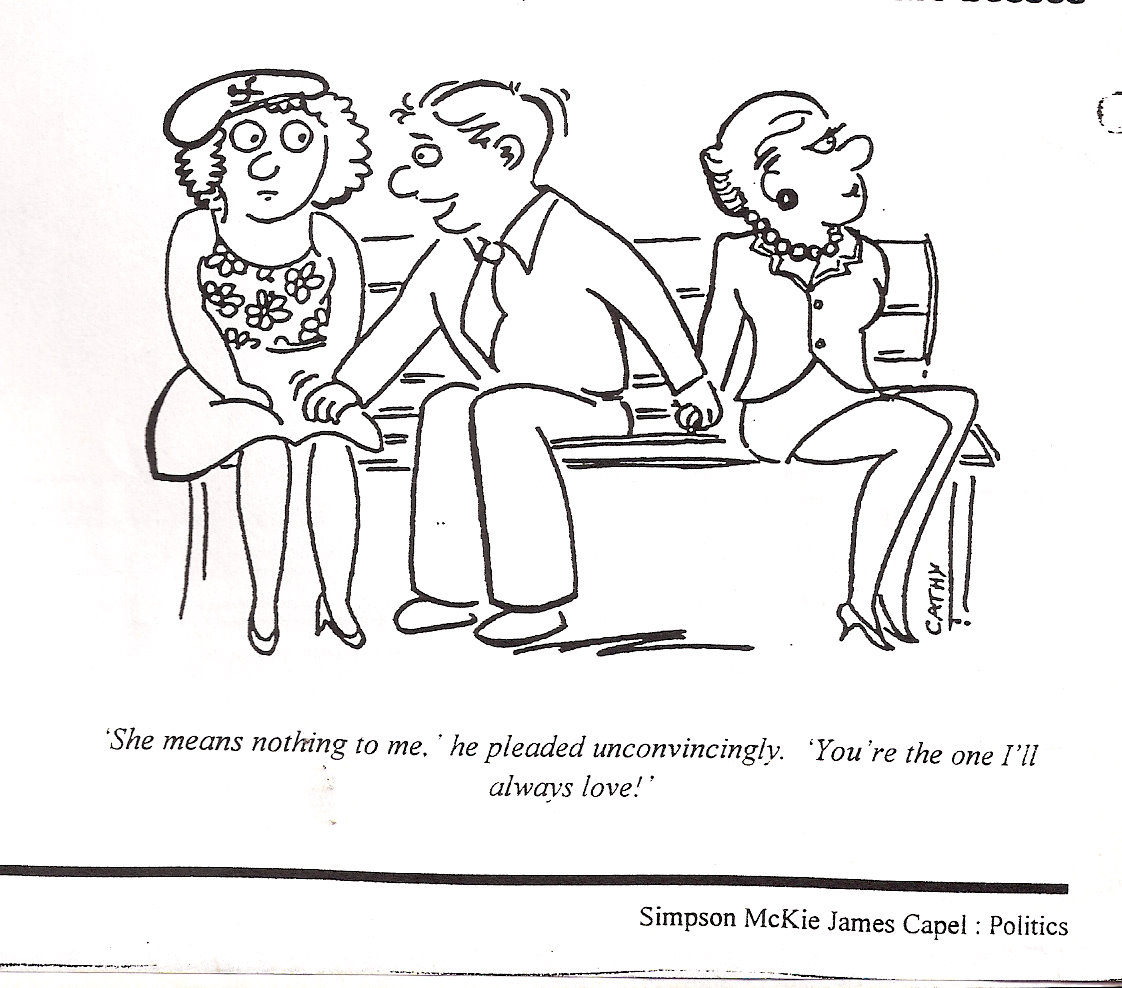
Febuary 1997 - a cartoon I commissioned - drawn by a friend - at least it's consistent!

A cartoon I commissioned in Feb 1997 by Cathy Quickfall (thanks Jenni B) – at least I’m  consistent!

Trading Tito for Gill

President Zuma’s announcement yesterday (Sunday) that Gill Marcus will replace Tito Mboweni as Governor of the SARB in November is likely to feed anxieties about policy continuity – despite reassurance that policy at the SARB will not change under Marcus.

The issue is not that Marcus is less competent or more likely to side with organised labour’s attacks on inflation targeting or that she would join the ANC’s leftwing allies and support forcing down interest rates and the currency. If anything Marcus’s experience as outgoing Chairperson of ABSA and the markets’ experience of her in previous positions as a SARB deputy governor and deputy minister of Finance are positives.

The issue is rather one of timing. Zuma’s Sunday press conference came out of the blue and his explanation for why the sudden announcement was awkward:

I have re-appointed Mr Mboweni as Reserve Bank governor. However, he has indicated his wish to leave in November 2009 to pursue other interests.

Given the indication from Mr Mboweni, I have therefore decided to designate Gill Marcus as governor of the Reserve Bank with effect from the 9th of November 2009.

 Markus was in exile with the ANC and played an important role at ANC headquarters in Lusaka in the 1980’s. She was a member of the ANC NEC from 1991 until 1999. This makes her a more senior ANC politician than the deployed Tito Mboweni. There is speculation that Marcus fell foul of Thabo Mbeki  before she left government and the ANC NEC in 1999 – which, in and of itself, could put her closer to the “Zuma Camp”. However, these relatively deeper ties into the ANC and its current leading faction, will not necessarily make her a more compliant SARB governor.

The problem with the timing of the appointment is that Cosatu has been pushing for the non-renewal of Mboweni’s contract and doing so by marching on the SARB to hand over petitions and by threatening mass strikes. In an environment where macro-economic policy (including monetary policy, nationalisation and privatisation and aspects of trade policy) are less certain than they have been since 1996, appearing to give in to this trade union demand is not going to do much for financial market confidence.

This surprising appointment is a useful microcosm for perceptions about policy instability in South Africa under the Zuma government. The appointment is a good one (as far as it goes) but by making it now government has essentially deposed the person who has come to represent policy certainty (in this case inflation targeting). The action fails if it is seen as part of a strategy of communicating with financial markets.

The Price of One Man’s Life and Death?

Nelson Mandela’s 91st birthday

Symbolic events usually have more than one meaning.  For those who comment on South African financial markets, Nelson Mandela’s 91st birthday (today) is probably “investment neutral”.

However, financial markets do not list the price of everything.

Born in Mvezo on the banks of the Mbashe near Qunu in the rural Transkei Nelson Mandela has become a perfect mirror of the struggle of black South Africans for liberation.

His biographer, Anthony Sampson, points to two events at the time of his birth that for the historian are real gifts:

  • the African National Congress – formed 6 years before, sent a delegation to London to plead for the rights of black South Africans;
  • Hendry Mandela, the boys father, was stripped of land, cattle and income by a white magistrate for refusing a summons.

From circumcision to missionary school, from Fort Hare to the ANC Youth League and the Defiance Campaign, Nelson Mandela’s life is the movement of the ANC from polite deputation to the British government, through peaceful resistance and on to the massive repression of the late fifties, the growing rapprochement between the African nationalists and the South African communists, the decision to launch armed resistance and the finding of comfort and succour with the Soviet Union.

Then prison for Mandela and exile for Oliver Tambo and 27 years in which the African National Congress travailed in these parallel wildernesses.

The rest is recent history.

For the last 6 years the Mandela heritage has been marketed by the slightly tacky 46664 campaign (it’s his prison number and the campaign is Disneyesque with an aging “Live Aid” feel about it; completely divorced from the culture and issues of the South African liberation struggle).

Today 46664 is punting another clunky number: 67 minutes. This is the number of years Nelson Mandela performed “unbroken and dedicated community service”. The idea is that those who support him will do 67 minutes of community work in honour of the great man … and a worthy thing it undoubtedly is.

Despite all of that, Nelson Mandela is the last symbolic link to the full ambit of the ANC’s struggle – which is the struggle of most black South Africans. Crucially, he also represents the compromises and tolerance that characterised the negotiations from 1990 and the election in 1994.

With each passing moment Mandela’s death is closer and this gives focus to anxiety about South Africa’s future.

Our feelings about the lives and deaths of “great” men and women allow us an emotional link to the grand scope of the history we live in and through.

The death of Pope John Paul II and of Diana Spencer gave a sense of how, in the age of celebrity, the so called general public become emotionally connected to the grand human drama that can usually only be understood a long time afterwards and at many degrees of abstraction.

Nelson Mandela’s death will be such a moment for humanity, because it will represent the drawing together of important threads of the last several hundred years of human history.

The point, however, for the investment specialist in South African financial markets is that the real running of the country and the dealing in the compromises between the old South Africa and the new, has long moved on from Nelson Mandela. It has now become a truism that even in his last years as president Nelson Mandela was already more important as a symbol than as a politician and statesman.

When he dies there will be real and visceral grief from comrades, friends and citizens who have participated with him in the struggles for African liberation. I imagine too, that  throughout the world there will be an unprecedented outpouring of emotion that will will elevate the symbol even higher than the man.

When Nelson Mandela dies the South African financial markets –  the currency, the equities and the bonds and products that derive from these – will not falter. But that only tells us a small thing: the ticker tape does not list the price of every important thing.

Architects of Poverty – Book Review

Architects of Poverty
Architects of Poverty by Moeletsi Mbeki (Picador Africa – Pan Macmillan 2009) R152 at Exclusive Books in the V&A Waterfront

…it was the Africans who caught the people in the interior and sold them to the owners of the ships that transported them to the Americas to be sold into slavery. So it was the Africans who needed the guns to protect themselves against the communities they raided for people to sell. (Preface; page x)

Moeletsi Mbeki’s new book is not a scholarly work. It is, instead, an angry tirade against “BEE and its subsidiaries – affirmative action and affirmative procurement”; and a warning that these policies are at the root of the de-industrialisation of the country.

The underlying metaphor for Mbeki is the slave trade with the high consuming black elite implicitly compared to the tribal chiefs who conspired with the slave traders to deliver the flower of Africa’s youth into the holds of the slave ship. Those who actually ran and directly benefited from the trade  – the slavers and plantation owners – become, in Mbeki’s analysis, the resource extraction industries, the dreaded “Minerals-Energy Complex”.

At the outset he makes it clear that his complaint is something more than a moral critique of the corruptions and conspicuous consumption of the new elite. The consequences for Mbeki of the system that has “BEE and its subsidiaries”; at its heart is the condemnation of the vast majority of South Africa’s people to poverty and marginalisation.

The two crucial players in Mbeki’s drama are, firstly,  the black upper middle class, which:

… dominates the country’s political life today but … plays next to no role in the ownership and control of the productive economy of South Africa; its key role is overseeing the redistribution of wealth towards consumption. It manages (or should that be mismanages?) a few state-owned enterprises inherited from the National Party era. (page 73)

The second set of crucial player are “the “oligarchs” – an unfortunately loose concept in Mbeki’s lexicon, referring to “big business” and foreign investors, specifically those involved in the extraction industry:

The South African economy is dominated by the extraction of minerals from the ground, processing them into metals through the use of electric power and chemicals and selling them to the rest of the world. Most of the assets of the economy are devoted to these activities, which also account for most of the country’s exports

The “oligarchs” are at the centre of the Minerals-Energy Complex web and represent the overwhelmingly dominant set of interests in determining key aspects of policy, according to Mbeki’s analysis.

Other groups and sets of interests: organised workers, peasants and farmers, manufacturing capital and the poor and unemployed are all losers in the division of spoils between the MEC and the black elite, who between them are the “architects of poverty”.

The precise mechanism through which the narrow self interests of the MEC and the black elite converge to the detriment of the country as a whole is through a system of what can best be described as bribes.

The primary object of the economic oligarchy during the Codesa II negotiations was to ensure the preservation of the MEC. The quid pro quo for representatives of the black upper middle class, the ANC politicians, who agreed to the preservation of the MEC was the creation of BEE.

Thus BEE is, at its heart, a bribe intended to pay off – and ensure the corruption of – the political elite, and to cause it to drop its demand for nationalisation of the mines. However there is a hidden quid pro quo as well that is at the heart of Mbeki’s fears. The MEC is, in Mbeki’s analysis, addicted to cheap labour. One of the ways to keep down the price of labour is to subsidise its reproduction by supplying it with cheap manufactured goods. According to Mbeki, beyond the preservation of the MEC “the emerging black political elite” also agreed to strip open South Africa to cheap Asian manufactured goods and thereby maintain the supply of cheap labour to the MEC.

The consequences of this bribe is the hollowing out of the South African manufacturing sector – and Mbeki’s explanation of why the ANC elite and the MEC excluded the domestic manufacturing sector from the Codesa II negotiations. Thus the BEE bribe is the direct cause of the de-industrialisation of South Africa.

The second level of the “bribe” is the payment of social grants to the poor. Increased public spending on welfare has increased, according to “the doubters” (the group to which Mbeki clearly belongs) not out of the goodness of ANC leaders hearts:

… it has been done to placate the poor so that they do not rebel and, most importantly, it has been done to buy the vote of the poor. (p84)

Mbeki argues that a country develops when it is able to harness the energies of its people and put them to productive use. (P85) But that the “resource curse” is allowing/causing South Africans to live off the fat of the land – and not as a result of their own work and ingenuity:

This is precisely the trap into which the ANC government has fallen. At least a quarter of the population receives social grants that would not be available if South Africa were not rich in minerals. Without mineral wealth to redistribute government would have to work harder and be more creative about finding solutions to unemployment and poverty. Resource wealth makes it possible for the government not to have to put an effort into redeveloping the economy to create more jobs.

There is a psychological injury entailed in the bribe of social grants:

Grants also add to and/or accentuate the humiliation that unemployed people feel about being dependent and unproductive and therefore unable to look after themselves and their families.

Moeletsi pushes his analytical luck – and helps to explain why he is under the hammer of  the Alliance at the moment – when he goes on to argue that the poor, in a futile effort to regain their self-respect:

… support demagogues who claim they, too, are marginalised and therefore want to replace the ruling elites with people-friendly governments. This, in a nutshell, is what happened at the ANC conference in December 2007, when delegates voted out their president and most of his cabinet.

It seems justified to challenge Mbeki and ask what alternative he would pose to Black Economic Empowerment. Given the racially skewed system of ownership and control inherited by the ANC government, was redistribution not an inevitable priority? Even if purely for the purposes of containing political risk? Some of Mbeki answers to similar questions from journalists and at conferences imply that redistribution is, in his opinion, in and of itself, a bad thing.

In fact, it strikes a fatal blow against the emergence of black entrepreneurship by creating a small class of unproductive but wealthy black crony capitalists made up of ANC politicians, some retired and others not, who have become strong allies of the economic oligarchy this is, ironically, the caretaker of South Africa’s deindustrialisation (61)

Architects of Poverty takes many digressions into broader African politics – especially exploring the failure of Zimbabwe and of various strategies for regional  integration, as well as the evils of dependency on donor aid. But Mbeki keeps circling back to his consuming theme:

With the advent of parliamentary democracy in 1994, South Africa’s real bourgeoisie, (i.e. the “oligarchs” – ed) through the process of Black Economic Empowerment …. created a new class from among the African National Congress (ANC) politicians. But it is a pseudo-bourgeoisie whose purpose is to act primarily as an interlocutor in the inner circles of the new political elite on behalf of the real bourgeoisie. Like the pseudo-states in sub-Saharan Africa, these pseudo-bourgeoisie are not a class of entrepreneurs. At best they are crony capitalists who are patronised by the economic oligarchy, just as Africa’s pseudo-states are patronised by Western powers through foreign aid. (p157)

Mbeki’s book is great as a moral critique of the excesses of the new South African elites; but suffers from a weak and haphazard use of theory. ‘The political elite’ is an easy concept, not entailing great abstraction and ‘the beneficiaries of BEE’ can be named by a glance through the Financial Mail’s Little Black Book; but Mbeki should take more care when collapsing these commonsense concepts with “the black middle class” or even “the state”, “the bourgeoisie”, “the peasantry” and the Mineral-Energy Complex.

In general Mbeki casually slips in and out of the language of a Marxist critique and analysis of the contending interests in South Africa, but he appears to mean a slightly different thing almost every time he uses a concept. How an economic class emerges and comes to articulate its interests (in Marxist theory) is a useful (but strictly circumscribed) contribution to economics and social theory. But the “bourgeoisie” is not, for example, just another name for the secret meeting of a couple of businessmen getting together to advance their narrow interests. Unfortunately Mbeki’s lackadaisical use of theory is going to strengthen the hand of the communists, trade unionists and ANC heavyweights who are already baying for his blood.

So do not read the book for its accuracy and theoretical precision. Read it as the honest and angry critique it appears to be. Read it because Mbeki has dared to speak what he sees as the uncomfortable truth to the new and the old powers in South Africa.

An interesting aside is that Moeletsi is the brother of Thabo, South African president ousted from leadership of the country last year (and from the party at Polokwane in 2007). It is clear from much of the book that Moeletsi has made his views clear to his brother and that he blames him for putting in place the cornerstones of the system. But Moeletsi is even more strongly critical of the new ANC leadership and he is clearly angry with them for their ousting of his older brother. There is an interesting story published in the Citizen based on Moeletsi Mbeki’s comments at a recent conference in Johannesburg:

He said that the ANC had been “very good” at establishing a political system and the Constitution, but had not done well in economics.“I never expected them to because they have never run a business.” He said that at least he and his brother, President Thabo Mbeki, had worked in the family’s spaza shop as children.“But when my brother gets kicked out as head of government, you won’t have anyone there who has actually managed even a spaza shop.

It is difficult to imagine Thabo and Moeletsi Mbeki running a spaza shop – and even more difficult to imagine that this equips anyone to run an economy. However Moeletsi Mbeki’s critique is, at it heart, an assertion of the simple virtues, usually ascribed to the petit bourgeoisie: thriftyness, hard work, frugality and respect for the property of others and for your own. In this assertion the book succeeds.

Excerpt from Architects of Poverty

Architects of Poverty by Moeletsi Mbeki (Picador Africa – Pan Macmillan 2009) R152 at Exclusive Books in the V&A Waterfront – if you can find it where they are hiding all their copies under a table right at the back … conspiring with the evil Minerals-Energy Complex (MEC), no doubt.

First things:

  • Time and tide have intervened and I am not going to be able to publish a review of this book before I leave in a few hours for the Otter Trail with my son where, as Paul Simon might have said: I have reason to believe, we both will be received, in Graceland.
  • I have read the book twice in preparation for reviewing it here – which I will do on my return – but for now let me urge you: buy this book. It is simple (sometimes simplistic) but it bravely and clearly rips the heart out of the body of wheedling and lies that underscores the system of crony capitalism and corruption which is becoming the dominant mode of existence in South Africa. For his pains Moeletsi Mbeki is going to fall as foul as it is possible to fall (even more foul than his brother fell) of the ruling elite.
  • Herewith is an extract from the book as a taster:

Black Economic Empowerment(BEE) has not proved to be the fatal blow to South Africa’s oligarchs that Nelson Mandela and black nationalists of his era once envisioned. In fact, it strikes a fatal blow against the emergence of black entrepreneurship by creating a small class of unproductive but wealthy black crony capitalists made up of ANC politicians, some retired and others not, who have become strong allies of the economic oligarchy that is, ironically, the caretaker of South Africa’s de-industrialisation. BEE in South Africa is, in reality, another attempt to siphon savings from private-sector operators in an environment where there are no peasants and where most of the private sector is locally owned.

The fact that BEE is an uphill battle for South Africa’s political elite is the result of the ability of the private sector to resist dispossession. But these are early days. Time will tell who will emerge best from what could be a titanic struggle by the political elite – recently joined by organised labour – to confiscate the wealth of South Africa’s current private-sector owners. An even bigger question, however, is what impact these struggles will have on the growth potential of the South African economy.

Most people in South Africa, in Africa, and the rest of the world naively believe that BEE was an invention of South Africa’s black nationalists, especially the ANC, which won the first democratic election in April 1994, leading to Nelson Mandela becoming the country’s first black president. This could not be further from the truth. BEE was, in fact, invented by South Africa’s economic oligarchs, that handful of white businessmen and their families who control the commanding heights of the country’s economy, that is, mining and its associated chemical and engineering industries and finance.

The flagship BEE company, New Africa Investments Limited(NAIL), started operating in 1992, two years before the ANC came to power. It was created by the second-largest South African insurance company, SANLAM, with the support of the National Party government-controlled Industrial Development Corporation(IDC), a state-owned industrial investment bank created in 1940. The formation of NAIL was soon followed by the creation of Real African Investment Limited (Rail), sponsored by mining giant Anglo American Corporation through its financial services subsidiary Southern Life. The object of BEE was to co-opt leaders of the black resistance movement by literally buying them off with what looked like a transfer to them of massive assets at no cost.

To the oligarchs, of course, these assets were small change. SANLAM created NAIL by transferring control of one of its small subsidiaries, Metropolitan Life, 85 percent of whose policy-holders were black, to several ANC and PAC affiliated leaders. The device used was to split shares of MetLifeinto a small package, dubbed high-voting shares which gave the politicians (funded by a loan from the IDC) control of the company. Overnight the politicians were transformed into multi-millionaires without having had to lift a finger because all the financial wizardry was performed by Sanlam’s senior executives. All the politicians had to do was show up at the party to launch NAIL and thank their benefactor. Even the debt the politicians incurred was largely fictitious because it wasMetLifethat had to pay it back to the IDC.

This financial razzmatazz was designed to achieve a number of objectives. It was intended to:

  1. Wean the ANC from radical economic ambitions, such as nationalising the major elements of the South African economy, by putting cash in the politicians’ private pockets, packaged to look like atonement for the sins of apartheid, that is, reparations to black people;
  2. Provide the oligarchs with prominent and influential seats at the high table of the ANC government’s economic policy formulation system;
  3. Allow those oligarchs who wanted to shift their company’s primary listings and headquarters from Joburg to London to do so;
  4. Give the oligarchs and their companies the first bite at government contracts that interested them; and
  5. Protect the oligarchs from foreign competition while opening up the rest of the economy, especially the consumer goods and manufacturing sector, to the chill winds of international competition.

All these machinations were eventually incorporated into South Africa’s democratic constitution by the creation of a category of citizens, apparently 91 percent of the population, to be known as previously disadvantaged individuals (PDIs). The ingenious legal notion of previously disadvantaged individuals created the impression that all black South Africans could or would benefit from BEE. This legitimised the co-option payment to the black political elite by dangling before the black masses the possibility that one day they, too, would receive reparations for the wrongs done to them during the apartheid era.

BEE and its subsidiaries – affirmative action and affirmative procurement – which started off as defensive instruments created by the economic oligarchs to protect their assets, have metamorphosed. They have become both the core ideology of the black political elite and, simultaneously, the driving material and enrichment agenda which is to be achieved by maximising the proceeds of reparations that accrue to the political elite. This has proved to be disastrous for the country. The black elite, which describes itself as made up of PDIs, sees its primary mission as extracting reparations from those who put it in a disadvantaged position. To achieve this requires the transfer of resources from the wrongdoer – perceived to be white-owned businesses and the state – to the victim, the PDIs. By this logic the state owes the PDIs high-paying jobs. This transfer of wealth from the strong to the weak is what has come to be known as BEE.

Enormous consequences follow from this apparently simple formulation:

  • In order for the wrongdoer to be able to pay reparations, the wrongdoer has to maintain a privileged position. This is the principle of fattening the goose that lays the golden egg.What this means is that the corporations that were allegedly responsible for victimising the PDIs must not be transformed beyond putting a few black individuals in their upper echelons. The protection of these corporations has gone so far as to allow them to move their head offices and primary listings from Joburg to London to shield them from possible economic and political upheaval in South Africa.At a broader level, the battery of Washington Consensus policies – which include trade liberalisation, balanced budgets, privatisation, inflation targeting, as well as the small state – all serve to protect the interests of South Africa’s big business, one of the two main payers of reparations.
  • For the victim to continue to draw reparations it is critical that he or she remains perceived as a victim and as weak. This means that the former freedom fighter must be transformed from a hero who liberated South Africa into an underling.The payment of reparations to the black elite thus achieves the opposite of what it is claimed it was designed to do, that is, make its members leading players in the economy. In reality, it makes members of the black elite perpetual junior support players to white-controlled corporations.
    # One of the most destructive consequences of the reparations ideology is the black elite’s relationship with, and attitude to, the South African state. As the state is said to have been party to the disadvantaging of the PDIs it is therefore also perceived to owe them something. By way of reparations the state must therefore provide PDIs with high-paying jobs. By extension, the assets of the state are seen as fair game. The approach of the black elite to the state is, therefore, not that of using the state to serve the needs of the people but rather of using it, in the first instance, to advance the material interest of PDIs.Not surprisingly, corruption under the ANC government has grown by leaps and bounds, leading Transparency International – the worldwide watchdog on corruption – to downgrade South Africa in the world’s corruption tables. According to the Transparency International Corruption Perceptions Index, South Africa dropped from No 34 in 2000 to No 54 in 2008. In 2008 the least corrupt countries were Denmark, New Zealand and Sweden and the most corrupt country was Somalia, ranked at 180.Ironically, one of the most important restraining influences on the abuse of the state for the self-enrichment of the black elite is the white-controlled corporations – the abovementioned layers of golden eggs – because these corporations need the state to function efficiently in order to provide a stable business environment as well as functioning transport and communication infrastructure. The judiciary and the independent mass media also play an important role in this regard.
  • The ideology of reparations traps members of the black elite into seeing themselves as the beneficiaries of the production of other social groups and therefore primarily as consumers. To facilitate their role as consumers the black elite sees the state essentially as distributive rather than developmental. Most importantly, the black elite don’t see themselves as producers and therefore do not envisage themselves as entrepreneurs who can initiate and manage new enterprises.At best, they see themselves as joining existing enterprises, the process of which is to be facilitated by the distributive state through reparations-inspired legislation. This is the most striking difference between the black elite of South Africa and the elites of Asia, where the driving ideology is entrepreneurship.