Zuma – time for his democratic technocrats to shine

This is not a budget review. There are just too many of them out there and I am in the middle of a roadshow to the South African fund management industry where the budget is being VERY well received.

This is more a comment on the whole budget season that yesterday’s excellent National Budget began.

The good thing about Zuma’s presidency has always been the fact that he has let every contending faction into the ruling tent.

But, I hear you cry, they are milling about in there in confusion, stepping on each other’s toes and bellowing and mooing in a kind of bovine riot as they fight to get as close as possible to the trough.

Well yes, but aside from that. You see, the Alliance of the disaffected (thank you Stephen Friedman) always consisted of an unhealthy number of BEE wannabes who wanted their turn to tear at the dwindling cherry. But they were never alone. The communists, the trade unionists, the ANC democrats who thought Mbeki had sold the revolution down the river and then a whole host of people whose contribution had been thwarted by the logic of the Mbeki imperial presidency (avoid real participation by the structures of the party, the alliance or even parliament in decisions, because they will go against you) they were all in there together. The fight between the “communists” and “nationalists” is very much a fight within the Zuma camp.

Thus, we come to the first season of the Zuma presidency in which their plans and budgets are revealed. It is important to remember that this is the first real political season of the Pirates of Polokwane (thanks Zapiro).

Well, so far we are seeing the first rays of light we have encountered in many dark months. The thugs and gangsters and vampiric crony capitalists and the racially chauvinist cabal at the centre of the security establishment (all of whom make up an important element of Zuma’s support base) have had all the running and all the press and have done all the bellowing, mooing and grunting at the trough.

Now it is the turn of the technocrats. This is the crew of lefties and trade unionists and dour financiers and tax collectors who were included in the Zuma cabinet, and gave many of us some hope to cling to in the darkening months of the whole second half of last year.

Yesterday Pravin Gordhan revealed a thoughtful budget that took all of the continuity that Manuel always showed, but added a real democratic inclusiveness that the previous minister was never able to demonstrate – given his crucial position in Mbeki’s non-inclusive regime.

Today we will hear Rob Davies and the DTI talking “industrial policy”. This is policy that sets up a combination of incentives and disincentives to shape the kind of growth we will achieve: how inclusive or job rich it will be.

During the next two weeks we will hear parliament debating the budgets of each and every department of government and finally all will be  revealed.

I think it is worth treating this process with an open mind.

I will, as far as possible, provide some insight into the process as we go along.

The State of the Nation nutshell note

I have whipped through the State of the Nation address while Jacob Zuma is just getting started. My initial impression is good, maybe even very good …. but maybe there has just been so much bad news and poor performance that any detailed and thoughtful stuff from government is likely to impress me …

Here are some bits and pieces:

As always the address was long on the broad brush, leaving the details to ministerial budget votes over the next few weeks.

However, there were interesting bits:

First a claim that no-one appears to be believing …. I will have to check these figures and see how they arrived at them:

We are pleased to announce that by the end of December, we had created more than 480 000 public works job opportunities, which is 97% of the target we had set.

More money for public infrastructure – power and transport

Over the next three years government will spend R846 billion on public infrastructure.

One of the most favourable public expenditure/infrastructure statements was:

Among other things, this will look at the participation of independent power producers, and protecting the poor from rising electricity prices.

We will establish an independent system operator, separate from Eskom Holdings.

Money to subsidise the employment of first time young workers

Proposals will be tabled to subsidise the cost of hiring younger workers, to encourage firms to take on inexperienced staff.

He announced a plan to hold departments accountable:

The Ministers who are responsible for a particular outcome, will sign a detailed Delivery Agreement with the President.

It will outline what is to be done, how, by whom, within what time period and using what measurements and resources.

Very concrete education targets:

We aim to increase the pass rate for these tests from the current average of between 35 and 40% to at least 60% by 2014.

Results will be sent to parents to track progress.

In addition, each of our 27 000 schools will be assessed by officials from the Department of Basic Education.

This will be recorded in an auditable written report.

We aim to increase the number of matric students who are eligible for university admission to
175 000 a year by 2014.

Brutal admission on certain health failures:

We must confront the fact that life expectancy at birth, has dropped from 60 years in 1994 to just below 50 years today.

We are therefore making interventions to lower maternal mortality rates, to reduce new HIV infections and to effectively treat HIV and tuberculosis.

Policing:

We are implementing plans to increase the number of police men and women by 10% over the next three years.

Concrete stuff about housing and mobilising private sector funds:

We are working to upgrade well-located informal settlements and provide proper service and land tenure to at least 500 000 households by 2014.

We plan to set aside over 6 000 hectares of well-located public land for low income and affordable housing.

A key new initiative will be to accommodate people whose salaries are too high to get government subsidies, but who earn too little to qualify for a normal bank mortgage.

We will set up a guarantee fund of R1 billion to incentivise the private banking and housing sector, to develop new products to meet this housing demand.

The State of the Madiba Nation

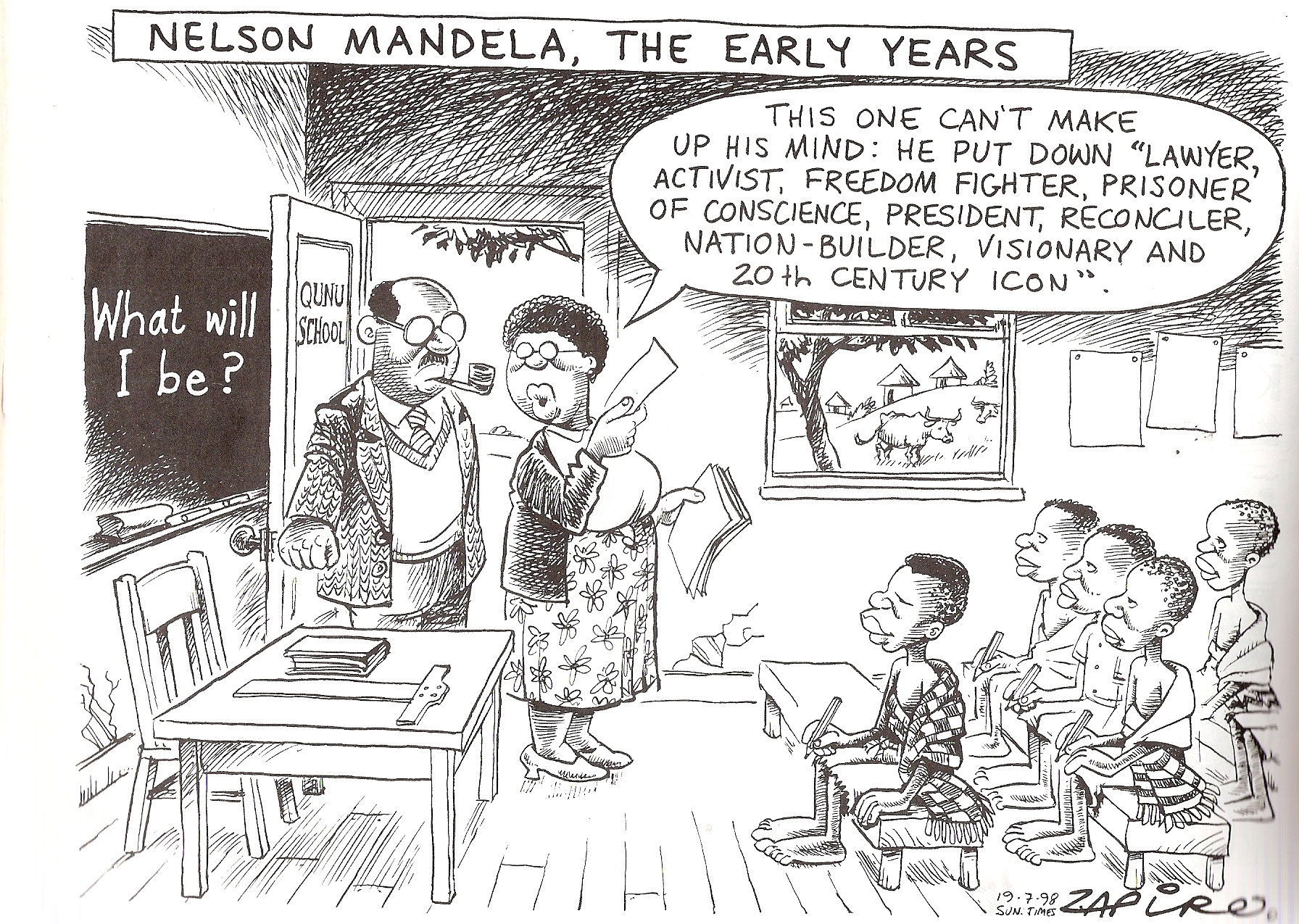
Twenty years ago today Nelson Mandela was released after serving 27 years in prison. Zapiro, as always, is the most elequent in his praise of the old man.

Jacob Zuma will deliver his State of the Nation address tonight, in part in honour of the service and leadership of  Rohlihlala, in part to stand briefly in the aura of the respect and love the great man still commands.

Nationalise or Starve … or both

Here is a radio interview that was not conducted with me this morning:

Why would the ANCYL want the state to grab 60 percent of an ailing mining industry?

Because Julius wants everyone to be able to afford a R250 000.00 Breitling like the one on  his wrist …

oops sorry, wrong piece of paper … here’s the right one:

Because some corporate finance wide boy has worked out a way to salvage a slew of BEE deals that are under water; deals that were premised on the continuation of the commodities super-cycle into the far and distant future.

How will nationalisation help?

The ANCYL are proposing suspending the issuing of licences; they want the state to set up a mining company and they want the state to nationalise 60% of each existing and all new mining operations …

Yes, but how would that help BEE mining deals?

You think this government would not pay compensation, proper market related compensation, if it came to take 60 percent of  mines belonging to Tokyo, Patrice, Cyril, and Mzi … and Saki and a few others? They will pay, trust me on this.

So you think it is just a scam?

… no, not only a scam. Nationalisation is a traditional badge of radicalism. In an environment  where the majority of South Africans have not benefited much from liberation it is politic for an organisation like the Youth League to assume the posture of heroically trying to take the wealth back from the greedy mine owners and give it to the people.

But isn’t it a fact that the mining houses make huge amounts of money and pay workers poorly and feed nothing back into the communities they work in?

Hmm, yes that is mostly true, but the big multinationals have learned to be on their best behaviour: environmentally friendly, money to local communities, good safety records …. the way to get the most out of being endowed with minerals is make those requirements as stringent as the productivity margins on any one operation allow. So charge royalties and tax them and require a whole range of social goals be fulfilled ….

But isn’t that what the 2002 Mineral and Petroleum Resources Development Act does?

Exactly. That act set up the Mining Charter and was based on a brutal and honest exchange between government and all the big investors in our mining sector … remember the leaked draft of the Mining Charter, the huge sell-off, the (then) Minister of the (then) Department of  Minerals and Energy rushing around the world’s financial centres explaining government’s intentions with regard to the  proposed Act and the BEE process … then the long struggle to set the level of royalties …. this is a process that we have been through …

But surely government can change its mind, and say: no we want more from the sector?

Of course it can – and investors have always treated that as a risk; they would have preferred a clause somewhere promising set levels of BEE ownership and unchangeable targets for the various aspects of the codes. Investors hate governments shifting the goal-posts. But this proposal is a lot more than shifting the goalposts. Nationalisation along the lines the Youth League is proposing is …. ‘a whole new ball game’, so to speak.

But surely we need to get the most out of our mineral resources – for the benefit of the poorest South Africans?

Why do you think state ownership of mines is likely to make them more productive … better generators of state funds, fairer to the workers … better for the environment …. more likely to feed back resources into local communities? All governments’ records as owner/managers of companies is appalling. And let me say that THIS government’s record as a  manager of the assets and resources it inherited stands out for reasons that probably no-one wants to brag about. The way to get the most out of the mines is to leave them to the professionals and tax them and oblige them to deliver certain social goods to just this side of the profitability margin.

Well, we have to leave it there … thanks Nic, and thank you all for listening …

Goodbye Mister Zuma, it’s been …. unsettling

I am trying to work out if Jacob Zuma is condemned to be a one term president; shuffled off the stage by a shamefaced ANC leadership as soon as humanly possible.

I think he will be, unless he is saved by a titanic power-struggle that is not settled in time for the 2012 ANC national conference and centenary. That way he might blunder on, apparently happily, until 2017. Heaven forbid.

There was something endearing about our president’s deep chuckle at Davos last week after he defended his polygamy:

That’s my culture. It does not take anything from me, from my political beliefs, including the belief in the equality of women. (Chuckle, chuckle, chuckle)

But ‘endearing’ became ‘tragic’ when three short days later the Sunday papers brought us the slightly belated news of another happy event in Jacob Zuma’s life: the birth of a baby daughter to proud mum Sonono Khoza, daughter of Iron Duke Irvin Khoza.

I am forced to assume the story is true; that Jacob Zuma is the father of  Thandekile Matina Zuma. He has neither denied nor confirmed the rumour but his record in this department would make it unsurprising that the number of his (known) offspring rises from 19 to 20.

There is little that needs be said about this matter, except maybe: Sonono is 39, her sister died of AIDS; Jacob Zuma is 67, the president of South Africa and  the guy who infamously took a shower after having unprotected sex with another young woman, someone who was HIV positive, someone who immediately went on to accuse him of raping her.  He married his fifth wife in January – bringing the number of current wives to 3. Enough.

Those who conspired to oust Thabo Mbeki by backing the then beleaguered Zuma must be feeling queasy about how this first term is going.

Mbeki spent much of 2006 and 2007 arguing (never directly but always strongly) that this man appeared to have his pants around his ankles and his hands in the till; he was just not the right sort of chap to inherit the mantle that had been passed down from Mbeki himself, from Madiba, from OR Tambo and a host of other legendary leaders.

Zuma’s Polokwane backers, that peculiar alliance of traditional ANC democrats, trade unionists, criminals who Mbeki had cleaned out of the state and BEE aspirants who wanted their bite at the cherry, decided to ignore the evidence of Zuma’s  moral turpitude and take the gap he presented.

I wonder if those who genuinely wanted to improve governance or fix the ANC’s internal democracy and those who believed Mbeki had failed the poor consider this path we are on, on balance and after all is said and done, to be worth it?

None of the things that apparently so concerned them has been fixed. Most problems have deepened and the most serious problems, especially the rise to dominance of vampire capitalism and corruption, are significantly worse today than they were under Mbeki.

The trends might have been heading this direction anyway, but we feel adrift: leaderless and defenceless against the predations of the hordes of pirates who came along for the Polokwane ride.

So do not look to the president for the strength – of politics, ideology or character – to lead us through this swamp.

Take a trip through the blogs and discussions about this matter in the popular media. It seems that aside from satisfying his own needs and whims, Zuma has achieved one thing: he has become grist to the mill of racists and Afro-pessimists everywhere.

They love him, in a complicated and twisted way, because for them he confirms their deepest fears and hatreds.

And for this, we are all significantly poorer.

Sexwale: Oh I just can’t wait to be king!

The spat over Tokoyo Sexwale’s report criticising Gwede Mantashe for not stopping the booing and humiliation of Julius Malema at the SACP conference in December is more important than it seems.

The direction a country takes (economically, socially and culturally) emerges from the interplay of too many factors to make the future even vaguely predictable. But it is always useful to look at the big bets being made by the most focussed and voracious players in politics and business. So, one way of understanding what is happening in the ruling alliance (and I accept there may be other ways) starts by assuming Tokyo Sexwale’s actions are always and at all times directed towards becoming president of the ANC in 2012 or failing that, in 2017 – not a weak assumption in my opinion. Becoming president of the ANC is the same as becoming president of the country (in 2014 or 2019 respectively).

Tokyo is placing himself – carefully and precisely – within the contest and conflict between “nationalists” and “communists” in the ruling alliance and he is doing so because he believes he can ride one side to victory over the other – and then ride that horse on to almost any destination he wants to hop off at. I am not sure that he can get what he wants this time around, but I would bet a considerable amount of money that these are his intention.

The conflict (which Tokyo hopes to exploit) between “nationalists” and “communists” is, in turn – and again in my opinion – also a proxy conflict, although one closer to, but still not perfectly reflective of, the real world.

(Please note that I am doing my own lumping of people below and – to some degree – I am using very loose definitions of “nationalist” or “communist”. The individuals hereby lumped would be unlikely to support my categorization or any of the implications I draw. I justify using the categories because right now there appears to be a significant overlap of both the language, actions and how individuals line up around the issues dividing the alliance within each group – giving the terms and/or concepts ‘communist’ or ‘nationalist’  particular force and effect for analytical purposes here.)

The nationalists

The nationalists include in their ranks those who believe the ANC must seek to represent all classes of South Africans and that the recent relative strength of the communists is damaging this endeavour. Here too are the anti-communists (for practical and/or ideological reasons) as well as the right-wing hang-em-high populists. The main component – and or the main hangers-on, depending on your perspective – of this group are the “TenderCapitalists” and those who otherwise hope to leverage their political access to take as much economic advantage of the state or quasi-state bureaucracy as possible.  Those in this broad category include Fikile Mbalula, Julius Malema, Billy Masethla, Tony Yengeni, Winnie Madikezela Mandela, Siphiwe Nyanda, Dina Pule, Ngoako Ramatlhodi, Nomvula Mokonyane.

This group and anyone trying to lead them, can draw on a rich intellectual tradition in the ANC that has always emphasised the dangers of the organisation adopting too narrow an ideology and thereby losing its ability to provide leadership to other classes (in the terms generally used in this and the communist traditions in South Africa these ‘other classes’ include peasants, the lumpen proletariat {i.e. the unemployed and the youth}, professionals and aspirant bourgeoisie and, more controversially, the actual bourgeoisie.)

At this stage the two organisations clearly dominated by this group are the ANC Youth League and the Umkhonto we Sizwe Military Veterans Association.

The communists

The communists are less diverse, but probably range from those driven purely by ideology and an instinct for collectivism (or being rooted in collectivist organisations like Cosatu) to those genuinely motivated to get the best deal possible for the poorest South Africans – even if their economic theory is never going to deliver this result. Those within this group include Gwede Mantashe, Blade Nzimande, Jeremy Cronin, Zwelenzima Vavi  and a host of less well known individuals. Both Cosatu and the SACP are dominated by individuals from this group.

If the main show (politically) in town is actually, as I assert, the conflict between the nationalists (as described) and the communists (as described) then the outcome of the conflict can be in no doubt. The nationalists come closer to being an economic class or at least an extremely powerful group of people who have one overwhelming set of interests in common: their desire, preparedness and ability to use the state to get rich. The communists have a set of idealistic ideas and a trade union movement. They don’t have a hope of blocking the relentless march of those who have caught the heady scent of easy riches.

What is depressing is that the communists had an inkling of the dangers they would face after they had successfully allied with the nationalists to oust Mbeki at Polokwane. This from The SACP and State Power – The Alliance Post Polokwane – Ready to Govern:

A negative scenario in which the left fails to hegemonise the post-Polokwane reality, and instead (and particularly after national elections in 2009) a new alliance of “1996 class project floor-crossers”, “compradorists” and “fugitives from justice” coalesces around a programme of awarding influential posts, tenders and contracts to themselves, while the factional destabilisation (and not democratic transformation) of the state, including the criminal justice system, persists.

Tokyo?

So back to the original premise. I think it is becoming clear that Sexwale, having made his money through Mvelphanda after being stopped in his tracks by Mbeki in the late 90’s, is back in the running and he has chosen the steed he hopes to ride to the presidency.

Can he pull this off? I think he is tainted by how rich he is and will be more so as accusations emerge that he is using his wealth and Mvelephanda contracts to reward certain factions and king-makers he hopes to woo.  I don’t know if the accusations are true, but they are certainly being bruted about. I think a run for the presidency by Tokyo would be formidable – especially now that Mbeki is no longer there to stop him like he was stopped in the 90’s.

So the long and the short is: he could make it, he’s got the wiles and the stamina and the financial muscle. But a post-Polokwane ANC president with a silver spoon in his mouth is a real stretch and Tokyo Sexwale’s bid will be up against it, no matter how skilfully he rides his powerful but ugly horse.

Prime Evil for the shabbiest Shaik – what kind of deal is this?

Could someone please guide me here.

Has every hick journalist and political cartoonist received privileged notification that the Presidency is on the verge of jointly pardoning Shabir Shaik and Eugene De Kock? In a sort of tit-for-tat?

I cannot work out which gallery would be being played to and for which purpose.

Are we to understand that in his overwhelming desire to pardon and reward his former financial advisor, Jacob Zuma would release the Apartheid mass-murderer to keep possible critics happy?

The idea is absurd and I cannot bring myself to believe that it hasn’t been made up by journalists of various hues looking for a story beyond the endless and tacky conflict in the ruling alliance.

The precedent for a similar equation of evil is F W De Klerk’s 1992 release of Wit Wolf spree killer Barend Strydom as an apparent quid pro quo for the release of Robert Macbride commander of the cell that carried out the Magoos bombing.

Strydom had gone on a rampage killing as many black people as he could while walking through the streets of  Pretoria in November 1988. Macbride had done a number of things as commander of an uMkhonto we Sizwe cell including take the ANC perilously close to targeting civilians in the bombing of the Magoos  Bar in 1984 in which 3 people were killed and 69 injured.

Both Strydom and Macbride had been on death row when capital punishment was suspended in 1990 but that is about as far as the comparison goes.

We can, at a real streatch, understand that De Klerk was satisfying two distinct constituencies in the 1992 releases.

But what possible constituencies need to be satisfied in the pardonings  of Shaik and De  Kock. White people want De Kock pardoned and Black people want Shaik pardoned?

I don’t think so –  the suggestion is ridiculous, even for the Zuma presidency.

The Stabproof Protektorvest

Here is something along the same lines, or at least in the same universe of sartorial symbolism, as the ANC leather jackets story. You couldn’t have failed to read about the stab-proof protective vests being marketed to soccer fans who hope to visit South Africa during the World Cup. You can get yours in your team’s colours. Yaaay!

Click on the image below to get whisked to the website so you can purchase something for yourself; or perhaps not. It’s a steal at $69.95 plus bag and free delivery. But that’s not all: with every purchase the company will donate a dollar to a charity to combat knife crimes.  How can anyone contain themselves?

The South Africans are fuming at the insult. Even the Democratic Alliance’s shadow Minister of Tourism Greg Krumbock is “dismayed” at the “alarmism” – I know it sounds like I am making this all up – including that name – but I am not.

While you are on the Protektorvest website, be sure to go to the thoughtful link to the SAPS crime report for 1 April 2008 – 31 March 2009. Most helpful of the knife-proof vest manufacturers, don’t you think?

I have covered similar World Cup scare issues more seriously here and with a lighter touch here and here.

Apartheid Reparations and Foreign Investment

Could IBM, Fujitsu, Ford, General Motors , Rheinmetall and Daimler be guilty of “knowing participation in and/or aiding and abetting of the crimes of apartheid; extrajudicial killing; torture; prolonged unlawful detention; and cruel, inhuman and degrading treatment”?

Should they be tried for this crime in a US federal court?

If they are found guilty should they jointly pay billions of dollars to a group of black South Africans who have brought the class action suit under the peculiarly named Alien Tort Claims Act in the New York federal court?

Here is a copy of the ‘Second Amended Complaint’ including a list of plaintiffs and defendants that is available on the Khulumani Support Group (an Apartheid victims support organisation) website. It spells out all the ways in which the plaintiffs believe each company or category of company became guilty of a crime by  bolstering, arming or funding the Apartheid regime. Note that since this time the list of defendants has been narrowed to those mentioned in the first paragraph of this post.

An interesting aspect of this fascinating drama is that Thabo Mbeki’s government openly opposed this case on the grounds:

  1. it threatened South Africa’s sovereignty to try such a matter in a  US court, especially because the much praised domestic negotiation  had agreed that the Truth and Reconciliation Commission was the binding forum and chosen process;
  2. it would discourage foreign investment.

Jacob Zuma, on the other hand, has removed government’s objections to the process and last year had Justice Minister Jeff Radebe write to the American court and tell it the South African government believed the US court to be “the appropriate” place in which to resolve the matter.

The Zuma regime was surprisingly joined by the Obama regime in endorsing the US court as the appropriate place for the motion to proceed. The amicus curiae brief the US government sent to the court is a useful summary of the facts of an extremely complicated matter and can be read in full here – I found the link on Simon Barber’s excellent “American Notes”  blog.

The go-ahead for the US court to hear the matter from both the US and the South African government is based primarily on the fact that while amnesty would have been the result of full participation in the TRC process, the defendants – and, in fact, most businesses operating in Apartheid South Africa – never participated in the process. Thus there was relatively minimal disclosure (at the TRC anyway) of business’ dealings with the Apartheid regime and hence no amnesty.

The founding myth of the Rainbow Nation is that we have dealt with the past and go into the future with knowledge and forgiveness. The case in the US federal court challenges this assumption and asks some extremely difficult questions that have consequences way beyond South Africa.

Here are some of the questions as I see them:

  1. The TRC process failed in a number of ways; will cases like this one help redress the failure, or will they undo the few successes – with regard to reconciliation and forgiveness – the TRC did have?
  2. The TRC process created a collective victim group and a collective perpetrator group in a way that allowed single people (including legal persons) to avoid carrying the can or receiving any significant compensation for Apartheid human rights abuses. Won’t legal processes with more clearly defined defendants and plaintiffs redress this?
  3. Won’t raking the muck of the past continue to cause conflict and division, especially between black and white South Africans in the present and the future?
  4. How does a publicly owned company that has operations across the globe assess risk associated with politics in the countries in which it operates – especially when oppressive governments are its direct clients and customers? Recent examples might include Nestle in Zimbabwe and Google in China.
  5. If the domestic government is not a customer, it still sets a regulatory environment that might make the company guilty of an offence if it complies with the law. Yes?
  6. Is disengagement from a particular country dominated by an oppressive government always the right approach?
  7. What does this say for domestic businesses?
  8. Should aspirant black business men and women have refused to accumulate capital in Apartheid South Africa – except as criminals?

The list of questions could probably go on ad-infinitum, but that will do as a start.

One thing you may have noticed I left off was the Mbeki government’s first objection based on the fact that such cases might deter foreign investment. Such cases might place more onerous due diligence requirements on any company that operates across borders and in countries where governments might become guilty of human rights abuses. No company is specifically going to punish an ANC led, democratic South Africa if a US court finds it culpable of bolstering the previous NP led Apartheid South Africa. It’s not logical and it is not in the company’s interests.

A leather jacket by any other name …

Some things just have to been seen to be understood. While preparing the review article “While we were away” I checked through the ANC website and was delighted by the pictures of a range of leather jackets the ruling party is selling online. Here is as much as I could get from a poor quality screen shot, but click on it to visit the site to see these garments in all their high definition full-colour glory… and perhaps you might feel brave enough to purchase something for yourself; perhaps not.

I am not sure whether this has anything to do with political analysis, but I know there is an excellent metaphor in here somewhere, I just can’t quite think of it.

While we were away …

Having  just returned from an idyllic holiday, I am forced to take stock of what I missed …

The Communists versus the TenderCapitalists

A “TenderCapitalist” is not an over-sensitive entrepreneur. It is a South African person, much loathed by the communists,  who uses his or her  race and/or political connection to win tenders from the state or from private companies hoping to fulfil their BBBEE requirements or just hoping to suck up to the ANC. The South African Communist Party has made it clear it thinks the ANC Youth League president Julius Malema is the ring-leader of this faction in the South African political economy.

The SACP conference and the booing of Julius Malema brought things to a head and throughout December and early January there has been something of a toing and froing between Julius Malema and Blade Nzimande.

The spat continued at the Slovo memorial in Soweto on Wednesday 6th of January when Nzimande said that “narrow African chauvinism” threatened Slovo’s non-racial vision and that the slogan: “liberation of blacks in general and Africans in particular” should not be “corrupted into a narrow anti-white African chauvinism” – quoted in Independent Online.

A few days later at the ANC 98th birthday rally in Kimberley Julius Malema suggested that there were “super-revolutionaries” that wanted to “co-govern” with the ANC. On Sunday, in a statement apparently coordinated with Malema, Jacob Zuma said in an SABC interview that the ANC does not “co-govern” with any other party. In response Blade Nzimande, quoted in The Times, said:

I don’t know who coined the term. It’s people’s figment of their imagination. This issue is manufactured by people who are anti-communists.”

The stage is set; let the theatre commence.

The death of Tshabalala Msimang

Manto Tshabalala Msimang died on December 16 of complications from a liver transplant. Msimang was minister of health from 1999-2008 and presided over a period of health policy uncertainty that began with Thabo Mbeki’s insistence that there was no evidence that HIV causes AIDS. A committed revolutionary who went into exile in 1962 under orders from the then banned ANC, Manto Tshabalala Msimang died as government policy and practice around the HIV/AIDS epidemic finally started to achieve traction.

Matric pass rate drops – again

On Thursday last week education minister Angie Motshekga announced the matric results which showed a two percentage point decline in the already dismal pass rate to 60.6. This is the sixth successive year of drops. The figures are, on closer examination, even worse than they first appear. The science pass rate (those who got above 30%)  dropped about 15 percentage points to 36.8 and the maths pass rate remained unchanged at 46 percent. Nothing is better predictive of future prosperity than improving education outcomes. Nothing (obvious) is more predictive of future troubles, on a number of fronts, than the converse.

Attack on Togo soccer team at CAF in Angola

On Friday January 8th the bus carrying the Togo soccer squad to CAF fixtures into the Kabina enclave in the extreme north of Angola. Several officials and players were injured. Rebels in the Kabinda enclave have been at war since the early 60’s (firstly against the Portuguese and later against independent Angola which has insisted that the oil rich territory stay incorporated as part of the country).

The South Africans have insisted that any suggestion that the security situation in northern Angola is in any way similar to that expected to obtain at the World Cup in South Africa later in the year is ludicrous and possibly racist. However all national security officials will have been reminded how easy it is to target an international sporting event to get maximum coverage for your cause, as I argued here. Watch this space …

President Zuma moves (way) up in the popularity stakes

Sapa reports (on South Africa – The Good News – and in many other places) that Jacob Zuma has increased in popularity amongst all groups but most notably amongst Indians, Coloureds and Whites since last April’s election. It’s a surprise, but mostly a good one.

The SACP Conference – as I head off

Tomorrow morning at the crack of dawn I will begin travelling with my children for a respite after two years of my (it seems somehow personal) Great Recession.

We will be moving through some places that are less connected than others, so I will be posting irregularly for some time.

For this reason I wanted to say something  about  the South African Communist Party’s special conference in Polokwane before I go and before it finishes on Sunday.

Our red brethren have been meeting since Thursday and it seems they have been having an interesting and boisterous time.

Much of the media coverage has centred around a visit by Julius Malema, Billy Masetlha and Tony Yengeni during which the ANC Youth League president was booed and reportedly walked out in a huff, threatening to ‘tell on’ to the president.

But the underlying conflict that is playing itself out between the SACP and a powerful faction of the ANC is the main show in town.

And the SACP leadership is ‘on message’, constantly attacking what it sees as emerging black capitalists whose primary method of accumulation is tender abuse and looting of the state. It appears that the communists believe this “project” is THE real and immediate danger.

The coordinated attack emerges from even a cursory reading of (most importantly) the political report to the conference, but also from the opening address (some of these links are a little dicky – it seems to be a problem with the SACP’s site) by SACP chairman, Gwede Mantashe, a speech by Cosatu’s Zwelenzima Vavi and an address by the Young Communist’s Buti Manamela.

The political report says it most clearly (it’s a longish quote, but it gives one an excellent idea of the main issues in our politics):

This new tendency has its roots in what we might call “Kebble-ism” – in which some of the more roguish elements of capital, lumpen-white capitalists, handed out largesse and favours and generally sought to corrupt elements within our movement in order to secure their own personal accumulation agendas. Some of this largesse helped elements within our movement to emerge as capitalists in their own right.

(…)
In particular, these elements of BEE capital have been exploring a class axis between themselves and the great mass of marginalized, alienated, often unemployed black youth. The material glue of this axis is the politics of patronage, of messiahs, and its tentative ideological form is a demagogic African chauvinism. Because of its rhetorical militancy the media often portrays it as “radical” and “left-wing” – but it is fundamentally right-wing, even proto-fascist. While it is easy to dismiss the buffoonery of some of the leading lieutenants, we should not underestimate the resources made available to them, and the huge challenge we all have when it comes to millions of increasingly alienated, often unemployed youth who are potentially available for all kinds of demagogic mobilization.

We do not use the term proto-fascist lightly, nor for the moment should we exaggerate it. However, there are worrying tell-tale characteristics that need to be nipped in the bud. They include the demagogic appeal to ordinary people’s baser instincts (male chauvinism, paramilitary solutions to social problems, and racialised identity politics).

Now  I disagree with a host of the economic solutions that the communists seem to take as gospel and I am convinced that left to their own devices they would kill creativity and diminish personal liberty without commensurate social gains. However, it is the communists who appear to be most clearly identifying where we are going and what the dangers that confront us are.

They might be full of economic nonsense (i.e. stuff with which one disagrees) but you can always trust the reds to spot the fascists before even the fascists themselves know what they have become!

Farewell lessons from Joel – who clearly still believes in government

I do not believe that government, by the pure force of will of the members and the clarity of their thinking, can change all societies or societal processes for the better. In fact, I tend to believe that outside of the basic provision of services and the function of co-ordination, benign neglect is what any country needs most from its government.

So, while I do not believe that governments can do much good, I am not advocating that we should not take the government, its capacity and intentions, seriously.

Because one thing is clear: through commission or omission, governments can really mess things up.

Thus I was interested and a little touched to see Joel Netshitenzhe’s farewell speech to his government colleagues. The address was reproduced in full in Ray Hartley’s excellent blog – Ray is editor of The Times as well as the Times Live website; and you can learn more about the inestimable Joel Netshitenzhe from my previous posts and their various links here and here.

Firstly, Joel gives a sense of how long he has been around government (actually from the very first and he was also central to the ANC’s ‘government in waiting’ in Lusaka:

From the early days with Mandela, when he complained that there was no smell of coffee in the corridors of the Union Buildings and we had to construct the president’s office virtually from scratch. We learnt then what it means to manage a transition and unite a nation;
And the cerebral pursuits of the Mbeki era, combined with forging an integrated democratic state;
To the firm but modest hand of Motlanthe in managing an uncertain transition; and
Now, the Zuma era, which holds the promise of merging some of the defining attributes of the two main phases of the first 15 years of democracy and taking us to a higher trajectory.

Then he quotes Geoff Mulgan, head of the policy and strategy unit in Tony Blair’s office – a position very similar to the one Joel has occupied in the four successive government’s he mentions above:

“It is widely assumed that governments have lost power … [T]he perception of powerlessness is an illusion … Governments overestimate their power to achieve change in the short term and underestimate it in the long term.”

Then he advises on how power can be exercised; how government should conduct itself to most powerfully affect shape outcomes:

If I were to add my tuppence worth, I would advise that for the Presidency to be able to exercise leadership in the context of changes being introduced, it:

  • Carefully wield the soft and hard power it has: winning the allegiance of departments, other spheres and society at large;
  • Master the science and art of ensuring all centres of government embrace the Presidency’s initiatives as their own;
  • Ensure both dignified articulation of generic issues and a dignified silence when necessary; and
  • Perhaps most importantly, organise the best parties ever at the end of the year so colleagues can know each other better.

Then he almost ruins it all by quoting a mawkishly sentimental Chris de Burgh song (see correction for this false attribution in end note) – but it kind of works, given the idea that he was part of the organised ANC endeavour that came to power in 1994 and then had to try and fix the things that had been broken:

Black bird singing in the dead of night

Take these broken wings and learn to fly

All your life

You were only waiting for this moment to arise

Black bird singing in the dead of night

Take these sunken eyes and learn to see

All your life

You were only waiting for this moment to be free

I for one am going to miss his influence on government; and, in as far as government has any positive influence on our live, I imagine we all will.

(End Note – Blackbird is actually a Beatles song. My error started with Joel, who said it  was a Chris de Burgh song he had heard recently. I compounded the error by the fact that I never checked if he had it right and then presented his casual attribution as authoritative. Go to the comments on this post to see discussion around the song and see me suddenly decide that the song is actually quite deep and insightful, now that some kind readers have corrected me as to provenance and attribution of the song.)

Do you remember the Broederbond?

The appointment of  Menzi Simelane to head the National Prosecuting Authority is profoundly reminiscent of the National Party’s style of rule in the declining years of Apartheid.

Do you remember the Broederbond, and other instruments of Afrikaner Nationalism? Do you remember the stolid manipulation of every conceivable government, parastatal or private institution? The constant need to appoint National Party apparatchiks to every level of management?

The fundamental nature of Menzi Simelane , down in his bones and in his genetic code, is to do what he is told by the president and the party. As director general of Justice he attempted to instruct the prosecuting authority to desist from prosecuting Jackie Selebi, he lied for Mbeki, he lied to the Ginwala Commission and he believes the executive has the right to instruct the prosecuting authority – and hang what the constitution says.

Now Jacob Zuma has appointed this man to head the National Prosecuting Authority. This soon after Zuma appointed Mo Shaik – whose only apparent credentials is slavish loyalty to Jacob Zuma – to head the South African Secret Service. The Secret Service and the prosecuting authority? What could he want with those institutions?

(Read that inestimable constitutional law professor and blogger Pierre De Vos for details, transcripts and intemperate language and barbed apology)

There is no doubt – in my mind, at any rate – that Simelane is appointed primarily because he will be prepared to lie and otherwise intervene in the legal process to protect this president and these rulers as he has done for the previous gang.

Only a government entirely overrun with apparatchiks and political gangsters could make an appointment as brazenly  in-your-face as this. This is haughtiness and lack of sensitivity taken to new and dizzying heights. This is the demonstration that the Zuma government will go to any lengths to protect itself from legal prosecution – no matter what the consequences for sentiment, constitutionality and good governance.

The declining years of Apartheid saw the best of young Afrikaners abandoning the party and the bureaucracy of government. What they left behind was an increasingly predatory state in terminal decline, deeply corrupt and entirely dependent on patronage and extra-legal manipulation.

This is the brink upon which we again stand.

Welcome back to the progressive trade union movement

This war won’t be won from our air-conditioned offices but in the branches and structures of the ANC, just as it happened in the build-up to Polokwane. – Zwelenzima Vavi at a press conference yesterday (30/11/2009)

It’s over; Cosatu is back where it belongs.

The trade union ally fought its way into the ruling tent and finally gained admittance at the Polokwane conference of the ANC in 2007.

Cosatu has, since its formation in Durban on December 1 1985,  played the role of the prickly and critical ally of the ANC.

The organisation has consistently been on the side of the angels (in that role, anyway), acting as the stern fraternal critic of government and the ruling party on issues as diverse as Zimbabwe, HIV/AIDS and corruption. After the end of legislative Apartheid in 1994 the glue that had bound Cosatu to the ANC was weakened and Cosatu became ever more strident in its criticisms – especially of cronyism.

The mythology that Cosatu constructed for itself and helped imprint on the 2007 Polokwane class project (hmm, can I patent that?) was that the ANC had been hijacked by an Mbeki led deviation with the promulgation of the Growth, Employment and Redistribution macro-economic policy in 1996 (the 1996 class project).

What Cosatu was doing in the lavish ruling tent, according to their own narrative, was saving the ANC from the 1996 class project.

Cosatu is a trade union movement. Of all possible trade union movements, Cosatu was NEVER meant to be the government. The organisation is the trickster, the Shakespearian fool and it has immeasurably strengthened our democracy by playing that role.

But a trade union movement is limited by its need to protect the interests of its members. I have argued time and time again here and here (for example) that the interests of employed workers ARE NOT identical to the interests of the nation as a whole.  Any attempt to place the interests of employed workers – especially the short-term interests – at the centre of national policy would be profoundly damaging to the South African economy and democracy.

This is not an abstraction. It’s about investment flows, the laws that structure the labour market and the costs of doing business here. Government must balance the creative greed of capital and the suffocating fear of organised labour – in a rough nutshell, so to speak.

The last thing we need is either business or organised labour running government.

Cosatu has stood steadfastly against the rising tide of cronyism and tender abuse within government. But as soon as it has become part of government the organisation pushes to entrench the short-term interests (labour brokers, forced lower interest rates) of the formally employed … and that’s in the interregnum before its leaders join the gravy train.

So instead of watching its own structures and leaders sucked into the familiar patterns of greed and corruption which seem to be the inescapable quagmire of governance in South Africa, Cosatu must find itself a base in the wilderness from which to ‘speak truth to power.’

(Note: There are questions that are begged:
  • Is it appropriate or realistic for Cosatu to conduct its battle  “in the branches and structures of the ANC, just as it happened in the build-up to Polokwane’.
  • What does this mean for the “Alliance”? Split? Drift along?
  • The SACP is obviously talking to Cosatu and coordinating with them. Where does the SACP go?
  • Whereas I do think Cosatu’s apparent exit from government into civil society presages a massive – and generally positive  – upsurge in civil society opposition, this is bad in the short-term for investment risk and, more importantly, civil society opposition is unlikely to divert these trajectories of cronyism, abuse of power and weakness at the centre.
I will try to address these in the next few weeks.)