The communists have got this right

Here’s something important to read and understand.

From a South African Communist Party Central Committee statement  released today – I just caught it on Politicsweb here.

You can disagree with the communists about a range of points of strategy and of principle, but they accurately and urgently identify populism as exemplified by the ANC Youth League ruling faction (and be clear, this is what they are talking about) as the greatest threat to the ruling alliance and, more importantly, to the South African democracy.

This is their call to arms:

We are dealing with an anti-worker, anti-left, anti-communist, pseudo-militant demagogy that betrays all of our long-held ANC-alliance traditions of internal organizational democracy, mutual respect for comrades, non-racialism, and service to our people. It has created substantial space for an anti-majoritarian, conservative reactive groundswell that seeks to tarnish the whole movement, portraying us all as anti-constitutionalist and as narrow nationalist chauvinists.

It was only a matter of time before a rescue attempt of the sliding democratic project was launched from within the alliance. It was always going to come either from Cosatu or the SACP – and despite its lack of a mass base, the SACP is more venerable and respected within the ANC

The communist leadership has dissipate into government and its voice has been softer and more defensive as a result. It remains to be seen if the party is still able to crack the whip loud enough to drive our domestic version of Zanu-PF back into its cage.

The limits of politics

I think both the DA and the ANC might be on the verge of an evolutionary spurt that will change what they are and thus see them shifting into new ecological  niches in our political landscape.

I also think that the landscape itself changes much slower than we think or hope.

Voluntarism is a term for a species of political error – and I dredge this up from the gleaming days of my youthful involvement in the ‘mass democratic movement’ in South Africa. The taxonomic system we developed for naming and defining ‘mistaken beliefs’ was tiresomely thorough and self-righteous, but I have to confess that I still dip into that frame of reference and find there useful analogies and ways of understanding the world.

Voluntarism  means believing that through pure force of will, cleverness of organisation, brilliance of strategy, accuracy of tactics and shear hope, anything could be achieved no matter what the inherent conditions.

I am convinced that the Democratic Alliance foray into the townships and squatter camps is either a form of voluntarism or it will result in the DA becoming something else entirely – and ultimately something very similar to what the ANC has become.

This somewhat pessimistic view of politics is based on the assumption that politicians and political parties do not have a free hand to sell what they like to whoever (whomever?) they like.

The racial divide in South Africa and the racial solidarity of the groups which face each other across that divide is a deep structural phenomenon and not a casual consumer preference.

When Julius Malema talks about “the Madam and her tea girl” referring to DA chief Helen Zille and the DA MP and national spokesperson Lindiwe Mazibuko he finds a resonance.

This ‘resonance’ is not something created by clever marketing and it is also not something that can be got rid of like Vodacom changing its colours from blue to red.

Groups of people, their ideology, culture and attitudes can be changed – particularly in the powerfully denaturing environment of modern industrial cities. This is how an African peasantry became  the urban proletariat of South Africa’s modern capitalism. And it was this process that created the possibility of an ANC that represented all black Africans in the country and not just specific tribal groups.

But do not overestimate the power and speed of this process. Think of the ethnic boroughs in New York; think of the Xhosa/Zulu tussle in the ANC and think of the unbridgeable divide between the black and white experience in South Africa.

South Africa’s history, including colonialism and Apartheid, has a powerful momentum in our lives today. I think this means that the hope that the DA with more black faces and branches (but essentially the same ideology , structure and principles) could make a serious electoral challenge will remain just that – a hope.

A party still called the Democratic Alliance could displace the ANC, but only by becoming something very similar to its foe i.e. led by black people with a history of opposition to Apartheid and primarily about redressing the past,  directing state resources to benefit black people and  channelling wealth towards the emerging black elite.

The “rump” of the DA are good old white liberals (in the best sense of the word) who have their ideological roots in the closing years of Apartheid.

A party with such a “rump” will never (in any time frame that could be relevant to us) represent a majority of black South Africans – even urban professionals, even a significant minority. To represent those people the DA would have to be of those people, run by those people and be an instrument to further the interests of those people.

I do think urban African professionals are in the process of defecting, with disgust, from the ANC.

But I will be looking for a Movement for Democratic Change lookalike (to the ANC’s ZANU-PF) to emerge from the South African political dynamic.

That ultimately means I am still looking for an organised defection by the industrial working class and their middle class allies that will emerge from a split in the Ruling Alliance – that would probably put Cosatu on one side and the ANC on another.

On this basis the ANC could lose control of the cities to a political formation like the MDC –  although not one that could be portrayed, as the MDC has been by ZANU-PF and by the ANC (which can already sense the threat), as having been funded and set up by white farmers and other ‘enemies of national liberation’.

There is a part of me that hopes I am wrong … that we have it within ourselves to escape the awful gravity of our history; that we really are free to choose our future.

My view, however, is that the choices we do have are all within a narrow band of possibilities confined by the deep structural features of our past and present.

Thus the ecology of our society and our politics remains the same – or at least changes extremely slowly – but the creatures that inhabit the landscape are modified by natural selection and drift and displace each other in the niches that are available to them.

(My next post will deal with the question of what the ANC is becoming as it changes its niche as the party narrows and shifts – geographically, ideologically and socially.)

This added after publication:

The über-troll of South African political analysis R.W. Johnson added this gentle corrective to the version of the above article published on Politicsweb: “Am I the only person astonished by the fact that Mr Borain can’t spell voluntarism ?” He’s quite right about this – as he is about so much – although he is usually also interesting. He was, appropriately, hanging out with the racist bullies in Politicsweb’s comments section, so I shouldn’t be terribly surprised at his sneering tone.

The word is voluntarism (not volunterism, as I originally had it … I got it wrong because I mistakenly thought ‘we’  had made it up and I could therefore spell it as I pleased) and it means: “any theory that regards will as the fundamental agency or principle, in metaphysics, epistemology, or psychology”  – from Dictionary.com.

Top ranked political analyst in FM survey

This is faintly awkward for me, so I put it right there in the headline – leading with my chin, so to speak.

I run this blog for a number of reasons:

  • It’s a discipline – it forces me to think about the political news flow;
  • I am, in principle, in favour of deepening political debate – the more forums, the more people think about politics, and the more subtle and complex those thoughts are, the better for all of us;
  • It fulfils a personal need for an audience – I’ll deal with that with my shrink if I ever get one again …
  • and I use it to market myself to people who might pay me for my services as a political analyst or speaker.

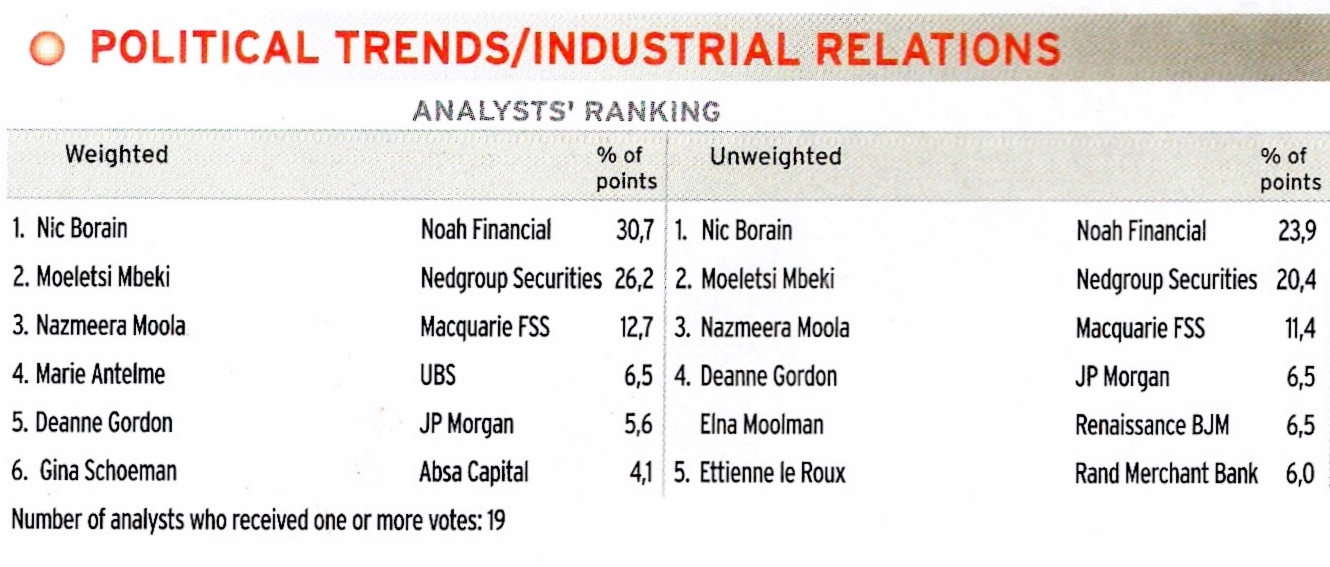
It is the last need that causes me to mention here that I was, to my great surprise, last week announced as the top ranked analyst in the Financial Mail annual Analyst of the Year Survey – in the category: Political Analysis and Industrial Relations.

Here’s the whole “leader board”:

I am particularly proud of this award for several reasons, but these are the important two:

First, the rank is determined by a vote from South African fund managers at the pensions funds and asset managers. These are professionals who have to pay for the analysis and assess its financial value to them and their businesses. It’s a vote I value.

Second, I am in auspicious company – even though some people on the list are not primarily “political analysts”. I don’t know them all (and will only mention the ones I do), but I am a great admirer of Moeletsi Mbeki (as anyone who reads this blog will know) – and Deanne Gordon and Nazmeera Moola are valuable and supportive friends, top economists and thorough and original thinkers (and have both been highly ranked in many categories in this survey in the past).

Quick one on some damn lies

You might be wondering why the Sunday papers were filled with conflicting version of the results from the municipal election.

The answer is contained in a decent story on Times Live written by Brendan Boyle:

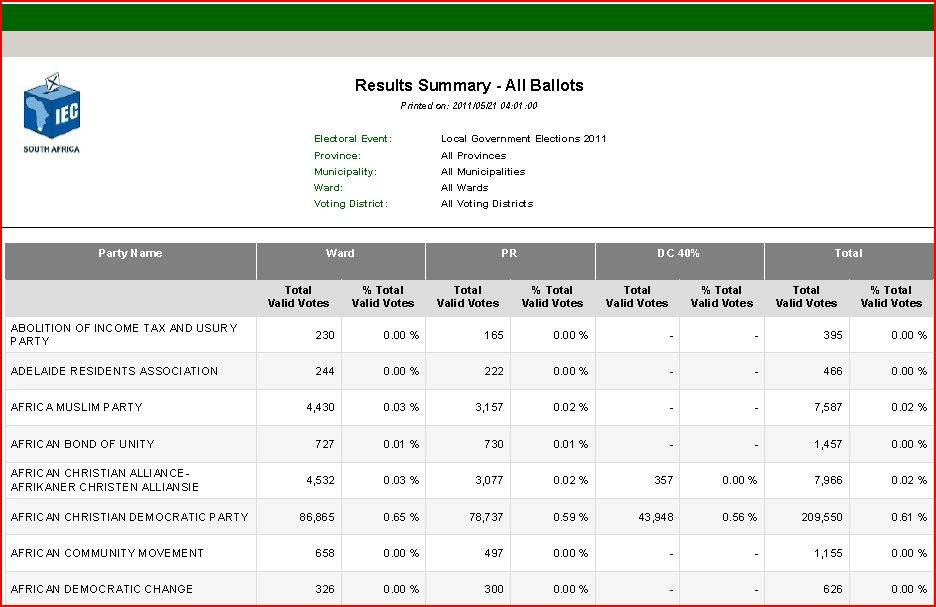
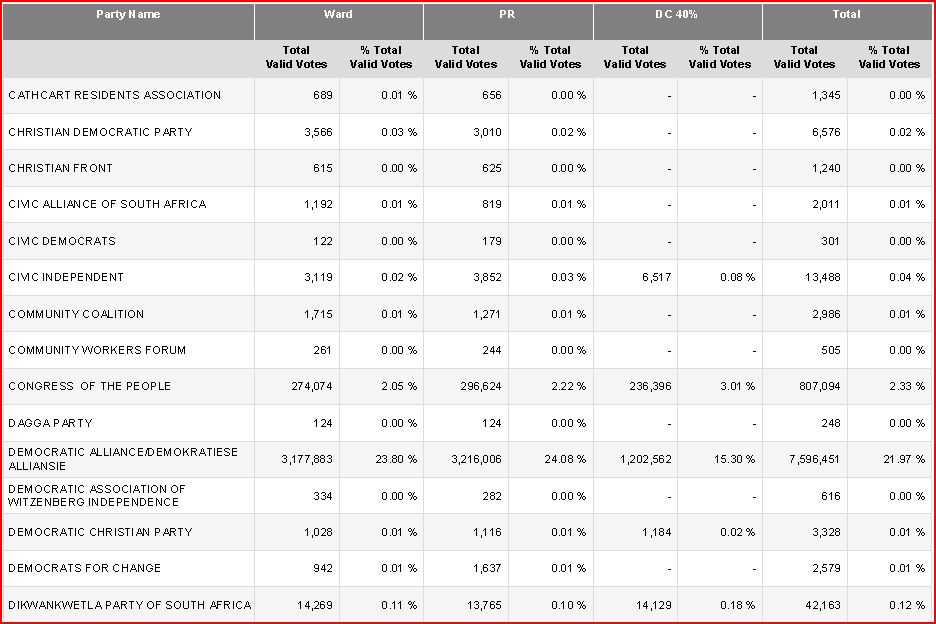
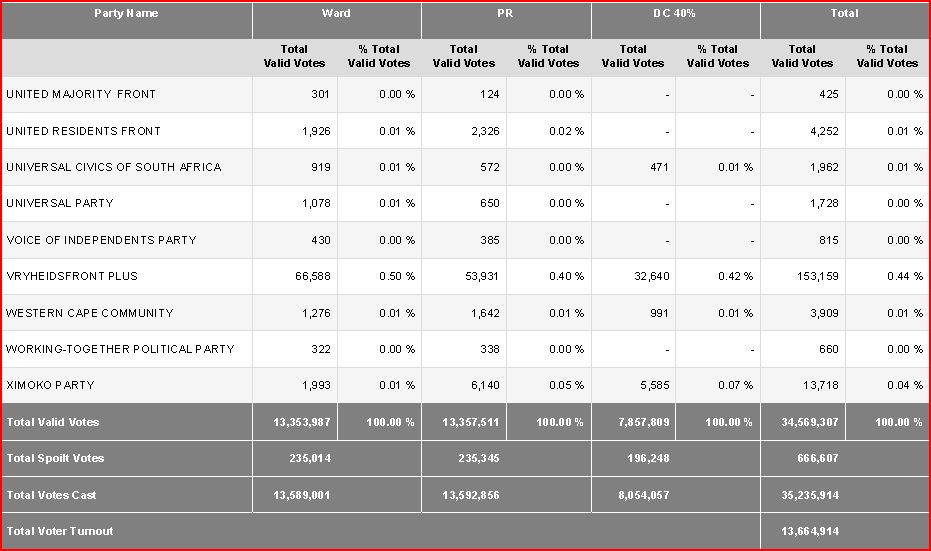
The DA took 23.80% of the vote for ward candidates, 24.08% of the proportional representation vote for parties, 15.3% of the vote for ward councillors and 21.97% of all votes cast.

The ANC took 60.98% of the ward vote, 62.93% of the proportional representation vote, 69.43% of the district council vote and 63.65% of all votes cast.

So you can spin your version in a number of ways – and everyone has been furiously doing just that. See here for the DA using the proportional vote comparison which gives it 24.08 percent versus the ANC 62.93 percent and therefore casts its performance in the best possible light (something it is perfectly in its rights to do.)

(This added half an hour after publishing – it has been pointed out to me by some of the people I follow on Twitter – @Bruceps and @RyanCoetzee – that the only choice that all voters were offered that indicated their party preference is the proportional representation vote which gives the ANC 62.93 percent and the DA 24.08 – strongly persuasive that this is the number that most accurately indicates party support.)

The Sunday papers seems to have arbitrarily shifted from one usage to another.

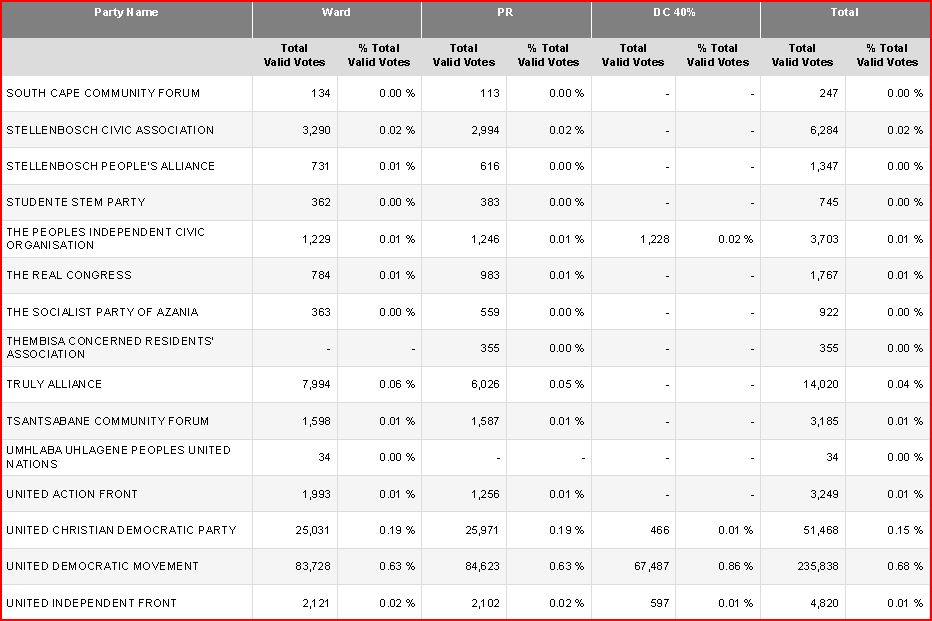
I have used the figures from the IEC website for the overall total of votes cast for parties. Here they are (if you click on any one of the nine it will enlarge and become readable):

This is significant … but don’t collapse in astonishment

As of right now (this was 12.40 on May 20 2011) the ANC is sitting at 63.63 percent of the vote (66.35 in 2006), the DA at 22.1 (14.77), the IFP with 3.94 (8.05) – and newcomers to municipal elections COPE with 2.31 and the National Freedom Party with 2.54. The other important factor to consider is the ID got 2.02 percent in 2006 – which we must assume has mostly gone to the DA in this election.

The trends are important but are likely to be overlooked by the degree in which they were exaggerated before they appeared.

If anything the ANC is likely to continue to drift upwards and the DA downwards – because the constituencies in which the ANC is stronger are bigger and messier and therefore results take longer to come in.

The leader article in this morning’s Business Day points out that only 9.2 percent of South African’s are ‘white’ and with the Democratic Alliance running at about 22 percent of the vote the official opposition has already broken out of it’s racial ghetto.

I think this is the correct way to spin it.

Some DA supporters might be feeling disappointed – it looks like they have only one metro (Cape Town); but my feeling is anything more than this was hopeless optimism.

The DA talking up its game was always going to end in tears.

The fact is the party has done extraordinarily well – particularly in the metropolitan areas.

The ANC has won with reduced majorities almost everywhere and the DA is up an astonishing 8 percent on its performance in 2006.

These are the significant trends in the election and the statisticians will be furiously projecting forward to 2014 – although you should note that the ruling party tends to do worse in the municipal vote (a global trend).

The ANC is giving hints that it takes the criticism and promises to fix the three areas that have contributed to the reduction of its margins: candidate selection, poor service delivery and widespread corruption in local councils.

Were this to happen the results, as they are running, are the best they could be.

Some observations about the election lead-up

I am feeling the welcome pressure of a flood of paid work.

The only drawback to this happy state of affairs is I have not been able to put as much effort into updating this website as I would like.

In future I will generally be posting the quirkier side of politics and investment risk – occasionally from a more personal perspective.

I will not be telling you about what I had for breakfast, my deep and interesting views on Islay single malts or the fascinating behaviour of my small brown dog. I expect more posts to have the character of Saturday’s Rowan Atkinson skit – which could have been made for this election – or this one from a few months ago on celebrity culture and the rise of grandiosity in our politics.

Meanwhile here is a summary of some of my views on the lead-up to Wednesday’s vote.

(Note: just before the dog ate my homework my finger slipped on a small streak of high dudgeon that had somehow spilled on my keyboard and I pressed the “publish” link before I had a chance to edit the following piece. I have now cleaned it up slightly, but feel free to email me at nic.borain@gmail.com to point out any mistakes I missed – or to engage me about the article.)

Julius Malema

If the ANC Youth League president was a stock traded on the JSE I would be calling: “buy, buy, buy –  fill your boots! ”

He’s under-priced because of the hammering he has taken over the last 6 months, and the market – as reflected in what the ANC likes to call “the print media” – has not adequately woken to the fact that he is the star of the election.

I have argued before that Malema is the coming man in the ANC and, perhaps, the country. I will not be entirely charmed to have been proven right – although a lot can go awry ‘twixt now and the time of full accounting. But let there be no mistaking or underestimating Malema’s current cachet.

He appears to have done the hard work – personally, in his own name and own voice – in mobilising the constituencies most likely not to have bothered to vote on Wednesday.

This doesn’t even have to be true. It appears to be true, and that is all that matters.

He stuck one in the eye of ‘the madams’ and ‘the masters’ and, as difficult as it is for me to swallow, I am fairly certain that for this reason alone there are millions of South Africans whose hearts swell with pride as they think about their Juju’s audacity and bravery.

Whatever else happens he will be remembered by the loyal party workers and bureaucrats as having turned pro when the going got tough – and taking the fight to the Democratic Alliance just as the Official Opposition was  looking scary.

And this was all building on – and in addition to – the enormous public relations coup of the “kill the boer” trial – which united the party, its leaders and its faithful behind him.

I do think that a party and a country in which a young populist of the streak and character of Julius Malema is so strongly ascendant is in all kinds of trouble in the long term … but that, so to speak, is another story.

I also think financial market sentiment – particularly as effected by the ‘nationalisation of mines’ debate – will counter track his rising and falling fortunes.

Jacob Zuma

Jacob Zuma has had a fair to good election. This activity is his strength and as with Malema he has earned loyalty points from the party faithful for his tireless commitment and skill in working the crowd.

I am interested in the nature and extent of pressure that he appears to be under – particularly pressure emanating from the Youth League and those that hope to ride that organisation to power and even greater wealth.

President Zuma, to my mind, is awkwardly caught in a relationship of mutual dependence with the sections of the Ruling Alliance with whom he shares the least ideological and cultural ground.

Zuma is the natural Nkandla patriarch, dispensing largesse and spreading his seed in as a wide a circle as possible. These are the attributes that Cosatu and the ANC’s leftwing most despise yet Zuma is their champion and they his.

The confirmation of post-Polokwane populism

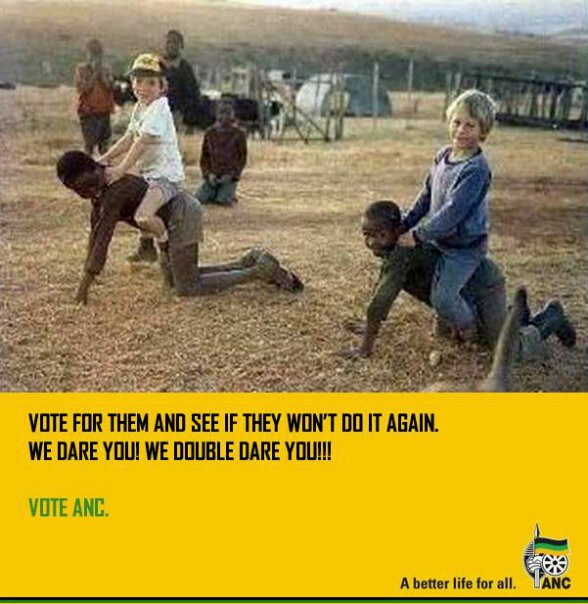
I miss the arrogant and austere Thabo Mbeki who would have been ashamed to use the kind of underhand tactics implicit in some of the  ANC election posters – I am assured this one is the genuine article, but I still have difficulty believing it.

For me the word “populism” has a meaning that implies a combination of characteristics, including clever mixing of fact and fiction, appealing to the most base human emotions as well as the manipulation of the fears, greed and anger of oppressed and vulnerable people.

At first this image made me laugh out loud – it is a photograph, so inescapably true, as well as being strangely familiar. Until I paused and realised how manipulative and abusive it actually is – using the image of happy children playing together (in circumstances we cannot know but are encouraged to imagine) to evoke hatred, rage and fear.

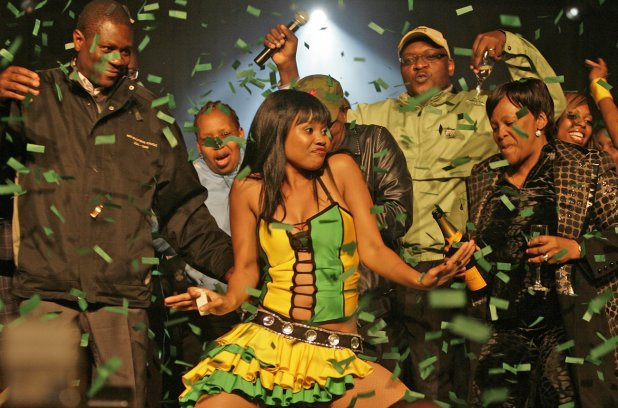
The ANC conducted the 2009 election campaign in the style of  a televangelical rally spiced with hotdogs and wet t-shirts.

It is probably arrogant and elitist to hate this kind of politics as profoundly as I do – but I would rather have that defence than for there to be any possibility of being swept up into either the sexy razzmatazz or into the fear and hatred.

This election has given the faintest hint of what a cornered ANC might be capable of and the kinds of appeals it might be prepared to make to the most base elements of its constituency.

Not, mind you, that the DA is guiltless of softer versions of both the ‘sexy razzmatazz’ and the ‘fear and loathing’ populism. But the “Fight Back”slogan seems to have receded and Helen Zille’s sex appeal is such a specialist taste that I am less bothered by the DA’s mass-marketing strategy than I am by the ANC’s.

Helen Zille also rises

My own view is that Helen Zille, for all her preppy awkwardness, jolly-hockey sticks enthusiasm and excruciating body language,  is the Iron Lady of our recent history and has struck at the heart of ANC complacency and tolerance for corruption and failure.

Whatever happens to the DA’s feisty campaign in this election, Helen Zille herself has achieved an extraordinary place in our history. She has personally shaped her party and pushed it into new territory – against history and against personal limitations – where it is, in my estimation, going to play a growing role in the politics of a post-Apartheid South Africa. This would be a phenomenal and transcending achievement for party that originated in the last white parliament.

Results – counting chickens and pigs in pokes

I strongly suspect that ANC panic and DA overreach is going to leave a lot of people slightly shamefaced or deeply relieved.

There is no realistic or publicly available polling data but my thumbsuck guess – unlike that of Allister Sparks – is that the DA does less well than the hype has led us to believe and that the ANC does not go much below 60 % no matter how big the stayaway vote from the party’s angry and disillusioned supporters.

The DA seems to have set its supporters and party workers up for disappointment. Who cannot think that the party will not do considerably better than it did in the 2009 General Election or the  Municipal vote in 2006? But the way it is being spun, anything short of 4 metros and 40 percent of the vote (a vanishingly unlikely outcome) is going to feel like defeat.

Will the ANC lose enough urban African support to scare it into cleaning up its act?

I am ever hopeful, but I am breathing while I wait.

The cacophony – let it stop!!

It is perhaps slightly pretentious to hate exclamation marks as much as I claim to – but I think the sheer awfulness and triviality of the the political debate deep into election time calls for more than one of the flashy little symbols of overstatement and hyperbole.

I refuse to discuss the toilets any further. I promise I will never talk about the ANC’s leaders ‘snuffling’, ‘grunting’  or ‘squealing’ at the trough ever again, no matter how extreme the provocation.

It is an arms race of metaphor and hyperbole and eventually the language cannot adequately express the appropriate range of feelings.

I look forward to a period of calm understatement, starting next week Monday, as we recover from Sunday’s last gush of whining, triumphalism and sage and important thoughts from the analytic establishment.

Damnation … without relief

Real debates about societal problems and ways of fixing them have little to do with elections – which of necessity appeal to the most base and common human drives.

What we have is a Hallmark Hell of platitudes, populism, red herrings and whining.

Spare a thought for those few politicians for whom the behaviour required to win elections is so abhorrent that they develop peculiar lines on their faces that can only have been etched by sickly smiles designed to disguise disgust.

It seems like a gift from the comic gods that the Toilet Saga has become central to this election.

Well for ‘relief’ (you will see in a moment how that joke works in relation to the DA/ANC spat)  from the elections and other bodily discomforts here is one of the finest comic sketches ever to see the stage.

Rowan Atkinson, masterfully combining a sort of pre-Mr Bean goofy prissiness with English reserve plays The Devil welcoming the recent recruits to hell.

Two asides before you click on the link:

  • first, be warned that gentle digs at “the French”, “the Germans”, Christians, lawyers and atheists could, in cases of extreme sensitivity, cause offence;
  • second, I attach the text of the skit below the video, because this is the first time I have embedded a link to YouTube and I have elsewhere experienced the irritation of such links not working for some arcane YouTube management or copyright protection related reason – but it is Atkinson’s delivery that makes it so funny, so watch the video if you can.

http://youtu.be/XFGrQMD6Uqc

The Devil’s Welcoming Speech

Ah hello! It’s nice to see you all here. As the more perceptive of you have probably realised by now, this is Hell, and I am the Devil, good evening, but you can call me Toby, if you like. We try to keep things informal here, as well as infernal. That’s just a little joke of mine. I tell it every time.

Now, you’re all here for….. Eternity! Ooh, which I hardly need tell you is a heck of a long time, so you’ll all get to know each other pretty well by the end.

But for now I’m going to have to split you up in groups.

Will You Stop Screaming!

Thank you.

Now, murderers? Murderers over here, please, thank you. Looters and Pillagers over there. Thieves, if you could join them, and Lawyers, you’re in that lot too.

Fornicators – if you could step forward? My God, there are a lot of you! Could I split you up into Adulterers and the rest? Male adulterers, if you could just form a line in front of that small Guillotine in the corner.

Em… The French, are you here? If you would just like to come down here with the Germans. I’m sure you’ll have plenty to talk about.

Okay, atheists? Atheists over here please. You must be feeling a right bunch of Nitwits. Never mind.

And finally, Christians. Christians? Ah, yes, I’m sorry but I’m afraid the Jews were right. If you would come down here, that would be really fine.

Okay! Right, well are there any questions? Yes. No, I’m afraid there aren’t any toilets. If you read your Bible, you might have seen that it was damnation without relief, so if you did not go before you came, then I’m afraid you’re not going to enjoy yourself very much, but then I believe that’s the idea.

Okay. Well, it’s over to you, Adolf! And I’ll catch you all later at the barbecue. Bye!

Jacob Zuma versus the ANC Youth League

Yesterday President Jacob Zuma met white farmers in the KwaZulu Natal Midlands and reassured them about nationalisation of mines and about land seizures.

He said: “What Malema said is neither the ANC’s nor the government’s policy … the farming community must not be shaken by his comments.”

A few moments ago the ANC Youth League responded – and I put the full statement below.

This morning I argued to my paying clients – mostly asset managers and pensions funds who are concerned about these issues:

The noise about uncompensated land seizures and mine nationalisation will continue up until the ANC’s Centenary Conference in Bloemfontein mid-year 2012 but current investor friendly policies are likely, in broad terms, to be reaffirmed at that conference.

This ANC Youth League statement does not change my view, but I am sure the financial markets can feel the heat:

ANC YOUTH LEAGUE NATIONAL WORKING COMMITTEE STATEMENT ON PRESIDENT JACOB ZUMA’S COMMENTS ABOUT LAND REFORM AND NATIONALISATION OF MINES.

12 May 2011

The ANC Youth League National Working Committee met on the Thursday, the 12th of May 2011. Amongst other issues, the NWC noted the comments of ANC President Jacob Zuma on Land Reform and Nationalisation of Mines in response to the questions by the people he addressed in KwaZulu Natal. In response to the fears and insecurities expressed by those people, particularly in relation to land reform, the President is reported to have amongst other things said, “Malema is on a learning curve and the farming community must not be shaken by his comments. What he says are simply his views”.

The ANC Youth League is concerned by the manner in which President Jacob Zuma addresses policy issues contained in the discussion documents of the ANC Youth League towards the 24th National Congress. The question of expropriation of land without compensation is a policy proposal contained in ANC Youth League discussion documents for the 24th National Congress, and not “simply his [President Julius Malema] views”. Attributing the views expressed in the discussion document to ANC Youth League President Julius Malema is not helpful and can only serve to isolate him from the organisation. The views expressed in the 24th National Congress discussion documents have gone through the processes of the ANC National Working and Executive Committees and never personal views of ANC Youth League President.

The ANC Youth League is concerned because we believe it is appropriate for all members of the Movement to engage the ANC Youth League on its policy positions and not isolate any of its leaders. This assists all communities the ANC engages to appropriately understand the policy making processes of the ANC, which the ANC Youth League participates in. We believe that the manner in which the issue of land reform was responded to is not consistent with this principle. The President of the ANC Youth League is expressing views contained in the ANC Youth League discussion document, which is inspired by the ANC 52nd National Conference’s observation which says “We have only succeeded in redistributing 4% of agricultural land since 1994, while more than 80% of agricultural land remains in the hands of fewer than 50,000 white farmers and agribusinesses. The willing-seller, willing-buyer approach to land acquisition has constrained the pace and efficacy of land reform. It is clear from our experience, that the market is unable to effectively alter the patterns of land ownership in favour of an equitable and efficient distribution of land”.

The ANC Youth League on further concerned on how the question of Nationalisation of Mines is responded to because the ANC has a resolution on how the question of Nationalisation of Mines should be approached, in line with the ANC National General Council’s “greater consensus on nationalisation of Mines and other strategic sectors of the economy” and the Freedom Charter. The ANC has put in place a process on how best the issue of Nationalisation of Mines and other strategic sectors of the economy should be approached. The ANC Youth League is of the view that the response by ANC President to the farmers is not consistent with the resolution of the ANC National General Council and what the National Executive Committee instructed should happen.

Once again, the ANC Youth League calls on all South Africans—black and white, members and leaders of all ANC led alliance structures, all leaders of the ANC and all people concerned about the future of South Africa to read ANC Youth League discussion documents and ANC 52nd National Conference resolutions and engage the issues raised there. This will benefit those who want to engage us and sharpen the perspectives of the ANC Youth League towards the ANC YL 24th National Congress and ANC 53rd National Conference.

Issued by the ANC Youth League National Working Committee

It’s war out there

As the cannonade and sharp retorts of the Municipal Election become deafening, it strikes me how alike are elections and wars.

Both these human endeavours are faced with comparable technological, communication, infrastructural and personnel challenges.

Generals preparing for war and political leaders for elections have this in common:

  • They must have a game plan and clear objectives, including a realistic view of the chances of success and the costs involved in achieving objectives.
  • There must be lots of money available.
  • They must have a clear understanding of the enemy and the enemy’s resources and capabilities.
  • They must have precise information about the terrain upon which the battles will take place and the loyalties of the citizens who inhabit that terrain.
  • They must have a complex and balanced organisation at their disposal which contains the full capabilities and capacities that might be required – from senior management down to foot-soldiers, and encompassing every specialist skill that might be applicable to the proposed campaign as well as the most varied arsenal possible.
  • They must have systems of supply and replenishment – allowing funds and resources to flow to where they are needed.
  • They must have a system of communicating to every level of the force and auxiliary services;
  • They must have a system of communicating to the world and general public not directly involved in the war.

I suspect one could search for more complex similarities, but the issue of interest to me is how both elections and war require – or cause, I am not sure which –  propaganda and distortion of the truth.

We have all heard the notion: “The first casualty in war is the truth” – (Aeschylus 525 BC – 456 BC) and it is apparent listening to what  the principal players in our election say of themselves and each other that “the truth” seems infinitely elastic and vague.

The most obvious contravention of the rules of engagement have been Julius Malema’s comments in Kimberly over the weekend: “We must take the land without paying. They took our land without paying. Once we agree they stole our land, we can agree they are criminals and must be treated as such.”

But Malema is just a weapon that gets deployed in the battle, and I doubt any one army in this conflict is innocent of the impulse to use every single weapon in its arsenal.

And we shouldn’t be surprised.

For the strategists and generals are up to their necks in the campaign, it is all they think about, all day and all night, sleeping, eating and on the toilet. As the final day comes closer, every possible advantage, every weakness of the enemy, every inch of ground, every weapon in the arsenal … becomes important and worthy of exploitation.

A kind of frenzy takes over the leadership and all caution or higher feeling gets brushed aside.

It’s win at all costs … and that is pretty much where we are right now.

And that is the problem.

In nine days time we are all going to look up from the carnage and find a world very slightly changed by the battle that has been fought.

It is only myopic politicians and generals who could possibly believe their little war/election justified the distortions and propaganda they have deployed.

On being a useful idiot

We all get an occasional red herring dragged across the trails we follow.

For political analysts this is an occupational hazard.

Our “sources” have their own agendas and we have to be eternally suspicious of the bright little threads of information we find scattered across our paths.

Here is a paraphrase of a piece of information I have heard several times and in several slightly different versions in the last few weeks:

Word from deep inside the ANC is that the ruling party’s own polling data is hinting at a catastrophic swing in their biggest urban African constituencies towards the DA.

Now I would hesitate to imply that serious spin doctors in our political kingdom would normally spend much time and energy ensuring that Nic Borain was lead or mislead in a particular way.

But during an election the parties throw prodigious amounts of energy into the void and at times like this even your humble servant occasionally gets caught in the crossfire.

So, without having any clue as to whose interests the viral spread of this particular snippet might serve this is the breadth of my suspicion:

  • The information is an exaggeration of something that is true and comes from DA strategists hoping to deepen the momentum achieved and create a sense of excitement in the electoral constituency and in the party machine.
  • The information is neither true nor false (is either invented or partial) and is put about by ANC strategists to mobilise previously loyal voters who, out of disillusionment or apathy, were unlikely to vote on May 18.
  • That the rumour is designed to galvanise the lethargic or disillusioned ANC party machine – a swing towards the DA by urban black professionals will be an intolerable repudiation of the current stewards of the ANC.
  • That the information is being put about as part of the myriad factional battles within the Ruling Alliance – most obviously as a stick to beat Jacob Zuma with in the lead-up to 2012.

Of course it might just be the plain and unadulterated truth that the ANC’s bespoke polls are indicating a serious swing in urban professional African constituencies away from itself and towards the DA.

This seems a logical consequences of some of the failures of delivery and the endemic spread of corruption and cronyism – but not a trend I would have imagined registering on the pre-election polls.

I do not expect any swing will massively change the structure of local government, but I imagine it would be symbolically important.

The most positive outcome of any such swing is one in which ANC party reformers use it to attack the drift  towards cronyism, corruption and incompetence in their party and government.

And, of course, any such  increased representivity of the DA will continue to act, in word and deed, as a check and balance on the African National Congress.

However before I get ahead of myself, let me just state that I think it is always safer to suspect that the information is leaking for a particular purpose before I conclude that I have got hold of the thread because of superior sources or methods, or because the ANC’s strategic centre has become a leaky sieve.

My sources may be superior and the ANC’s election campaign may be collapsing in a heap … but bitter experience teaches me that the more likely explanation is that someone is attempting to play me … like an out of tune harmonica.

Defining The Enemy

What happens when we define ‘the enemy’ in terms that would justify shooting them down like mad dogs in the street?

I have often felt that the terms of our political debate are too extreme – from all sides of the political spectrum.

The idea or assertion that the government, the state and the ruling party is made up of an undifferentiated herd, squealing and grunting at the trough, might be rhetorically satisfying, but it’s wrong and not designed to foster our democracy.

But a more serious problem is emerging as the a Ruling Alliance, feeling threatened and burdened, has started characterising all forms of opposition as driven by white capitalists full of nostalgia for Apartheid.

The best example I can find is contained in Blade Nzimande’s Chris Hani Memorial Lecture.

Nzimande makes explicit something that is being articulated from every part of the Ruling Alliance – and it is important not to dismiss his words as part of a “loony left” view.

Nzimande defines two enemies of freedom, democracy, national liberation and “our revolution and its objectives”. These enemies are:

  1. The new tendency including tenderpreneurship and the general danger of business interests within our broad movement overrunning and defeating the revolution
  2. The anti-majoritarian liberal tendency

The first one is clearly ‘the enemy within’ – tenderpreneurs and similar – and in this he might be supported by the DA.

But in the lead-up to the municipal election, it is the second enemy and how “it” is defined that is of interest to me.

This is the essence of it pulled out as quotes and paraphrasing from the lecture:

Firstly, the Democratic Alliance and the print media are the organised representatives of the enemy.

Thus: … there is a “liberal offensive against the majoritarian character of our democracy” that with “growing arrogance and strident nature” is “pushed by the likes of the DA” but mainly conducted by its “principal ideological platform and mouthpiece … South Africa’s mainstream print media”.

Secondly, the enemy consists largely of previous beneficiaries of Apartheid:

In fact the (anti-majoritarian) liberal agenda seeks to defend, protect and advance the interests of the white capitalist class and the petty bourgeoisie, without explicitly saying so like during the era of the racist apartheid regime; and yet in a manner not different from white minority rule, but in conditions of black majority rule!

Finally, the main strategy of this enemy is to get the state to stop supporting the poor and instead make it (the state) an instrument for making capitalists richer still.

At the heart of the liberal offensive is the objective of weakening the capacity of the state to act in the interests of the overwhelming majority of the workers and the poor … In addition such state intervention in favor of the capitalist or local ruling elites … undertake(s) further measures (like repression and destruction of the trade union movement, especially its progressive components) in order to ensure that the conditions for the reproduction of capitalist relations of production are strengthened.

Believing your own propaganda

Like all effective propaganda these characterisations by the Ruling Alliance –  here expressed in the mostly pseudo-intellectual terms of Marxist Leninism – rely on packaging elements of truth with confirmations of  people’s lived experience – at the same time confirming their prejudices and fears.

In this universe a Media Appeals Tribunal or the disruption of a DA rally in Mamelodi are minor acts of resistance against an evil and dangerous invader.

The lie that the DA only represents Apartheid nostalgia equals the lie that the ANC is only a platform for pillaging the state.

Both characterisations leave the protagonists stranded on their high horses beyond the frontiers, with no roads back and no options but to push forward into the night.

Slightly cynical quotations about elections and democracy

From one of my favourite books of all time: Cassell Dictionary of Cynical Quotations (John Green – Cassel, 1994) with a few comments from the peanut gallery.

The first few are new here, but I then attend append – not sure what I was thinking – to the end of the post “Some light weekend contempt” (August 21 2009) and “Some (more) light weekend contempt” (October 25 2009) – because those quotes are mostly excellent, funny and timeless and I have good reason to believe you haven’t seen them before and I hope they delight you as much as they do me.

On the lead-up to May 18

People never lie so much as after a hunt, during a war or before an election.

Otto von Bismarck

Bad officials are elected by good citizens who do not vote.

George Jean Nathan


In general, we elect men of the type that subscribes to only one principle – to get re-elected.

Terry M. Townshend, speech 1940


Whatever politicians, activists and manipulators propose, it is the phlegmatic, indifferent, ingrained electorate which disposes.

Don Aitkin, quoted, 1969

On why I don’t trust democracy without extremely powerful systems of accountability and recall

What seems to be generosity is often only disguised ambition – which despises small interests to gain great ones.

Francois, Duc de La Rochefoucauld, Maxims 1665


There are hardly two Creatures of a more differing Species than the same Man, when he is pretending to a Place, and when he is in possession of it.

George Savile, Marquis of Halifax, Political, Moral and Miscellaneous Thoughts and Reflexions, c.1694


The higher a monkey climbs, the more you can see of his behind.

General ‘Vinegar Joe’ Stilwell

On democracy’s ability to hide underlying power dynamics – and how it is invariably abused by the powerful

A democracy is a state which recognises the subjection of the minority to the majority, that is, an organisation for the systematic use of violence by one class against another, by one part of the population against another.

V. I. Lenin, The State and Revolution, 1917


Democracy is the name we give to the people each time we need them.

Robert, Marquis de Flers and Arman de Cavaillet, L’habit vert, 1912


Parliaments are the great lie of our times.

Konstantine Pobedonostsev, 1896

(Hmm, this reminds of something):

That a peasant may become king does not render the kingdom democratic.

Woodrow Wilson, 1917

On whose fault it is, anyway

Democracy is a device which ensures that we shall be governed no better than we deserve.

George Bernard Shaw


Democracy is a form of religion. It is the worship of jackals by jackasses.

H. L. Mencken, Sententiae, 1916

On the (slightly fascist) idea that in as far as democracy allows the views of ‘the average man and women’ to be the dominant view, it is an awful system of government

Now majority rule is a precious, sacred thing worth dying for. But like other precious, sacred things …. it’s not only worth dying for; it can make you wish you were dead. Imagine if all life were determined by majority rule. Every meal would be a pizza.

P. J. O’Rourke, Parliament of Whores, 1991


Democracy: a festival of mediocrity.

E. M. Cioran

The democratic disease which expresses its tyranny by reducing everything to the level of the herd.

Henry Miller, The Wisdom of the Heart, 1941


A man may have strong humanitarian and democratic principles, but if he happens to have been brought up as a bath-taking, shirt-changing lover of fresh air, he will have to overcome certain physical repugnances before he can bring himself to put these principles into practice.

Aldous Huxley, Jesting Pilate, 1926


An Honest politician will not be tolerated by a democracy unless he is very stupid … because only a very stupid man can honestly share the prejudices of more than half the nation.

Bertrand Russel, Presidential Address to LSE students, 1923

Some light weekend contempt

Our Democracy?

 Democracy gives every man the right to be his own oppressor.

James Russel Lowell


Democracy becomes a government of bullies, tempered by editors.

Ralph Waldo Emerson, Journals, 1909 – 14


Democracy is the art of running the circus from the monkey cage.

H.L. Mencken, 1916

Jacob Zuma?

An honest politician is one who when he is bought will stay bought.

Simon Cameron, 1860


Cosatu?

It is a general error to suppose the loudest complainer for the public to be the most anxious for its welfare.

Edmund Burke – 1769

Hlope?

A judge is a lawyer who once knew a politician.

Anonymous

Steve Tswete?

A horrible voice, bad breath, and a vulgar manner – the characteristics of a popular politician.

Aristophanes

Obama?

Anybody that wants the presidency so much that he’ll spend two years organising and campaigning for it is not to be trusted with the office.

David Broder, in the Washington Post, 1973

Polokwane?

Revolution, n. In politics, an abrupt change in the form of misgovernment.

Ambrose Bierce, The Devil’s Dictionary, 1911

The SACP?

Every revolutionary ends up either by becoming an oppressor or a heretic.

Albert Camus, The Rebel, 1955

The DA?

What a liberal really wants is to bring about change that will not in any way endanger his position.

Stokeley Carmichael

Some (more) light weekend contempt

On the drift to the left in South African policy making:

When buying and selling are controlled by legislation, the first things to be bought and sold are legislators.

– P. J. O’Rourke

On certain young leaders in South African politics:

Fame is but the breath of the people, that is often unwholesome.

– Thomas Fuller 1732

On the much revered family of North American mythology – and a metaphor for the Ruling Alliance:

Sacred family! …. The supposed home of all the virtues, where innocent children are tortured into their first falsehoods, where wills are broken by parental tyranny, and self-respect smothered by crowded, jostling egos.

– August Strindberg 1886

On love – and the current state of the ANC/SACP/Cosatu alliance:

The voyage of love is all the sweeter for an outside stateroom and a seat at the Captain’s table.

– Henry Haskins 1940

On the global debt crisis and the Great Recession?

What is robbing a bank compared with founding a bank?

– Bertolt Brecht 1928

or:

A bank is a place where they lend you an umbrella in fair weather and ask for it back when it begins to rain.

– Robert Frost

Hellen Zille?:

A woman can look both moral and exciting – if she looks as if it were quite a struggle.

– Edna Ferber 1954

Blade Nzimande:

The urge to save humanity is almost always a false front for the urge to rule it.

– H.L. Mencken 1956

Is this the way the cookie crumbles?

This way:

  • The business of government becomes the business of enriching the governors … rather than the business of governing and thereby serving the electorate’s overarching interests?
  • The extremely rich rewards to be gained from holding political office cause the party list process – especially in the ANC – to become one of mayhem and murder, endlessly chaotic and contested?
  • All classes of South Africans whose interests are inimical to the looting of the state, political patronage, ransacking the parastatals, incompetent government and tenderpreneurial activity of all kinds (the black and white middle classes, the industrial working class and the urban poor who are dependent on service delivery as well as big and small business, which both need a functional state, stable rules and the rule of law)  begin to shift their support to opposition parties, social movements and trade unions?
  • In turn this puts pressure on the Ruling Alliance as Cosatu and ANC democrats start pushing against the tide.
  • The ANC withdraws into governing through systems of patronage and razzmatazz populism as its class base shifts to the rural poor, unemployed urban youth, the state sector and the political/economic  elite and fast-and- loose forms of international capital and organised criminals (the last two categories are experts in dealing with this kind of politics)?

I think this is the way the cookie crumbles. With the proviso that no-one knows the future – and it is always more unexpected than not –  and I think the cookie crumbling in the way that I have described means:

  • The Democratic Alliance continues to transform its racial profile (in electoral support as well as leadership) and strengthens its support in urban constituencies throughout the country in the May18 national municipal election.
  • There is a significant showing in that election by other opposition parties and independents.
  • Cosatu begins to plan for the inevitability of either ‘a coup’ within the ANC or a withdrawal from the Ruling Alliance and the establishment of a viable alternative political home.
  • The backlash within the ANC after the election will be severe leading to very high levels of contestation before and during the 2012 elective centenary conference.

That’s the way I see it, although I might be wrong.

If I am right, the next few months is the last chance for the ANC to be saved from the future its current leaders are securing for it.

A rescue job will have to reject the Nkandla style patronage networks as well as the ANC YL style technocratic tenderpreneurialism and those who back it. That doesn’t leave much political room for a challenge or much of an internal constituency in which to nestle it – other than on the left.

Just thought I would mention that in passing … I am now so busy with paid work (hurrah!) that “in passing” is the only time I will have for a while.

Black fabric, the creak of leather and a flash of red …

Remember the ANC’s online leather jacket sale; those amazing garments seemingly designed for a camp 1970’s version of a black Star Wars?

And the Stabproof Protektorvest (TM) that some enterprising person tried to flog to 2010 World Cup visitors to South Africa who needed to withstand the blows they could expect to be rained upon them by the hordes of ‘machete wielding tribesmen’ the UK gutter press was warning about?

Well, what do you make of how Julius Malema and his delegation arrived at court yesterday to defend against the charge that singing Dubula iBhunu constitutes hate speech?

… and in case you can’t see the accessories properly, here is another one:

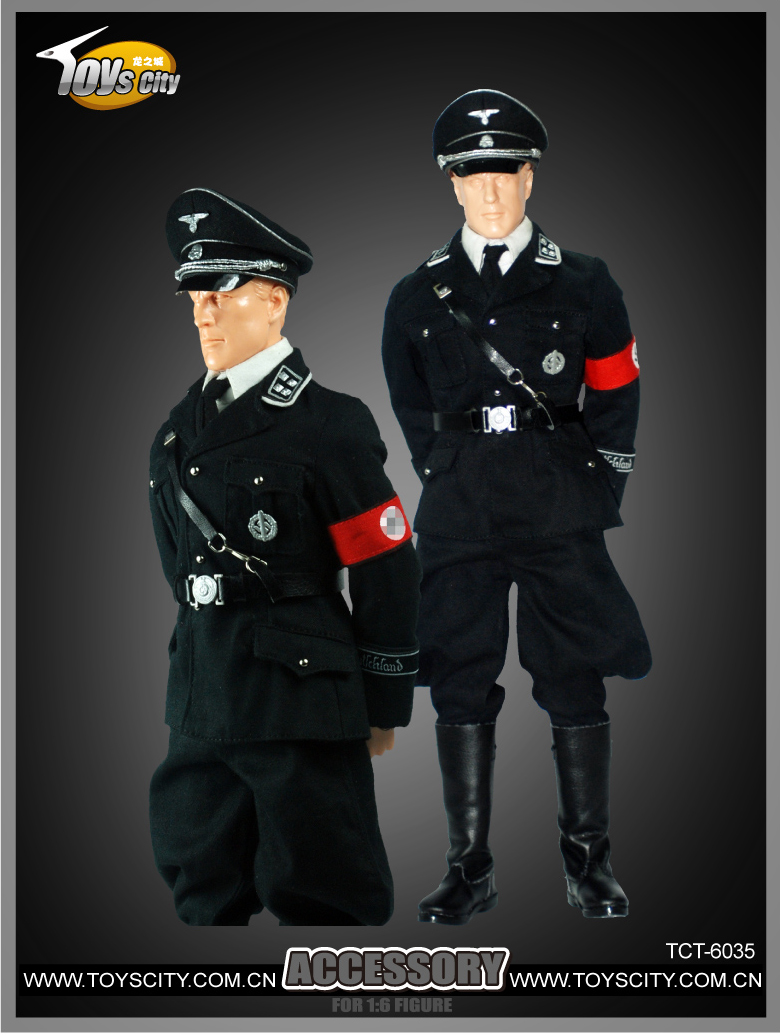
So what do the Nazi party, the AWB and the ANC Youth League actually have in common?

Certainly a sense of camp elegance and style; dark flowing fabric and the gleam of steel and silver, cut through with the clean heroic red.

And the instinctive understanding of the marketing value of a bit of curling-lip arrogance, creaking leather and a hint of sex and violence on the side.

And perhaps a few other tendencies and traits that will reveal themselves over time.

(The sources of those pics were as follows: the accessory close up was: http://www.timeslive.co.za/local/article1016881.ece/Jujus-guards-cause-chaos and the one of Malema surrounded by his elegant guards came, I think, from http://www.iol.co.za/news/crime-courts/who-is-malema-at-war-with-1.1056002.Please visit those sites.)


Chris Hani – and my part in South Africa’s downfall


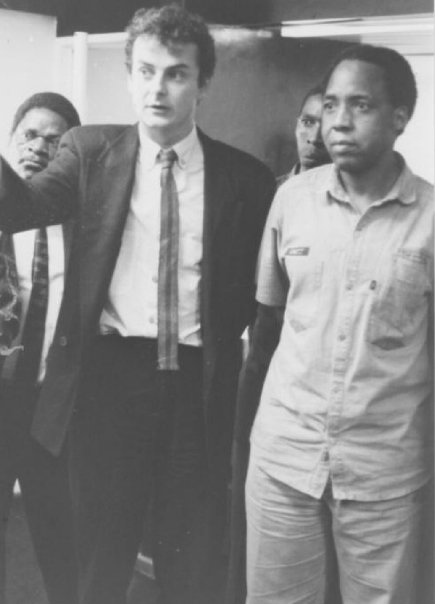
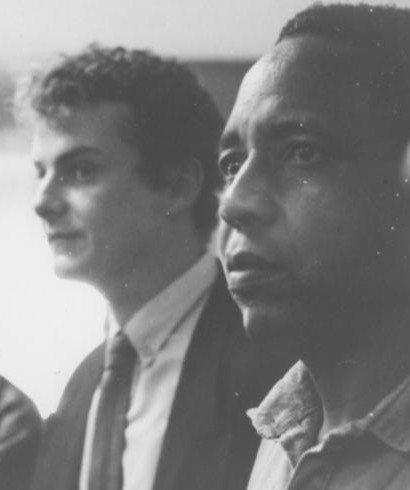
For a brief time in the late 1980’s I had occasion to spend some time with Chris Hani, then Chief of Staff of the ANC’s uMkhonto we Sizwe and Secretary General of the South African Communist Party.

I was working for the Institute for a Democratic Alternative for South Africa (IDASA) and a meeting between the ANC’s military and the South African Defence Force seemed like a natural extension and deepening of the work IDASA had done in putting the white establishment in contact with the ANC.

I met Chris several times in Lusaka where we prepared the agenda – and then, obviously, at the conference and several times afterwards.

He was an interesting guy – serious, charming and slightly too ready to tell me the story of how he travelled, through the underground, into danger, with Pliny, Virgil  and Shakespeare in his knapsack … I’m not perfectly sure of the actual authors and titles of the classics he carried, but the point was that he mentioned, more than once, that he did so.

I was already aware in those days of the depth of murderous gangsterism that had enveloped Joe Modise’s leadership of MK – a trend and tendency he took with him into Mandela’s first cabinet and helped set the ANC’s elite on the course for the destination it has reached.

Chris was the great hope for cleaning up Modise’s mess and he was also seen as an antidote to Thabo Mbeki’s technocratic shuttle-diplomacy.

I became aware while organising the conference that some ANC strategists were using the opportunity to show Chris Hani was just as charming and able to talk to whites as Mbeki.

I asked him, in my naivety, about the rumours that he and Mbeki were competitors. He convincingly, to my ears, pooh-poohed the idea saying that he and Thabo were like a tag team, each with his own strengths, but united in the identical goal – and further, he claimed, they were good friends as well.

I had no special intelligence to validate (or otherwise) this claim. Perhaps they were. Perhaps they would have been the A-Team of the post Mandela administration, balancing each other’s faults, playing to each other’s strengths. I know it’s unlikely, but it is difficult not to dream of how things might have been.

As it happened Chris was almost disturbingly charming and persuasive at the conference.

We only managed to get ex-SADF and Bantustan leaders as well as a whole lot of shady and not so shady military and arms dealer types on the domestic delegation.

I have reason to suspect that I might have brought the running dogs of the global arms trade along with that delegation and I often shudder at the thought that I might have played a role in helping the global arms corporations bury their deadly wasp eggs deep into the ANC, later to hatch and gorge themselves just carefully enough so that the host stays alive … but I comfort myself with the fact that Joe Modise had long since sold his and the ANC’s soul to the worst and most rapacious branch of global capitalism.

I remember watching Chris holding forth late one night; he stood behind two seated and coyly smiling white men with thick rugby players necks – there is a reason stereotypes are stereotypes! Chris had a hand on each of their shoulders and he was rubbing them as he spoke with languid and swelling rhythms, about the future of non-racialism and shared patriotism that awaited us.

The big white guys were in love; it gleamed out of their teary eyes and Chris had his head back and eyes closed like he was conducting an exorcism.

I don’t know if Chris Hani would have made a difference if he had lived.

Only a precious few have managed to resist the seemingly irresistible pull towards corruption and greed. You watch all of your friends and comrades become part of that system (the same system that laid its eggs in the ANC that would later hatch into the Arms Scandal and worse), the memory of the ideals that drove you become vague … everyone else is doing it, what is the point in me hanging on while they are all busy with the business of securing themselves for life?

It was Tokyo Sexwale who wept beside Chris Hani’s body on 10th April 1993 outside the house in Boksburg. There was something about Chris that reminds me of Tokyo Sexwale (who I do not know personally but seems to exude a similar charisma that makes one think of a suspiciously charming pirate).

Reading Mandy Wiener’s Killing Kebble over the weekend and getting the insight provided by Fikile Mbalula flattening a bottle of Johnny Walker Blue in Kebble’s home … Mbalula and his ANC Youth League comrades treating the servants with extreme arrogance, trashing the house like spoiled children … it is difficult not to be filled with a sense of loss and longing.

Mbalula was 9 18 (oops) years old when I sat with Chris Hani in Lusaka planning how best to drive wedges into Apartheid’s army and win any potential enemies to our side.

I don’t know for sure what he would have thought of this thrust to catapult the “new generation” of leadership into power in 2012 – including, horrifyingly, Fikile Mbalula for Secretary General.

But I suspect he would have drawn the line here. The ANC is not yet in the hands of  Mbalula and his cronies – who are so reminiscent of Joe Modise, only slightly more refined.

There have always been heroes in the liberation movement who fought the tendency towards cronyism and rent-seeking abuse. I thought Chris Hani was in the process of becoming one of those when I worked with him in the late 80’s.

Like James Dean and Jesus Christ, Chris Hani’s virtues are frozen as an historical artefact.

There is a part of me that is relieved he will never be tried and found wanting.

(Note: my friend the fabulous artist Isabel Thompson helped organise that conference and my fellow Bruce Springsteen fan and mentor to so many of us Gavin Evans took the pics and posted them on facebook which is where I found them.)