Youth unemployment – our deepest sytemic threat

If you thought the interminable debates about

  • the laws and institutions that structure our labour market and
  • government subsidies for first time youth workers

were just silly ideological wrangling then take a look at this graph from the OECD economic survey of South Africa. Let the extraordinary relative numbers speak for themselves.

1. Persons aged 15-24 years, 2007 data for Brazil. Source: OECD, Labour Force Statistics Database; ILO, Laborstat Database; and Statistics South Africa, Quarterly Labour Force Survey.

Youth unemployment seems to me predictive of so many societal and personal ills – the high increase of interpersonal crime, especially rape; generally increased mortality figures – especially as a result of HIV infection and non-compliance with treatment regimes and homicide; social unrest, that in our case easily turns into service delivery protests and xenophobic violence; the rise to prominence of politicians in the mould of Julius Malema … I am sure we could all thumb suck a list that could go on and on and on.

The point, confirmed by the OECD study – the executive summary is here and the main findings and recommendations are here – is that GDP and employment growth must be lifted and obstacles placed in the way of our doing this by the vested interests of the trade union movement and the crony capitalists must just be shoved aside.

Politicians tend to hate markets – for good reason

… politicians and chief executives of all political colours become angry when anonymous markets do not take their assertions at face value. The anonymous market cannot be dictated to or defeated in debate. Leaders cannot shout down, fire or arrest the nonexistent Mr Market.

This from a fine piece of commentary from John Kay in the Financial Times, republished in today’s Business Day.

The article is premised on US and UK politics where “the political left” and “the political right” take opposite views of the market – a state of affairs that does not have an exact corollary in South Africa:

The anonymity of markets delights the political right, which welcomes it as a check on state authority, just as it infuriates the political left, which deplores the freedom of the market from democratic control.

Monetary policy — a market-based policy favoured by the right — restricts spending by price through the discipline of higher interest rates.

Fiscal policy, favoured by the left, requires political choices about levels of taxation and public spending.

In South Africa “the political right” and “the political left” would not be defined in these terms except if you understood the Democratic Alliance to represent “the right” and the ANC “the left” – a set of definitions that is not entirely helpful.

The article neatly summarises why politicians in power tend to hate the judgement of the markets. Who can forget Trevor Manuel’s 1996 comment? “I insist on the right to govern …. I insist on the right not to be stampeded into a panic decision by some amorphous entity … called the market.”

“The market” punished him profoundly for the comment and he seemed to have learned something important from that lesson that came in his first few months of what was to be the longest term of any minister of finance in the world.

Kay’ is no libertarian extremist – he cautions that “all extremists seem to believe that their brand of authoritarianism represents true democracy”.

But he pulls no punches against the politicians who futilely attack “the gnomes of Zurich” and the “teenage scribblers” when markets declare, with magisterial equanimity, their lack of confidence in those politicians.

Catch the full article here.

Selebi plays Zuma, Agliotti plays Shaik

I can’t help but think of the Selebi corruption trial and conviction as a proxy for the big one that never happened.

There’s a story about Glenn Agliotti wandering around Shell House in the early 90’s, undoubtedly looking to meet and great the returning leaders of the ANC.

Somewhere in those chaotic corridors where incompetence was already a watchword he bumped into Jackie Selebi who was then the ANC Youth League president and member of the ANC National Executive Committee.

Too many versions of this story exist – some putting the meeting much later when Selebi was already a member of parliament, to which he was elected in 1994.

But the version I have is Selebi was part of the “advanced guard” of ANC cadres who had been sent to prepare the way for returning leaders, and that the first casual, supportive meeting took place as early as 1990.

Now the Jackie Selebi story has been exhuastingly, if not exhaustively, rehashed during the trial during which our previous Commissioner of Police and head of Interpol has now been found guilty of corruption – with Glenn Agliotti being the corrupter.

Similar story to Jacob Zuma’s

It reminds me of a similar set of stories about our erstwhile president Jacob Zuma. He was also part of an advanced guard and his version of Glenn Agliotti was none other than Schabir Shaik – who looked after him, gave him pocket-money and places to stay and, ultimately, traded on his name and access and went to prison for the crime of corruption.

The whole edifice of the organisation that became the sum total of our political and governing leadership was uniquely vulnerable during that brief moment of return.

They had nothing: no money, nowhere to stay, no transport and no infrastructure.

They were like innocents arriving off the boat in the new world; a whole legion of sharp and dangerous types were waiting to sidle up to them offering comfort and succour and help and support.

It doesn’t excuse Jackie Selebi just like it doesn’t excuse Jacob Zuma (who through political shenanigans remains untried and unpunished) but it is important to remind ourselves how vulnerable these men and women were and how easily they fell.

There is a moment when the frog in the pot on the stove is in cool comfortable water. As we watch, with horror and disgust, the frog stew boiling furiously and the green scum frothing into the flames we should keep that in mind.

Kampala bombings as ambush marketing

Sunday’s Kampala (capital city of Uganda) bombings during the World Cup finals in a rugby club and a restaurant where people had gathered to watch the match were important for too many reasons to name here – although the tragic human suffering, with the death toll standing at 76,  must rank first.

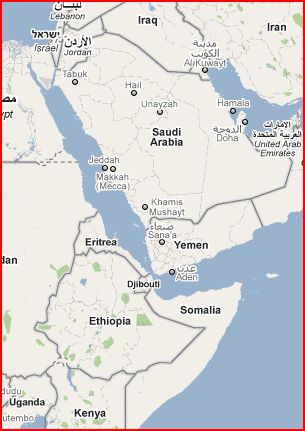
For those who might have any doubt about the political and other importance of  the attacks, apparently by Somalia’s al Shabaad, look at the map.

The failed Somalian state is the point from which destabilisation cascades any direction; southwards into Africa and northwards and eastwards into the Gulf of Aden and the Middle East.

This blog discussed various security concerns associated with the World Cup, imagining the worst while recalling horrors at the 1974 summer Olympics in Munich and the attacks at the Champions League Twenty20 cricket in Mumbai in 2008.

The point I made then was that a myriad groups – including international terrorists – would try to use the focus on the World Cup to get their cause noticed.

Kampala is probably being punished for its 2700 soldier deployment into the African Union peacekeeping mission in Somalia (AMISOM). The region’s politics are extraordinarily complicated, but on the face of it the bombings should probably be understood as an attempt to use the World Cup focus to make maximum impact.

Ethnic cleansing by rumour

Jacob Zuma said at a press conference in Sandton yesterday:

I’m not certain whether there have been threats of xenophobia. I know that there have been rumours that have been reported. (Reported in The Star)

As I drove towards Cape Town on the N1 on Sunday people were already streaming north, belongings in those huge carrier bags – they lined the side of the highway on the Paarl end of the tunnel. At that time spaza shops belonging to Somalians were already being burned in townships around Paarl and Franschhoek.

Outside of the Western Cape it might be true, as the president says, that the xenophobic threats are “a rumour”. But ethnic cleansing does not require current violence; it requires a history of violence and a promise of the same. The history is clear (here for previous post on this issue, here for a devastating M&G photo gallery of the May 2008 riots) and the promise of further violence has been reported constantly since late 2009.

It seems to deepen the injustice  that the current round of ethnic cleansing is taking place just as South Africa and its citizens are being hailed for their hospitality and general warmth during the Fifa World Cup.

Parastatals: fleshpot flashpoint

How to explain the decision to start a review of the parastatals by a presidential committee just as Public Enterprises minister Barbara Hogan was busy with that job?

When anything in our country seems confusing it is always useful to abide by the famous injunction from Watergate’s ‘Deep Throat‘: follow the money.

The raison d’être of the new political/economic elite – the thing that brought it into being and the thing that sustains and grows it – is the opportunity to take rents out of the economy. The overwhelming bulk of the low-hanging fruit in this endeavour is in the public sector – specifically in senior management positions and the multi billion dollar expenditure of the Parastatals.

Now if what you are/what you do is sheep stealing you don’t want an independent and famously incorruptible shepherd tending the flock. Far easier to give the job to a few of your wolf mates.

Understanding history

There are times and places when history feels like it is just meandering along minding its own business.

South Africa today is not one of those places or times. Here history is being driven and whipped along by an evil monkey on its back.

This particular evil monkey is none other than the squabble to harness the state to the task of personal accumulation.

Karl Marx and Frederick Engels, writing in The Communist Manifesto in 1848 said:

The history of all hitherto existing society is the history of class struggle.

The “class struggle” shaping our course would have seemed a little eccentric to Karl Marx. There is no simple division into proletariat, bourgeoisie, petit-bourgeoisie – with the aristocracy fading into oblivion and the lumpen-proletariat skulking along the edges.

Here you have an elite that has emerged through leveraging political power – in exactly the same way as the local representatives of the previous political oppressors (the Afrikaner Nationalists) did from 1948.

The Afrikaner nationalists began to lose young Afrikaners (at a greater rate than before) from the early 80’s. The reasons are complex but using the state to advance the economic interests of a political/ethnic group deadens creativity, grows authoritarianism and the stultifying effects of patronage drowns cultural growth.

I suspect exactly the same thing is happening in the ruling party.

For an excellent review of the shenanigans in Public Enterprises read Christelle Terreblanche’s article from the Sunday Independent here. For a brilliant – and quite moving – overview of the growth of what I elsewhere call Vampire Capitalism, read Moeletsi Mbeki’s Architects of Poverty – which I review here.

A Looter Continua

In a rush on my way from Namibia to the Garden Route – it’s a hard life, but someone has to live it.

The big stories are:

  • the continuing decline in employment numbers;
  • the National Working Committee’s decision not to charge Zwelinzima Vavi but to criticise him for alleging that Minister of Telecommunications Siphiwe Nyanda is corrupt.

StatsSA’s Quarterly Employment Survey released on Monday showed that the formal sector had lost 79 000 jobs between December and March – or that the number of people employed in the first quarter of this year dropped 1% from the previous quarter. The point is simple: unemployment is a deep systemic threat to long term stability in this country and – to some degree – we are experiencing the removal of the short term stimulus associated with World Cup infrastructure build. That doesn’t make the World Cup a bad thing, but it does mean we need to moderate our expectations.

Vavi’s “let off” comes as no surprise. The core of Tenderpreneurs that have risen in the balance of power through clever play post the Polokwane Putsch would dearly love to shaft their irritatingly principled previous allies on the left but the time is not yet right. The ANC and government is not yet purely a device for extracting rent out of the economy. A luta continua.

And then, just because this Reuters picture lends itself so well to a previous line from these posts:

Sepp Blatter and Jacob Zuma were like twinkly old non-English speaking train robbers still dashingly on the run all these years later. They can’t speak English – or any kind of sense – but their delight at how much money they have managed to stash away is infectious.

I tag it on here – with my own caption:

World Cup – stimulation or diversion?

Last night, I felt the pull of warring emotions.

The occasion was the watching of the World Cup welcoming concert on TV from the comfort of my own lounge. The general effects seemed to be intensified by the fact that I could see (the fireworks, lasers and helicopters anyway) and hear the one taking place in Cape Town’s Grand Parade about a kilometer away.

A couple of things:

  1. Sepp Blatter and Jacob Zuma were like twinkly old non-English speaking train robbers still dashingly on the run all these years later. They can’t speak English – or any kind of sense – but their delight at how much money they have managed to stash away is infectious. They both came onto the stage together and Sepp Blatter spoke first and Jacob Zuma stood meekly beside him – just in case there was any doubt as to who will be running the country over the next month and a half.
  2. Bishop Desmond Tutu’s warmth and sweetness is undiminished and his eccentricity is coming along nicely.
  3. The delights of Shakira are numerous and cross generations and genders.

The truth is I felt my critical faculties slipping away, sandwiched as I was between the celebration in Johannesburg and Cape Town.

The official opening is later today and after that Bafana Bafana will play Mexico. Perhaps the bubble will break if The Boys lose to El Tri (The Three Coloured … ok, it doesn’t appear to translate very well). But for now there are not many South Africans who can put aside their crack-fizzed enthusiasm and take a long hard look at what is going down.

So one last time: have we diverted resources that should have been used to build houses and create jobs for the poor? Is this not just a ridiculous and over-the-top bit of flim-flam? I mean the children that lead the guests and players around have got a McDonalds sign on their shirts!

I don’t think South Africa hosting the World Cup is a waste of resources and this is a sketch of the reasons:

  • Since 1994 resources have poured into the task of upliftment and, aside from the hugely effective social grants that have grown exponentially from 2000 to now, much of the social expenditure has been skimmed by successive layers of government cronies and tenderpreneurs (the fronted and the fronters) and the vampire capitalists who take rents out of almost every transaction in our economy. World Cup spending has provided a focus for infrastructure. Perhaps we did not need this emphasis on stadiums, airports, hotels and associated transport networks, but much of this “stuff” is multi-purpose. The Mail and Guardian might find some significant dirt in the tender documents of Fifa’s local organising committee which they successfully forced into the public domain (thankfully our courts have ruled that South Africa’s constitution is not suspended by our craven delight at hosting the Fifa superpower.)  So the advantages of this infrastructure are locked in – this will be here after Fifa has packed up and gone.
  • Most economists seem to agree that the World Cup associated tourist spending will boost GDP  by between 0.5 percent and 0.7 percent. That is not earth shattering but a thousand little businesses – from flag sellers on street corners to guest houses – are booming. That must count for something.
  • To some unquantifiable degree and in ways that are only becoming apparent now, this World Cup is going to re-brand South Africa . Perhaps it will not go as far as Thabo Mbeki’s hoped for proof that South Africa is as efficient as Germany, slick as Hollywood and clearly an emerging African superpower.   Part of that re-branding will be: “oh yes, they can also do the sentimental and gross commercial sell-off of their national assets” but part of it is more complex. The crowds are multi-racial and the South African fans are projecting a shared excitement and togetherness that is already proving confusing, particularly to English and US media and fans. The Rainbow Nation still has some force and effect as an idea. The evident success of the build programme around the stadiums, hotels, airports and transport networks goes some way to proving a degree of technical prowess and capacity. This combination (non-racialism and a competitive logistical, infrastructural and technological capacity) does provide a platform upon which to rebrand the country.

I have to publish before 5 am … so I am going leave it there (that is how my wordpress account is set up and I don’t know how to change it). The lowbrow media – particularly in the UK – are clinging tenaciously to the machete-wielding- tribesman-in-leopard-skins-raping-and-chopping-up-tourists idea but this is going to conflict with the positives most of the 325000 (official figure) to 250000 (my figure) visitors who have arrived for the spectacular spectacle will experience.

They are going to have a good time … I can feel it.

What would the ANC do without Cosatu?

You hear it bruted about that Cosatu provided the organisational structure and person-power to wrestle the ANC from Thabo Mbeki and his Xhosa-Nostra. You also might be told that the same strengths of Cosatu has won the ANC successive national elections.

However, if you listen closely and to another set of people, you will hear that it was, in fact, the ANCYL that provided the infrastructure and capacity to undertake the Polokwane Putsch and that the architect of the 2009 general election victory was Fikile Mbalula, the ANCYL president prior to Julius Malema and clearly the candidate of the Youth League for higher office come 2012 (in the realm of the ANC) and 2014 (in the realm itself).

I think what happened at Polokwane required slightly different organisational capacities from those required in a national election, but common to both is: large amounts of money, a strategic centre that can plan and execute a national campaign that comfortably moves between the big picture and local, door-to-door type work and, finally,  a large group of deployable activists or cadres.

Cosatu cannot dream of competing with the ANC’s cash reserves. We have all heard that this might be the richest political party in the world. Chancellor House aside, I would be hugely surprised if the ANC had not put itself first in the economy wide asset transfer that is taking place in the name of transformation.

That much money automatically provides for a strategic centre and local and provincial machinery – and, to some degree, deployable party workers (paid rather than volunteers). You can hire the Saatchi and Saatchi to be a proxy for the strategic centre, you can buy in logistics from a host of service providers.

Cosatu structures are quite specifically related to the job of being a trade union federation and each individual union has even more specific structures and functions related to the business of organising workers around wages, working conditions and bargaining processes.

These structures and functions are not easily “deployed” either into national elections or take-over bids in the ANC – and nor are individual worker members who, by definition, have a day job. Cosatu has always recognised a practical tension between work place issues and national politics – as well as the fact that many of its members follow diverse politics or no politics at all.

When you are running an election every resource and edge feels important but Cosatu in not the prime driver of success in ANC politics – focused inwards or outwards – and many of the real advantages it brings can, in modern electoral and party politics, be paid for.

Perhaps the original question should have been:

What would Cosatu do without the ANC?

Cosatu has – by design and accident – put more emphasis on its political relationship with the ANC. In part this is because: globalisation of the labour processes market, mechanisation of the labour process, the Great Recession (following on the global debt crisis) and the rigidities of the South African labour market have combined to keep employment levels low and falling in this country.

Cosatu membership has, as a consequence, been stagnant or declining from a high of 1.869 million in 2000 and has shifted from productive sectors of the economy towards the public sector.

Cosatu have been tempted into politics because of the difficulties it experienced in the economy. Having chosen or being pushed in this direction, more and more organisational resources have been put at the disposal of the political strategy, further weakening the ability to organise on the shop floor around shop floor issues.

When the union backs the ANC publicly and uses union resources to fight ANC campaigns (or campaigns in the ANC) it is courting a weakening of its organisation, a loss of members and a polarising effect that can leave its leaders isolated. In turn its commitment to the political realm increases as more organisational eggs are put in that basket.

This is where Cosatu is. Even in the late 80’s, at the hight of anti-apartheid resistance, Cosatu was more cautious about ‘playing politics’ than its leadership is now.

In essence the Cosatu leadership is committing more and more irretrievable resources to a strategy that must ‘win’ the centre (the power to direct the state and government policy) if it is to hold on to its members.

Cosatu cannot ‘win’, ‘take over’ or dominate a multi-class organisation like the ANC. If I am right about this and right that this is the strategy that Cosatu has committed to then the trade union federation is destined to become little more than a competing faction in the already fractious ruling party.

I suspect that at some point Cosatu will have its own moral equivalent of Polokwane which will allow a workerist trade union federation to go back to basics and a more politicised Left group to link up with the SACP as a powerful faction within the ANC competing for power and direction with all comers.

Ruling Alliance breaking under the strain of corruption of “members of the cabinet and/or senior party leaders or officials”

Short of an angry and vindictive divorce you don’t really get a more serious breakdown between previous partners than described by the amazingly revealing Cosatu’s press statement yesterday threatening the end of the ruling alliance because ANC has laid disciplinary charges against Cosatu secretary general Zwelinzima Vavi.

This is what the statement reveals:

  1. The powerful National Working Committee (here‘s a list of members of that august body) of the African National Congress has decided to lay disciplinary charges against Vavi;
  2. Cosatu suspects (or knows) that the charges relate to a Cosatu statement, delivered by Vavi, in which the trade union federation criticises, amongst other things the fact that “newspapers continue to carry stories of allegations of corruption against Ministers and we are still to hear the President or Cabinet announcing that these allegations will be subjected to investigation ….” and further:  “Perceptions … runs deep in our communities, that government is soft on corruption, in particular if it is committed by members of the cabinet and/or senior party leaders or officials.”
  3. The original Cosatu statement is a devastating critique of the Jacob Zuma led ANC and it was just a matter of time before those who believed they were the “members of the cabinet and/or senior party leaders or officials” singled out hit back;
  4. The Cosatu statement (catch it here) accuses these “cabinet and/or senior party leaders or officials” of sneaking the attack on Vavi into the NWC meeting by waiting until those who would have stopped left.
  5. The statement strongly implies that Zwelinzima Vavi is entering the leadership race for 2012 and that this somehow must be read together with the ANCYL push to get rid of Gwede Mantashe and promote Fikile Mbalula.

Business Day has a quote from Malesela Maleka of the SACP that perfectly summarised what is actually going on:

There is a small grouping in the ANC that is in a hurry to gain power, and alliance leaders stand in the way of their get-rich-quick scheme.

It cannot be such a small group if only “alliance leaders” are standing in the way, but this is succinctly put and reeks of the ugly truth.

DA success, Xenophobia and Malema – the hidden connections

Much is happening on the political front that I would love to be discussing here, but paid work is, thankfully, taking up my time this week. Thus the following is broad brush and a little rushed – the point I wanted to make is that the issues are all connected – in dark and unsettling ways.

Julius on Nationalisation

Parliament started public hearings on the establishment of  a state-owned mining company. Malema  gave the ANCYL’s views and he repeated the call for the immediate suspension of mining licences to prevent the current holders “looting” the mines. Jacob Zuma later in the General Assembly said: “If this issue causes such excitement, then debate it with Mr Malema. He is there.” See Business Report’s take here.

DA Success

The Democratic Alliance made serious gains in by-elections earlier in the week – this from The Cape Times (IOL) this morning:

IN a watershed night in South African politics, the DA trounced the ANC in two of its strongholds – Gugulethu and Caledon – gaining two wards where there was not a single white voter and the majority were blacks, not coloureds.

In Ward 44 in parts of Gugulethu and Heideveld, where the DA received 21.6 percent of the vote in the last election in 2006, the party received 60.5 last night.

And in Ward 12 in Caledon’s Theewaterskloof municipality, where the DA received only 6.6 percent in 2006, the party garnered more than 60 percent.

We are obliged to do some work on these numbers (how many people voted, demographic and other changes since 2006) but it implies a surprising level of disaffection with the ANC in areas that can only be described as ‘previously safe’ ANC wards.

Xenophobia

I have been picking up from African foreigners living in townships around Cape Town for at least the last 6 months that they were being threatened that post the Fifa World Cup and post the obsessive media focus on South Africa associated with the soccer they can expect to be driven from their homes – I discuss it here and this is the key paragraph from this March 24th 2010 post:

It has become something of a legend and commonly accepted “fact” by foreigners living in South African townships that post the World Cup and in the lead-up to the local government elections in 2011 the xenophobic violence will erupt on a scale beyond anything that has happened in the past.

The issue is breaking across the spectrum of the South African news media as I write.

The Hidden Connections

The ANC government is failing in service delivery and the evidence is everywhere that there is a degree of panic in the party’s ranks about the 2011 local government election. The ANC is under various kinds of threat, but the threat that concerns its leadership most is the possibility that they lose the support of the poor. This environment gives voice to the worst of those who have found a home in the ANC; those who understand the power of the call to take back what is “rightfully ours” – the land and the mines; and those who covertly would harness the rage and fear rife in the townships – a strategy indistinguishable from the early activity of the National Socialist German Workers’ Party. The older ANC members would be genuinely outraged at any suggestion that they would countenance these strategies but it is difficult not to conclude that these forces are unleashed in our society as a direct result of the failure of ANC leadership.

Ancestors under the bed and behind every bush

I almost missed this, and can barely credit it, but I thought I better put a link to the story about Zuma invoking the ancestors on the ANC’s behalf. (The story is ultimately from Buks Viljoen of Die Beeld and republished online by news24.com.)

It seems Zuma threatened that should your support for the ANC  waver the ancestors will make you sick. I’ve been feeling a little poorly myself of late and my support for the ANC could be said to “be wavering” – in an understated, English kind of way. So maybe there’s something in it.

Here is the story and just to show that at least someone is taking the threat of the ghostly hordes of ANC supporting ancestors seriously, here is the Reverend Meshoe of the African Christian Democratic Party berating the president for his outrageous appeal to traditional African beliefs – catch that here.

Strike while the iron is hot

No-one can take serious issue with the leopard for pouncing down on the neck of a wayward sheep and dragging the carcass back up the rocky outcrop to her cubs for a leisurely feed. It’s what leopards do.

Engaging the leopard in any special pleading about the benefits of keeping this particular sheep alive is, well, it’s just silly, isn’t it?

The gathering wave of strikes means the scent of blood is thick in the air and Cosatu’s haunches are bunching and its tail is twitching.

The trade union federation is sniffing the scent of blood. As the strike season gains momentum the coincidence with the Fifa World Cup is causing Sipho and Sally Normal deep anxiety.

“How can Cosatu hold the World Cup to ransom?” I hear our good citizens gasp.

But the real question should be: ‘how could Cosatu not seize this once in a lifetime opportunity?’

The trade union movement has leverage right now – and for a limited time only – like it has never had before.

Our politicians have inevitably embedded themselves with the Fifa invasion – with about as much moral fortitude as those journalists who embed themselves with superior invaders in other kinds of wars.

Cosatu member unions already had the extra leverage they derived from having backed the right gang in the Polokwane Putsch, but it is the potential to disrupt the Fifa World Cup that gives its voice a new continent cracking resonance.

You want a settlement three times the inflation rate? You’ve  got it, baby –  just don’t take the focus away from a moment as potentially rich as that perfect Zidane head-butt.

When management and unions stare each other down, a thousand considerations come into play – and while much hinges on the price of the package that will be paid for labour this is not the only consideration.

Management might accept a higher settlement if labour agrees to lock in an acceptable rate of increase in the years ahead – and vice versa. Or the parties can shift bits of the package around so that either management or labour feel that they are getting a better deal.

But there are other and more complicated influences on the bargaining process and one of them consists of getting a fat guy to lean on the other side for you.

If this was the USA 70 years ago organised crime might have lent a hand to one side or another, depending on the interests of some business oligarch, a connected Senator or a union boss playing the field. In South Africa the fat guy is the state and for a variety of reasons he is likely to lean on management and business owners.

When striking Transnet workers marched on parliament last week to insist that Minister S’bu Ndebele back their demands, the politicians sent Mawethu Vilana, a former Cosatu researcher out to speak to the angry workers. This from The Sowetan

Vilana said the government took the strike very seriously and that Deputy Transport Minister Jeremy Cronin and Deputy Public Enterprises Minister Enoch Godongwana were “involved” in trying to find a resolution.

The strike against Transnet appears to be close to resolution, but a larger national strike against the electricity price increase is gathering its skirts in the wings.

Cosatu is led by the kind of people whose instincts are to think of Fifa and the astonishingly named Sepp Blatter as just another gang peddling products that ensnare the user with false promises of bliss. But Cosatu also represents a constituency that loves the Beautiful Game and like a small boy is having to sit on its hands it is so excited about the coming festivities.

So Cosatu is not without limits on its behaviour and nor are its member unions. Cosatu has increasingly failed in the last several years to win over the “ordinary citizen” or ‘the middle ground’ when its strikes have spilled over into public protests. Just one too many image of groups of fat people dancing down a road with sticks, turning over rubbish bins and breaking shop windows has meant that anyone who is not a Cosatu member is less likely to stand as firm as those fabled Apartheid oppressed communities that stopped buying Fatti’s and Moni’s pasta to support the brave workers and their leaders who eventually went on to form Cosatu and drive the revolution itself.

The heroes always live long ago and their legend gleams more with time. But it is difficult to imagine a world in which Cosatu’s leveraging the World Cup for narrow financial gain is celebrated as a blow struck for transformation and liberation.

But in the same breath it is important to remind ourselves that Cosatu is just doing what it must do. It’s purpose is to ruthlessly fight for the advantage of its members over both the vested interests of the powerful, the collective interests of the nation and/or the desperate interests of the weak and downtrodden. In truth, the leopard really has no choice and cannot change its spots.

Jacob Dlamini on National Service – nobody says it better

I had been gearing up to say something snide about Defence Minister Lindiwe Sisulu’s ridiculous call for a reinstitution of national service.

I know many people will instinctively approve of her suggestion. It speaks directly to our despair about the failure of  the education system and the worry about the “Lost Generation”.

Well, be that as it may, I cannot overstate how bad an idea I think this is – and how arrogant and undemocratic the assumptions behind it are. I mean, she says in motivation of the idea, that the service delivery protest are being fronted by “our youth, with excessive anger and misdirected energy and frustration etched on their faces.” Misdirected? Huh, I don’t think so.

But my breathless indignation aside, how could anyone imagine that it would be an efficient allocation of our scarce national resources to have the bloated and increasingly ridiculous institution of the SANDF provide a rite of passage ritual for youth leaving school?

So anyway, while I was gearing up to say something I came across Jacob Dlamini’s opinion piece in today’s Business Day. It is so good and so well written that I humbly suggest you read what he has to say.

Click on the first few paragraphs below to go to the full story on the Business Day site.

Sisulu patronises SA’s legitimately angry youth

THEY just don’t get it, do they? Defence Minister Lindiwe Sisulu told Parliament on Tuesday that she wanted to reintroduce conscription. According to a report by Business Day Online, Sisulu said this “will not be a compulsory national service, but an unavoidable national service”. She was quick to say the government did not want to repeat the mistakes of the past.

Sisulu reportedly told Parliament that she wanted the defence force to provide a rite of passage for young people “leaving school with no skills and no prospect of being absorbed into a labour market that is already glutted”. She said: “Every culture known to men has a process of coming of age. This includes some initiation into responsible adulthood, where the line is drawn from childish ways to purposeful, responsible adult behaviour. We can do that for this country, because that is the one thing we need, to build a future for our development and prosperity. A place where the young unemployed can find skills, dignity and purpose.”

Sisulu presides over the most pampered, but also the most inefficient military in Africa, what on earth makes her think the aged, generally obese, unprofessional and ill- disciplined South African National Defence Force is equipped to teach young people about “responsible adult behaviour”?

Unemployment growth is a deep systemic threat

The quarterly Labour Force Survey from Statistics SA is a timely reminder of what really matters when assessing political risk associated with investing in South Africa.

Julius Malema’s predations,  Jacob Zuma’s extraordinary sex life, Cosatu’s and the SACP’s millennial economics would just be irritating noise, unless they relate to the country’s chronic levels of unemployment, poverty and inequality – and the racial overlay of the same.

Think of society as a complex system and unemployment, poverty and inequality as deep tectonic stresses that honeycomb and hollow out the underpinnings and foundations of the system. As the stresses grow so does the potential for catastrophic events.

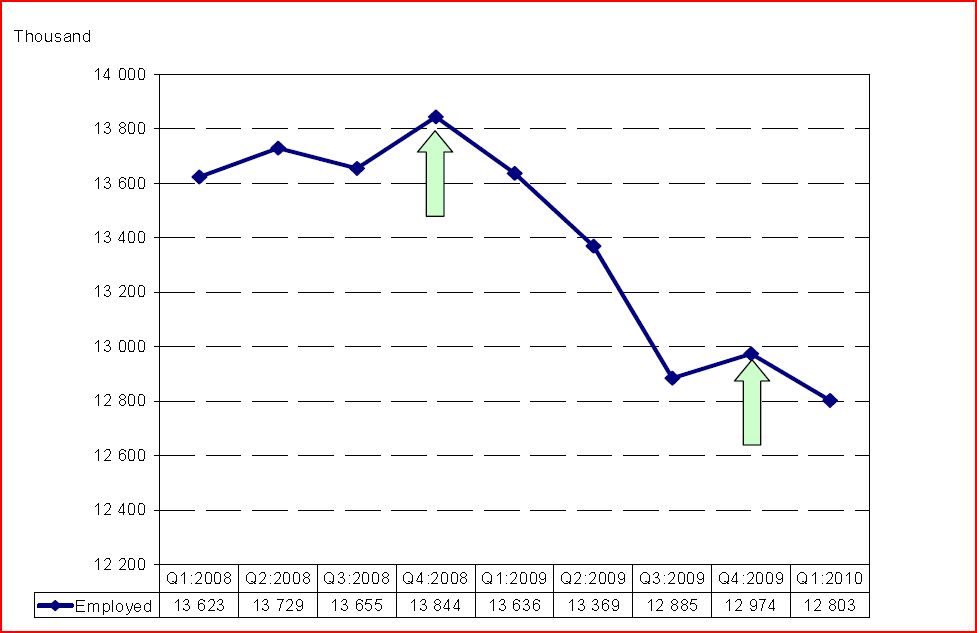
South Africa has the highest jobless rate of the 62 counties tracked by Bloomberg and the unemployment rate rose for a fourth consecutive quarter in the first three months of this year – that’s a 1.3% contraction in employment or the loss of 171 000 jobs in that period. The following graph shows the general trend – and also demonstrates slight seasonal increases in the fourth quarters of 2008 and 2009, the result of the obvious stimulations from the holiday season and the rush to get things done.

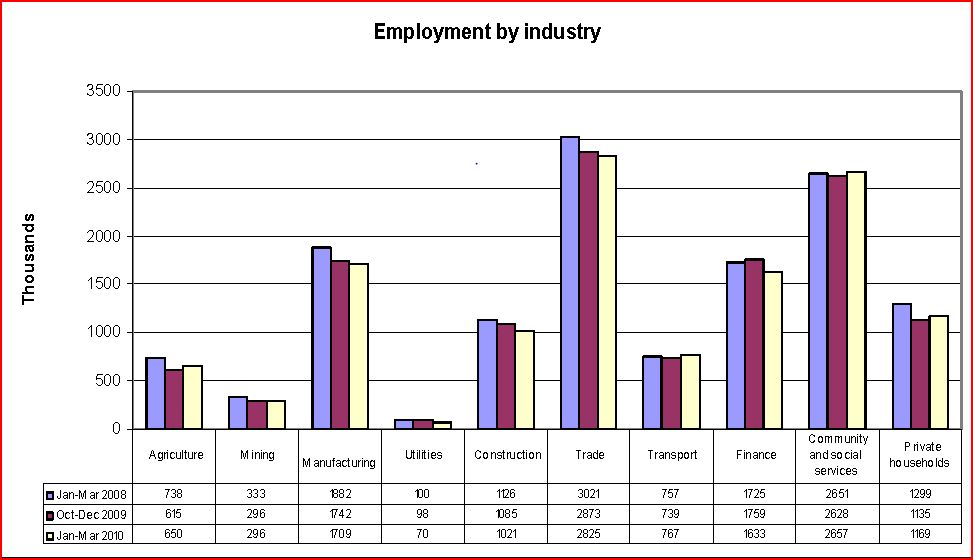
Employment contracted in all industries but Agriculture, Private Households, Transport and Community and Social Services.

Read this alongside these points:

  1. More than 50% of South Africans live within the most common definitions of “poverty” or “below the poverty line”,
  2. South Africa has dropped approximately 30 places in the UN’s  Human Development Indicators index (to 125) since 1990;
  3. South Africa shares with Brazil and a few other Latin American countries the highest measures of inequality (the “Gini-coefficient“) in the world.

Add to this the dismal outcomes of Affirmative Action and Black Economic Empowerment and you have a system shot through with instability.

When we worry about the ANC and its performance – and the increasingly profound failures of its key leaders –  when we worry about State Owned Enterprises like Eskom being hijacked by a predatory new elite, when we worry about the collapse of governance and service delivery in poor townships; our worry is actually about the impact on the deep, underlying trends in unemployment, poverty and inequality- and the possibility of fixing these problems.

When the bombast coming from the political and economic elite draws the national focus away from the real issues and challenges, then the trouble we are in becomes more threatening and more concerning to investors.