Stalking Horses at the NGC

I have been sickly and trying to pay the bills.

All my ‘paid for’ commentary on the NGC is done and I can finally get back to home ground where I feel more comfortable to make some wild accusations – and I will, finally, be more explicit in this post about who I think the bad guys are and who I think the less bad guys are.

At the outset, forgive me; this is long and requires a degree of effort to plough through. I believe your efforts will be rewarded in the end – but I would think that, wouldn’t I?

The NGC, just like the world itself,  becomes a cacophony, impossible to follow and impossible to interpret, without a guiding theory or a framing shape to look through.

The “theory” I am going to use here is that the NGC was the terrain on which two broad factions in the ruling alliance clashed. How you slice-and-dice a thing, conceptually, is always important for what you conclude, so much of what appears below is an attempt to unpick what and who those ‘factions’ consist of.

To think that what was happening at the NGC was “about” the nationalisation of mines call will lead to ‘error’ (you can see Lenin in my heritage when I use terms like that). Instead the NGC was “about” a more fundamental and complex power struggle.

The picture is additionally complicated when we consider that there were over 2000 delegates at the NGC (1500 from branches, 500 from the leagues/Cosatu/SACP/SANCO/PECs and 800 deployees/non-NEC ministers/DGs/premiers/CEO’s of SOE’s) and the interplay was vast and varied.

So instead of trying to cover everything I am going to look through the prism of an alleged power struggle between two broad factions or groups of interest.  This will ultimately be another attempt to “follow the money”.

Here then is the prism through which I believe it is most useful to look:

  1. The ‘nationalisation of mines’ (NOM) call was always a “stalking horse”. The term “stalking horse”  refers originally to  “a horse behind which a hunter hides while stalking game” (WordNet) and is defined in Wikipedia as “a person who tests a concept with someone or mounts a challenge against them on behalf of an anonymous third-party … if the idea proves viable and/or popular, the anonymous figure can then declare their interest and advance the concept with little risk of failure … if the concept fails, the anonymous party will not be tainted by association and can either drop the idea completely or bide their time and wait until a better moment for launching an attack.”  Oh yes, I love the language.
  2. The ‘nationalisation of mines’ call (hereafter called NOM because in fact, it has less do with policy and more to do with power) is best understood as the political platform of a particular alliance of groups and individuals and interests that has as its objective the winning  to power in the commanding heights of the ANC and the South African State. The NOM is therefore something more (and less) than a policy proposal. It is a contingent strategy for winning power – and getting the ANC to nationalise the mines would be a desirable side-affect for some of the participants.
  3. The first part of the NOM is the Youth League’s own specific ambitions, which have most obviously been expressed as a campaign to elevate Fikile Mbalula to the position of Secretary General of the ANC – the position currently occupied by Gwede Mantashe. Mantashe is despised by the League for a number of reasons, but mainly because he is part of those who believe the ANC Youth League is part of an ambitious rent seeking agenda. The League considers itself to be a “king maker” in ANC electoral processes and the organisation has energy and mobility and time to move quickly around the country to influence decisions at a branch and provincial level – a feature it demonstrated successfully at and in the lead-up to Polokwane.
  4. The second part of the NOM are those mining tycoons who want their BEE deals bailed out by the taxpayer. Who could have failed to notice the unified voices of those gleaming billionaire siblings Patrice Motsepe and Bridget Radebe as well as Minister of Housing Tokyo Sexwale backing the NOM in the lead-up to the NGC or at the conference itself?
  5. The third part of the NOM is the election campaign of Tokyo Sexwale to succeed Jacob Zuma. Has he specifically funded and backed the ANC Youth League so that it can be deployed in its traditional role of “king-maker” on his behalf – or because he wants his BEE deals bailed out … or both? It is impossible to prove – either that he has passed money/business/tenders the way of the League or why he might have done so – but that he has done so – with the intention of becoming president – is clearly the view of most of “the left” in the tripartite alliance.
  6. The clearest unifying principle behind the NOM and the most distinct characteristics of its participants is that they are first in the queue to gouge a rent out of the ANC’s economic transformation agenda. The nationalisation of mines call is tailor-made for the broader agenda of the NOM:  there are real material benefits for the backers, it allows the policy bereft Youth League to appear radical and pro-poor – and anti-white capitalist – to its potential supporters; it forces the current top leadership under Zuma (for the sake of investment and economic stability) to deploy itself to defend against something that would naturally appeal to the rank-and- file’s populist instincts.
  7. So who is the NOM challenging? Essentially “the incumbents”, which at one level just means Jacob Zuma, but at another level means everyone who has assumed a leadership role in government, party and the Tripartite Alliance as a consequence of Jacob Zuma’s elevation as well as the ideas and policies that have come to be crafted by that incumbent group.
  8. The “incumbents” should also be conceived of as including all those tenderprenuers, Nkandla hangers-on and Zuma family members whose fortunes are linked to the fortunes of the incumbent leadership.
  9. Do the members of the NOM even know who they are or what they are part of? Mostly they do – because there is an increasingly bitter conflict, for example, between the ANC Youth League and the SACP. When powerful factions clash, they strengthen themselves, make themselves more defined; they force anyone and any issue into the framework of their clash. We saw this in the Cold War, but more recently and specific to the groups here, we saw this in the struggle to stop Mbeki and elevate Zuma. eventually everyone knew whether they were “for” or “against” the motion. Attempts to stay sane, principled and above the fray are inevitably MIA in this kind of overblown factional dispute.

Given that framework, what actually happened?

NOM preparation

Firstly, the NOM did extensive (but insufficient) spade work around the policy that fronts their agenda. Julius Malema and Floyd Shivambu have been on an extended road trip, selling the idea for over a year. They have written for newspapers and addressed conferences. Malema threatened to withdraw Youth League support from any leader who did not support the call. The Youth League attended all provincial preparation conferences for the NGC and was successful in getting its view represented in every delegation from every part of the country. There are extensive reports that members were instructed to infiltrate ANC branches and emerge later as NGC delegates. The style associated with “winning” this view at various conferences was a combination of exclusive focus on the issue and heckling, booing and threatening any opposition – in the now time-honoured traditions of the League and its members.

What the financial backers of the NOM and members of the broader NOM agenda were doing in the lead-up to the NGC should not be underestimated. Individual backers of the NOM have extremely extensive resources. Such wealth and power gives individuals the ability to reach people and process far from themselves – and snap them like a twig.

Incumbent preparation

It is difficult to say how much work the incumbents did. I have made the assumption that securing the Tripartite Alliance was key to the incumbents preparing for the onslaught they knew was coming at the NGC. In this context the brokering of the ending of the public sector strike and the carefully worded apology from Cosatu to the Zuma/government for the language workers and their leaders had used during the strike was, in part, an attempt to establish the ground for a united front against the NOM agenda at the NGC. Comprises and certain concession were probably made to “the left” – but I will discuss this in the conclusion.

The NGC opening – political and organisational reports

Jacob Zuma’s Political Report and Gwede Mantashe’s organisational report were interesting for a number of important reasons but what is relevant for this post is both reports were correctly interpreted as a significant shot across the bows of the NOM. We can all delight in the fact that Winnie Mandela had to physically comfort the distraught Julius Malema after the dressing down he received during Jacob Zuma’s opening Political Report and take to heart her now immortal words ” … every parent is allowed to talk to their children … Every organisation is like a parent.”

Commission 5 victory and then plenary defeat

The sighs of relief ‘the incumbents’ might have breathed after the NOM’s early humiliation were soon replaced by anxiety when the NOM decided to put all of its eggs in one basket (this is one time that cliché is justified) by sending 45 of the Youth League’s 66 delegates to the Wednesday economic transformation commission. It appears that all supporters of the NOM including Tokyo Sexwale and several other BEE mining tycoons flooded the commission to ensure a particular outcome. The best article in the public domain I have seen about the commission is by Moipone Malefane and Caiphus Kgosana in The Sunday Times of September 26 – catch it here.

Joel Netshitezhe , Lesetja Kganyago  (DG in the Treasury),Trevor Manuel, Enoch Godongwana (Deputy Minister Public Enterprises) and old stalwart on this issue, Jeremy Cronin, were amongst the key ANC intellectual and economic thinkers who tried to hold the line at the meeting. Their appeal for thoughtfulness and care around an issue likely to costs government hundreds of billions of Rand were reportedly overwhelmed with bullying, heckling and unthinking repetition of the demand: adopt the call, as we have defined it, as policy!

Without having seen the exact statement that emerged from this commission it is clear that the Youth League (and everyone else present) was under the impression that they had scored a clear victory and the inner cabal reportedly headed off to the Hilton Hotel to celebrate victory in the style to which they had become accustomed.

The ANC Youth League’s (and the NOM’s) celebration was premature. The next day at the plenary session of the NGC Minister Geoff Radebe (husband of Patrice Motsepe’s sister, Bridget, and someone who had expressed support for the basic premise of NOM earlier) delivered a watered down version of the results of Commission 5 – and the ANC Youth League leaders exploded, ultimately sealing their fate by appearing to storm the stage in an aggressive manner.

Conclusion

Ultimately, through the support of delegates from across the alliance at the plenary, a watered down version of Commission 5 carried – essentially calling for thorough cross-country comparison and analysis of nationalisation as part of government’s ability to influence economic growth patterns in favour of the poor and unemployed. This study was mandated to report back to the 2012 Bloemfontein/Mangaung 100th centenary elective National Conference.

In the end it was not ‘the incumbents’ that were overwhelmed by the “shock and awe” campaign of the NOM. In the end it was the NOM that lost the skirmish – they overestimated the efficacy of their own preparation and they underestimated the coherency of the opposition – as well as degree of anger that is now widespread towards the ANC YL and its leaders.

The paucity of facts in the public domain does not relieve us of the obligation to think about what may be going on and develop a view as to the potential risks involved in any situation. Wile E Coyote might have said ‘what we don’t know can’t hurt us’, as he wandered over another cliff, but in the real world what we don’t know can sometimes be deeply threatening. So the explanations I have given here are my best attempts to muster an explanation for as much of the story as possible. I am sure that at some point in the future some of the guesswork and necessary assumptions might prove misguided – but that is life in the threat analysis business.

Three final points;

Firstly, it is okay to delight in the set-back of a particularly voracious self-enrichment agenda at the ANC NGC. But it is important not forget that the conference left unscathed similar agendas in many other places in ANC and affiliated ranks, including in the Zuma family itself.

Secondly, the defeat of the NOM is a tactical, tangential issue. Like the Governator, they’ll be back.

Finally, the victory was bought at the expense of some kind of compromise with “the left”. I expect the upcoming Cabinet review of a New Growth Path to be more sympathetic to a host of issues traditionally seen as part of an SACP or Cosatu platform (including Rand policy, inflation targeting, downward pressure on interest rates, nationalisation of the SARB, tax on short-term capital flows, industrial policy, National Health Insurance and the establishment of a state-owned bank.) The consensus within “the incumbents” is inexorably moving towards a rejection of some of the basic tenants of the Growth, Employment and Redistribution Macro-Economic Policy as defined by Mbeki and Manuel.

Our future is full of as yet undefined state intervention. I wouldn’t feel so bad about this if I didn’t agree with Cosatu that this state, in this place and time, is rapidly becoming a predator.

If you’re winning and you know it clap your hands, clap your hands

Reading Stephen Grootes’ tweets this morning while Jacob Zuma was delivering the Political Report at the ANC NGC was a little like listening to soccer on the radio – you had to rely on the noise level to guess at what was happening.

Grootes’ excellent commentary during the presidential address gave lots of attention to how loud the audience clapped.

Here’s one from about 11h30 this morning:

#NGC Zuma “Leagues subject to ANC discipline.” Huge applause. Malema sinks lower in chair. Something could happen here.

Or a little earlier:

#NGC JZ Also angry at people speaking publically un-mandated. Biggest applause so far.

And then near the end:

#NGC Zuma – juniors must respect seniors. Huge huge applause. ANC junior structures must respect senior structure. More clapping

I love this new world. I sat toting up the claps and concluded that both Malema and Cosatu had a bigger fight on their hands than either seemed to have bargained for.

My amazement and delight deepened when I was interviewed over Skype instant messaging by a senior business journalist about my interpretation of the vulnerability of the Rand given some of the agenda points at the NGC. Turns out she was sitting next to Stephen Grootes, and a group of other people whose tweets I was following. I suppose this could be either farcical or fabulous, it depends on your perspective.  As it was we laughed together briefly, and electronically, which is to say there was a bit of lol and rofl on the side.

One other thing that delighted me about the cauldron of the meeting of the electronic universe and the flesh and fabric one, was this little set of Verashni Pillay’s funny and clever tweets:

I was in a student political body with Floyd Shivambu back in the day. I tried to get them to call me comradess. Didn’t take

And then a little later:

Gill Marcus wanders past, her trademark kaftan a sombre black. A statement on demandes to nationalise the reserve bank?

Verashni Pillay also noted that the Zuma’s Political Report seemed to have hit the ANC Youth League hard:

Cabal of youth leaguers laugh outside the venue but refuse interviews after the whipping they got. Lungisa conspicuously absent

And then, with guiless charm, she went on to say:

I’ve got to say ANCYL spokesperson Magdalene Moonsamy was looking very pretty today. Pity she’s gone So Very Quiet tho

Catch Stephen Grootes’s (apologies; the perils of editing under the influence of germs) Phillip de Wet’s review article in the Daily Maverick here – (I like the article and the headline.)

Cosatu’s plans for full employment

Cosatu has released its long awaited document in which it provides the facts (as it sees them) and theoretical underpinnings for “A Growth Path Towards Full Employment” – and in doing so attempts to align its views with those emanating from Minister Ebrahim Patel’s Department of Economic Planning (the Two Year Strategic Plan) as well as Minister Rob Davies of DTI’s (IPAP2).

Stephen Grootes at the Daily Maverick has done an exemplary quick analysis (catch that here). I am not quite certain I am as gung-ho capitalist as the guys down at the the DM are … although I am as clear as Grootes is that Cosatu’s main planks of policy would turn us into a wasteland in two flicks of a lamb’s tail – as not even my old Granny was prissy enough to say.

I saved a copy of Cosatu’s full document here and hope to give it a more thorough treatment than the cursory skim I gave it in the middle of last night. Whatever I conclude will be faithfully reported on these pages.

If I had to cook up an explanation ….

(I posted this in the boarding queue at Cape Town International on my way to Johannesburg and that means there were a few typographical errors, some of which I have now corrected. Where the sense has changed – as in the final paragraph – I indicate the changes I have made.)

If my life depended upon cooking up an explanation for why Julius Malema was attacking Jacob Zuma in the open and forthright way he has been doing in the lead-up to the National General Council it would go something like this:

If when those who wish to be king arrive at the National Conference of the ANC in 2012 and Jacob Zuma is still president of the country and organisation and Kgalema Motlanthe is still his deputy, then there is a very strong imputation that Kgalema will go on to become president – of the party and the country.

So those who wish to be king (and because of age or some other factor cannot wait until Motlanthe serves a full term) would have to be angling for some way of achieving the recall of Jacob Zuma before that conference. That way, Kgalema could do another caretaker job between now and 2012/14 and the regal aspirants could gear up for a 2012 (ANC National Conference)/2014 (general election) coronation.

To achieve the recall of Jacob Zuma, it would be necessary to portray him, his presidency, his sexual behaviour and the accumulation of wealth of his family as constituting a clear, present and current emergency and crisis for the state and for the ANC. (In a non-relative sense this alarmist claim is true and appropriate. In a relative sense, Jacob Zuma is not alone amongst top ANC leaders in behaving in this fashion.)

A recall of Jacob Zuma could have even more catastrophic consequences for the ANC than the recall of Thabo Mbeki. I discuss some of the consequences of the recalling of Mbeki as part of an argument for why I think it is unlikely that Zuma could be recalled before his first term of office expires here. What I don’t mention in that article is the additional conflicts and problems that might arise from the recalling of Jacob Zuma in his Kwazulu “constituency”. This is not just about ethnic chauvinism, but it is persuasive to me that there would be myriad and dangerous consequences attached to recalling “100% Zulu Boy” before he has even got going.

So whose attack dog does that make Julius Malema? Work that one out for yourself. It is not difficult. There are several candidates, take your pick.

Sink or swim

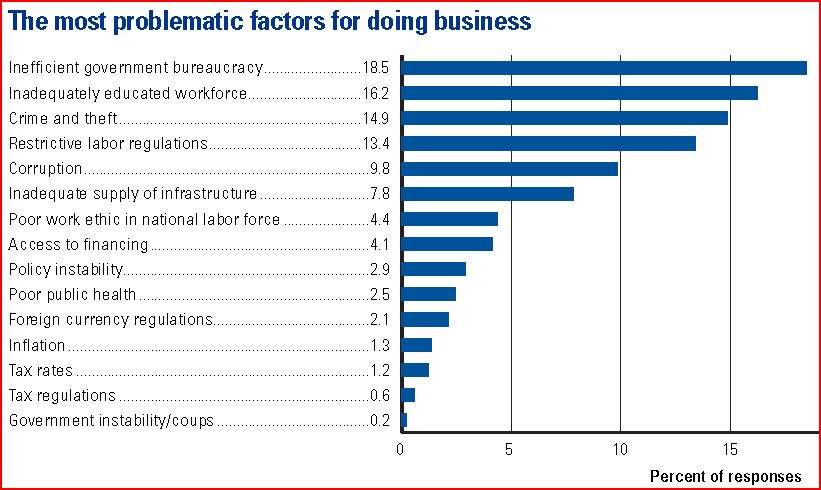
Here is the summary of South Africa’s performance in the Global Competitiveness Report 2010 – 2011. The highlights are mine and the seriousness of the problems is obvious..

While we quite rightly bemoan health, education and labour market failures it is interesting to note we were top ranked – in the whole world! – in two categories: in auditing and reporting standards as well as in the regulations that govern our securities (financial instruments) exchanges.

But on with the bad news: part of the process of the construction of the report involves asking the opinion of “business leaders” (see note below about methodology) about their concerns. The top four concerns they had about South Africa are not a huge surprise:

From a list of 15 factors, respondents were asked to select the five most problematic for doing business in their country and to rank them between 1 (most problematic) and 5. The bars in the figure show the responses weighted according to their rankings.

Methodology note from the press release: “The rankings are calculated from both publicly available data and the Executive Opinion Survey, comprehensive annual survey conducted by the World Economic Forum together with its network of Partner Institutes (leading research institutes and business organizations) in the countries covered by the study. This year, over 13,500 business leaders were polled in 139 economies.”

Click here for a link to the full report.

Excellent Crime Stats – against a dark background

From murder to car jacking and from GBH to rape the April 2009 – March 2010 Crime Statistics published yesterday indicate significant and welcome improvements.

Unfortunately the absolute levels are still extraordinarily high and in one area, crimes against women and children, there have been large and distressing increases.

See the really unusually well written and interesting ‘Crime Situation in South Africa’ document from SAPS  here and links to all the ‘per category’ figures here.

(This added a few hours after publication: here for per province/per station as well as the national crime totals and here for really interesting interactive maps per category per ‘a command area’ (not sure how that geographic area it defined, but the graphic display is is particularly interesting.)

Zuma recalled? I just can’t see it …

I want to discuss this business of commentators predicting that Zuma will be recalled before he has finished his initial term – but first a brief advertisement.

This blog was set up, in part, to generate paid work for myself. One of the things that I do for a living is talk to (or write for) employees, customers, agents, managers, governments and/or boards of directors about various aspects of politics and political risk. If you want me to address your conference, talk to your book-club or write in your newsletter, please feel free to contact me at nic.borain@gmail.com.

There … that wasn’t too difficult.

So back to the recalling of Jacob Zuma.

(I write the following with a degree of trepidation; I have just heard that there is a big emergency get-together at Luthuli house – ANC headquarters – and there are swirling rumours about newer and worse sexual indiscretions – all of which might make what I say below look silly and wrong.)

But anyway, onwards:

I am sometimes astonished at the levels of confidence with which “some among us” pronounce on the details of the future. It’s as if they are already living there, but have popped back to share a few choice bits of certainty with us.

I am referring specifically to the swath of commentary that seems to be predicting the recall of Jacob Zuma ahead of the 2012 elective conference and 100th anniversary.

I fully accept there may be major plays on the go of which I am blissfully unaware; but I just cannot see any of the disaffected alliance factions dare to put the ANC through what it went through with the recall of Thabo Mbeki.

That little episode broke the hearts of  many of the staunchest ANC cadres who had stood firm through storms so fierce and bitter they are impossible to describe.

The manner of the recall of Mbeki created Cope, for goodness sake, and has laid seeds of conflict and factionalism that will still be plaguing the ANC in 50 years time.

Recalling Mbeki ripped the ANC’s intellectual capacity to shreds and it has lost the coherent involvement of the standard bearers of its intellectual traditions – you only need to look at the quality of the NGC discussion document to know this is true.

The best of those involved in the Polokwane Putsch – and the later recall of Mbeki –  understood the seriousness of what they were doing. But these individuals (who were always the minority within the Alliance of the Disaffected – thank you Stephen Friedman) believed that radical invasive surgery was required to save the ANC and the country from the various predations of Thabo Mbeki.

Anyone who reads this blog will know that I tend to think that those few ‘good people’ profoundly miscalculated and that they have unleashed something decisively more disastrous than (the moderately awful) Mbeki presidency.

But this is not the time to have that argument out in full.  What I wanted to do here is remind readers that the upcoming ANC NGC is unlikely to be about recalling Zuma. The NGC is a policy and review conference. It’s important because it is likely to reveal the hands of many of those who are contending behind the scenes for leadership in 2012 (in the party) and 2014 (in the country).

Further, all of the jostling for 2012 is actually about the position of Deputy President of the ANC. The precedent for appointing the Deputy as the president is powerfully entrenched post-Polokwane. So if they don’t go for Zuma for a second term – which is an increasingly strong likelihood – it is almost certain that Kgalema Motlanthe would be the candidate.

Much can go wrong with that view – and I hate sticking my neck out this early and leaving myself open to having to eat my hat or humble pie as the case may be. But this must be the first case scenario. Unless I am missing a trick or two.

If we hear tonight that Zuma is stepping down because of another sex scandal – well, I’ll just have to face that humiliation when it comes.

On Zuma’s own future, I have discussed it before (here) and I hereby reproduce a slimmed down version below:

Who can say what the future holds for Zuma?

Will Zuma serve a second term?

Will he serve out his first term?

Who dares give an answer to these questions? Oh, alight I will.

I have burned myself before by being a little too sure and a lot too wrong about what the future holds.

Analysts like myself are constantly encouraged to take a firm view of what is going to be going down down the road. The client – usually a fund manager – is the person who has to take a bet on a number of future trends and it usually helps him or her to hear strongly stated predictions with the various arguments that support these from various analysts. If these analysts disagree, all the better. Hence outlier positions are often useful.

With those qualifiers, my ‘professional expectation’ is that Zuma will survive the first term of his presidency.

Both the ANC itself and the interplay of the Alliance partners are a real mess, but it took a Polokwane to throw out Mbeki and anyone involved in that process is probably still counting the costs of that exercise. In other words, doing it again, and this time without the kind of unanimity that surrounded the Mbeki ousting, would have to be overwhelmingly urgent as the costs in division and discontinuity would be overwhelming. And I don’t think there is any consensus in the alliance of forces (clearly no longer an alliance) that backed Zuma against Mbeki that there is the requisite urgency around the person and performance of the President.

I am less confident (although strictly speaking I am not confident – in the sense of being certain – about any ordering or outcome of events in the future) about the second term. Up until a few weeks ago I would have said: it is always easier to allow the sitting president to stay in his job when the big contending forces are still involved in the war of position; that no side’s victory is yet in sight. But even if the big power plays are not yet completed by the ANC centenary conference in 2012 there might be a consensus that a safer pair of hands (Motlanthe?) may be in order.

Zuma’s term as president is, unfortunately, proving itself to be that bad.

The end of the ruling alliance

Ruling alliance in happier times

Commentators and politicians are outdoing themselves announcing either the end or the permanence of the ANC/SACP/Cosatu alliance.

This is Jacob Zuma on the subject – at the Kwazulu-Natal ANC General Council on Friday:

I have read so many alliance obituaries. If leaders express their views, people think that we are fighting … The alliance will be with us for a very long time. (Catch that here)

And this is my (humble) opinion on the subject:

This strike –  as a culmination of other things but also in and of itself – is the death knell for the ruling alliance. (Catch that here)

This business about claiming that the alliance is about to break or will last until the Second Coming is something of a secret code for insiders in the political analysis business. “Insiders” are smugly convinced that the tripartite alliance benefits its constituent elements and these constituents will therefore never leave – and we love to use the analogy of a marriage where the couple fights endlessly but is bound by children, finances and habit so tightly that the partners will be together until death parts them.* I discuss some of the ties that bind here.

“Outsiders” – including those who have never belonged to any of the organisations concerned, as well as foreigners and supporters of parliamentary opposition parties – listen to the noise coming out of  ‘the alliance’ and they take the noise-makers at their word: the alliance is heading for the rocks; it is obvious to anyone with eyes and ears.

The “outsiders” have it.

Philosophically, I am one of those who believes we are what we do. Thus, it is not what Zuma, or Malema or Nzimande or Vavi claim, it is what they, and their organisations, do that counts.

The ruling alliance is not, primarily, a name. It is a description of a shared history, set of values and, most importantly, an accepted set of policies and an agreed upon process for deciding about such policies; and is also the formal forums and organisational structures through which such decisions are taken and implemented.

The only thing of significance that “the ruling alliance” did was throw Mbeki out of office and replace him with Jacob Zuma. Everything that has happened since needs to be seen through the “you are what you do” prism. The constituent organisations have done nothing together except violently disagree, actively try to undermine each other (and each other’s leadership ) – and they have agreed upon nothing and done nothing in concert.

Except for the media appeals tribunal (catch my criticism of Jeremy Cronin’s defence of that here) which, bizarrely, is the single thing that the ANC, the SACP and Cosatu have agreed upon – although Cosatu is wavering even on this as the damage done by the public sector wage strike to their relationship with the ANC deepens and intensifies.

It is as if they are saying: “We (as ‘the alliance’) have nothing to offer – but we have a plan to slap anyone down who point that out.” Frankly, I am not surprised.

* (note) What the “Insiders” are actually referring to is a sense of identity invested in the struggle against Apartheid under the broad leadership of the ANC and, crucially,  that traces its ideological lineage through to the “Congress Movement” – from the United Democratic Front, the Natal Indian Congress, South African Congress of Trade Unions, the South African Communist Party, the Congress of Democrats, the Transvaal Indian Congress and the African National Congress.

(Hmm, I am adding this half an hour after posting the above, just to make myself as clear as I am able, and in case anyone missed the point: If the structures don’t exist, if the decisions are not taken or implemented, if there is real and intense conflict over policy then ‘the alliance’ has already ended – and it makes no difference what the various leaders and commentators say. This is the de facto situation, even if it is still possible to argue that, de jure, the alliance continues on and on.)

The resurrection of Julius Malema

Chasing my tail trying to get the bills paid.

But two important things not to lose sight of:

Firstly, Julius is back.

The weekend National General Council of the ANC Youth League was a personal triumph for him and he emerges from Gallagher Estate with his star, once again, steadily on the rise.

In the bitterly divided Ruling Alliance Julius Malema can come clean and stand tall – as a Breitling wearing anti-communists, anti-Cosatuite, who is unashamed of using his political connections to make as much money as possible.

He has invested his transformation credentials with the Youth League’s call for the nationalisation of mines (to which has been added the removal of the willing-seller/willing-buying principle with regards to land distribution) as well as with his overtly populist appeals to a form of ethnic solidarity to “African children” and “those who look like us”.

It my opinion he is now this puts him in the leading cadre of the “nationalist” faction of the ANC that is in the process of confirming itself as the dominant faction – a process that will be reflected in the tone and tenor of the ANC’s NGC later this month.

More than ever I am of the view that Julius is the coming man (as I argue in the piece that continues to get the biggest traffic on my website here) and he has now overcome the setback associated with the dramatic revealing of his business interests as well as the disciplinary action taken against him by the ANC – both earlier this year. He’s got 30 years to emerge as a central ANC leadership person – I can’t think of anyone better placed.

SACP wants to spend your money

Secondly, for those interested in underlying political risk for financial markets, you have got to read the SACP’s latest Umsebenzi Online (Volume 9, number 17) – The long and the short of it is they hope to continue “directing both our public and private financial sector resources towards investing their funds towards this new growth path.”

It is important to understand what the SACP thinks it is doing. The organisation wants to get the “banks, insurance companies, investment and asset managers” to use the money they are tasked with investing to finance a number of goals that government (and presumably therefore, the Ruling Alliance) specify.

Where does the money they are talking about come from? It is the savings and nest-eggs of every South African that the SACP is proposing be put at its and the ANC’s  disposal. I am all for encouraging socially conscious investment, but this idea is classically Stalinist as well as being stupid – the money would find a safe place to hide if the ANC and the SACP tried to get their hands on it; except for the money belonging to the weak and vulnerable, who are always the true victims of policies like these.

The article is called “Funding the National Democratic Revolution” so they make no bones about what they want to do with the savings of teachers, workers and old people and … well everybody who has saved and invested money in South Africa.

The Umsebenzi is more specific about forcing a change in the investment criteria of the Public Investment Commission so that it “promote(s) the five priority areas of government’s development programme.” Again, be clear what is being proposed here. The PIC essentially invests the R740 billion worth of pensions of public sector employees. This is whose money the SACP wants to spend – after the probity of government and public sector spending we have seen over the last few years, who would countenance this?

Whoever wrote this document clearly believes this money belongs to government – when, in fact, it represents most of the life savings of government employees. The interests of the owners of that money is that they get the maximum return, while the supremely grandiose SACP decides that the “real” interests of those people is that their money gets deployed in “government programmes”.

The suggestion is so puerile and undemocratic that I am tempted into hyperbole – and all the more dispiriting because the SACP is all that is standing against the rise of the Zuma/Gupta/Malema imperative. You can catch the full article here.

Waiting for a saviour to rise from these streets*

Just when all hope flees, as the last good politician still within government leaves his/her post to join the feeding frenzy and as the last decent officials trying to do a public service throw up their hands in disgust; and as the striking workers blockade the last functional HIV/AIDS clinic and trash the streets again; and as the broken bits of the Ruling Alliance go  for the kill in their eye gouging, groin stamping gutter fight – just as all hope flees, whose silhouette is it that appears, backlit and heroic, flying in low over the horizon?

Is it a plane?

Is it a bird?

No, it’s … hmm, I’m not really sure.

When things are going as badly wrong as they are going for us, the person to look out for is the one who seems to have been sent by history itself as the solution to all of our problems.

I am not suggesting, as my old Granny used to say: don’t worry, cometh the moment, cometh the man or all’s well that ends well. I am suggesting the very opposite.

This is more of a warning to be careful about decisions we make when we are desperate than it is anything else.

Societies, political parties and whole nations are uniquely vulnerable at times like these. Our desperate need is for someone who can raise an anti-corruption army, is prepared to control the unions, able to fix service delivery and able to make the difficult decisions that will allow job rich economic growth.

The darker and more dire things become – and goodness knows they are as dark and dire as anyone can remember – the stronger our wish fulfilment drive becomes.

Where is the good-looking one, with the strong jaw and the easy, comforting manner, and the very firm but gentle eye and the plan and the promise and the words – and the record, or at least one you can, in your desperation, convince yourself of?

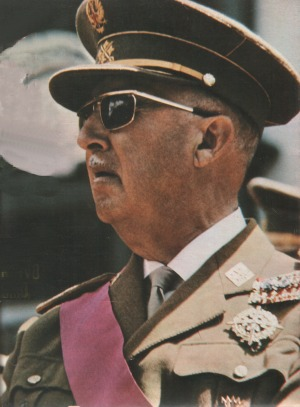
This is the moment in which nice Germans welcomed Adolf Hitler and Spaniards General Franco. King Constantine II of Greece inducted the awful “Regime of the Colonels” in 1967 saying he was “certain they had acted in order to save the country” and there was  a (brief) Argentinian sigh of relief when Brigadier-General Jorge Videla overthrew the execrable, incompetent and authoritarian regime of “Evita” – as popular culture has dubbed Isabel Martínez de Perón.

I am not suggesting that a fascist opportunist and criminal is about to present him or herself as the saviour from our woes – or that things are so bad that we risk losing our judgement and welcoming him/her into the stockade. Well, not yet.

But explicitly and implicitly various political factions and individuals have presented themselves as alternatives, and the solution to our current problems.

There’s Zwelinzima Vavi – and whatever kind of workerist paradise he represents – who heroically criticised the media appeals tribunal and has laid about himself with a stout cudgel at all the worst of the cabinet ministers and officials trying to stuff the last tasty bits of the family roast into their distended bellies. And he’s available next year.

Deputy Minister of Police Fikile Mbalula suggested (of criminals) we should “shoot the bastards!” and in so doing presents a kind of law-and-order (and anti-communist) alternative, clearly being supported by the ANC Youth League and tenderpreneurs everywhere.

Lindiwe Sisulu dresses nicely and would be excellent if we ever panicked enough to need a kind of Cleopatra/Boadicea empress to save us.

Tokyo Sexwale is getting the kind of press that suggests he is an effective anti-corruption campaigner and an excellent Minister of Human Settlements i.e. he’s clean and gives good service delivery – and he’s  bright, presentable, charming, good-looking and available – very available.

(This added as an afterthought: don’t discount Kgalema Motlanthe as a sort of leftish compromise that we have grown used to and, obviously, Mathews Phosa with his charming Afrikaans poetry and his friendly demeanour and his market friendly comments and his bitter struggle with ANC leader and communist Gwede Mantashe. Also consider a scenario, one I discuss elsewhere, where none of the contending factions achieves dominance and everyone agrees to stick with the burdensome incumbent … all is still possible.)

The National General Council of the African National Congress (to be held in Durban from 20 – 24 September) will reveal the main factions and their key representatives for leadership. The last NGC resulted in a rebellion against Mbeki and foretold his rout at Polokwane. This one is likely to be as instructive.

The point I wish to make here is a simple one. Those who appear to offer solutions must be judged in terms of who they are, what they have done and what they really represent. Just because we are in trouble does not mean we can afford to lose our critical faculties. My long gone Granny would have had two more things to say on the subject: don’t throw the baby out with the bath water, and don’t jump from the frying pan into the fire.

* The title of this post comes from the glorious “Thunder Road” by the inimitable  Bruce Springsteen (it doesn’t really fit the story … but I really love the song:

You can hide `neath your covers
And study your pain
Make crosses from your lovers
Throw roses in the rain
Waste your summer praying in vain
For a saviour to rise from these streets
Well now Im no hero
That’s understood
All the redemption I can offer, girl
Is beneath this dirty hood
With a chance to make it good somehow
Hey what else can we do now?

Strike – not as easy as it looks

The news media is full of toyi-toying fat people in red T-shirts blockading hospital gates interspersed with pictures of dead and dying babies.

Alternatively the coverage is of other fat people in red T-shirts clutching sticks and whips trundling around, with their fat bottoms swaying, looking for pupils (bravely trying to uplift themselves by continuing their studies during the public sector wide strike) to beat and otherwise disrupt.

There is a degree of truth in the story… I mean, turn on your television, they’re everywhere, with their megaphones and coffee flasks (and clearly a lot of biscuits and sandwiches), belligerent and unattractive as it is possible to be.

But I suspect that we should treat the picture and the solutions that seem obvious (and are being offered by every newspaper and television station in the country – with unusual unanimity) with more than a degree of caution.

It’s impossible to realistically analyse the strike here – and anyway that is work I have to try to sell to a paying client – but there are some questions I would urge us all to bear in mind.

I lay some of them out here as bullet points:

  • Government has offered 7% with a R700 housing allowance (an offer that amounts, according to the employer, to between 9.4 percent and 8.5 percent, depending on grade) and unions are demanding 8.6 percent wage increase across the board and housing allowance of R1 000. This seems closer than it is – the difference between the offer and counter offer, when aggregated across the public sector, makes a huge difference to the fiscus and to the actual take home value of the workers’ pay packages. Both parties have something to fight for.
  • Workers strike at great cost to themselves – generally, by-and-large and when all the exceptions are smoothed out. Try for a moment and to imagine risking your job and deliberately deciding to take on being portrayed as greedy, callous and on a kind of stolen holiday. This is especially true in the public sector, where the customers you are involved in servicing are your neighbours, their children and the sick of your community.
  • We have the highest levels of inequality (measured by something called the Gini coefficient) of any country that keeps realistic figures in the world – and if not ‘in the world’ then we are in the company of only one or two others. In a public sector wage conflict the employer is government (with politicians representing the owners and the senior bureaucrats the managers). The differential between the earnings of public sector workers and their employers – both of whom take their pay package from the public purse – is a factor many times higher than in most countries in the world. When you add to this the public perception (and the strikers are part of that public) that the politicians are engaged in a nasty, sharp-toothed feeding frenzy at the aching teat of the public purse, ransacking the long built up assets of the public sector and using every mechanism possible to extort money from the private sector, is their any wonder that public sector workers see their lot as unfair?
  • Cosatu and its various member unions and the worker leadership “on the ground”, so to speak, is getting the kind of press it deserves. The behaviour of too many striking workers is so unacceptable that the unions are inviting a Maggie Thatcher to emerge from these battered streets to crush them and reformulate the South African economy to be a growth machine that will benefit merchant bankers and the rich … and no-one else. And the public will cheer that politician on, because the unions have not bothered to see the middle-ground as worth fighting for.
  • This strike –  as a culmination of other things but also in and of itself – is the death knell for the ruling alliance. It imposes upon the vague conflict between Nationalists and “Tenderpreneurs” on the one hand, and trade unions and communists on the other, a clear organisational character and a clear set of objectives and costs over which the contenders deeply disagree. Government might find more money. The unions might shift an inch to meet government’s next offer but I suspect this is the moment that South African politics has been circling ever since Mbeki slapped the unions and “the left” into a subservient position over ten years ago. I am not awaiting a formal announcement by Vavi that he is leading his cohorts into the wilderness. But I expect that in practice the unions and the communists will be out of government within the next few years (Perhaps even more than they were “out of government” under Mbeki … and I use “the next few years” to give myself a margin).

This week is going to be full of the strike and its consequences. It is, ultimately, not a hugely profound point,  but now, more than ever, we need to urge caution in seeing the world as a simple representation between good guys and bad. This impulse, to see things as if they were simple and easy to understand, is increasingly the direction of public discourse on radio, newspaper and television. We need a kind of private media tribunal in our heads.

World Cup Prequil …

I am going to have to keep a straight face as I do this.

I am not unaware that “sex sells” – and I come from a political tradition that is endlessly anxious about the depiction of women’s bodies and about whose cause is being served by that depiction – but here goes …

The latest issue of GQ Magazine carries – amongst many interesting and stimulating articles and photographs – my thoughts on the Fifa World Cup. What you might find interesting is that I wrote it before the event – but the magazine has only now hit the market. I think I got it right … but you decide for yourself.

(Thanks to that excellent editor and friend Craig Tyson for the various permissions to republish this here. So go and buy the magazine – it is an interesting read).

Click on the image of the cover to link to the article.

qererqet

Are we there yet?

The ArcelorMittal /Imperial Crown Trading deal (in all its complexity) is deeply threatening to the future of investment in South Africa.

If I ran a display indicating threat levels to the South African democracy the readings would be higher now than at any time since the successful establishment of majority rule in 1994.

Such a statement is obviously subjective. So here goes:

South Africa’s future depends on sustainable economic growth. This is the minimum condition that must be met if we are to roll back the current levels of unemployment, poverty and inequality.

The minimum condition for economic growth to occur is for domestic and international investors to continue to put their money and creativity to work in the country – preferably on an ever expanding scale.

Investors, domestic or international, are always primarily concerned with the safety of their asset and the predictability of returns.

“Political risk”, for investors is the risk that the actions or inactions of government could affect their ownership of their asset and what they can expect to earn from that asset.

Political risk in South Africa has always been about the macro insecurity caused by the levels of unemployment, poverty and inequality – and, crucially, the racial overlay of the same. Political risk has always been encapsulated in a simple question: can/will this government secure my asset – in a situation where ownership of such assets is so unequally spread?

This isn’t only a question for adrenaline stoned young  bond, equity and currency traders sitting in the global financial capitals with their cold little eyes glued to the screens.

If the answer is: ‘the government cannot secure the asset’, or even worse: ‘the government itself might be the thief in the night’, the people who are in the deepest kind of trouble are not sitting in London and New York.

When governments preside over the kind of slippery asset switching that has characterised the ArcelorMittal/Imperial Crown Trading deal, the people that suffer are the poorest and most vulnerable. The reason for this is not because this particular deal is  important, by itself,  to the future of employment and economic growth in South Africa. What’s important is that all the other money and creativity wandering around global markets looks in on this deal and acts in accordance with what it learns.

And what did this “capital and ingenuity looking for a home” learn from the ArcelorMittal/ Imperial Crown Trading deal about making a home here?

In the short term:

  • The issuing of mineral and prospecting rights by the South African government is a process so fraught with danger that it is impossible to trust the authority not to steal,  or be in league with those who wish to steal, your assets;
  • The only way to secure your asset – and effectively compete in this market –  is to hire individuals from the powerful political families and factions – at a huge expense – to act as your partner.

The money and ingenuity looking for a long term home – i.e. capital that is prepared to set up bricks and mortar and businesses with global reputations to uphold – is going to be particularly cautious about deals like this one because:

  • It exposes Black Economic Empowerment to be nothing more than a mechanism to bribe the political class – rather than what it was promised to be: a mechanism to spread the benefits of capitalism to the previously denied and disadvantaged;
  • It acts as a massive drain on the productive employment of capital i.e. it adds so much extra costs to the normal costs of conducting whatever business you are in that the benefits of being in South Africa, as opposed to anywhere else, disappear;
  • The kind of “money and ingenuity” that you get when your market presents such long term risks are short term specialists – the ones who make a living out of basket cases and are used to dealing with them – with their bribes and coups and political meddling.

So the ArcelorMittal / Imperial Crown Trading deal – with all of its ins-and-outs – pushes up political risk to levels last seen in the  mid-80’s at the time of PW’s Rubicon Speech.

And that is what I am telling anyone who asks my advice about political risk and investment in South Africa.

Jeremy Cronin – the acceptable face of the Media Tribunal

Jeremy Cronin’s light defence of the proposed media tribunal couldn’t have come at a worse moment – a few hours before the showy arrest of the Sunday Times journalist Mzilikazi wa Afrika.

That’s a pity, because his comments were more sensible and readable than those of his comrades – although still misguided and, ultimately, dangerous, as I shall argue.

Jeremy Cronin - no longer a victim of the powerful

It’s difficult not to lump into one basket the various hostilities emanating from government and the ruling alliance towards the media.

Aside from the aforementioned arrest, and several high-profile verbal attacks on the press,  there is the Protection of Information Bill wending its way through parliament and the ANC’s own proposed ‘media tribunal’ up for discussion at that organisation’s National General Council in a few weeks time.

Here  for a link to the ANC’s extraordinarily badly written and poorly argued document (Media Diversity and Ownership) proposing the media tribunal. Here is Jeremy Gordon’s irritated criticism of the document on the happily trending rightward Politicsweb. Here, for those with time on their hands, is the tedious Protection of Information Bill.

I think the impression that the ANC and government are engaged in a concerted effort to make the media more compliant is indisputable. The fact that they are doing what governments, ruling parties and “the powerful” do in all places and at all times does not mean they should not be criticised and watched carefully and suspiciously. It just means that we should be less breathless and astonished when we do the criticising and watching.

So before Cronin’s piece gets drowned out by the sound of jackboots let us examine the points he makes.

Firstly he correctly points out that the major newspapers have had a nasty few weeks – he mentions Business Day apologising to General Nyanda for shoddy journalism in a story “alleging intended corruption in the suspension of his Director General”. He points out that The Times carried an apology for a story alleging that Blade Nzimande had called for the jailing of journalists (catch a cached version of the original stupid story here – frankly The Times deserves whatever punishment they it gets for that trashy headline!)

Cronin interestingly chooses not to mention the City Press being forced by the Ombudsman to apologise to ANC Treasurer General Mathews Phosa – see that here. It is possible that his deadline missed the release of the Ombudsman’s order, but he may not have mentioned it anyway because his point is that the self-regulatory mechanisms are inadequate – that what we need is a tribunal answerable to parliament.

Where Cronin deserves credit is he then lists the various problems he and his comrades have with the media that a media tribunal is not designed to address:

  • the  “narrowly anti-ANC oppositionist stance” of much of the “print media”;
  • failing to balance the “watch-dog” role with other roles like providing “ordinary citizens with accurate information”;
  • the centralised ownership of big newspaper “corporations” (a matter he thinks would be better addressed by the Competitions Commission);
  • The foreign ownership, especially of the “Independent” newspapers, which has resulted in working capital draining out of these organisations to support loss making operations in other countries;
  • the “trashy tabloid” character of much of the print media, that results from the profit imperative being imposed on the newsrooms.

For Cronin, the ‘media tribunal’ is somewhere that:

… members of the public, including (but not only) high-profile personalities, can take concerns around grievous misrepresentation and unethical reporting …

without having to go to the expense and difficulties of the courts.

Now if that was all there was to it we would all pat Jeremy (Cronin, not Gordin) warmly on the back and add our support to the tribunal. There are two linked issues, however, that I would like to take up with Cronin.

Firstly the tribunal is not argued in anything like the terms that Cronin argues in the gigabytes of documents and criticism that come from his comrades and their various organisations – just throw your eye (as certain South Africans are wont to say) over the aforementioned execrable Media Transformation, Ownership and Diversity document. In amongst all the bullying and bombast is every single argument that Cronin disavows.

So are we meant to accept the media tribunal for the sensible reason that Cronin advances or reject it for the outrageous and dangerous reasons his comrades advance?

The second issue I wish to take up with Jeremy Cronin is more subtle but actually gets my goat in a more profound way. In a thousand different ways Cronin presents himself and the ANC as the wronged victim of the powerful, centralised, foreign owned and corporate print media. This is big business imposing its arrogant will on the democratic movements of the people and the workers.

That is, quite frankly, rubbish. It is time that Cronin woke up to the reality that he is the powerful one and/or the representative of the powerful. I get that big business is going to be selling its line into the public consciousness every chance it gets, but it will take a lot more than Cronin’s innocent belief in his own good intentions and the good intentions of his comrades to convince me that they are, in fact, not the bigger of the problems that confront us and our media.

Make the circle bigger Nathi – or dance alone

Occasionally our correct and coded political dialogue is enlivened by a less experienced politician whose staff were out to lunch when their boss put pen to paper – or word in mouth, as the case may be.

One such instructive episode has been a piece by Minister of Safety and Security (Police) Nathi Mthethwa in which he attacks Helen Zille for, essentially, challenging the notion that Jacob Zuma is in any way the inheritor of the mantel of Nelson Mandela.

This article (astonishingly I think you will agree) is prominently and proudly carried  in the official ANC journal, ANC Today. You can catch the full text here.

Minister Mthethwa breathlessly and breathtakingly lacerates that “disgusting madam”, … “Helen Zille and her ilk sinking in the foul waters of self-aggrandisement”.

She is the “pitiless lone voice from the gutter” with her “disgusting, shallow and shameful short memory”  she is “obsessed and blinded by her hatred of the ANC” .

She has “unveiled yet again her infamous stripes” by “urinating on the progress being made” and  “(s)he continues to suffocate in her own choking fires of hatred and unrestrained banal rank opportunism” with her “barren infantile political posturing”.

Goodness!

You might well ask what the scary and threatening leader of the Democratic Alliance said that caused the Minister of Police to wax so lyrical.

Helen Zille in her weekly missive (SA Today) took up the occasion of Nelson Mandela’s birthday to make a few sharp points about the blurring  between party and state in celebrations around the old man’s 92nd birthday.

She ends her stern, school headmistress admonition with:

The great irony is that the more the ANC diverges from Nelson Mandela’s vision, the more the ANC seeks to own it … The ANC does not own Mandela. The ANC gave up its claim to Mandela’s legacy when it diverged from the values he cherished. Instead, Mandela’s legacy belongs to all those people in South Africa, from all backgrounds, who still value selflessness, integrity, non-racialism and freedom for all under the law.

This really must have hurt to have sent Minister Mthethwa into such babbling apoplexy.

The minister and his colleagues who allowed the article to be published with such proud prominence have failed to learn the most important thing about politics. Politics is always about winning the middle ground and isolating your most dangerous enemy from his/her potential friends.

The immense value of the symbol of  Nelson Mandela to the ANC is precisely that he is a lifetime leader of the ANC and is venerated across the political spectrum. The political task of the ANC must be to give leadership to “the nation” and to the middle-ground, to be accepted as the legitimate leader of the South African state. Part of achieving this goal surely must be – for the ANC – to welcome its political opponents to venerate Mandela?

It seems obvious to me that through this defensive bullying and bombast Mthethwa achieves the very opposite – and frankly must be making DA strategists wring their hands with glee.

But I am coming to think I expect too much from a political party that advertises the death of its strategic sense by placing this kind of ignorant diatribe by one of its leading members in its leading publication.