Zuma was to Polokwane what Malema hopes to be to Mangaung

Doesn’t the Julius Malema saga feel so familiar?

Remember how the Jacob Zuma campaign seemed to transform each new obstacle placed in his path into fuel for his political train that eventually steamed triumphant into Polokwane in December 2007?

The fact that he was known far and wide as hopelessly incapable of moderating his sexual behaviour and as being on the take from, at least, Shabir Shaik, seemed to make almost no difference to the eventual outcome … unless the legal and other processes to charge him actually strengthened his claim to the presidency.

He was the victim of Mbeki’s shenanigans and he was heading a column of pro-poor ANC alliance cadres that were coming to take the ANC back from the pro-monopoly capital “1996 class project” – and every deed or word against that was coming from the privileged few defending their privilege. The marching column was irresistible and Polokwane was its destiny. Or at least that was the narrative that seemed to win out.

With the benefit of hindsight it is clear that Zuma’s success was all about momentum – and its inevitability is a post hoc construction.

I remember a movie from my childhood where the hero escapes almost certain death (it was either Indiana Jones or one of the Bonds ) by running across about fifty metres of crocodile infested waters by … yes, you guessed it: stepping on the back of each starving crocodile but with such speed that he was on his way to the next one before they snapped at him or sunk.*

That is probably a better metaphor for Zuma’s perilous progress towards Polokwane than the one that has him steaming towards that conference as if it was his manifest destiny. The second post of this blog was called The Accidental President and in it I argued that Zuma’s presidency was a result of an unlikely set of circumstances and he was not a character that many could have previously imagined in the role.

On closer examination it becomes clear that Zuma, on several occasions, almost crashed and burned – and came close to going to prison. Ultimately it was only the forward momentum of his campaign that allowed him to escape the snapping crocodiles at his heals.

In fact, I would put it even more strongly: for Jacob Zuma the only way to avoid ignominy and prison was to win the presidency.

And that is where the comparison with Julius Malema becomes so compelling – especially in his weekend attempt to boost the Economic Freedom in Our Lifetime campaign into the mouths and minds of the genuinely marginalised and poverty-stricken in places like Diepsloot and Bantu Bonke.

Just as his disciplinary hearing comes to a head.

Just as his questionable personal finances start to be ‘put to the question’ by various authorities.

Just as he prepares to lead the marches on the Chamber of Mines and the Johannesburg Stock Exchange.

He told those audiences: “They [the whites] found us here. They did not bring any land nor did they bring any minerals.”

And: “”We are here for every one of you. We will not rest until you stop worrying about where your next meal will come from.”

Woven into every word and phrase is the argument that the incumbent leadership of the ANC has failed the poor. That Julius Malema’s fight against Jacob Zuma is actually a fight to have the needs of the poor and dispossessed met.

Can Julius Malema, engorged as he and his comrades apparently are from sucking the marrow from the bones of Limpopo’s  (amongst others) public purse skeletal public finances (some bad metaphors are impossible to fix – ed)  hope to pull off this audacious argument?

Clearly he can.

Clearly he is betting on himself to be sitting up in the cab of a triumphant train steaming into Mangaung; to have turned all obstacles aside and spun the narrative of the little guy standing up against the incumbents, standing up for the poor and dispossessed.

The parallels are not perfect. Julius Malema is not the apex of a push for the presidency of the ANC – he is too young, untested and controversial to aspire to those lofty heights this time around. He is rather part of the campaign of other powerful contenders – although he hopes to be nested near the centre of a new ruling configuration of the ANC.

Finally, Zuma had the backing of the SACP, Cosatu and a host of ANC democrats exhausted by Mbeki’s stale centralism – as well as a swathe of aspirant BEE wannabes who felt excluded from the previous gravy train.

Julius Malema (and those who hope to benefit from his campaigning) have nothing like the mighty alliance of those disaffected by Mbeki’s presidency.

After yesterday’s radical cabinet reshuffle and Zuma’s apparent ability to reinvent himself as an anti-corruption and responsive president I would have to bet on the incumbents and against the invaders at the castle gate.

This is the week, however, when Malema’s gamble will either pay off or fail.  On Wednesday his disciplinary hearing resumes. On Thursday and Friday the marches on the JSE and the Chamber of Mines will take place.

This is not an accident of timing.

This is about planning, planning by individuals and groups with large appetites for risk – especially when the prize is so rich and the price of failure so high.

*I have a terrible feeling that someone has used that metaphor for Zuma’s march to Polokwane before … so let me apologise in advance if I stole it … and while on the textual commentary – I found this in Wikipedia while trying to check if the image had, in fact, been used for Polokwane before:

“Ross Kanaga as James Bond used four crocodiles as stepping stones to reach safety on the other side. Kananga, who owned the crocodile farm seen in the film, and after whom the main villain is named, did the stunt five times wearing the same crocodile skin shoes as his character had chosen to wear. During the fourth attempt, the last crocodile bit through the shoe and into his foot.The fifth attempt is one seen on film, with the tied-down crocodiles snapping at his feet as he passed over them.”

Beat the dog till the owner comes out

Tokyo comes out to defend Julius Malema in the disciplinary hearing?

To be followed by Winnie Madikizela-Mandela and Tony Yengeni?

It is an almost too perfect reversal of Julius Malema’s own metaphor after his victory at the Eastern Cape provincial conference of the ANC Youth League in August 2010:

“We will never surrender to Blade. He has never been a member and has no understanding of …  the youth league … Their people have been receiving serious lashings in the youth league conferences. As we said before, we will beat the dog (SACP) until the owner (Nzimande) comes out” … (a copy of The Herald editorial I took that from here.)

The boot, at the moment, seems to be on the other foot (or ” the stick is in the other hand” might have been better – ed.)

The “dog” that is now being beaten at the disciplinary hearing is Julius Malema himself and the owners that are revealing themselves are Tokyo Sexwale, Winnie Madikizela-Mandela, Tony Yengeni and friends.

And who is doing the beating? Why, the South African Communist Party and Blade Nzimande (as well as Jacob Zuma, Gwede Mantashe and many – but by no means all – in the incumbent leadership of the ANC).

Last weekend, almost while the disciplinary hearing was sitting, SACP Secretary General Blade Nzimande said to  the SACP provincial congress in Esikhawini, near Richard’s Bay, in northern KwaZulu-Natal, that young people should be discouraged from participating in the ANC Youth League’s Economic Freedom in Our Lifetime marches and protests on the 27th and 28th of this month:

“Do not allow yourselves to be used by people with agendas that are not in your interest … We are not going to be supporting any march whose intention is malicious and to undermine the authority of the ANC and the government.”

Breaking ideological stereotypes and confusing the foreigners

Spare a thought for those of us whose job it is to explain to foreign investors why the communists are leading the fight against a youth movement calling for the nationalisation of mines, the expropriation of land without compensation and “Economic Freedom in Our Lifetime!”

I could, of course, have just sent them a few extracts from Fiona Forde’s An Inconvenient Youth – Julius Malema and the ‘New’ ANC (Picador Africa 2011).

Here she is, sitting outside a hotel in Caracas Venezuela chatting with a sulking Julius Malema on his way back to South Africa (from a conference of the World Federation of Democratic Youth taking place in downtown Caracas in April 2010)  to face his previous disciplinary hearing. She has been getting a lesson from Julius on the importance of matching the leather of his watch strap with his belt and his shoes.

Venezuela has never seen so many designer labels as it has these past 48 hours since the arrival of the South African young ones. They descended on the city with their expensive suitcases and travel bags, top-of-the-range baseball caps, flashy T-shirts, snazzy shoes and sneakers, sleek manbags and a string of other expensive accessories hanging out of them – and a bodyguard in tow – all dressed up for a socialist youth conference.

I have been wondering how they must appear in the eyes of the other youth who have flown in from all over the world, and who are also staying at the Avila. The three-star hotel is swarming with casually-dressed, young delegates and among them, to my mind at least, the South Africans seem to stand out a mile.

When we understand that these delegates are the very same people who have formulated the “Economic Freedom In Our Lifetime” slogan, the implacable opposition of the South African Communist Party to the campaign becomes  obvious.

The campaign is a classic attempt by a parasitic elite to manipulate those who are really poor and dispossessed so that these disenfranchised citizens become the battering ram and the lever through which that elite can capture even more resources and assets than it has already – through tender abuse and diversion of state resources into their own pockets.

So the dog is being beaten.

But we would be unwise not to think deeply and carefully about the nature and intentions of the owners that rush out to defend their animal.

China’s my ANC*

The Arch live on national television on Sunday night was full of his old and delightful twinkly theatricality.

“Watch out ANC government, watch out!”

My own view is he has every right to his anger and he expressed it with aplomb (and I am deliberately leaving aside placing the Dalai Lama anywhere on the continuum between “paragon of virtue” and “another narcissistic human-rights rock star” – because I think he is irrelevant to the question of the ANC’s moral failure in this case.)

Now Tutu didn’t actually say the ANC was either worse than, or equivalent to, the Nats, but I still wish he would keep in mind the problem of the inflation of metaphor.

He said that the ANC government’s failures of visa issuance are worse than those of the Nats – because at least with Apartheid’s masters you expected the worst.

Which is obviously still rubbish – even in this more limited form – to anyone who remembers how much focus was given the domestic and international movement of black people by the machinery of the Apartheid state.

But moral watchdogs are obliged to bark as loud at the gradual rise of tyranny as they do when that bloody moon reaches its apogee – which is why I am not going to quibble with the Arch; he is doing his job and all strength to him.

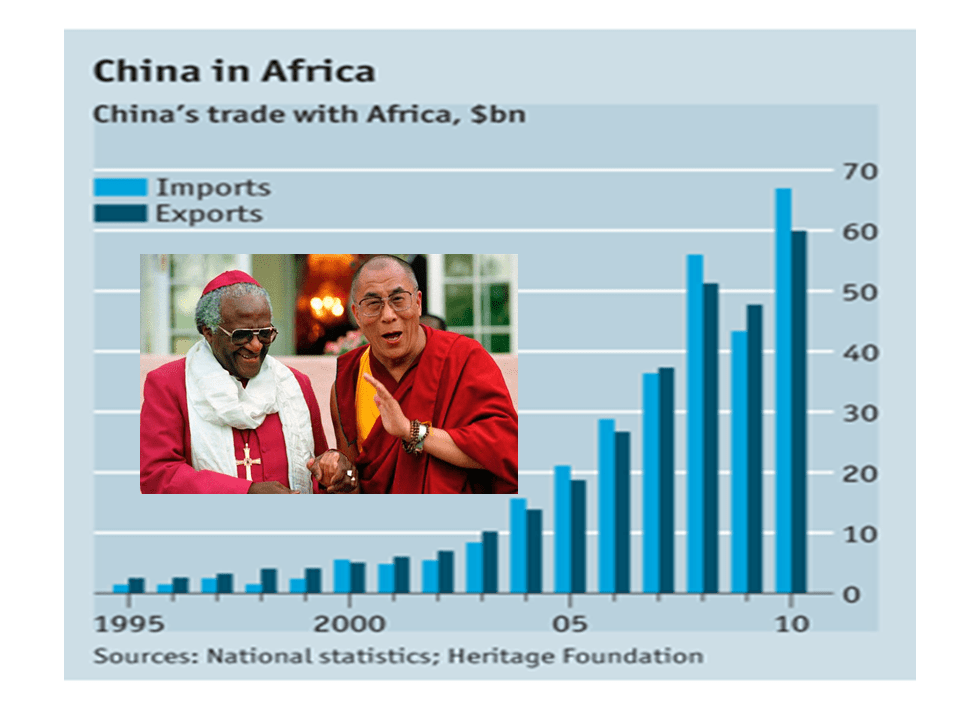
What I originally wanted to do was draw a graph using the 4 previous post-1994 South African visa applications (that I know of) for the Dalai Lama and plot them against the rise of China in Africa and the fall of principle within the ANC – but I think that has too many axes (including the grinding kind) and I couldn’t get it to work in Excel.

In 1996 Nelson Mandela invited the Dalai Lama and met him face to face; in 1999 Thabo Mbeki’s government gave him a visa as part of an international interfaith conference but refused to meet him; in 2009 Mbeki’s government refused him a visa altogether and today Zuma’s government has ignored the issue entirely.

You can plot those points yourself against this graphic that I have cobbled together:

The explanation for the changing stance of visa applications becomes fairly obvious when you track them along that curve.

And then, if you have the time or the inclination, feel free to suggest a speech bubble for the protagonists.

*If you are not South African that headline is going to be difficult to explain. “My china” is slang for “my good friend”. So “China’s my ANC” is a species of bad pun crossed with an unintelligible inside joke. (Note: It has been pointed out to me in the comments section below that “my china” meaning “my friend” comes from rhyming Cockney slang … China plate/mate … should get my brass tacks right.)

Game of Thrones in the ANC

A good friend of mine in New York* recently put me on to “A Song of Ice and Fire” – a seemingly endless series of swords and sorcery novels by George R R Martin.

This is the crack cocaine of fantasy fiction but it is also a surprisingly brilliant study of politics and power vacuums.

The fictional edifice of the “Song of Ice and Fire” is built around the consequences of the death of a powerful king. In the aftermath the kingdom collapses into factional chaos, pretenders to the throne contest for power and war rages across the land.

Scheming power-brokers manipulate and assassinate their way through the dysfunctional court as provincial lords and petty “hedge nights” ransack, pillage and rape “the small folk” all across the Seven Kingdoms.

What an excellent metaphor.

The demise of Thabo Mbeki at Polokwane in December 2007 and the political cycle towards Mangaung in December 2012 is our own Song of Ice and Fire and the intrigue and viciousness in the ANC’s internal struggle feels like it is being run by the Lady of Casterly Rock, Cersei Lannister – but you will have to read the books to fully understand how apt and awful that comparison is.

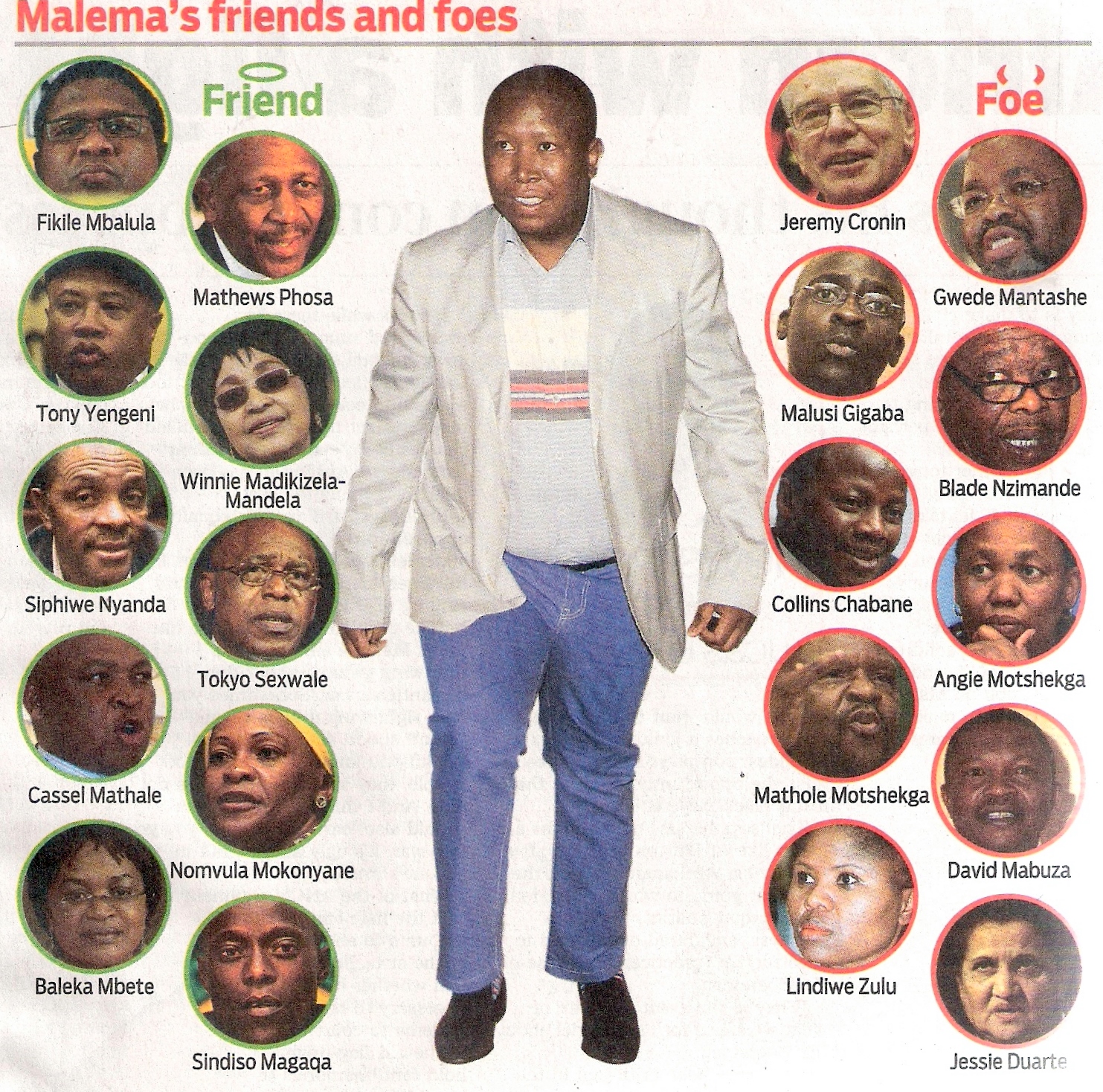
Two weeks ago the increasingly excellent City Press published the following schematic of what it sees as the individuals in the main factions contesting for power at Mangaung (using Malema as the proxy for the broader conflict):

(see at the end of the story for my optional key to that graphic)

One of the problems with factional battles like this one is that it is not always possible for the participants to choose which side they are on – or, in fact, whether to be on any side at all.

As the powerful interests clash in the Ruling Alliance there can be no ‘innocent bystanders’ or anyone above the fray. A factional dispute like this one is a bit like the Cold War used to be. It imposes itself upon the whole structure; every forum, every election and every policy debate gets forced into the dominant paradigm  of the overall contest for power.

One of the dangers – with this analysis and with the more general struggle – is that it is increasingly difficult to work out what each side stands for and how they might differ from each other.

When we use Julius Malema’s friends and foes as the proxy for the broader struggle it is easy to portray the challengers as the most voracious faction, fighting for the right to loot the state and dominate patronage networks. The problem is that the incumbents, certainly Jacob Zuma himself, can hardly be portrayed as the good and brave king to Malema’s dastardly evil knight.

There are shades of grey here that we are going to need to have a more subtle sense of as we get closer to whatever compromises might emerge at Mangaung.

It’s best not to act as a cheerleader for any one faction or part of a faction in a struggle as complex as the one unfolding within the Ruling Alliance. And while today’s heroes can be tomorrows villains and vice versa I would still use Julius Malema’s friends and foes as a rough guide to who the most dangerous enemies of our democracy are. Malema himself is a bit player, just the most visible aspect of a fight that is much deeper and more involved than his personal future. But he’s a useful proxy, nonetheless.

One of the pay-off line from A Song of Ice and Fire is a phrase that is the perfect warning to give the players in the ANC’s internal conflict:

‘In this Game of Thrones you win or you die.”

But George RR Martin has another device that he keeps repeating, threateningly, as the lords and knights struggle and murder each other for the throne.

“Winter is coming”, he keeps warning, constantly reminding the reader and his characters that there are much greater threats than the outcome of their brutal squabbles.

Winter is coming.

* That’s Tony Karon, editor at Time Online and expert on all things Middle East. He tells me he has also, several times, used metaphors from A Song of Ice and Fire, including: “Goldman-Sachs are like the Lannisters — no matter who’s on the throne, they’re always on the Small Council.”)

(My schematic key to the graphic – not required reading, and a little bit cobbled together: the friends are Mathews Phosa,  ANC treasurer general and  previous premier of Mpumalanga, one of the ANC’s top six, National Working Committee (NWC) member and a member of the 81 person National Executive Committee (NEC); Fikile Mbalula, previous ANC Youth League president, currently a head of campaigns in the ANC as well as minister of sport in government – highly effective in both positions he is being pushed by this faction to replace Gwede Mantashe as ANC secretary general – on the NWC and NEC;  Tony Yengeni, fraud convict and ex-ANC speaker of parliament (during which time he was caught defrauding parliament by accepting a discount on a luxury car during the tendering process for the arms deal while he was the member of a parliamentary committee reporting on the same deal), ex-member of the ANC underground, tortured by Apartheid police agents in the late 80’s. He is on the ANC National Executive Committee and on the National Working Committee; Winnie Madikizela-Mandela convicted fraudster, wicked step-mother of the nation, she who famously said “with our boxes of matches and necklaces we will free our country”, prime ANC populist who was married to Nelson Mandela and struggled bravely while he was imprisoned, but later accused of several human rights abuses …. and has taken every opportunity to identify herself with Julius Malema and his various calls for nationalisation and expropriation of “white owned” property. On the NEC and generally still influential and symbolically powerful as any member of the ruling party; Siphiwe Nyanda chief of staff of ANC’s armed wing Umkhonto we Sizwe and later head of South African National Defence Force (in which capacity he was regularly accused of being a significant recipient of some of the billions paid in arms deal bribes) and lately minister of telecommunications from which he was fired by Jacob Zuma during an avalanche of accusations that he had illegally enriched himself by getting R55m tenders from Transnet for his security company (GNS or General Nyanda Security) – also eviscerated by the media for his extremely expensive habits and choice of vehicles as a minister – on ANC NEC and NWC; Tokyo Sexwale, has long been thought to be the power behind the Malema challenge, although little evidence had been presented to prove this – and he was recently reported as referring to Malema as “that loud mouthed young man” – he was a popular premier of Gauteng when the fell foul of Thabo Mbeki machinations in the late 90’s, he withdrew from politics and became a successful business man – now reported to be extremely wealthy (through the company he founded, Mvelaphanda Holdings) – he has returned to politics and threw his hat into the ring in the lead-up to Polokwane in 2007 indicating that he would be prepared to take the ANC presidency if he was so nominated and elected. Instead Jacob Zuma became president and ended up appointing Tokyo as Minister of Human Settlements – a difficult position in which he has appeared to perform adequately – his wealth makes his election to the ANC top spot a difficult road …. but his determination and deep pockets make him a serious challenger; Cassel Mathale, premier of Limpopo and the closest of close allies (business and politics) to Julius Malema – the Limpopo province is beset by very high levels of cronyism and tender abuse by senior ANC politicians …..; Nomvula Mokonyane – surprised to see her on the list, premier of Gauteng and former housing minister – she has conflicted with another very powerful player Paul Mashetile (ANC Chair in Gauteng) who I would have thought was closer to Malema that she – she is on the NEC (ex-officio, which means she wasn’t elected there);  Baleka Mbete, ANC Chairperson, NEC and NWC – powerful … conflicted with Zuma and Motlanthe over whether she could keep the Deputy President post she help under Kgalema Mothlathe’s caretaker presidency – which put her in conflict with the Zuma camp at the start of his government in 2008; Sindiso Magaqa Secretary General of ANC YL and powerful Malema henchman.

And foes: Jeremy Cronin; key ANC intellectual and deputy secretary general of South African Communist Party (SACP) – as well as effective deputy minister of Transport – he has been the main intellectual opposition to Malema taking him on around mine nationalisation (accusing him of dishonestly fronting BEE interests and being interested in plunder) and on his general populist politics which Cronin and the SACP characterise as racially chauvinistic and even “proto-Fascist” comparing Malema arc explicitly to Germany in the 1930’s on the ANC NEC; Gwede Mantashe powerful ANC secretary general who also holds the position of SACP Chairman – he is one of the main targets of the Malema fronted faction as a leading voice against cronyism in the ANC – the push from the right is to replace him with Fikile Mbalula who is probably the best organiser of the opposition – Mantashe is gruff and famously speaks his mind, a characteristic that has put him in conflict with the most voracious cronies – in the ANC and the trade union movement – NEC and NWC …; Malusi Gigaba – ex-President of the ANC Youth League, but now adequate minister of Public Enterprises (but not about to shoot the lights out) in Zuma’s cabinet – gradually assumed to role of being a key defender of Zuma and the incumbents against the Malema battering-ram on the NEC; Blade Nzimande – top Secretary General of SACP and (adequate minister of higher education) – came in for a lot of flack from Cosatu for not focussing on building the SACP as well as for his expensive choice of cars as  Minister,  NEC and NWC; Collins Chabane – key intellectual and minister in the presidency (monitoring and evaluation) – respected ally of Zuma, opposed mine nationalisation – ANC NEC and NWC; Angie Motshekga – minister of basic education (shaping up well) and ANC Women’s League president … denies she recently suggested that one of the solutions to current crisis was dissolution of the ANC Youth League – NEC and NWC; Mathole Motshekga – ANC Chief Whip in parliament (always a powerful position) and law lecturer at Unisa in his spare time. ANC NEC … maybe opposition to Malema thrust is a family affair?; David Mabuza; Mpumalanga premier and ANC chairperson recently accused by ANC Youth League of “interfering” in the Youth League politics i.e. backing Lebogang Maile to replace Malema and the recent ANCYL national conference … a challenge that fizzled – he is on the ANC NEC;  Lindiwe Zulu, senior foreign affairs official previous Ambassador to Brazil, close Zuma confidant and powerful behind the scenes player building his image abroad …. she ran into flak from the ANC YL for appearing to back the MDC in Zimbabwe against ZanuPF. She is also close link with Angola for Zuma. ANC NEC.)

Nationalisation revisited revisited … if you know what I mean

In case anyone was wondering if I had disappeared into the ether: I have been seriously busy and have had no time to post on the blog.

If you were paying extra attention, you may have noticed that a post reviewing the nationalisation of mines debate appeared and disappeared a few weeks ago.

My mistake – it was bespoke for a month, and I jumped the gun. I am now able to publish it and you will find it below.

Meanwhile I am into my second reading of An Inconvenient Youth – Julius Malema and the ‘New” ANC by Fiona Forde. It is exceptionally good and I strongly recommend you go out and buy yourself a copy. I have begun a review which I will publish here during the course of the week.

But meanwhile, here is the month-old nationalisation update/review. My views haven’t changed much since I wrote it … and it is good to get it on the record … even if it is a little turgid and written in an overly formal tone.

Nationalisation update/review

The nationalisation of mines debate in South Africa is, as predicted, reaching new heights of sound and fury. Yesterday it appeared that Cosatu was officially supporting the Youth League call. This is a situation fraught with danger although I do not change my assessment that the ANC is unlikely to decide on mine nationalisation along anything like the lines proposed by its youth wing.

Summary bullets

  • Yesterday Cosatu economist Christopher Malikane argued that the ANC has accepted as fact that the mines would be nationalised and that it was only a question of “how” not “if”.
  • This does not imply significant new risk although the markets are likely to interpret it as such.
  • In reality Cosatu is significantly divided on the call and current shifts in Cosatu policy have more to do with (important) internal conflicts.
  • Cosatu does not have the final or even main say over ANC economic policy and its current flirtation with the Youth League is actually about frustration with not achieving its policy aims with the ANC.
  • The ANC and its left wing allies have been consistent and steadfast in their criticism of the call and I outline the history both of the Youth League call and of the critique of the call in this report.
  • The nationalisation call has consistently been deployed in political battles for power within the ANC and in government which both gives the call unrealistic political energy and makes the threat difficult to interpret or assess.
  • The ANC has set its Economic Transformation Committee the task of assessing the call and making proposals. I expect clarity to emerge in November this year but a final decision will only be made at the centenary national conference in December next year.
  • Cost, international agreement, the Bill of Rights and the constitution make it inconceivable that the ANC attempt to nationalise the mines.
  • However I think the party and government will use the threat as a stick to get a better deal out of the mining houses.
  • Between now and the final decision the “sound and fury” will keep the issue alive and the threat present.

Cosatu shifts towards the ANC Youth League

Yesterday  Congress of South African trade Unions economist Professor Christopher Malikane was reported to have said at a South African Chamber of Commerce and Industry forum that the group charged with discussing the nationalisation of mines in the ANC had moved beyond the issue of whether the mines should be nationalised and is now purely considering modalities to achieve this aim. “Investors are looking for certainty around the issue of nationalisation, well this is the certainty they need,” he said.

The ANC Youth League managed to place formally on the agenda of the ruling African National Congress (at the party’s National General Council in September 2010) the proposal that government consider nationalising a majority share of the mining industry – for report back and a decision at the party’s Mangaung elective centenary conference in December 2012.

The general noise gets louder

With the ANC and government leadership mired in controversy relating to poor service delivery, poor government performance and accusation of corruption – and the Zuma presidency as weak as it has ever been – the ANC Youth League and its supporters in government appear to have seized the initiative and are making all the running at a public level. Investors and other observers would be forgiven for thinking that the slogan “Economic Freedom in our lifetime!” and the calls to nationalise the mines, banks and the land (that last explicitly without compensation) were not government policy. I am of the view that owners of mining equity and other property in South Africa are starting to feel the heat.

My view

My view has been that the ANC is highly unlikely to decide to nationalise the mines – although uncertainty in this regard will persist right up until December 2012 (although some clarity is expected to emerge after the ANC committee examining this issue reports back some time in November this year).

I think that the party and government will attempt to use the populist surge to discipline the mining companies to fulfil their social and Black Economic Empowerment obligations under the Mining Charter (which arises out of the 2002 Mineral and Petroleum Resources Development Act).

Additionally government and the party are likely to use the opportunity to change the tax and royalty regime to extract more revenue from the sector – particularly with the imposition of a tax on windfall profits.

Finally I think it likely that new obligations will be placed on the mining companies – especially with regard to some form of obligatory contribution to the building and maintenance of transport and power infrastructure near where the mining operations are located.

Brief History of the nationalisation call

The ANC Youth League on nationalisation of mines

Soon after the current leadership of the ANC came to power at the landmark Polokwane conference in December 2007 the ANC Youth League elected Julius Malema as its president (in April 2008).

By the end of that year Julius Malema and the Youth League began proposing that the mining industry be nationalised. This was the essential elements of that proposal:

* an immediate suspension of the issuing of mineral rights and permits;

* the establishment of a state owned mining company;

* the nationalisation – with or without compensation – of fifty percent of all mining operations;

* that licenses only be issued in future on the basis of a 60 percent equity stake being held by the state owned company.

The Youth League drew authority from the historic Freedom Charter document. The document, drawn up in a national consultative process led by the African National Congress in 1955 and adopted at the Congress of the People in Kliptown says of the economy:

“The national wealth of our country, the heritage of South Africans, shall be restored to the people; the mineral wealth beneath the soil, the Banks and monopoly industry shall be transferred to the ownership of the people as a whole”.

Criticism from the Left of the ANC Youth League call

The major critique of the ANC Youth League call was formulated by Jeremy Cronin, Deputy Minister of Transport and Deputy Secretary General of the South African Communist Party (and major ANC intellectual and ideologue).

It is my guess that Jeremy Cronin was deployed by the incumbent leadership of the ANC in the belief that a criticism of the nationalisation call articulated by leading communists would defuse the Youth Leagues claim of militancy and radicalism – and I therefore cover these arguments in detail here.

Cronin argued that the Freedom Charter passage supports the idea that “the people” get the full benefit of the economic resources “not that there be a narrow bureaucratic take-over by the state apparatus and the ruling party’s deployees” (all Cronin quotes in italics in this section from SACP’s Umsebenzi Online Volume 8, No. 20, 18 November 2009).

The state owning important aspects of the economy says nothing, for Cronin, about whose interests are being served:

“Hitler’s Nazi Germany, Mussolini’s fascist Italy, and Verwoerd’s apartheid South Africa all had extensive state ownership of key sectors of the economy.”

So for Cronin the 2002 Mineral and Petroleum Resources Development Act had already gone some way to fulfilling the Freedom Charter’s objectives by explicitly stating:

“… that South Africa’s mineral and petroleum resources belong to the nation and that the State is the custodian thereof ….  In other words, it is the “nation” (with the state as custodian) and not the mining companies that have legal ownership of the mineral resources beneath our soil”.

Cronin argues that the Youth Leagues proposal of nationalising

“mining houses in the current global and national recession might have the unintended consequence of simply bailing out indebted private capital, especially BEE mining interests”.

And further that:

“Many of our gold mines in particular are increasingly depleted and unviable. Some reach costly depths of four kilometres below the surface. Recently the global gold price has bounced back, but it is telling that, unlike in the past, our gold output actually dropped by some 9% in the same period. Our gold mines are simply no longer able to respond dynamically to gold price rises.”

Cronin (while making it clear he thinks “the people owe the mining houses absolutely nothing”) points out that South Africa’s Bill of Rights sanctions expropriation but requires compensation at a price agreed by both parties or determined by the courts.

The bottom-line for Cronin is that nationalisation would do nothing to further the “national democratic struggle”. Rather it;

“would land the state with the burden of managing down many mining sectors in decline … burden the state with the responsibility for dealing with the massive (and historically ignored) cost of “externalities” – the grievous destruction that a century of robber-baron mining has inflicted on our environment. In the current conjuncture, nationalising the mining sector at this point would also probably unintentionally bail-out private capital, in a sector that is facing many challenges of sustainability. The problems of liquidity and indebtedness for BEE mining share-holders are particularly acute.”

Opposition to and support of Youth League call

President Jacob Zuma, ANC Secretary General Gwede Mantashe (who is also SACP Chairman), and Minister of Mineral Resources Susan Shabangu have all explicitly rejected the ANC Youth League’s call – with Shabangu having famously said that the mines would only be nationalised “over my dead body”.

However despite this being the overwhelming position of the ANC and government, the Youth League scored a significant victory by having its proposal placed formally on the ANC’s policy agenda – achieved at the National General Council meeting in September last year.

At that conference Tokyo Sexwale (Mvelapanda Resources and Human Settlements minister) and Bridget Radebe (Mmakau Mining, wife of minister of Justice and Constitutional Development Jeff Radebe and sister of Patrice Motsepe) both came out in support of the ANC Youth League’s call – giving some weight to the now widespread allegation that the Youth League is operating with a hidden and funded agenda to have failing Black Economic Empowerment deals bailed out by government.

Arguing against the call were leading ANC intellectuals Joel Netshitenzhe, Jeremy Cronin and Trevor Manuel. However the ANC incumbent leadership failed to block the Youth League proposal and it is now formal policy of the ANC to investigate the matter and report back for a decision to be made at the centenary National Conference of the ANC which will be held at Mangaung (Bloem) in December 2012.

The ANC’s Economic Transformation Committee

The committee tasked with formulating the ANC’s position on the nationalisation of mines is the Economic Transformation Committee – which has the general brief of investigating the role of the state in economic development and is the natural forum in the ANC to develop a position on nationalisation.

There is not much in the public domain about the proceedings of the committee, but it is my information that Gwede Mantashe is overseeing the work of the committee which is formally headed by Enoch Godongwana (deputy minister of Economic Development and ANC NEC member).

The contributors thus far include those from the ANC Youth League, Joel Netshitenzhe, MZ Ngungunyane, Cosatu, Floyd Shivambu, Paul Jordaan and the National Union of Mineworkers. The full text of the initial contributions can be found in the last five issues of ANC’s internal discussion publication “Umrabulo” (find those on the ANC website at http://www.anc.org.za/list.php?t=Umrabulo).

It is my understanding that those opposed to the nationalisation call – for the reasons that have already been summarised in this report – are attempting to craft a compromise that will allow everyone to save face while allowing government to wrestle a better deal out of the mining companies – as stated in the “My view” section at the start of this report.

It is my understanding that the committee will report back in November this year and I expect the markets to get an indication of how the debate will pan out then. However, it should be borne in mind that the formal conclusion of this debate will only be reached at Mangaung in December 2012 and the noise is likely to continue right up until the last minute.

Cosatu’s shifting sands

The major change of external inputs into my assessment has been a struggle within the Congress of South African Trade Unions that has resulted in a shift away from the federation’s original position which was closely aligned with the view of the SACP and the incumbent leadership of the ANC – as articulated by Jeremy Cronin above.

The last unambiguous statement from Cosatu on this general issue came in the form of a joint communiqué with the SACP on the 24th of June 2011- I quote it here in full:

“… periods of capitalist crisis are also typically characterized by various forms of right-wing demagogic populist mobilization acting on behalf of various capitalist strata in crisis, but often masked behind a pseudo-left rhetoric. We believe that the same phenomenon is apparent in SA, finding a potential mass base amongst tens of thousands of unemployed and alienated youth in particular. However, behind this populism are often well-resourced business-people and politicians seeking to plunder public resources. We resolved as the SACP and COSATU to close ranks and to expose the true agenda of these tendencies and their connections to corruption and predatory behaviour in the state.”

However, at the Cosatu National Executive Committee meeting a week later a split appeared in Cosatu that has impacted on this debate.

The conflict is complicated but in a nutshell, it is between a faction led by powerful Cosatu Secretary General Zwelenzima Vavi and Irvin Jim of the National Union of Metal Workers (Numsa) of South Africa and a faction headed by leaders grouped around the National Union of Mineworkers (NUM) under Frans Baleni. Broadly the NUM/Baleni faction is supportive of the SACP and the Zuma leadership of the ANC while the Vavi/Jim/Numsa axis has become frustrated with broken promises (concerning both corruption and economic policy) of the Zuma/ANC leadership and would generally seek a more radical socialist or workerist political solution than is being offered by the ANC.

The Vavi/Jim/Numsa faction has over the last month begun courting the ANC Youth League, and attempting to harness the energy coming from this sector for its own ends. This is highly opportunistic as Vavi and Numsa have consistently characterized the Youth League leadership as “right-wing demagogic populist” and the League’s nationalisation call as fronting a corrupt BEE agenda looking to take a double bite out of resources available for transformation.

Rank opportunism or not, the crack in the Cosatu position is adding a new element to nationalisation debate. It is my understanding that the National Union of Mineworkers remains opposed to the ANC Youth League call, but the new element will undoubtedly add some confusion.

The point to remember about Cosatu – a point reiterated by the ANC and government leadership time and again – is that the federation represents a sectional interest. There are obvious reasons why some elements in Cosatu would want the mines nationalised – who wouldn’t want a guaranteed job for life as a Greek style (up until recently) government employee?

It is to NUM’s credit that its president Senzani Zokwana said in November last year that the Youth League was being reckless with the industry and that the League’s call was inspired by rich Black Economic Empowerment recipients looking to get failing deals bailed out by the state and Frans Baleni a month ago reiterated: “It is not only the private sector that has invested (in mines), but the workers with their pension and provident funds have also invested. We should have maturity and the debate should not have political undertones.”

It’s the law!

A key motivator of my view has been that South Africa is bound both formally and informally to agreements – including in the Constitution – that make it impossible to nationalise the mines without full compensation. Nationalising 50 percent of the mines would cost in the region of $130bn. There is no conceivable advantage – and an almost endless downside – for the government to nationalise the mines. Therefore it is not going to happen – although the end result might look like a compromise and might entail the establishment of a state owned mining company, although one with a much smaller asset base and agenda than conceived in the Youth League’s call.

Nothing material has changed that would allow me to change the view – although my confident smile has assumed a slightly brittle quality. Cosatu was never going to be the determining factor in this debate but the weakness of the ANC leadership – in particular the weakness of Jacob Zuma’s presidency – means that I am no longer certain that the centre of the Ruling Alliance can hold.

From the start the nationalisation of mines call has, in part, been a stalking horse for leadership challenges within the ANC and government. I have argued elsewhere that the call has been central to Tokyo Sexwale’s political ambitions and that he has covertly supported the Youth League in this regard for some time.

Now we have an element of Cosatu attempting to forge some form of alliance with the Youth League around the call clearly as part of a strategy to shift the leadership balance within the ANC.

The Youth League itself is using the call for its popular mobilization potential to help push its own candidates (particularly Fikile Mbalula – currently minister of sport) for higher office.

In this environment it would be foolhardy to be overconfident about the call. However it is my opinion that predicting the success of the Youth League call would be the same as predicting the imminent failure of the South African democratic project and state – a view I believe is too extreme and alarmist.

In many ways what is happening now is very much as predicted: the situation will be full of sound and fury right up until a decision is made at the end of 2012.

Julius Malema and predicting the future you want

The déjà vu is washing over me like the phantom symptoms of a late winter bout of hypochondria.

I remember the lead-up to Polokwane.

The thuggish crowds outside Jacob Zuma’s court appearances.

The man we had known was in Shaik’s pockets since 1993, he who famously couldn’t keep it in his pants, the rape accused shower-after-baby-oil-sex to fend off HIV/AIDs who had only been doing his Zulu man duty by her, Umshini wami mshini wam …  it was entirely impossible that my ANC would ever allow this man to rise to the venerable chambers previously occupied by heroes of the stature of Oliver Tambo and Nelson Mandela … and kept lukewarm by Mbeki’s occasional visits.

And my paying clients insisting I make a call: will he become president?

Well, say I, Mbeki only appointed him deputy because he needed to fend off the challenge from Winnie a-fate-too-awful-to-be-contemplated-by-the-financial-markets Madikizela-Mandela. He had a certain ethnic appeal, so to speak, in the Inkatha heartlands of Kwazulu-Natal but Mbeki knew no-one would ever seriously propose him as president!

And as I knew, you don’t bet against Thabo Mbeki, the master of palace politics …

… and now here we are again.

The weekend the charges against Malema were announced, SARS, the Public Protector and the Hawks were reportedly deep into investigations of their own.

How could Malema hope to sell himself as a victim just as his lifestyle and his predation on the public purse became the subject of such intense scrutiny?

Can the man whose clothes and accoutrement cost the annual income of any twenty of the youths he hopes to represent … represent them or gain their sympathy?

Yes! I need to shout in my own ear. Yes they can … they have … they will again.

Maybe not this time.

This situation has its own dynamics and there is no point in second guessing what the ANC Disciplinary Committee might decide after it finishes meetings this week – but we mustn’t pretend to ourselves or anyone else that we can tell the future.

Will Malema’s minions brute about the streets wearing 100% Juju t-shirts and threatening to fight to the death for their … leader?

Will this sway the process?

Where is the unswayed process going anyway?

There are only two things I know for sure.

The first is that I do not know what the future holds for Julius Malema. He could be banished from the ANC. His disciplining might  provoke a backlash that conceivably could lead to Zuma’s downfall and to Mangaung being an even more corroding rerun of Polokwane. He might disappear into obscurity in the wasteland that (until very recently) has been politics outside of the ANC. He might spend a few years in the wilderness and return chastened and wiser and work his way back to becoming the coming man.

The second thing I know for sure is that my desire for particular outcomes is a serious barrier to me thinking sensibly about which outcomes are most likely.

I know this is not a great and profound insight – nor am I here on the road to Damascus or any particular destination; intellectual, metaphorical or spiritual.

I do hear the breathless clamour of the prediction and analysis industry prophesying the best and the worst of all possible worlds – depending on the emotional predisposition of their target market.

Predicting the worst is often a mistaken attempt to warn against a particular course of action … it’s a political act and an act of propaganda.

Predicting the best is often a semi-religious act, a sort of shamanistic incantation, willing a particular future into the present.

For me, I admonish myself daily:

It is okay to hope the ANC will rediscover its soul and its leaders their long-lost spines. But hoping for a thing does not make it more probable. No-one knows what is going to happen with Malema. So sit on your hands and wait like the rest of us.

‘Economic Freedom’ debate rescued from hijackers

Two brief thoughts – on a rainy Cape Town Sunday:

Firstly – a by-product of Malema’s (possible) retreat

I have a feeling that debates ranging from mine nationalisation, land distribution and continued white economic dominance in the South African economy have just been saved from the gangsters in the ANC Youth League who have been using these as a cover for looting.

It has been difficult not to lump every statement about ongoing race based inequality with the smokescreen slogans used by the ANC Youth League leadership – and many equally corrupt politicians.

The latest Commission of Employment Equity Annual Report says whites still occupy 73.1 percent of top management positions – and blacks 12.7, Indians 6.8 and coloureds 4.6?  Yeah, well they would say that wouldn’t they – after all, that is (one of) Jimmy Manyi’s old outfits and he is the grandmaster of running racial interference for pillaging resources destined for development!

Willing-seller, willing buyer policy of land distribution responsible for only 5 percent of redistribution targets met? Yeah, well, guess who are trying to get themselves a portfolio of farms a la Zanu-PF?

Nationalise the mines? Yeah, so you can rescue your BEE backers and get a piece of the action yourself?

But that was last week.

Those issues are back on the agenda, but this time the discussion might be led by people genuinely looking to harness the country’s resources for development and transformation – not looters, corrupt tenderpreneurs and “demagogic populists” disguising their true intentions.

If anyone thought we could go on with the levels of unemployment, inequality, poverty and racially skewed distribution of ownership and control of this economy I suspect they will find they have been very much mistaken.

One of the consequences of the retreat of the Malema agenda is that we will all have to deal with the issues we have, up until now, been able to dismiss or deflect because they were ‘owned” and propagated by thugs.

Itumeleng Mahabane says it like it is

In a similar vein – and my favourite read of the week – was Itumeleng Mahabane’s column in Friday’s Business Day.

He deals with a variety of aspects of the country’s debates about development and transformation.

In tones that have been tightly stripped – of anger, I suspect – Mahabane appeals for the debate to lose the “prejudicial invectives” and that participants should “desist from creating cardboard villains”.

He makes 4 main points (actually he makes a whole lot more, and it is not impossible that I misinterpret him here – and he is certainly more subtle and nuanced than my summary below – so read the original column – the link again.)

Firstly he suggests (although in the form of a question, not the statement as I have it here) that we have to acknowledge the damage our Apartheid past has done our country, leaving “the inequity of our income distribution and the historic systematic destruction of black capability”.

Secondly he hints that the state cannot assume more economic responsibility before we have fixed accountability – and thereby arrested corruption.

Thirdly he appeals for a sophistication of our views on the labour market – I think by suggesting that a degree of duality is crucial.

But, he warns:

I do not subscribe to the simplistic and questionable idea that the inability to hire and fire people is the core cause of structural unemployment. The balanced high growth would create demand for labour, regardless of labour rigidity.

Fourthly he asked us analysts why:

we casually, without considering the social implications, vilify workers and the working class, making them useful villains for complex economic challenges? We almost never give view to the body of evidence that shows that market rigidity and anticompetitive behaviour is a significant factor in deterring investment and output and that, in fact, it contributes to SA’s excessive business and skilled-labour rents.

Those are important views – and an important corrective to aspects of our debate about development.

Pravin Gordhan and the Labour Market

You might have picked up from warm and welcoming statements by the Democratic Alliance and a flood of beaming news stories that our Minister of Finance Pravin Gordhan said something slightly more exciting about economic policy than the bland pap from the policy kitchen of the increasingly awkward compromise which is the Ruling Alliance.

But before anyone gets too excited we should look at exactly what he said.

First up, in the main body of his speech to the 14th annual conference of the Board of the Institute of Internal Auditors – a body I suspect has hitherto not been allowed to bask at the centre of an important breaking news story – he suggested as part of his list of things that need to be done to “energetically reposition, restructure and reform our economy” :

Lower the cost of young, inexperienced low-skilled workers for firms to stimulate the demand for labour

That is from the paper as published on the the Treasury’s website – catch that here – it is well worth a read.

Then press stories – this from the New Age – seem to imply that he took things a little further in discussion. I give you the full text below, especially as the journalist has left off quotation marks on the key sentence, making me wonder if this is more a case of hearing what you want to hear than it is an accurate reflection of exactly what the minister said:

The New Growth Path envisages the creation of five million jobs by 2020. Gordhan suggested that South Africa might have to relax its labour laws in certain cases to grow jobs. “We may have to change the way we see the labour dispensation in South Africa,” he said.

For example, a balance needed to be found to retain the jobs of the 10,000 people working at clothing factories in Newcastle, KwaZulu-Natal, while still allowing them to earn a reasonable wage and keeping the factories open.

There is no doubt in my mind that the inflexibility of our labour market is partly responsible for the high levels of unemployment in this country.

I have tired of pointing out that as the representative of the ‘already employed’ Cosatu is not to be trusted to talk on behalf of the ‘unemployed’ – with whom its interests often conflict (see here, but a number of other places as well).

The Minister of Finance’s job is to find an economic policy that somehow reflects the national interest – and not the sectional interest of organised labour.

The most important government priority is to find ways to grow the economy in a manner that helps create the greatest number of jobs.

With a government gone soft in the middle, led by a compromised and beholden president, it is a relief to hear someone in power, however tentatively, at least name the nettle if not actually grasp it.

Of course Cosatu wants to nationalise the mines!

Wouldn’t you want to have a job for life as a public servant, with guaranteed medical and benefits in a parastatal company that government would push up borrowing and taxation to keep afloat no matter what?

Of course you would – any of us would … just like the Greeks did up until very recently.

When Cosatu economist Chris Malekane argued as he did yesterday, stating with imperious certainty that the discussion about mine nationalisation was over – that the ANC NEC was unanimous and that it was not a question of if, it was a question of how – we should not be too surprised.

Malekane was talking the book of a particular faction of Cosatu – and his views are in stark contrast to views that had been expressed by leading member of the National Union of Mines.

While Malekane said Cosatu had encouraged the Youth League to place the debate on the agenda, National Union of Mineworkers president Senzani Zokwana said in November last year that the Youth League was being reckless with the industry and that their call was inspired by rich Black Economic Empowerment recipients looking to get failing deals bailed out by the state. “I believe that there’s no threat to any investor …. I don’t think that view (nationalising the mines) will fly given the facts at our disposal”, he said.

Frans Baleni NUM Secretary General said just a month ago: “It is not only the private sector that has invested (in mines), but the workers with their pension and provident funds have also invested. We should have maturity and the debate should not have political undertones.”

NUM has to care about the the state of the mining sector – it has members who would undoubtedly lose jobs if the mines were nationalised.

Additionally NUM is lead by the ANC/SACP supporting faction of Cosatu – with Vavi and NUMSA increasingly seeking ways forward around and beyond the ANC.

The ANC incumbents have done everything they can to stop or limit this debate – and they have been supported in this by the South African Communist Party. The president, cabinet ministers and senior party officials have argued that it was never ANC policy to interpret the Freedom Charter clause on the nationalisation of mines and “the commanding heights of the economy” in the crude and mechanistic was the Youth League has done.

I am convinced that it is entirely impossible that the ANC will nationalise the mines along the lines proposed by the Youth League. It would cost in the region of $130bn (see excellent Reuters article here) and it would break a long list of formal and informal obligations South Africa has with trading partners – as well as explicit reassurances the ANC gave at the time of the leaked mining charter in 2003. Finally, owning the mines would oblige government to take on the accumulated risks associated with environmental damage those mines have built up over the years as well as the risk associated with volatile resource demand.

Government’s task is to get the best possible value out of the non-renewable resources with which the country is endowed. I don’t see any scenario in which that could be achieved through the nationalisation of mines in the form described by the Youth League or that supported by a faction of Cosatu yesterday.

Malema agenda in retreat

I am back from my travels where I spent much time discussing the ANC Youth League’s “nationalisation of mines” call with investors.

The long and the short of my views are that I don’t think the ANC will decide to nationalise the mines at its December 2012 elective conference in Mangaung. I do, however, think the ANC will attempt to use the populist surge to beat a better deal out of the miners (in terms of the companies’  social obligations, obligations to contribute to infrastructure development as well as the likely imposition as a special tax on windfall profits.)

However I also think that markets will remain anxious about nationalisation and will tend to counter-track the rise and fall of Malema’s personal fortunes.

With this in mind I think the Youth League and its President are in a degree of trouble.

Monday morning  one time radio show host, sometime actor and columnist Eric Miyeni was published in the Sowetan saying of Ferial Haffejee, editor of City Press:

Who the devil is she anyway if not a black snake in the grass, deployed by white capital to sow discord among blacks? In the 80s she’d probably have had a burning tyre around her neck.

That evening ANC Youth League spokesman Floyd Shivambu sent out a statement that read:

The ANC Youth League agrees with Eric Miyeni’s column … He should continue to be an honest, fearless activist who speaks his mind and not fall into the trap of those who blindly support interests of apartheid beneficiaries.

On Sunday Julius Malema accused President Ian Khama of Botswana of being “a foot stool of imperialism, a security threat to Africa and always under constant puppetry of the United States” and further that the “ANC Youth League will also establish a Botswana command team, which will work towards uniting all oppositional forces in Botswana to oppose the puppet regime”.

On Tuesday Jackson Mthembu, ANC spokesman, said:

The ANC would like to totally reject and publicly rebuke the ANCYL on its extremely thoughtless and embarrassing pronouncements on ‘regime change’ in Botswana … This insult and disrespect to the President (Honourable Ian Khama), the government and the people of Botswana and a threat to destabilize and effect regime change in Botswana is a clear demonstration that the ANCYL’s ill discipline has clearly crossed the political line.

Surely we are into injury time by now – even the jellyfish Zuma leadership must have reached the end of its tolerance?

Two weeks ago previous key backer Tokyo Sexwale described Malema as a “loud-mouth young man”. Even Malema’s long term defender Mathews Phosa appeared to agree that the nationalisation debate had been handled badly and that the ANC had “dropped the ball” with regard to reconciliation and nation building.

Does this not leave Julius defended by only his organisation and a few wannabe intellectuals of the Miyeni stripe ?

Malema does not head an army of disenfranchised, unemployed and angry black youth. He has courted this crucial fraction of our society – usually as a deployed voice of the ANC itself – but in reality he lives a life of the überflash, so far removed from the unemployed and disenfranchised that his claims to the contrary smack of the worst and most dangerous forms of manipulative populism.

The point?

Markets should interpret what is happening as serious headwinds for the “Malema agenda” and that means much of the sound and fury will be removed from the nationalisation debate … a good thing for our politics and our economy.

Happy Birthday Mister President ….

I’m still in the USA, but for those who might have missed it (40 minutes ago), here is the ANC Youth League’s “happy birthday” message to their new favourite ANC leader.

I will leave the statement in full below, not because I am a news wire service for the Youth League, but because clearly they are polishing the arguments for why Kgalema Motlanthe must replace Jacob Zuma at Mangaung in December 2012.

I am not at all certain it is going to fly – we have to be sure that the most powerful groups that backed Zuma have finished getting their slice or have given up trying … and we have over a year before that is finalised.

In preparation for having to listen to endless blather on the long road to Mangaung it is wise to digest the arguments and counter-arguments early on … it makes them easier to ignore later.

The ANC Youth League wishes ANC Deputy President Kgalema Motlanthe a joyous and productive happy birthday. Comrade Kgalema Motlanthe is one of the most outstanding leaders of the ANC amongst his generation and has always brought forth creative and innovative solutions to South Africa’s socio-economic problems.

As General Secretary of the National Union of Mine Workers, Comrade Kgalema was involved in the establishment of the Mineworkers Investment Company (MIC), which was wholly owned by the Mineworkers Investment Trust. During his tenure, NUM established the JB Marks Education Trust, which provided bursaries to mineworkers and their dependants, and a resident trade union school called the Elijah Barayi Memorial Training Centre, located in Yeoville, Johannesburg. He was also involved in establishing the Mineworkers Development Agency, which focused on the developmental needs of ex-mineworkers, their dependants and communities.

As Secretary General of the ANC, Comrade Kgalema Motlanthe held the ANC together amidst massive difficulties of intolerance and purging of leaders of the ANC who were seen as opposed to the forces that be. Comrade Kgalema recurrently spoke against government deployees who refused to follow mandate of the African National Congress on key policy decisions and directives. Comrade Kgalema is not a compromised leader and can at all times provide leadership to all sections of society and the ANC.

Comrade Kgalema Motlanthe is the first leader of the ANC in the democratic dispensation to propose the idea of founding a State Owned Mining Company to fund free education. The ANC Youth League today draws inspiration from his good lessons, creative and innovative ideas on how the country should move forward. When the ANC Youth League was militantly raising the question of African leadership in key and strategic economic sectors of the State, Comrade Kgalema proposed the idea of sending students to the best Universities outside South Africa to gain skills, education and expertise on critical, scarce and vital skills in order to contribute to the development of the economy in the future.

As President of the Republic of South Africa, Comrade Kgalema Motlanthe excellently and modestly managed the transition from 2004 General elections government to the 2009 general elections government. He handled transition in a very modest and wise manner, which did not isolate members of the ANC and critical members of the bureaucracy who were made to believe the ANC is out to get them.

As a progressive internationalist, Comrade Kgalema Motlanthe has never agreed to make unsustainable and unnecessary assurances to imperialist Masters, even when he addresses them in their countries. Recurrently, the contributions of Comrade Kgalema Motlanthe reflect a deeper understanding of ANC traditions, policy positions and various conjectures of the National Democratic Revolution. The honestly and frankness he expressed in the 52nd National Conference Organisational Report on challenges facing the ANC, and the solutions proposed by Congress will for a long time guide the ANC at all levels.

Comrade Kgalema Motlanthe represents a brighter future of the ANC and the country and will always be celebrated as one of the best leaders of his generation of ANC leadership. Happy Birthday Comrade President!

Issued by the ANC Youth League

Contact Floyd Shivambu, ANC Youth League Spokesperson

0828199474

Neither the best nor worst of all possible worlds

Arrived late last night in New York from London (and Edinburgh and Frankfurt)  and the lag means I am only going to want to fall asleep at exactly the time it will be most unsuitable to do so.

I have been travelling (for Indian owned Religare Capital Markets, where I have a new berth) with the excellent Michael Kavanagh who is a mining and metals specialists. We have a story which interestingly balances the South African political risk (especially associated with nationalisation) and the long-term bullish outlook for  platinum. We are half way through a global tour talking to fund managers who specialise in investing either in mining stocks or emerging markets … or both.

South Africans at the point of weeping and pulling their hair out because of the latest ANC Youth League posture, or the newest tender scandal or Jacob Zuma’s increasingly hopeless grasp on the complexities need to spend a little time with people whose job it is to compare South Africa as an investment destination with its peers.

Oh yes, they worry faintly about Julius Malema’s antics but their universe of comparison is huge and diverse … and if the worst comes to the worst the money they manage can shift very easily and early.

(Our parochialism causes us to believe) we have no-one with whom to compare our populists, gangsters, thugs and incompetents.

Trust me (or rather trust the fund managers with whom I have been speaking), ours are no worse than the equivalents in Russia, Brazil, India, China … and a host of similar investment destinations between which the money flicks and flitters.

One of my slides that might not charm a domestic audience causes nothing more than a wry smile here. This is par for the course for investors who concentrate on global emerging markets; some light relief before going back to worrying about whether Israel is going to bomb the Iranian nuclear fuels development programme or not.

We might as well smile – both because we are not as bad as we could be, but also because when you look further than the grotesque, our earnestness is almost sweet and crazy … to my mind, anyway.

Exit of BMF from BUSA?

Sitting in a lobby between meetings with resource funds in Edinburgh – they want to know about the “nationalisation of mines” call and where I think that is going. I will try and give feedback about that as I go along (London tonight and USA next week.)

But meanwhile briefly: the Black Management Forum pull out from Business Unity South Africa?

“The Capitalists” have never been a unified block; but the split between what BMF and BUSA represent is important.

As I have said elsewhere, BMF (along with the Youth League and similar groups) want the goodies out of employment equity and black economic empowerment legislation and regulation for themselves. They do not care about the functionality of the parastatals or the state or legislation that encourages economic growth. They care about maximising their advantage from transformation – getting the top jobs in parastatals and getting access to control of the linked patronage networks.

BUSA represents productive business – that needs a functional state and needs working utilities. It needs the best management. Its interests are in direct opposition to the BMF’s –  which represents the most parasitic elements of the new elite and see the public sector (as well as their leveraged advantage in the private sector) as an opportunity for rent seeking and looting.

I am delighted that they have pulled out of BUSA. At some point in a struggle to persuade a group to see the bigger picture and take account of the broader set of interests (especially of the poor and unemployed) a line is crossed and a cartel morphs into a gang. Beyond that point the laws of engagement have changed.

If you could see the sneering disgust from a whole lot of fund mangers about cronyism and corruption in South Africa (that I am experiencing as I move around Europe and the UK), I think you would agree that it is past time for us to deal with those who have proven that all they are concerned about is looting and getting the best for themselves and their members.

Let them go into the wilderness and raid as the outlaws that they are.

Oh no – not succession again so soon?

It is 17 months still until the ANC votes on its future leaders and over 3 years before those leaders are elected/re-elected to government.

That seems like an extraordinarily long lead time to fight that particular battle. One would have hoped our leaders would have more pressing concerns …. but anyway.

Cosatu is meeting from this morning and the ANC Youth League met last week and the leadership issue was/is firmly on the agenda in both meetings.

Paul Mashatile, Gauteng African National Congress chairperson, joined the call yesterday, arguing that the debate was happening outside the party anyway, so it was important that a “disciplined discussion” begin to take place within the party.

I thought I would cast my few cents into the fray (to mangle a few metaphors) and publish a slide that I have been using for the last 2 years for investors who are eternally interested in the outcome of succession debates in countries like South Africa.

What the slide doesn’t take account of is a push to remove Zuma entirely giving Tokyo a shot at the deputy presidency at Mangaung and therefore the possibility of  him becoming president of the country by 2019. That strategy is up against it, but the rewards of success will probably cause his backers to give it a full go.

Also having Julius Malema and Fikile Mbalula in the “jostling along for DP” section is not a suggestion that they might actually realistically aspire to this position in the short term –  rather that they are already important players in shaping the outcome.

If there is anyone you don’t recognise feel free to treat this as a write in Spot the Odd Man Out competition (the answer to that would be Lindiwe Sisulu); or Who’s the Dark Horse? (the answer to that would be Mathews Phosa) and Who’s the most favoured person never to get the job? (Cyril Ramaphosa by a country mile.)

African National Congress – under history’s flood

Following a previous post: The Limits of Politics I want to argue that what the ANC is becoming is less a function of the failings of its leadership and more a consequence of the titanic forces of social change.

The past and present history of the African National Congress could be characterised (in shorthand) like this:

National Liberation Movement

The ANC arose out of the fact of the prolatarianisation of an African peasantry and the deepening national oppression of all black South Africans – only codified in Grand Apartheid in 1948 but stretching back much further.

What the ANC was was a natural expression of the changing pattern of the oppression of Africans (and other black South Africans)  between 1912 and 1994. One way of understanding the shape, raison d’être, policies and leadership of the ANC during this period is to trace the history of the strategy and tactics of the pre-Apartheid and Apartheid states.

Each phase of ANC resistance to colonisation and apartheid – from the initial polite depositions of the early years, to the militancy in the 50’s, the banning in 1960, the crushing of the organisation’s internal structures, the launch of the ‘armed struggle’, the imprisonment and exile of its leadership, the playing catch-up after the 1976 explosion, the United Democratic Front as an internal wing to prevent Coloured and Indians being won over to a National Party strategy leading up to mass protests, negotiation – was mirrored in the changing structure of the society.

This is not to say the ANC was a perfect expression of all aspects of African resistance or that, in turn, such resistance was a perfect response to national oppression. The shape that all things assume is always a complicated expression of subjective and objective factors and this is true too for the African National Congress.

The forces that ended Apartheid

Of course the struggle for freedom of South African people and their organisations (and their allies around the world) is one way of understanding what brought about the end of Apartheid.

But another is to ask: what was Apartheid trying to control, for what end – and why did it fail?

Apartheid was ultimately a system of law, repression and inducements designed to deflect African’s economic and political aspirations away from white owned and controlled South Africa – for the purpose of securing white economic power and security.

It ultimately failed because Africans “voted with their feet”. The National Party was trying to legislate (and police) against the collective desires and actions of millions of people. But Africans would not have their aspirations diverted to the geographical or the political Bantustans. In the face of fines and brute force Africans kept coming back to the cities, the bright lights, the markets, the chance of work and the chance to do business.

To avoid complicating this further, let me say my own shorthand understanding of what was happening (and the timing of what was happening) is the South African and global economy were growing in ways that required an educated and settled workforce and this in turn raised for African South Africans the realistic possibility of being ‘settled’, ‘educated’ and, ultimately, of achieving a better life.

Apartheid and National Party rule constituted a barrier to the swelling aspiration of African South Africans – particularly for property, assets, homes and the right to work and live where they pleased.

The ending of Apartheid and National Party rule was the bursting of the dam.

1994 and beyond – the time of the flood

The African National Congress had always been forced to root itself in a marginalised African population and this meant it faced most forms of power in the society as the challenger and the outsider.

The ANC was able to ride the wave of rising African aspirations in the 70’s and 80’s – but there was no expectation that it meet those aspirations.

Everything changed of 1994.

The government’s of Nelson Mandela and Thabo Mbeki had a mandate and responsibility to use the winning of the ‘political kingdom’ to seek the economic one. What followed was a two-pronged approached to empowering the ‘previously disadvantaged”:

  • take the state bureaucracy out of white hands and put it into black ones;
  • encourage transformation of ownership and control of the private sector through employment equity laws and regulations and through the development of a black economic empowerment  regime.

The process very quickly assumed its own momentum and the first stratum of individuals who were sucked into the maelstrom was the political class … the senior members of the ANC and government.

Once you have begun to use the state as a lever to gain economic power it is difficult to stop.

But by the time Thabo Mbeki’s government attempted to formalise, control and broaden the process with the Broad-Based Black Economic Empowerment Act of 2003 it was out of control – and engulfing large sections of the ruling party and the senior levels of the state bureaucracy.

… and the point?

The point is not to exonerate the ANC or government or individual leaders who have become tenderpreneurs or crony capitalists. It is not even to excuse government (particularly Thabo Mbeki’s) for making specific errors in structuring the process  … there were others paths that could have been taken that might have made a difference.

But the reason I suggest this vantage point or approach is because I think the hope that this process could ever have been calm or orderly is based on misunderstanding the deep, structural and historical nature of what is happening.

A flood of wealth and power is moving from the old order to the new and has blurred the boundaries between the public and private sector and is threatening to overwhelm government and the ruling party. Once the waters have achieved a new equilibrium it may be possible to re-establish a separation and rebuild the laws.

But it is going to be close.