The Polokwane chickens are coming home today …

Today Pravin Gordhan presents his (and Jacob Zuma’s) first Medium Term Budget Policy Statement.

The post-Polokwane guillotine has been working overtime off late and we have seen the last remnants of the Ancien Régime flushed from the party, the state and government. The last man standing is Trevor Manuel, balancing precariously on a rapidly shrinking toe-hold.

Today we learn what Polokwane is going to mean for government plans to spend and raise money – which is often the most important thing that a government of the modern age can do.

The Great Recession combined with the extensive social commitments of Zuma’s backers means money is going to be in short supply – the Polokwane victors will have to find more (through taxation or borrowing) or they are going to have to cut their spending plans.

I think these are the questions that will reveal most about where our new government is leading us:

What level of budget deficit will Pravin Gordhan be prepared to run?

What level of tax increase does he (and our president and our president’s allies) estimate is bearable in the South African context?

Will Pravin give in to Cosatu/SACP’s plans for limitless support of loss making state enterprises?

Will Pravin Gordhan support expenditure of public-sector wage increases – to the degree that the trade union ally wants?

Will he find money for the unexpected increase in the A400M Airbus?

Will infrastructure continue to drive the economy and to what degree does the Polokwane victory for increasing the child grant to 18 year olds represent a shift in priorities?

In general, how much money can become available for social programmes?

It really is crunch time. I imagine many investors and business men and women have suspended judgement of the new management of the party and the state but have been increasingly concerned about how specific voices have come to dominate all public discourse. Let’s call these Vavi’s voice, Nzimande’s voice and  Malema’s voice.

Investors are not as easily spooked by political bombast as you may imagine. They tend to wait to see whether government puts our money where its mouth is first – remembering that this government and these politicians increasingly have a ‘potty mouth’ as Americans endearingly say.

Today financial markets will see for the first time into which mouth government will put our money. The conclusion investors in financial markets reach – which will ultimately be reflected in capital flows that aggregate their buying and selling decision – will be the Polokwane chickens coming home to roost.

Some (more) light weekend contempt

On the drift to the left in South African policy making:

When buying and selling are controlled by legislation, the first things to be bought and sold are legislators.

– P. J. O’Rourke

On certain young leaders in South African politics:

Fame is but the breath of the people, that is often unwholesome.

– Thomas Fuller 1732

On the much revered family of North American mythology – and a metaphor for the Ruling Alliance:

Sacred family! …. The supposed home of all the virtues, where innocent children are tortured into their first falsehoods, where wills are broken by parental tyranny, and self-respect smothered by crowded, jostling egos.

– August Strindberg 1886

On love – and the current state of the ANC/SACP/Cosatu alliance:

The voyage of love is all the sweeter for an outside stateroom and a seat at the Captain’s table.

– Henry Haskins 1940

On the global debt crisis and the Great Recession?

What is robbing a bank compared with founding a bank?

– Bertolt Brecht 1928

or:

A bank is a place where they lend you an umbrella in fair weather and ask for it back when it begins to rain.

– Robert Frost

Hellen Zille?:

A woman can look both moral and exciting – if she looks as if it were quite a struggle.

– Edna Ferber 1954

Blade Nzimande:

The urge to save humanity is almost always a false front for the urge to rule it.

– H.L. Mencken 1956

German footballers in bullet-proof vests

Well, here it comes.

The waves of terror and paranoia about deepest, darkest Africa are about to break on our shores.

And not just any kind of fear – more the  scaremongered kind generated by those whose job it is to sell protection.

Last night the global sporting media (BBC, SPC and AP) were awash with the following quote from Gunter Schnelle talking about 2010 in South Africa. Gunter is an operations director of BaySecur, the security company responsible for players and fans of the German Football Federation (DFB) for away games:

The possibility of the players going off-camp should be kept to an absolute minimum. In that case they should take the precaution of taking armed protection and wearing bullet-proof vests.

Hmm, perhaps the DFB can investigate technology for tainting the flesh and bones of German fans and players to make them less appetising to the lions and hyenas – to say nothing of the feral bands of cannibal children.

One shouldn’t sneer, but I cannot get down to my local supermarket without wading through throngs of delightful and happy Germans – and I have never seen one being gnawed on by the cannibals.

Jokes aside, South Africa’s crime rate – all kinds of crime, but especially crimes that entail significant violence – is the highest, or close to the highest,  in the world.

South Africa does not have the immediate terrorist threats that have done so much harm to international cricket in India and Pakistan, but being “the crime capital of the world”  we stand out in ways we wish we didn’t.

All this means is that those who sell protection and crime intelligence have a licence to print money when they are selling to foreigners who must travel to South Africa. It also means that those companies and “experts” are going to do everything they can to talk “up” the problem – because their bread and butter is linked to the punters being fearful.

I suppose the point is that the reality makes the security expert’s scaremongering an easy exercise.

Joel Netshitenzhe’s resignation: trying to read the signposts

We are all looking for signposts as to where Zuma’s government is going and where we will end up.

Joel Netshitenzhe’s resignation is an important signpost, but it is, perhaps, too early to make out which direction it is pointing in.

Here are some extracts of what the Young Communist League in Gauteng had to say (I picked up the press statement on the blog of my old friend, Ray Hartley, editor of The Times

The Young Communist League of South Africa (YCLSA) in Gauteng notes and welcomes the resignation of Joel Netshitenzhe as Director-General of the Policy Co-ordination and Advisory Services (Picas) in the Presidency. His departure signals an important moment within our society’s shift from the disastrous, failed neoliberal policies – such as the Growth, Employment and Redistribution strategy …

… Netshitenzhe was a central player within the 1996 Class Project that advanced these policies to appease both domestic and foreign capital, especially financiers … Netshitenzhe’s departure provides the ANC and its Alliance partners a strategic opportunity to champion a revolutionary agenda that transfers the wealth of our country to the people as a whole ….

The YCL goes on to lay the blame for service delivery protests at capitalism’s and Netshitenzhe’s door(s):

The ongoing service delivery protests, massive retrenchments in major industries, still-excessive interest rates, escalating food prices, skyrocketing unemployment rate, deepening inequalities and mass poverty will be seen as the legacy of policies championed by Netshitenzhe. In fact Netshitenzhe is a personification of the co-option of our cadres by capital. His 1996 Class Project watered-down the National Democratic Revolution, and prevented many of the advances we could have made after the 1994 democratic breakthrough.

President Zuma talked extensively and positively today about the role Joel has played in government, so the YCL in Gauteng should not be seen as having the last word on the meaning of the resignation of “Peter Mayibuye” (his nom de plume from the glory days). But it is important to keep an eye on what the youth wings of both the SACP and the ANC are saying – their views are often indicative – and a test – of where things are heading.

Farewell to Peter Mayibuye*

Joel Netshitenzhe has resigned as Director General in Trevor Manuel’s National Planning Commission in the presidency.

This comes a day after President Zuma reshuffled and attempted to explain the various roles to be played by the various ministers who fall into the economics cluster. The Business Day article suggested that Zuma had caved in to Cosatu’s concerns.

This ‘explanation and reshuffle’ comes, in turn, after weeks of bitter criticism, particularly from Cosatu, about the apparent sidelining of ‘their’ Minister Ebrahim Patel of Economic Development.

Now there might be a thousand different things going on, but Joel Netshitenzhe is a crucial ANC intellectual who has played a leading role in crafting the delicate balance the organisation has struck between global capital markets/foreign investors on the one hand and Cosatu/the SACP and the  ANC’s left wing on the other.

The ideological and policy stance of government and the ruling alliance – and particularly the role of “the left” and the silo of  issues and policy drives traditionally associated with the left – are currently being fiercely contested.

The concern – transient perhaps, and associated with the news flow – is that Joel was pushed or that he found the drift untenable.

*”Peter Mayibuye” was Joel’s nom de plume from the mid 80’s in exile when he edited the ANC’s journal Mayibuye as well as headed the ANC Department of  Information and Propaganda (yes,  they actually called it that) and served on the ANC’s Political Military Committee.

Signs of light as new old guard curbs Polokwane ideological excess

It is a small sign, but hopeful and interesting.

In the last week:

  • Billy Masetlha has drawn on deep ANC traditions to argue that the role Cosatu and the SACP are playing threatens the ANC’s ability to lead all classes and groups in South Africa. He has restated a clear premise of traditional ANC thinking: the organisation can never be socialist in its policy and orientation.
  • Joel Netshitenzhe is quoted in several newspapers this morning calling for the ANC not to attempt to micro-manage government and the state – and urging respect for the constitution.

Why is this important?

It’s important because :

  1. at Polokwane in 2007 resolutions were passed (and a general ethos prevailed) that would paralyse government by forcing it to wait for a mandate from an ill-defined “ruling alliance” before it could do anything – including make key appointments to parastatals;
  2. weakness at the ANC centre meant “the left” (and many other players) came away from Polokwane with the confusing notion that “the left”, including Cosatu and the SACP, were the cornerstone of the new management and the new atmosphere of “ultra-democracy” meant that their policies must be the policies of government.

Thabo Mbeki dealt with the same issues.

Mbeki on socialism? The much reviled “1996 class project” refers to the macro-economic policy developed by the then ANC government under Mbeki which was market friendly and compliant to global capital markets. Mbeki’s theory was South Africa needed foreign investment and the only way we would get it was to guarantee private property and the relatively free movement of capital. “The left” hated the thrust and the details of the policy.

Mbeki on government being micromanaged? Post the infamous Growth, Employment and Redistribution macro-economic policy,  Mbeki set in motion a process of moving power – in the form of day-to-day decision making as well as policy formulation – away from the ANC and towards government. Because of his predisposition and because his policies were under attack from “the left” he centralised power further, into the presidency and his own office.

There is no question that Polokwane was mostly a good thing – Mbeki’s centralisation had made the ANC and government an intellectual wasteland and a rubber stamp for decisions he himself was taking – decisions that both at the time and certainly in retrospect seem barely competent.

But Polokwane went way too far. The snap-back effect from Mbeki’s deathly centralism was ultra-democracy and a set of policies that are potentially deeply hostile to the private sector. You can’t play honest broker if you are specifically cheering for one side – which is what Cosatu and the SACP are, on a very wide scale, vociferously calling for the ANC to do vis-a-vis the private sector – especially with regards to the labour market.

Joel Netshitenzhe and Billy Masetlha have both, at one time, been confidants of Thabo Mbeki. But their credentials as deeply committed democrats who have given much of their lives (they are both in their mid-50’s) to the struggle for freedom and democracy in South Africa is beyond question. Both Cosatu and the SACP have already launched counter-attacks against Billy. I have no doubt that they will see Joel as a more complex and subtle – but potentially more powerful – threat to their narrow agenda.

The People’s Flag is … a sort of murky grey

I have been trying to figure out whether Billy Masetlha’s criticism assertion that there appears to be an attempted communist take-over of the ANC is accurate or relevant.

During this endeavour I came across an interesting passage from ANC Today, September 2007 (the lead-up to Polokwane). It quotes Joe Slovo:

“But, despite the fact that the ANC has an understandable bias towards the working class it does not, and clearly should not, adopt a socialist platform which the so-called Marxist Workers’ Tendency (expelled from the ANC) would like it to do. If it adopted such a platform it would destroy its character as the prime representative of all the classes among the oppressed black majority…”

The Marxist Workers Tendency. Goodness, that takes me back.

Recruitment into to the ANC underground for some of us at largely white, largely English speaking campuses in the late 70’s and 80’s entailed a healthy dose of sentimental Marxist Leninism (if there can be such a thing).

I still find myself singing under my breath, as I am getting ready to do something that requires my spirits to be roused:

The people’s flag is deepest red,
It shrouded oft our martyred dead,
And ere their limbs grew stiff and cold,
Their hearts’ blood drenched its ev’ry fold

Our ‘socialism’ somehow balanced our dual adherence to the African National Congress and the South African Communist Party.

We could explain how Marx had turned Hegel on his head and we could talk (well briefly, in a learned parrot fashion anyway) about the dialectical movement between theory and practice by way of historical materialism.

Concepts and words like “The Labour Theory of Value” and the “dipolar articulation of class forces in the conjuncture” could burble from our lips.

But boy, the thing we really understood was left deviation.

The Workerists, Partyites and gaggle of Trotskyites that emerged from the ‘Coloured’ community in the Western Cape were terrifyingly articulate and hated us ANC and SACP types. They believed the African National Congress and the South African Communist Party supported a politics that would lead to the emergence of a comprador bourgeoisie and a derailment of the path to socialism. I clearly remember then ‘ultra-leftist’  – in our terms – Ebrahim Patel (EP), wild haired and eyed, deeply frustrated by Congress dominance at UCT. Hmm, kyk hoe lyk hy nou!?

Anyway, there were uglier manifestations of our rigid adherence to the ANC/SACP version of Marxist/Leninism. We knew about the Marxist Workers Tendency who had been suspended from the ANC in 1979 and later expelled in 1985. We used to come across their lurid publication Inqaba Ya Basebenzi – and we made sure ‘the young people’ in our organisations were not reading that rubbish!

Billy Masetlha, ironically – given the fact that he was shafted by Thabo Mbeki himself – is leading the charge against the new “left deviation”.

He said, amongst other things in the Mail and Guardian (I can’t find the original story, but it is quoted here) (these quotes are all pulled together – they did not appear like this in the original M&G version:

“… I will have a problem with someone wanting to faceless individuals (want to) impose a communist manifesto on the ANC … We fired a lot of [comrades] in the past who wanted to do the same thing … The day the ANC sings to the socialist agenda, it would be signing its death warrant … If we have not pronounced our position on these new tendencies it does not mean we are fools …The ANC was not founded on a socialist agenda. Socialism has no space in the ANC.”

Unsurprisingly the ANC, the SACP and Cosatu have rounded on him soundly – all with separate statements worth reading for their take on “The Alliance”.

My own feeling is that Billy is living in the past. He was trained in a milieu (as was I – although he significantly pre-dates me – I think) that consisted of significant threats of “left deviation” and high levels of ideological contestation. He believes that ideology is actually important in the construction of the ruling alliance.

My own feeling is the glue that binds the ANC/SACP/Cosatu alliance is not primarily ideological as I argue here.

If this was me talking in the old days – when I was one of those who felt so powerful and clear that I could dismiss complex historical phenomena with casual ideological name calling – I probably would have characterised the new management of the ANC and the country as:

an unholy alliance between syndicalist trade unions and the most retrograde elements of the comprador bourgeoisie – those elements who fell foul of the law and of party discipline under Mbeki.

It’s probably more complicated than that …but I (almost) miss my youthful certainty – for all its (bombastic) shallowness and (pompous) sentimentality.

Pirates of Polokwane* Shaik their Booty

That was going to be my headline for the story I was going to write about the appointment of Mo Shaik to head the secret service.

I decided not to write about it. I simply can’t.

I was going to point out that the South African Secret Service is responsible for all non-military foreign intelligence and counter-intelligence functions. I was going to say that in the post-9/11 globalized world that makes SASS scary powerful.

I was going to gently hint to possible readers about Mo’s recent history of scheming mediocrity, of his Stalinist grandiosity and his few weeks training with the Stasi in the GDR in the 80’s that supposedly qualifies him for the job – but I realised the adjectives were over-the-top –  and detracted from the general story.

I wanted to remind readers that Mo brought his friend Cyril Beeka to Polokwane as his bodyguard. I was going to leave that out there like a mysterious depth charge …

Then there was Trevor Manuel squashing Mo at Polokwane, when Mo said there may be a place in Zuma’s government for Trevor, if only he could break his habits of thought.

It would have been useful to put in the quote from Trevor when he snapped back:

Your conduct is certainly not something in the tradition of the ANC. It is obvious you have no intention of becoming part of any elected collective within the organisation, yet you arrogate to yourself the role of determinant

Hmm, I was going to say that Trevor underestimated Mo …. but maybe he overestimated Zuma. I was going to ask you to consider what Trevor Manuel must be feeling now.

It would have been interesting to talk about the Mandla Judson Kuzwayo Unit of the ANC underground and Operation Bible and Nkobi Holdings – and Mo’s central role in the Heffer Commission in 2003. But what could I say about these things that would stand up in court?

It would have been important to describe  Mo Shaik’s role in the struggle (by the now ruling ANC faction) to prevent Jacob Zuma facing corruption charges. Or his more general role in backing Zuma’s rise to the presidency.

And I would have liked to remind us of the damage done to our politics by a partisan security establishment – and by loyalist appointments.

Then I would have had to go into Mo Shaik’s tight relationship with brother’s Chippy and Shabir – I don’t really know much about Yunus.

It almost would not have been necessary to mention that Chippy headed SANDF defence procurements – the heart of the arms-deal scandal.

And of course the “dying”  convicted fraudster Shabir needs no introduction – not in his role in bribing Jacob Zuma and not in his preferential access to arms deal contracts through his relationship with Chippy and Zuma.

But then I realised I am just too discomforted to talk about this without drowning the criticism in hyperbole.

Would I be able to avoid words and phrases like “bombastic”, “mediocre”, “quasi-criminal”, “political bully” when talking about this and similar appointments?

Who cares if I think this is the first serious public sign of a deep and threatening  malaise in the ANC government?

So I decided I wouldn’t write anything about it until I had calmed down and taken a deep breath.

So I didn’t.

* See the incomparable Zapiro’s “Pirates of Polkwane”

(PS – added on October 5: the DA comment published on Politicsweb is unusually good. See it here.)

Julius snippet – while Rome burns

While I am writing a response to the shocking news that Mo Shaik will be our new head of the SASS (South African Secret Service) here’s a thing you just can’t miss:

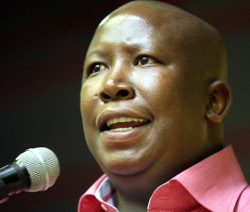
Julius Malema attacked Nedbank from a platform while addressing students at the Mangosuthu Technikon in Umlazi, Durban.

The real reason Nedbank had withdrawn funding from Athletics South Africa, said the ANC Youth League leader, was because the company was unhappy that our three medals from the world championships were won by blacks.

Julius Malema (Jelly Totsi - thanks Andrew D) looking like his good self

Fleshing out his position – so to speak – he went on to say: “What does the youth league know about hermaphrodites? The imperialists must not impose this on us if they have hermaphrodites where they come from. They must enjoy living with their hermaphrodites, because in South Africa there are no hermaphrodites.”

And a jolly good argument it is, too.

The story, in all its confusing glory, is laid out here. That is also where I got this picture, which, lets face it, paints a thousand words.

It is impossible to avoid: Cosatu is the enemy of the unemployed

Let’s be clear here. Cosatu might oppose unemployment, but that is an abstraction and Cosatu’s opposition is largely symbolic and ineffectual.

It is the interests and strivings of the unemployed themselves that Cosatu actively works to counter.

It’s obvious really. Cosatu is a federation of trade unions. A trade union is the representative of employed people, as employed people. As such the collective interests of employed people (the sellers of labour) is to get the best deal – in terms of wages and working conditions – from the employer (the buyer of labour).

As in any market, if the seller can control the supply of the good he or she can command the price and the terms of the deal.

But how to control the supply of labour in a situation of high unemployment?  By locking the unemployed out of the labour market!  Cosatu strives – and has generally succeeded – to deny the unemployed and the potential work giver access to each other.

Opposition to labour brokers, calls for increases in the minimum wage and a range of compulsory regulated collective bargaining processes have one thing in common: they lock in the interests of those already inside the system. They work together to make it either costly or illegal for the potential work giver to look beyond the pool of Cosatu members (i.e. the formally employed) for work seekers ( i.e. the formally unemployed).

The interest of the unemployed is to find work. The various protections and minimum wage and bargaining agreements and elaborate benefit schemes for those already in the system are of no interest to the unemployed who benefit nothing from these goods. In fact these “goods” impose a huge cost pressure on the work giver such that he or she will do everything possible to keep employment to a minimum.

Cosatu’s 10th annual congress closed this last week to much self-congratulation, much of it deserved.  Trade unions have undoubtedly saved capitalism from itself. The logic of the individual capitalist is to pay as little as possible (in wages and working conditions). It is only by the banding together of workers and the advancing of their collective interests (against the individual employer, through strikes and boycotts, and within the state and legislature itself) that working conditions have evolved into the human rights compliant work culture of modern capitalism.

But we forget at our peril that Cosatu represents a special interest group not coterminous with the national interest or the interests of all citizens. In important ways some of Cosatu’s interests are inherently opposed to the national interest.

Attempting to represent the national interest is the job of  the ruling party. Ruling parties can be captured by special interest groups, groups whose interests are at odds with the nation as a whole. Cosatu sometimes crows like it has successfully captured the ruling party. I argue here and here why I believe Cosatu has bitten off more than it can chew and already its crowing, to my ears anyway, is a hollow echo.

A back-to-the-future quote from FDR

Here’s FDR in an interesting quote I dug up. It’s from about 1935 – in the lead-up to his re-election in 1936 – and it is made to a journalist from the Hearst organisation.

FDR to a journalist in the run-up to the 1936 presidential election

This gives one a sense of how threatening was the Great Depression – to the very system of capitalist accumulation itself. This is, basically, FDR trying to save “the American way of life” from a real and significant challenge by socialists of various hues.

The Great Recession and particularly the excesses in the financial markets that helped bring it on, has strengthened similar force in our world.

The ANC and its alliance partners were ahead of the curve (as bankers like to say) on the family of ideas that FDR came to espouse: more equality, more regulations, more state, more taxation, more protection. The difference, though, is that FDR was trying to save capitalism from its own excesses. For Cosatu and the SACP, at least, they still claim to hope to use the excesses of capitalism against itself.

I remain convinced that the real power in The Alliance is the emerging and burgeoning  ‘capitalist’ elite and the ideas of this class are fundamentally similar to FDR’s and fundamentally at odds with the views the leadership of the SACP and Cosatu claim to espouse. 

(Note: My cute use of the word “claim” when referring to the views of some Cosatu and the SACP leaders is a result of the fact that I find it impossible to believe that leaders of the ilk of Blade Nzimande genuinely hope for the demise of capitalism when, in fact, they are becoming, in this historical moment and in this country, its main beneficiaries.)

Ruling party’s populism – such a clever trick

Just how broad a church is a broad church?

The ANC and the Congress Movement has always liked to refer to itself as “a broad church” – which basically means that people of different ideological persuasions should be able to find a home within the movement.

The Ruling Alliance is giving new definition to ‘broadness” – and no, this is not a joke about expanding waistlines in the ruling party (which is, frankly, no joke at all.)

Both Genghis Kahn and Mother Theresa would have found a home somewhere in the ‘Ruling Alliance’ – that is: the African National Congress (with its Youth League and Women’s League and uMkhonto we Sizwe vets), Cosatu (and its myriad affiliates) and the South African Communist Party (with its Young Communists League).

Last night the ANC Youth League came out in support of the solidiers who had clashed with police in Pretoria two weeks ago. This after the ANC’s Lindiwe Sisulu, Minister of Defence, threatened them with the full extent of the law – and quite right she was, too.

But the point is, it’s such a clever trick!

You can have ministers and leaders as diverse as telecoms minister Siphiwe Nyanda and SACP secretary general and Minister of Higher Education Blade Nzimande grossing out on the most expensive luxury cars in the world and you can have Zwelinzima Vavi, secretary general of Cosatu, attacking them for it. All comfortably within the same government.

This really does give new meaning to having your cake and eating it.

When a political movement is able to claim that it represents everyone, it represents no-one. Without a set of policies upon which a party can agree, the party replaces “politics” with “power”. If the ANC is not working for a set of policies and ideas then the hidden drivers can become power, wealth and patronage. What else is Julius Malema doing around the same table as Cyril Ramaphosa? What do they have in common? It seems to me that all they have in common is the hope that the Ruling Alliance stays the ruling alliance.

In the real world humans have a host of competing interests; and democracy, parliament  and the law is a system for mediating those differences.

So what interests has the Ruling Alliance got in common for which it is prepared to suppress differences of ideology and policy? 

There are only two possible answers:

  1. The Ruling Alliance suppresses differences because the broad agenda of transformation is too important to derail for tactical differences and clashes of class and ethnic interests.
  2. The Ruling Alliance suppresses differences of ideology, politics and policy because the benefits (in terms of money, property, power and/or prestige) of participating in government is more important for the individuals and groups concerned.

This is a straightforward clash between being motivated by individual greed and being motivated by concerns for the wellbeing of the struggling majority of South Africans.

I have no doubt that both these tendencies are true and struggling for dominance within The Alliance – and even within individuals within The Alliance. Ultimately one or other of such tendencies must become dominant.

The Polokwane revolution and the new Zuma administration presented themselves as favouring the former (saam staan for transformation) tendency. Not much supports this contention. I, for one, am waiting with (a)bated breath to see which way this thing is heading.

The White Stuff

It is difficult to know whether to laugh or to cry.

So, white refugees are streaming out of the burbs with their loot in big sacks on their aching backs, heading for Canada? The Great Trek II has begun and Brandon Huntley has gone to prepare a place for us in Saskatchewan or Churchill Manitoba? Hmm, can’t wait.

You have to ask: what has Canada done to deserve Brandon Huntley?

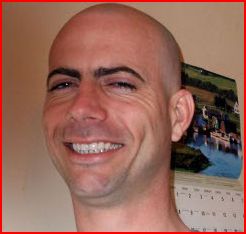
Brandon Huntley ... a picture tells a thousand words
Brandon Huntley ... stands out like a sore thumb ... hmm, yes he does rather

But then you remember. Oh, yes! His application for refugee status was successful. The panel that interviewed him accepted that he had been attacked 7  times (including 3 stabbings) by black people. Because he was white. Because he “stands out like a sore thumb”. They accepted that Brandon’s attackers called him a “white dog” and a “settler”. Ag shame, man!

So Canada opened the door. So Canada deserves what it gets. And watch out! Here we come, with our braais and boerewors and quaint views about the world. Canada you’re gonna love us!

Part of me is delighted by Brandon and the silly Canadian immigration board panel that accepted him in.  He might well be exaggerating to bolster his immigration case, but it is certainly within the realms of possibility that his story is true.

The country’s crime levels are out of control. There is racial anger swirling around the body politic.  The  “race card” gets played at every turn by cheating and failed politicians, bureaucrats and businessmen. It’s enough already.

But while we rub our hands in glee when the weak puncture the pretensions of the powerful, it is important to remember that the real and most numerous victims of  most sorts of crime in this country, especially violent crime, are poor and black. And what has consigned these victims to the bottom of the pile is Apartheid and its ongoing consequences. It’s difficult to think that someone called “Brandon” in the grip of trying to convert his tourist visa in Canada is justifiably placed at the centre-stage of South African history.