The Black Management Forum (BMF) is competing with the ANC Youth League to represent those who wish to gouge economic advantage from transformation and bulldoze every law, institution, practice and idea that stands between them and the smorgasbord.
Listen to the BMF president Jimmy Manyi at a recent conference hosted by his organisation as he urges us into the Animal Farm:
Firstly he attacks the protection of property in the constitution, saying the clauses insisting on fair or market value for appropriated land are the “sting in the tail”;
He goes further and argues “It appears the Constitution does not support the transformation agenda in this country”;
He bemoans court cases where previously disadvantaged individuals lost their court bids when trying to obtain tenders;
He attacks media freedom, asking “Why is it that the media can have a field day railroading the office of the president without impunity?” … although he probably means “with impunity”.
The times live report on his input concludes that: “Two further issues he feels need reviewing were Section 27 of the Constitution which pronounces on procurement and culture”
Manyi and those he represents are delightfully undisguised. There is something strangely compelling about a politics where the class that wishes to loot the state and pillage what it can from the transformation agenda sticks out a belligerent jaw and sulkily asserts: “F$@% YOU, it’s my right!”
I have often pointed out that the ANC’s clever- clever populism allows it to be all things to all people. I have mostly meant that that is a bad thing.
It is a legitimate question to ask: what are Julius Malema and Barbara Hogan (to name two arbitrary ANC leaders) doing at the same table? When you strip away all the noise and posturing you are left with the question: what, politically, economically, ethically, spiritually, culturally do they have in common? How can one organisation have so broad a policy that both these people can claim to find a home there?
Usually, my conclusion is that the original policies designed to transform us away from Apartheid are disappearing from the ruling alliance and being replaced by the objective of power (and wealth and influence) for its own sake.
This morning I want to temper that negative view.
Our society has a number of real and urgent contradictions or fault-lines where the clashing currents are difficult to manage. Here are some of the most important:
White versus black (versus Indians versus Coloureds)
poor versus rich;
the employed versus the unemployed;
Zulu versus Xhosa versus Pedi versus Ndebele versus Sotho, versus Tswana versus Venda;
Western versus African;
Urban, modern and fast versus rural, traditional and conservative – with a sub-theme of modern city women versus patriarchal men or at least men carrying around chauvinist and patriarchal ideas in their heads.
The fact of the matter is that these divisions are not represented in the clash of politics in our formal political processes of parliament and government. There is no one party on one side of any of these divisions and mostly no one party on the other.
A quick glance through the ANC’s top leadership, structures and relationships shows a very deliberate attempt to represent the full scope of South African society.
I have mentioned elsewhere how Jacob Zuma has played a crucial role in winning Zulu’s back into the ANC. Cyril Ramaphosa is in part there for Venda’s, Hogan for whites and women, Derek Hanekom for whites and farmers, Mac Maharaj for Indians; Trevor Manuel for Coloureds and business … and global capital markets; Baleka Mbete for women … the list really could go on for ever.
One of the reasons I think Julius Malema is unlikely to face serious punishment from the ANC leadership, is the organisation values the fact that, at one level of abstraction, he “speaks for” the 2.5 million young black South Africans between the ages of 18 and 25 who are unemployed and not in any kind of education. (I do think Malema is primarily a populist disguising his own greed, but his populism also articulates – or helps weave into the national debate – a real view and an actual constituency.)
Then the alliance relationships with Cosatu, with the SACP and broader relationships with Contralesa (Congress of Traditional Leaders of South Africa); the Black Management Forum and outwards all the way to polite meetings with the Afrikaaner Weerstandsbeweging are all concentric circles of the ANC attempting to straddle all divides in the Society.
I think there is a very real danger in this context of ANC politics and policy becoming meaningless and allowing people in it for personal riches and power to rise to the top.
But I think it is important to acknowlge the upside.
We are a society in which the formal insitutions of democracy are new and tentative – and the divisions are threatening and profound. As many groups and interests as possible need to find expression in the national political debate and the formal institutions do not yet represent them.
As a second prize, an overwhelmingly dominant ruling party that attempts to play the role of a parliament of all the people, that attempts to speak with the cacophony of the thousand arguing tongues is not all bad.
Julius Malema has received a body blow and is reeling about the ring.
I mostly want to discuss why this is important – beyond the obvious reasons that drive the obsessive media focus on the grandiose little ANC Youth League President.
But first a bit of context:
As I write Julius Malema is in the process of being disciplined in the ANC. He has sailed closer and closer to the wind in the last few weeks and, it seems, a dunking is now inevitable.
There are three main charges:
On a Zanu PF platform in Zimbabwe last week he attacked the MDC and praised the Zimbabwe “land reform” programme and used the opportunity to promise economy wide nationalisation in South Africa – this a few days after President Jacob Zuma had returned from trying to broker an agreement between the MDC and Zanu PF;
He sung – in defiance of a court ruling and of specific orders from Jacob Zuma – the old “struggle” song that includes the words “kill the boer, kill the farmer” – this transgression became more serious when Eugene TerreBlanche was brutally murdered by young black workers on his farm;
Each of these incidents received specific sanction from the ANC, but the straw that broke the proverbial camel’s back came when Malema was (quite bombastically) giving an interview at ANC headquarters on his triumphal return from Zimbabwe. For a variety of reasons Malema seemed to lose his temper and, in a bullying and autocratic fashion, threw out a BBC journalist. Catch that unsettling episode here. For the ANC, where form remains important, this rudeness was a step too far.
Julius Malema and the policy he represents is on the back foot. His behaviour has finally caused those who have backed and protected him within the ANC (particularly Tokyo Sexwale) to start to put distance between themselves and the Youth League leader.
His relative isolation is reinforced by a growing rebellion against him within the ANC Youth League – which he appears to be only just managing to control through bullying and barnstorming tactics.
So why do we so minutely follow the two steps forward, one step backward advance and retreat of Julius Malema and his cronies?
For me – as a ‘professional political analyst’ (someone whose non-evidential claim is that his political views are subjected to more rigorous intellectual testing than those of your average Joe or Sipho in the comments pages of timeslive.co.za before their airing … hmmm) – there is a real and legitimate reason. The Malema grouping is fighting to control the African National Congress and, in my opinion, the African National Congress remains, for better or for worse, the institution most able to affect South Africa’s future.
South African politics is overwhelmingly dominated by the ANC and nothing indicates that we are in a process of moving away from this domination. Our politics is racialised and people tend to vote their ethnic identity. The ANC has a de facto monopoly on the banners and flags and songs and dead heroes of the liberation struggle; and it has unprecedented capacity to spread goodies around its supporters and potential supporters. This combination – being the party of liberation and being able dispense the national largesse – kept the Mexican Partido Revolucionario Institucional or PRI (the Institutional Revolutionary Party)in power for over 70 years (sometimes with a different name) and it is not inconceivable that the ANC could rule for as long or longer – especially given the additional dimension of racial solidarity.
So, the setback suffered by Julius Malema and his cronies is important because this is the most dangerous wing of the most voracious faction within the ANC. It is not for nothing that Malema has been singled out by the hysterical and monomaniacal mass media in South Africa. His skill at taking rents out of an economy trying to transform itself is by no means unique within this or previous versions of the ANC, but it is his astute use of racial appeals to the poorest black South Africans to cover, disguise and justify his tenderpreneurial flare that makes him formidable.
I do not think it is all over for Julius Malema. A person of this political skill and focus is not going to be wiped off the face of the political realm because of a setback like this one. I expect him to be disciplined by the ANC and I expect that this will set him back a few years.
It is, of course, important to point out that Julius Malema is just an extreme version of something that has taken hold of the ANC at a very deep level. I am under the impression that the first thing the Zuma faction did when it came to power after Polokwane was change tender boards throughout the country. Do you think that was to clean them up after Mbeki’s depredations? I think not.
So closing down Malema is a necessary, but by no means sufficient, condition for cleaning up the ruling party and government. That would entail handing over to the ten or so people in the SACP and Cosatu leadership who are not themselves armpits deep on the take – and, unfortunately, they would begin paving the road to hell almost immediately.
So is Juju, as he is not very affectionately known by the aforementioned media, gone?
He is 29 years old which will make him 36 at the ANC’s elective conference in 2017 and 41 at the elective conference in 2022. He has got a lot of time.
I can almost hear, echoing the words of Arnold Schwarzenegger’s 1994 The Terminator, the battered Julius Malema growling: “I’ll be back”.
I, for one, am not holding thumbs that the next manifestation is going to be any better. In fact a Julius Malema, older and wiser, tempered in the fires of adversity – goodness, now there is a scary thought.
Herewith a note I wrote a week ago for a South African client concerning a recent whip around the London fund management industry
Foreign fund managers perceptions of South African political risk
I recently had an opportunity to interact with a few London-based global emerging market fund managers. These were generally from long-only equity funds, but included a smattering of everything else.
The main lessons I learned were
not to be overwhelmed by the negative news flow;
always think in relative terms – a negative and obsessive focus on South Africa is meaningless without realistic peer comparisons.
This was brought home to me again as the weekend news of the brutal killing of Eugene Terre’Blanche hit the local and international press. The media focus alone seemed to suggest that this was a potentially destabilising event. However the story has quickly descended into the squalid domestic tale it really is, and the over-the-top alarmism should be faintly embarrassing to those who trumpeted it over the holiday weekend.
Here are the main questions I raised in London and the main responses I received*:
The news explosion around Jacob Zuma’s latest romantic and similar engagements does not drive capital flows
This point did not need emphasising with the fund managers I saw. If anything they were faintly puzzled as to why I would bother to raise it. For them the emerging market universe has much colourful (and sometimes ugly) personal behaviour by the political leadership and other powerful members of society. Zuma’s polygamy and latest love child are way down the list of “transgressions” in that universe.
Conflict over economic policy making the investment and operating environment difficult
The point I was making was that Pravin Gordhan’s budget speech differed in important ways from both the DTI’s Rob Davies’ Industrial Policy Action Plan II and Ebrahim Patel’s Two Year Strategic Plan. My issue with this was that Jacob Zuma had not settled important policy conflicts within his cabinet.
The different emphases could be summarised as follows:
Pravin Gordhan supported fiscal restraint, inflation targeting, a segmented labour market and a competitive and unprotected manufacturing sector – and for this he was heavily criticised by Cosatu.
The policies espoused in IPAP 2 and the Two Year Strategic Plan from the Department of Economic Development implicitly called for monetary easing, a weaker currency and a vigorous programme of interventions into the domestic economy through the use of tariffs and taxes – policies strongly supported by Cosatu.
Several of the fund managers that I interacted with had recently (within the last few months) met with all the ministers concerned either as part of a marketing tour led by Jacob Zuma or while in South Africa themselves. The detailed interactions with all these departments had convinced them that the policies of government were the policies as espoused by Pravin Gordhan and further that the more activist policies from Patel and Davies were not uncommon in emerging markets and at least did not include new capital controls.
I am not convinced the policy confusion is ‘investment neutral’ – although I do not think is catastrophic. Cosatu and the SACP clearly believe they have a chance to set policy – including monetary and industrial policy – through the DTI and the new Department of Economic Development. Thus Jacob Zuma seems to be clearer and more decisive about these issues in front of foreign fund managers than he ever is in front of a domestic audience. He will reap high resistance and anger from Cosatu and “the left” when they realise they have been lied to again. I think it is clear we are seeing the first signs of this realisation – in, for example, the threatened strikes during the World Cup against Eskom increases.
Julius Malema and the Nationalisation of the Mines
Julius Malema provokes a lot of reaction wherever he is discussed. Not many fund managers take him seriously and again it is because they have met and dealt with senior government and party officials who have spoken of Malema with patronising indulgence and a touch of exasperation.
Susan Shabangu, Minister of Mining, has done good work in assuring fund managers throughout the world that there is no possibility that the South African government will consider the nationalisation of mines as a serious policy option; and I came across several people who had met her and been convinced by her assurances.
Cronyism and tenderpreneurial flair – the threat to service delivery, stability, the functioning of the parastatals
Continuing on the theme of Jacob Zuma’s inability to solve the big conflicts in his government I argued that cronyism, nepotism and tender abuse are:
important contributing reasons for the poor functioning of the State Owned Enterprises – the Eskom example reveals that enrichment agendas in tendering and the appointment of senior personnel damages the utility’s ability to do the job;
key to understanding the failures of local government and hence the ongoing violence of the service delivery protests.
There were few fund managers I met who disagreed with this assessment, although some, yet again, argued that in the universe that includes Russia, the Middle East and Brazil, South Africa stands out less than we would imagine.
The World Cup and the waiting Hangover
It is perverse to argue that the downside of the World Cup includes:
it could become the focus terrorist attacks;
it could be targeted by organised labour and taxi operators to strengthen their hand against government or employers;
it will inevitably entail a let-down or ‘hangover” period.
This would be a little like arguing that the downside of life is death and that it should therefore be avoided.
I never met a fund manager in London, or elsewhere for that matter, who disagreed.
*Please note that this is a subjective process, over determined by my own interpretation and by a selection processes out of my control. Any real collation of “the views” of fund managers must theoretically translate into their holdings and the prices at which they buy and sell.
The bludgeoning to death of Eugène Terre’Blanche together with the Zimbabwe public display by Julius Malema feels like a tableau arranged by a naughty god with idle hands.
Here’s the shape of it:
Malema, on a Zanu-PF platform, admires the seizure of white owned farmland and sings “kill the boer” – catch his words here. This is on a Zanu-PF platform. That party spent much of the 1980’s ransacking the liberation pantry. Just as the last few goodies were being looted and eaten by the engorged Zanu-PF fat cats popular discontent started to escalate and began focusing itself on the ruling party. With no wealth left to buy off the masses, the Zanu-PF cronies turned to what was left of the productive economy: the commercial farming sector. The land was largely white owned. Zanu-PF orchestrated the forceful invasion and seizure of the farms and commercial agriculture and foreign earnings collapsed.
Terre’Blanche, who infamously, and almost on a whim, beat a black man into permanent brain damage, is an icon of white supremacy – much diminished now and something of a joke; but undoubtedly sanctified by the manner of his death (it appears he was killed by young black labourers over a dispute about money). Already there is noise of a white backlash – although it is too early to say whether this should be taken seriously or not.
I don’t really need to say anything more. This story tells itself and it has its own energy … except perhaps it should be mentioned that Jacob Zuma has just attempted to mediate between the MDC and Zanu-PF – the history of Zanu-PF’s violent attempts to crush the MDC refers. Julius Malema is the President of the ANC Youth League – and I suspect someone more important and threatening than he first appears, as I argue here. Jacob Zuma is the president of the ANC and of the country and the SADC negotiator between the MDC and Zanu-PF … and Julius Malema refused to see the MDC while he was in Zimbabwe.
The first by David Brooks from the New York Times entitled The Return of History (a dig at Francis Fukuyama’s deeply mistaken The End of History and the Last Man – 1992). He constructs the history of Economics as a play in 5 acts. Act I is about a discipline that studied mythical Man, the “perfectly rational, utility-maximizing autonomous individual”. In Act II economics starts to realise humans are less rational than expected. Act III is the global debt crisis and the fact that traditional economics seemed to have zero predictive power in as far as this crisis was concerned. Act IV and V are the most interesting bits and point the way for a humble new economics more closely allied to the (appropriately humble) intellectual traditions of psychology and history.
Related – and the most interesting piece of writing I have read in some time – is What Does Greece Mean to You? by John Mauldin. It is written as a letter to his children (and I assume it really is what it claims to be because he puts their pictures – they’re a good-looking bunch – right in there and pre-empts a dispute with a supposedly more liberal daughter, red-headed Melissa, by denying his figures are a “Republican research conspiracy”). Mauldin explains to his children that the Greek (and Global) debt crisis must be understood as resulting from inevitably critical states in previously stable complex systems. If that sounds like a mouthful, go to the article, because without oversimplifying or intellectually short-changing in any way, Mauldin is able to explain how our global financial system is shot through with instability – and that until the debt is painfully unwound catastrophe is imminent. Catch it here, I recommend you do – and push through the early bits where he is paying the bills by advertising his “paid for” research products and writing – it’s the right thing to do.
Thanks to collaborator and friend Sandra G. for the heads up.
Take a look-see at the names that are linked in Evelyn Groenink’s excellent story about IT billionaire Robert Gumede’s wedding to Dr Portia Mkhize in Nelspruit last weekend.
Ignore if you can the author’s articulate disgust at the complacent and self-satisfied comrade billionaires and their squeezes grunting at the golden trough while Leandra burns.
Think instead of the names she links, almost as an aside: Mathews Phosa, Tokyo Sexwale, Julius Malema, Fikile Mbalula and then outwards into realms more obviously dark and filled with foreboding.
It’s an interesting social calendar piece that pushes the boundaries of the genre. Catch it here.
I go to the Big Smoke tonight (actually the name wouldn’t work today – there are not many cities in the world that are cleaner, more exciting and with better restaurants, parks and museums … in my humble opinion).
I will be seeing most of the big emerging market fund mangers and discussing South African political risk and the Zuma presidency with them. I am betting that, as usual, they will tell me I worry too much … look at Russia, they will say; or Brazil, Turkey, the Middle East … you want political risk?
It’s always a relief to hear foreigners with big money to invest saying that we underestimate ourselves, or that we worry too much.
I will try and post while I am there – possibly reflecting on what I can glean about what the big money thinks about our future – but if that doesn’t work, I will be back on Wednesday next week.
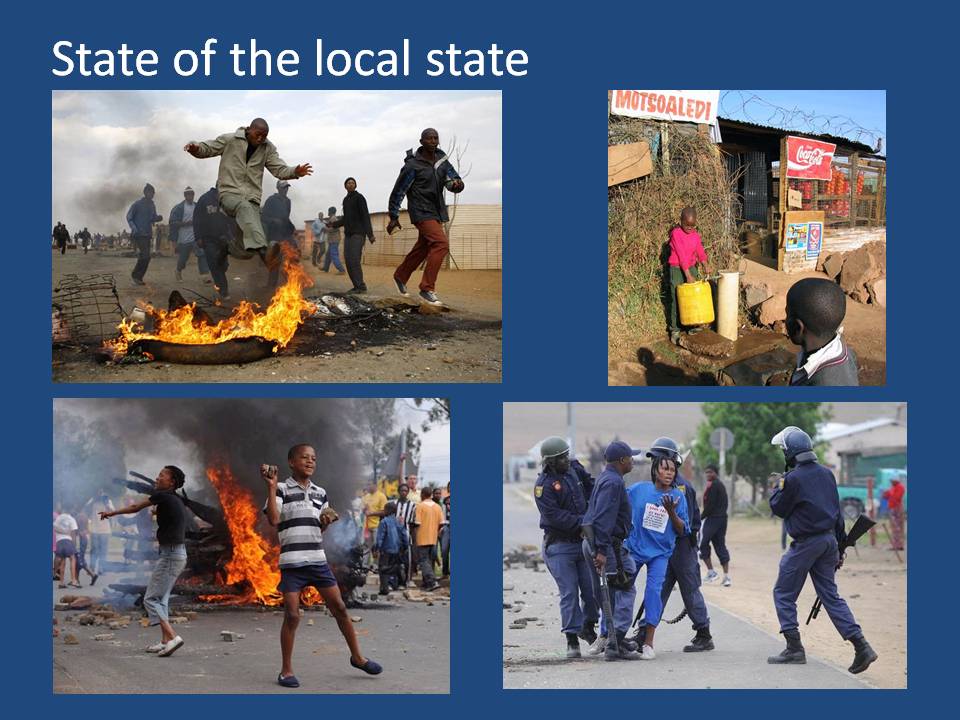
The local state – its politicians, agenda and bureaucracy, is under popular attack
It is starting to be whispered that there is a “hidden hand” in the service delivery protests*.
The problem (of the protests) is serious and threatening and government is starting to worry about high-profile violence during the World Cup.
These protest share a strong crossover constituency and architecture with the xenophobic violence that occurred May 2008. At that time, Thabo Mbeki’s spooks argued that a hidden hand was at work – in one bizarre version Zimbabwe’s Central Intelligence Organisation was fingered as triggering the violence to punish the Mbeki government for some impenetrably Byzantine set of motivations.
This time around the speculation is that the spreading protests have something to do with Alliance tensions i.e. the conflict (endlessly discussed in these columns) is fueling service delivery protests – I suppose that would mean either the ANCYL or Cosatu/SACP using popular discontent against the sitting council dominated by either the leftists of the nationalists respectively.
To argue that Alliance tensions is the (or even a) main driver is a bit of a stretch. The protesters themselves foreground slow delivery of housing and the whole gamut of services (toilets, sewerage, water, refuse , telecommunications, roads) but also have a sharp focus on corruption, maladministration, nepotism – and therefore, indirectly, on cadre deployment.
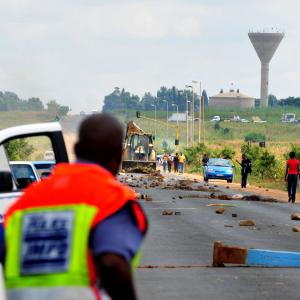
From M&G – Modderfontein Road in Ivory Park after service delivery protests
The protests appear to be coordinated. They have similar beginnings: “elders” – or the moral equivalent – meet in a town hall to discuss grievances; they decide to march to the municipal offices in the town centre; they carry placards about Eskom, housing, corrupt council officials; on the way they are joined by youth and the unemployed, and the march swells; somewhere near the edge of the town centre police stop the now more threatening and chaotic march; stones are thrown and rubber bullets fired; the protest breaks into smaller groups and spreads; councilors and council property are targeted and running skirmishes with the police occur over a few days; the ANC sends a SWAT team to the area and this team either moves against the council or stands firm against “anarchic” and “violent” protesters. At any point during this process the attention of the mob can turn to the foreigners – Zimbabweans, Malawians, Somalians , Mozambicans, Angolans, Nigerians and those from the DRC.
It has become something of a legend and commonly accepted “fact” by foreigners living in South African townships that post the World Cup and in the lead-up to the local government elections in 2011 the xenophobic violence will erupt on a scale beyond anything that has happened in the past.
The Davies-J Curve – the real hidden hand behind the violence
One of the reasons the government and the intelligence agencies are suspicious about the violence is that it occurs always in municipalities where there has been a degree of successful service delivery. The violence does not seem to happen in areas that are absolutely poor and unserved and have remained so for some time.
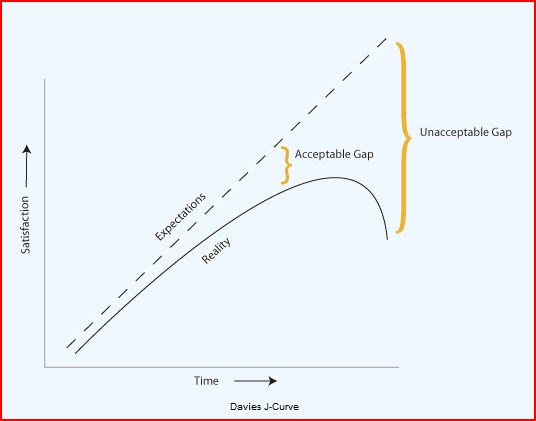
Interestingly this is precisely the situation predicted by US sociologist working in the late 1950’s, James C Davies. His theory is that rising expectations is related to the possibility of armed conflict but only when rising expectations – brought about by, for example, some degree of service delivery – meets a downturn. His theory became known as the Davies J-curve.
What happens is that when material and other conditions are improving, expectations rise faster than the individuals own situation. The system seems to be able to cope with this, except when there is a downturn of some kind – this is the sharply curved “Reality” line in the diagramme above.
This predictive framework (usefully discussed by the Centre for Security Studies here) almost perfectly mirrors what has happened in townships and poor municipalities since 1994. The violence seems to spike in early winter and it seems to be concentrated in areas that have had by-elections. In general it seems to be at its worst after national local government elections.
We must assume that in the lead up to such elections the ruling party and its councils push service delivery and the promise of service delivery. After the elections delivery collapses.
Thus the expectations are on an ascending path as the reality of delivery veers sharply downwards.
Violence results and often the weakest and poorest are both the victims and perpetrators of that violence.
* Orange Farm, Sedibeng, Siyathemba township in Balfour, Leandra, Lesilie, Oogies, Accornhoek near Bushbuckridge, Chochocho near White River in Mpumalanga, Protea-Glen, Dobsonville-Gardens in Soweto, Ennerdale in Fine Town, Reiger Park in the East Rand, Parys, Diepsloot, Attridgeville and Mamelodi – all names of service delivery protest hotspots culled from recent press reports. While I cannot place all these towns on a map (and am not even sure that some are not colloquial names for the same place) it seems clear that there is an unfolding crisis of governance in many of South Africa’s 283 municipalities , especially in the poorest, semi-rural communities.
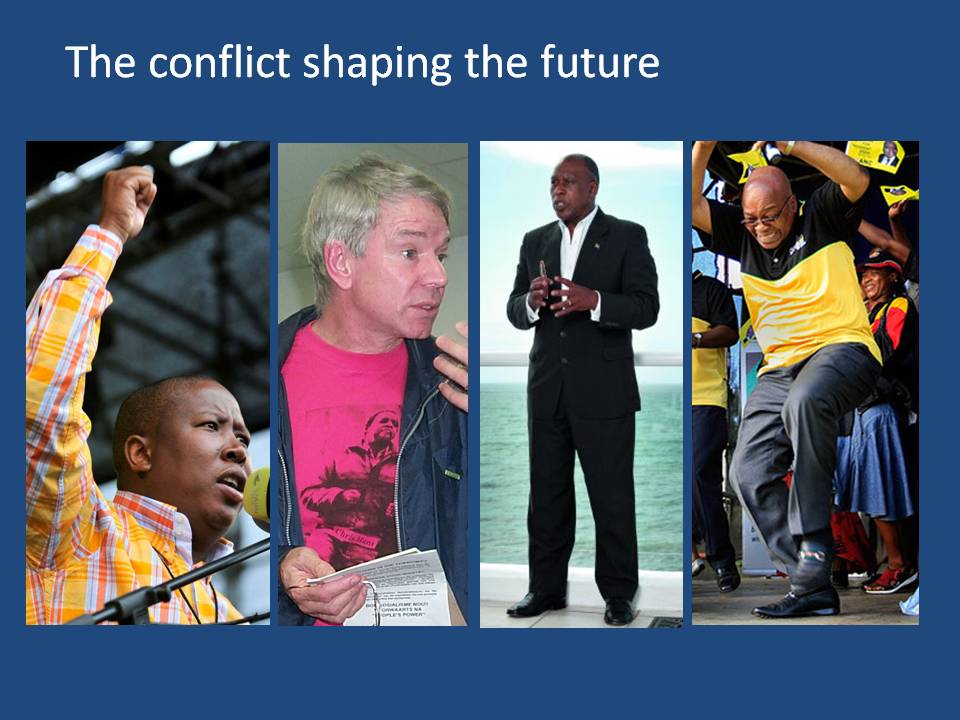
As promised another occasional slide that illustrates a major theme of the moment. I have put the meat into the caption – note the reversion to some traditional Marxist theory … fractions of capital and the working class fighting to wield the state? Was that Althusser or Nicos Poulantzas … hmm, no, for them the state was a site of struggle and not an instrument …. gosh, I’ve forgotten more than I ever knew.
This slide illustrates discussion about the “real” conflict shaping our future – I use the Eskom saga and the nationalisation debate to illustrate how an alliance of the most productive classes (the industrial working class and capital) is involved in a struggle with lumpen elements of the comprador bourgeoisie and ‘fugitives from justice’ over who gets to wield the state and to what ends
Absent from the slide itself are Zwelinzima Vavi and Bobby Godsell. Here they are wearing their respective hats as, in Vavi’s case, a leader of the industrial working class; and in Godsell’s case Chairman of Eskom (but more revealingly Chairman of the World Gold Council). They are up against the ANCYL and the Black Management Forum.
The costs of defeat and the prize of victory concern the fate of Eskom: will it be looted or will it be used as an engine of economic growth and job creation?
A quick run through documents and press statement emanating from the Congress of South Africa Trade Unions and the South African Communist Party reveals the existence of a new ‘song sheet’ our crimson brethren have devised to help them sing in tune with each other.
This is something more than a coordinated set of slogans and something less than a recipe for creating socialism, socialised production and a workers’ republic out of the ingredients of the conjuncture.
If I had to try to construct a Ten Point Programme out of the bits and pieces in the press statements and discussion documents of the last few months, but particularly the last few weeks, it would look something like this:
Argue that IPAP II (industrial policy) from Minister Rob Davies of the DTI in combination with Minister Ebrahim Patel’s Medium Term Strategic Plan (2010/11 – 2012/13) form the first pro-poor, employment creation oriented plan to put South Africa on a “new growth path” in which state intervention will lead to job-rich and equitable growth.
Argue that the Rand is overvalued and wherever possible criticise inflation targeting and call for the nationalisation of the SARB as well as devaluation of the currency to effect a growth of valuable jobs in the export manufacturing sector.
Link the Treasury under Pravin Gordhan to the economic tradition fostered by Thabo Mbeki and Trevor Manuel and keep pointing out that many of the senior bureaucrats in that department were trained and placed by the former president and former Minister of Finance; as part of this thrust attack labour brokers and the subsidy for first time youth workers as part of ongoing attempts to segregate the labour market.
Co-ordinate calls for a national health insurance and free and universal education.
Defend Gwede Mantashe (your man at the heart of the ANC leadership) and isolate the most hostile elements among the conservative nationalists, populists, tenderprenuers and anti-communists – Julius Malema and Fikile Mbalula (the proposed challenger to Mantashe) are perhaps seen as core elements of this “most dangerous friend” group, although Billy Masetlha and Tony Yengeni are in there somewhere.
Start preparing a strategy linking this group with those attempting to buy their way into leadership of the alliance i.e. those who have inherited the Brett Kebble mantel. The general direction of the red finger of accusation appears to point at Tokyo Sexwale.
Fight to stay in the alliance and fight for your views within alliance forums; make sure the ANC and government takes the results of those forums seriously.
Prepare your cadres to influence the outcome of the National General Council later this year and the ANC’s elective National Conference in 2010 – and start preparing a set of policies and candidates to support. In the process continually cement relationships between SACP and Cosatu
Always maintain a mass profile (through work amongst the masses) that is distinct, pro-poor, anti-corruption and principled; this strengthens your hand in Alliance forums but, more importantly, is your insurance policy if or when you are eventually forced out of the alliance.
It seems logical that despite the vicious atmosphere in the ruling alliance Cosatu, the SACP and the ANC’s own left-wing are not about to abandon the field to the “proto-facists“, populists, tenderprenuers and powerful hangers-on from the “1996 class project“. Not so soon after their triumph at Polokwane. Not after “capturing” two key cabinet posts and finding themselves in a position to, perhaps, profoundly influence government policy for the first time since 1994.
Those hoping that the tension in the ruling alliance would lead to a blossoming of opposition politics in parliament will have to wait a little longer. For now the real prize is still within the ANC and the ruling alliance.
I have been sitting on this for a few days partly because Cosatu’s Central Executive Committee statement on Thursday last week and the ANC response are as harsh as we have seen – and that includes the tone of voice that accompanied Cosatu’s huge strike against ‘Mbeki’s privatisation’ in 2002.
Cosatu has a long and interesting statement; one of the more important paragraphs read:
Regrettably, to our frustration and anger, the government continues with the tendency inherited from the previous administration to ignore policy directives it does not like and only implement those areas that the markets/capital are happy with. In this regard we are angry that the Treasury remain infected by the highly organised but conservative bureaucrats who have been driving neo liberal and conservative policies for the past 16 years.
The ANC replied:
ANC has grown weary of the latest media outbursts by COSATU, seeking to rubbish and undermine anything from the content of the President’s State of the Nation Address to the Budget Speech by the Finance Minister, as well as ANC policies. Taking pot shots at the ANC and its Government show signs by COSATU of veering towards oppositional politics and not sticking to Alliance politics and traditions.
The point for now is that this does not presage an actual splitting of The Alliance. Cosatu is going to mobilise its members to join and influence the ANC in the lead-up to the ANC’s National General Council later this year – much as they did in the lead-up to Polokwane in 2007.
Cosatu’s short term objective is to defend against the attack on Gwede Mantashe (emanating from, but not exclusive to, the ANC Youth Leage). The longer term objectives of Cosatu (and the SACP) are finally starting to emerge and I will deal with this in the next post.
For now Cosatu has attacked on a broad front:
‘tenderprenuers’, corruption and cronyism;
relaxation of the labour market;
failure of the ANC to stick with agreements that are reached in alliance summits;
monetary policy, inflation targeting and the role of the SARB and
a general lack of fit between micro and macro-economic policy.
For its part the ANC hadn’t quite finished with its fury at Cosatu’s CEC statement, and in particular Vavi’s niggling and constant accusation of corruption within the ANC and government.
Here’s the full text:
The African National Congress (ANC) has noted repeated allegations of corruption raised by the Congress of South African Trade Unions Secretary General, Cde Zwelinzima Vavi.
Cde Vavi speaks with conviction that “there is a tiny minority in the ANC leadership and membership which is corrupt and who use the ANC to enrich themselves”.
To this end, Cde Vavi has not raised this matter with the ANC in any of the fora of engagements we have and he has not provided any evidence of such allegations.
As a leader of the Alliance, we would have expected of him to have brought such a matter to the ANC leadership or even presented the list of such corrupt individuals. Together, we would have walk and matched to the nearest police station to ensure that such individuals are arrested. Cde Vavi would have assisted the ANC and government to root out the scourge of corruption in the country.
Cde Vavi’s failure to bring this weighty matter to the attention of the ANC and even his failure to report this matter to the law enforcement authorities, amounts to an insult to the standing and image of the ANC, its leadership and membership. These omissions on his part cannot amount to a fight against corruption but is reminiscent of grand standing.
Issued by:
Jackson Mthembu
ANC National Spokesperson
I don’t suppose it means much, but Jackson Mthembu was released from a police cell a few hours ago after been caught for drunken driving in Cape Town early this morning
Who dares give an answer to these questions? Oh, alight I will.
I have burned myself before by being a little too sure and a lot too wrong about what the future holds.
Analysts like myself are constantly encouraged to take a firm view of what is going to be going down down the road. The client – usually a fund manager – is the person who has to take a bet on a number of future trends and it usually helps him or her to hear strongly stated predictions with the various arguments that support them from various analysts. If these analysts disagree, all the better. Hence outlier positions are often useful.
“So what percentage likelihood would you place on Zuma becoming president?” I would be constantly asked in the lead-up to Polokwane.
“Oh, not more than 45% … the Mbeki machine is kicking in …. the Zuma character issues are overwhelming …. the left of the Alliance is betting against history …. the ANC prefers educated leaders …”, blah, blah fish paste; if I could only go back there and shut myself up. But I have to believe (in an existential sense) that it added some value.
I am sure anyone whose job it is to understand the workings of a particular societal process or phenomena is likely to make mistakes when pushed to give specific predictions of outcomes. For political analysts I suspect the dangers are greater than for most. The errors seem to congregate in two broad categories:
Confusing how it feels with how it is:
There seems to be a strong human instinct for story telling and narrative that causes us to think of the ordering and outcome of events as being rooted in the origin of a story. The error is that we tend not to hold randomness as our base case (as I think we should – or rather my experience has taught me I should.)
Confusing the subjective with the objective:
This is about the power of what appears to be the consensus. We tend to believe the views that we collect and hear from others, especially when they are reflected back at us by everyone we speak to and by the media consensus. The future is, objectively, full of surprises. Don’t be confused by certainty and repetition – he said sternly to himself.
With those qualifiers, my ‘professional expectation’ is that Zuma will survive the first term of his presidency.
Both the ANC itself and the interplay of the Alliance partners are a real mess, but it took a Polokwane to throw out Mbeki and anyone involved in that process is probably still counting the costs of that exercise. In other words, doing it again, and this time without the kind of unanimity that surrounded the Mbeki ousting, would have to be overwhelmingly urgent as the costs in division and discontinuity would be overwhelming. And I don’t think there is any consensus in the alliance of forces (clearly no longer an alliance) that backed Zuma against Mbeki that there is the requisite urgency around the person and performance of the President.
I am less confident (although strictly speaking I am not confident – in the sense of being certain – about any ordering or outcome of events in the future) about the second term. Up until a few weeks ago I would have said: it is always easier to allow the sitting president to stay in his job when the big contending forces are still involved in the war of position; that no side’s victory is yet in sight. But even if the big power plays are not yet completed by the ANC centenary conference in 2012 there might be a consensus that a safer pair of hands (Motlanthe?) may be in order.
Zuma’s term as president is, unfortunately, proving itself to be that bad.
The extreme nature of the reaction to the electricity price increase is about a number of things, perhaps most obviously:
the public and institutional suspicion that the crisis in Eskom is due to cronyism at a management level and looting via tender abuse by a politically connected elite, and
the Great Recession has left the society, but particularly the poor, deeply vulnerable to price shocks like this one.
The National Energy Regulator of South Africa has granted Eskom the right to increase its tariff 24.8 percent this year and a further 25.8 percent for 2011, and 25.9 percent for 2012.
The problem Eskom is attempting to address is its increasing inability to meet growing demand for electricity because of capacity constraints in the generation, transmission and distribution process – with this capacity already having caused the economic and social chaos of the rolling blackouts two years ago.
The price increase immediately:
makes it viable for Eskom to raise the more the R385 billion it has estimated it needs to upgrade its generation capacity;
reduces demand.
Either way (or rather, both ways) the constant threat to the extremely narrow reserve margin (the small safety gap between what is demanded by industry/society and what Eskom can supply) is immediately relieved.
The SACP and Cosatu are outraged. The SACP calls this a “catastrophic betrayal of the poor” and places the blame squarely on “a neo-liberal economic regime that did not encourage increased state investment”. Cosatu speaks in similar terms, but also appears to acknowledge that the increase is less than the 35% per year that Eskom wanted.
The level and timing of the increase is a political matter and it is quite likely that Eskom built a margin into its request to give the regulator and, by popular implication, government room to wriggle and demonstrate its caring and thoughtful approach. And this is as it should be in the political kingdom.
To make a real assessment of the validity and necessity of the price increase one would need a detailed and comprehensive analysis of Eskom, its productivity and its commercial soundness. In the absence of such an analysis here are two general points:
We have to move towards costs recovery in this kind of utility. It is appropriate to protect the poor and possibly subsidise the use of this kind of product, but the society as a whole must pay the price of the secure and ongoing generation, transmission and distribution of electricity. Hiding those costs through the state subsidising Eskom is a mistake.
It is crazy that this far down the road we still have a state utility that has a monopoly on the generation and transmission of electricity. What is it about the last hundred years of human history that could suggest to anyone that a state institution is likely to generate electricity more efficiently, cleaner and more securely than a competitive private sector and a traded electricity market?
Aside from the most satisfying stitching up of the ANC Youth League president there were two other excellent bits floating up through the dross of the weekend news; both from the excellent www.timeslive.co.za.
Firstly, Ray Hartley (editor of The Times and the Times Live website and author of the exceptional blog The Wild Frontier) interviewed Jeremy Cronin about, amongst other things, the dangers of populism. Cronin talks with clarity of the clear and present danger of a form of fascism that is taking root – and being encouraged to take root – in the mass of 18 – 25 year olds who are unemployed and not in any form of tertiary education in South African. Listen to him speak of “big man” authoritarian politicians dealing in patronage and claiming a shared victim-hood with under-serviced poor; and listen to him warn of the similarities of our present to both 1930’s Germany and present-day Zimbabwe. There is no question in my mind that the red finger of his accusation is pointing at the likes of Julius Malema and his crew. I highly recommend the interview; catch it here.
The second piece is from Ray’s colleague Mondli Makhanya, editor of the Sunday Times. He warns that the current ANC leadership is airbrushing both Thabo Mbeki and FW de Klerk out of history in much the same way as Stalin erased the image of Trotsky. It is an interesting point and, now that he mentions it, clearly true. Catch it here.














 Nic Borain