On having agency

The Activist Developmental State is an idea I feel deeply ambivalent about.

The picture below of Shanghai in the 1990s and then again last year is from a blog by Roger Pielke, Jr, professor of environment studies at the Center for Science and Technology Policy Research at the University of Colorado. (Thanks to Anthony for the link and please click on the pic to go to Pielke’s website.)
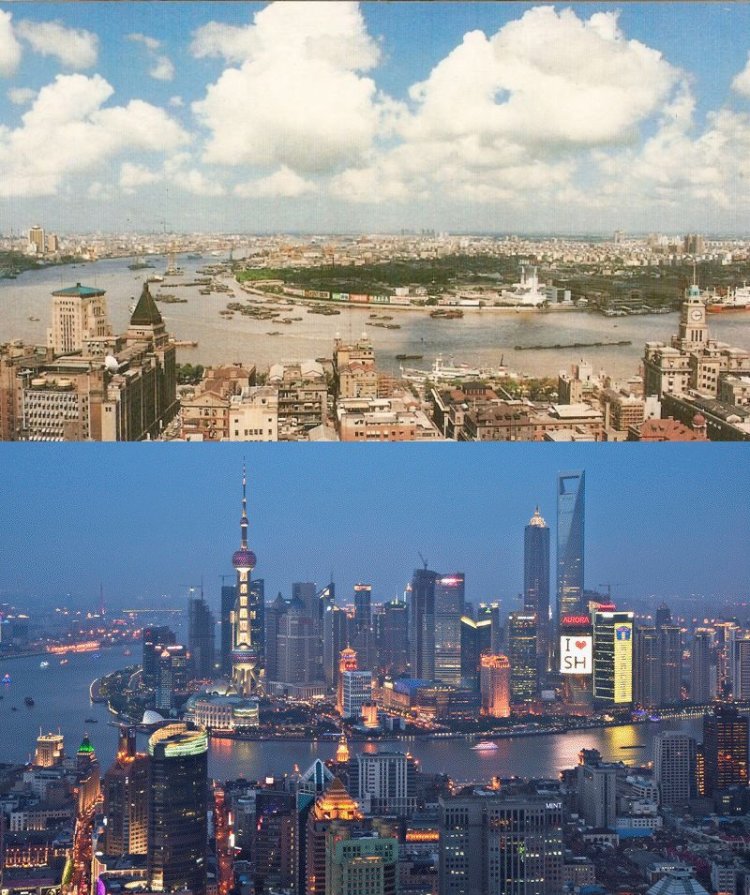
This stark, and wonderful, portrayal of astonishingly rapid social, environmental and economic change rather raises the question of how it was achieved.

And, more importantly for our provincial purposes here: can we do something similar?

The New Growth Path is a plan to achieve job rich, environmentally friendly,  economic growth while narrowing the Apartheid wage gap.

Saying it is a plan with those intentions says nothing about whether it has any realistic potential of achieving any of its objectives – or of perhaps leading to some unforeseen outcome.

So what did Chinese politicians actually do to “cause” these changes to happen?

Wikepedia says rapid growth came about as a result of the economic reform programme (I have left Wikepedia’s links and notes in there):

Economic reforms began in 1978 and occurred in two stages. The first stage, in the late 1970s and early 1980s, involved the decollectivization of agriculture, the opening up of the country to foreign investment, and permission for entrepreneurs to start up businesses. However, most industry remained state-owned, inefficient and acted as a drag on economic growth. The second stage of reform, in the late 1980s and 1990s, involved the privatization and contracting out of much state-owned industry and the lifting of price controls, protectionist policies, and regulations, although state monopolies in sectors such as banking and petroleum remained. The private sector grew remarkably, accounting for as much as 70 percent of China’s GDP by 2005,[4] a figure larger in comparison to many Western nations. From 1978 to 2010, unprecedented growth occurred, with the economy increasing by 9.5% a year. China’s economy became the second largest after the United States.

Leaving aside the obviously important question of whether these changes have led to greater human good, the New Growth Path very clearly and explicitly is going in the opposite direction on some of these issues (privatisation, contracting out, shrinking public sector) but flirts with weakening the rand to stimulate manufacturing and the traded goods sector (a central plank of Chinese growth).

Now I have no idea whether the New Growth Path will cause anything to change.

But my instinct says that the most important thing the state can do is step out of the way and allow damned dammed (damn! – ed) up human potential to find its way to the sea – like is revealed in the pictures of this great city at the mouth of the Yangtze river.

I definitely don’t hold some extreme libertarian view that wants to shrink the state to nothing and leave everything to the magical markets. “The State” is the mechanism by which we achieve all the myriad things we would not be able to achieve individually.

But there is a fundamental choice in approach to the state’s role. Should the state do “the thing” we require to be done or should the state regulate how “the thing” is done by the markets? Many “things” are not immediately profitably so enterprising private individuals do not do them. These things must obviously be done by the state if our democratic processes determine that they are desirable or necessary things do be done. And certain undertakings are too big and complex for one private enterprise. Those things are best done by the state or forms of state that arise through international co-operations.

The New Growth Path, it seems to me, bends the stick the way of the state being required to do more as well as more  regulation of the enterprise of private individuals.

I strongly suspect that this is a step in the wrong directions but I am uncertain enough to be open to persuasion.

Cosatu, Zuma and the New Growth Path

Busy, busy … and everything is slower; the brain and hands struggle with what they did with alacrity before the December holiday.

Anyway …

It is becoming clear that South African Investment Risk is going to be all about the New Growth Path (NGP) this year. So picking up from where I left off from the two pieces I wrote last year about the NGP, here and here – I did promise a third and, I suppose, this is it.

Zuma’s 2010

I get irritated by those those interminable news features reviewing or predicting the calender year as if it was a natural unit of history into which discreet trends neatly fit themselves and await their unpacking by news organisations short of December and January copy.

But then that means I failed to point out one of the most interesting features of 2010, namely the peculiar arc described by Jacob Zuma’s fortunes over the course of last year.

Remember how badly the year started for him?

He stumbled from crisis to crisis and the consequences of his sexual behaviour (consequences we are going to feel again this year) began to make even his most fervent backers nervous.

The second phase was the World Cup and the apparent surrendering of his position to Blatter and his merry band of soccer thieves. That phase ended with the gathering woes of the public sector strike and a serious challenge from “the right” at the NGC.

That is the moment he turned it all around, to everyone’s surprise – mine included.

His administration managed to negotiate an end to the public sector strike and secure Cosatu’s aid to stop the political challenge from the right (fronted by Julius Malema, but emanating from higher up the ANC/New Elite food chain – I cover that – exhaustingly if not exhaustively –  here.)

As I discuss in the previous link, it is my contention that he secured the victory by making policy concessions to the left and Cosatu (which are essentially contained within the NGP document – clearly not acceding to the left’s full agenda but going some of the way) and this sets much of the tone for a discussion about political risk in 2011.

The New Growth Path (NGP)

The New Growth Path (NGP) document was produced by the Department of Economic Development (23/11/2010), an institution that came into being as a direct reward to Cosatu for having backed Jacob Zuma’s rise to power at Polokwane and which is headed by a minister who hails from the heart of Cosatu’s leadership.

The origins of the NGP might be closely linked to Cosatu, but the fact that it is a real attempt to address unemployment that has been formulated in government (i.e. outside of the priority Cosatu objective of protecting the interests of the already employed) means it is full of suggestions that Cosatu has found itself unable to support.

But Cosatu’s doctrinaire and sectarian self-interest based criticism aside (see those here), this proposal is far closer to the policies of Cosatu than any macro and micro economic framework that has emanated from the ANC and government since 1996 – and this is because the document forms part of the payback to the trade union movement and herein is contained some of the risks associated with the policy.

The Activist Developmental State

The NGP is more than just a statement committing government to various broad economic interventions designed to achieve job rich economic growth. It calls for a fundamentally new approach to the administration of all aspects the economy and is highly interventionist and proposes that the the Department of Economic Development plays the lead role.

One of the most interesting critiques of the policy comes from the Chief Economist of the Sanlam group

It wants to regulate wages and salaries in the labour market, prices in the goods market, the rate of exchange in the currency market, interest rates in the money and capital markets, and dividend policies and therefore by extension equity prices. It even hints at rent control in its desire to reduce rentals for small businesses in shopping centres. (The New Growth Path – Does it really take us forward? – Jac Laubscher, Sanlam Group Economist – 01/12/2010 catch the full text of that interesting critique here).

The premise is that markets left to their own devises will not solve the problems, particularly of unemployment. Unemployment (as well as the full range of social ills in South Africa), in this paradigm (the paradigm of the NGP, not the paradigm of Sanlam or Jac Laubscher!), can only be addressed by vigorous state intervention.

The conventional or orthodox view in economics tends, in principle, to be wary of over regulation of the economy and markets by even the most efficient, vigorous and rigorous state or government agency. The potential for misallocation of resources, bureaucratic drag, distortions and inefficiencies (and therefore reduced growth) must be significantly increased when a new, untested and under-resourced agency nested in a national administration known for high levels of dysfunction is charged with leading interventions at every level into the economy.

Looser monetary, tighter fiscal policy

The stability and predictability of macro-economic policy has been one the great successes of post-1994 policy making in South Africa.

The NGP makes constant reference to achieving a “more competitive” currency – through the mechanism of “a looser monetary policy and a more restrictive fiscal policy backed by microeconomic measures to contain inflationary pressures and enhance competitiveness” (page 16 , The New Growth path – The framework – 23/11/2010).

Thus this policy holds out the hope/promise of stimulating the manufacturing sector (by making exports more competitive) but proposes to help control the danger of inflation inherent in this strategy by reducing state expenditure.

I do not expect government to either change the inflation target for the SARB or its general mandate “to protect the value of the currency in the interest of balanced and sustainable economic growth” (Constitution of the Republic of South Africa 1996/1996/2009-04-17/Chapter 13 – Finance), but the assumption must be – at least – that there will be downward pressure on the currency.

Labour markets and wages – the source of the conflict with Cosatu

What is fascinating about the NGP is that it calls for wage restraint and is, inevitably, starting a serious discussion in government and the ANC about the conflict between “quality jobs” and any jobs at all. Charged with creating employment, the NGP is inevitably going to come into conflict with the labour regime established after 1995 that so profoundly strengthened the interest of workers inside the system against the interests of the unemployed outside the system.

Conclusion

2011 is going to be the year that government finally shifts beyond the set of macro-economic policies enshrined in the Growth, Employment and Redistribution document that defined the Mbeki leadership – and so angered Cosatu, the SACP and the ANC’s own left wing.

Political analysis for this year is going to have a strong economic focus. We will have the national local government elections (the rumour I hear is May 18) and the never ending cycle of tenderpreneurial abuse by party and government figures.

All of that will continue to provide grist to our mill, but the big story for this year is all about government economic policy. Will they go too far for the financial markets and other investors? Can a government, any government, do anything to fundamentally alter the content and direction of economic growth? Can the Ruling Alliance hold itself together if the ANC grasps the nettle of the labour market? These are the big questions for the year.

The great South African soapie

Has anything changed?

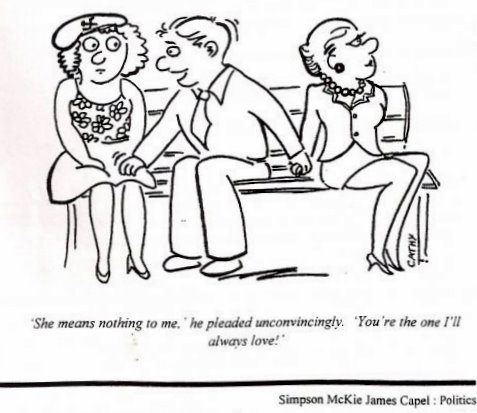
The guy in the middle is the ANC and his lying entreaties are addressed to Cosatu and the SACP while his real passion – and the furtive fumbling in the dark – are with business, global and domestic.

I commissioned that cartoon in 1999 and Cathy Quickfall did a better job than I could have hoped for: the Cosatu/SACP figure’s naive and hurt innocence, still wanting to trust Mr ANC; business in a sharp suit, her disdainful look into the distance with just the busy hand behind her back revealing her urgent and furtive intent.

In the intervening 11 years I have used this same cartoon on several occasions (here’s one) to ask whether the game has changed.

I believe this is still the game: the ANC’s vacillation between a “left” agenda (consisting of a combination of growing state welfare, increasing effective taxation on the wealthy and expanded intervention into shaping the economy’s trajectory) versus the promise (made more strongly in private) to global and local capital that it’s rights to property and the retention of the large share of profits are inviolate.

All governments are faced with a similar dilemma, but it is a peculiarly South African phenomenon that the “left” agenda is married to the ruling party through the formal institution of the Ruling Alliance and that the political choices have, for clear historical and structural reasons, been cast in ‘racial’ as opposed to ‘class’ terms.

The cartoon as constructed worked perfectly well for the end of the Mandela era as well as the whole of the Mbeki era – even if, in typical soap opera fashion, the relationships became so complicated and entagled that the essential nature of the clandestine affair became difficult to percieve.

The analytical challenge  for myself for 2011 will be to establish whether it holds true today.

There are indicators, including vaguely in the January the 8th statement and government murmurings about the New Growth Path, that hint that the grand French style affair might be coming to an end.

The rise of Jacob Zuma was, in part, the result of a tactical manoeuvre by Cosatu and the SACP to stop the deepening and elaboration of the affair between the ANC and some of the uglier strands of global capitalism.

The strategy seemed to fail when the Zuma administration appeared initially to be all about continuity of Mbeki’s economic policies combined with replacing his BEE beneficiaries with the Nkandla Crew – the worst of both worlds.

I am starting to suspect that a combination of the strategic choices that have been forced on Zuma (by manoeuvrings to his right) and the absolute imperative that the ANC increase delivery to the poorest South Africans (who are the majority of voters) bring us closer to the breaking of the triangle that the cartoon represents than we have been since 1994.

I will continue to gnaw at the bones of this question in this blog and I welcome any contribution you might make to this or any other discussion that takes place here.

Can you hear the drums?

Those who know me would expect me to profess that I would rather eat broken glass than say anything sentimental and upbeat for the sake of Christmas cheer.

They would also know that I often fail: that a sort of “jolly hockey-sticks” optimism can sometimes creep into my disposition, that the studiously steely eyes often mist over at the occasional heart-warming story – usually about children, dogs, down trodden people pulling themselves up by their own bootstraps (whatever that means) and politicians being hoisted by their own petards or any other suitable handle.

A bit lame I know, but that’s the way it is.

Anyway, nothing too mawkish this time – but still using every edge I can to generate interest.

Craig Tyson, my friend and the fine Editor of that  excellent men’s magazine GQ,  has agreed to my publishing in these humble electronic pages something of mine he has only recently paid for and placed in the December issue of his paper and ink magazine – which also has an excellent website you can catch here.

As I did previously: here is the cover of the GQ. Click on the nose of the gorgeous Gisela Calitz and you will be whipped through to my article arguing that it is, ultimately, unsurprising that political risk increased this year.

Only joking. You can click anywhere on the picture – I momentarily liked the thought of lots of people carefully resting the cursor on her perfect nose and giving it a little click, but I am over it now.

Oh, and buy the magazine. It’s a wonderful gift  for the season of giving … oops.

If this is the New Growth Path what’s the Old Growth Path?

This is the second of three articles about the New Growth Path (NGP) Framework released last week by the Ministry of Economic Development.

One of the architects (I must assume) of the NGP, Neva Makgetla  (an economist long associated with Cosatu and now deputy director general in the Department of Economic Development) recently examined both the Growth, Employment and Redistribution macro-economic policy and the ‘industrial development plan’ alternative usually advanced (in my opinion) by members of the SACP.

Writing in the September 2010 special issue of the African Communist (journal of the South African Communist Party designed as a forum for Marxist-Leninist thought) Makgetla spells out what she thinks are the problems with both polices are.

Her views of what has gone before are interesting because the new policy tries to marry these frameworks by taking only the best of both.

Someone should have warned them that in policy marriages, as in human ones, you take the good with the bad … but more about that in the third post about the NGP which I will probably only get to by Monday.

The ‘anti-poverty framework’ associated with GEAR

“In effect, the transition to democracy built an implicit social compact: business would retain its property rights, and by extension its wealth and standard of living, while government would use its tax revenues increasingly to address backlogs in services for black communities left by apartheid.”

Makgetla sees the 1996 GEAR policy framework as having left in place the basic structure of the Apartheid economy.

Path dependency meant mining and finance continue to dominate and that property relations and inequality remained unchanged.

But the strategy, according to Makgetla, was attractive to successive ANC governments because it was quick to roll out and provided immediate benefits for the poor (particularly through social grants), while (hopefully) stimulating production and generating employment as the poor consume more goods and services.

“(The major benefit of the strategy) from the standpoint of the state was that it did not require explicit intervention in the economy. It relieved the government of responsibility for transforming the economy, with the associated risks of failure and potential conflict with business. Instead, government could focus on the more agreeable task of improving the lives of constituents through the more conventional public functions of providing basic services and housing.”

The risks were largely in lost opportunity – not achieving “new kinds of economic growth and by extension enhanced employment”. Because the strategy was dependent on state revenues, it was ultimately hostage to the booms and busts of the global economy.

Her key assessments of the policy are:

1. the transfers remained too small to provide the hoped improvement in the conditions of life of the poor and therefore the expected increase in demand and economic stimulation;

2. the relatively strong rand meant that new demand for manufactured goods, especially clothing, appliances and household furnishings was largely met by imports, and

3. the poor were ultimately dis-empowered and demobilised by top-down hand-outs that are central to the strategy.

Industrialisation strategy – SACP alternative

This is the policy proposal that ‘stands in’, in Makgetla’s assessment for the traditional left contribution to the policy debate. It is best revealed, in her opinion, by the Industrial Policy Action Plan (1 and 2) of the Department of Trade and Industry.

These strategies are designed to encourage production of manufactured goods, especially for export.

The industrial strategy has the potential, in her opinion, to access larger markets in order to drive mass based production, which in turn will secure more rapid growth and higher employment.

Crucially, the approach is modelled on the relatively rapid development experienced in Asia especially in the 1960s and 1970s.

The version of the strategy she deals with – which is the version in IPAP2 of the DTI – explicitly requires government to change which parts of “capital” it supports i.e. government would need to collaborate more closely with “industrial capital”, while reducing support for mining, farming and finance.

The state should focus its support on conventional manufacturing especially of capital goods, transport, electronics – and to a lesser  degree “light industries” like clothing, food processing and minerals beneficiation. The policy tends to assume that services and production to meet domestic demand are inherently less competitive “and hence less desirable.”

Makgetla thinks there is high political risk for government in this strategy. The chances of failure in such an unequal society are high and if government adopts a strategy largely dependent on its effective intervention in the economy, it will get the likely flak along with the less likely kudos.

Risk is increased because the strategy is hostage to global demand for manufactured goods and RSA will be competing with China and almost every other developing country that sees this kind of strategy as central to their development path.

Finally, the industrialisation strategy supports long term economic growth but not employment and equity, which are not automatic consequences of growth. It ignores labour intensive activities like agriculture, services and construction and often leads to proposals to hold down wages to support competitiveness – she was prescient about that, but then she did help write the NGP!

On Monday I will spell out more specifically what the NGP proposes to do and I will make an assessment as to whether the policy will ever be implemented by this government and if it is, what it’s likely consequences would be.

If any of you are still with me by then, I will be surprised and you will probably be slightly sick of grandiose government policy making.

New Growth Path Framework bloodline

This is the first of three articles that look at the political and policy bloodline of the New Growth Path and the main criticisms that have emerged about the policy in the public domain over the last few days.

This first post is a summary – using quotes and paraphrasing – of Ruling Alliance statements about macro-economic policy since 1990.

To understand the policy we have to understand:

  • firstly how the policy fits into the discussion/dog fight in the Alliance over the last 20 years;
  • and secondly the fact that the policy comes from Minister of Economic Development, Ebrahim Patel, whose department and position, in my opinion, was a last-minute structural compromise to reward Cosatu (and to a lesser degree the SACP) for having backed Jacob Zuma against Mbeki.

So the big bulls (ANC and the SACP) have been butting heads for 20 years (see below) and now the little bull is trying to horn in on the action.

20 years in the trenches of the ideological squabble

Since the release of Mandela from prison in 1990 (and, in fact, well before that – mostly behind closed doors) different factions of the ANC, the SACP and Cosatu have had a sometimes productive and sometimes vicious policy debate about economic policy. At issue has always been the stance the state should take towards private business and the appropriate amount of persuasion and coercion required to achieve redress and redistribution.

The first sign of things to come was the speech Nelson Mandela made on his release from prison in 1990.  After the excerpt from Mandela’s speech I will let the comments flow and tell their own story of the conflict within the Ruling Alliance.

A history of the conflict in quotes and paraphrases

“The nationalisation of mines, banks and monopoly industry is the policy of the ANC and the change or modification of our views in this regard is inconceivable”

Nelson Mandela paraphrasing the Freedom Charter on his release from prison in 1990

“We are convinced that neither a commandist central planning system nor an unfettered free market system can provide adequate solutions.”

The 48th ANC National Conference, July 1991 from a conference resolution

“It was a demand-led and internal infrastructural development proposal, which envisaged less immediate concern with budget deficit reduction and inflation.”

African Communist No 147, third quarter 1997 discussing the Macro Economic Research Group’s (MERG’s) proposals from 1993

“Of particular importance was the proposal to restructure the economy by way of a policy of ‘growth through redistribution in which redistribution acts as a spur to growth and in which the fruits of growth are redistributed to satisfy basic needs’. This proposal was predicated on the central policy idea that the state needed to boost demand, primarily by ensuring that greater amounts of income would be received by the poorer sections of the population, which in turn would stimulate output and hence economic growth.”

Dennis Davis in From the Freedom Charter to the Washington Consensus 2002 discussing the RDP proposal of 1993

“Despite its ideology while in opposition, once in power the ANC government implemented an orthodox macroeconomic policy which stressed deficit reduction and a tight monetary policy, combined with trade liberalisation. The stated purpose of this package (the Growth, Employment, and Redistribution programme, or GEAR) was to increase economic growth, with a 4.2% rate programmed for 1996-2000. At mid-term of the programme, growth remained far below this target. The GEAR’s lack of success cannot be explained by unfavourable external factors; rather, the disappointing performance seemed the result of fiscal contraction and excessively high interest rates”

A standard left criticism of GEAR from: Stuck in Low GEAR? Macroeconomic Policy in South Africa, 1996-98 John Weeks Cambridge Journal of Economics, 1999, vol. 23, issue 6, pages 795-811

“Faced with deepening unemployment, poverty, and inequality, and with disappointing growth and investment, the GEAR policy framework has met with persisting criticism from COSATU and the SACP in particular. From the side of its principal proponents within the government, there have been several adjustments in the face of disappointment. Increasingly, GEAR has been redefined as a conjunctural stabilization program and not what its acronym suggested it once aspired to be (a growth, employment and redistribution strategy). In this rereading, GEAR was necessitated by global turbulence and by a very precarious foreign currency reserve situation in 1996. Its “success” is now measured not in terms of growth, employment, and redistribution outcomes, but anecdotally and by way of comparison—“whatever our problems, South Africa’s economy is not in the same predicament as Argentina, or Turkey, or Zimbabwe,” or “GEAR has helped us to survive the worst of global turbulence” (which may not be completely incorrect).”

Jeremy Cronin rephrasing GEAR as a conjectural stabilisation strategy – 1998

In an address to the Socialist International October 2003 and then in various speeches in 2004, Thabo Mbeki argued that solving unemployment, poverty and low levels of black participation in ownership and control of the economy had become very urgent. Further, he argued that to solve these problems an effective, strong and interventionist developmental state was needed – just proving that there is nothing new in heaven and earth. He put the case for improving the public service and extending the state’s influence and ability to lead the economy. “Influence” meant keeping hold of strategic state assets (and therefore a partial withdrawal from the privatisation specified in GEAR) as well as a detailing of micro-reforms including BEE. He placed a strong emphasis on private public partnerships as well as on galvanising a collective consciousness about the “common good”. From this shift the Accelerated and Shared Growth Initiative for South Africa (AsgiSA) was codified in 2005/2006. While it set targets for growth and employment, Asgisa was primarily an infrastructure investment programme combined with various (mostly supply-side) measures to remove impediments to growth – much of which the economy continues to benefit from today.

My own summary of Thabo Mbeki’s initial motivations for AsgiSA

In the lead up to Polokwane this was the definitive statement from ‘the left’ attacking the direction that the Mbeki government had taken: “The post-1996 class project” was led by a “technocratic vanguardist” state with the mission for “a restoration of the conditions for capitalist profit accumulation on a new and supposedly sustainable basis” (as opposed to “a revolutionary … transformation … to resolve the .. contradictions in favour of .. the working class ..”). The document argued that “The post-1996 class project” rests on three pillars: Firstly, the ANC leadership has mistakenly bought into a myth of a gentler, kinder world, but imperialism is stronger and more hostile to popular democracy than ever; secondly, to fit into this world “the second pillar of the project is a powerful presidential centre” that necessarily installs a top state/ leadership group of state managers and ‘technocratically’-inclined ministers and (often overlapping with them) a new generation of black private sector BEE; and finally, the project calls for the organisational modernisation of the ANC … “to transform the ANC from a mobilising mass movement into a ‘modern’, centre- left, electoral party”. There is a “manifest inability of capitalist stabilisation and growth to resolve the deep-seated social and economic crises of unemployment, poverty and radical inequality in our society. The ravages to the ANC’s organisational capacity and coherence (are caused by) “the attempts to assert a managerialist, technocratic control over a mass movement, and in the crises of corruption, factionalism and personal careerism inherent in trying to build a leading cadre based on (explicit or implicit) capitalist values and on a symbiosis between the leading echelons of the state and emerging black capital.”

My paraphrasing of the SACP Central Committee Discussion Document. Bua Komanisi – Volume 5, Issue No1 May 2006 – difficult to read but a perfect summary of the position that exists to this day in the SACP

Then came the answer to the ‘left critique’ from the central ANC leadership: “…the trapeze act here is to co-opt the ANC, formally, as an organisation pursuing socialism; and then condemn it as having betrayed the socialist project”. First, and most importantly the ANC denies that it ever was or should have been an organisation whose objectives was to achieve socialism. The ANC, the document claims, is the organic result of the struggle of black South Africans for national liberation and redress for what they suffered and lost under Apartheid. Additionally the ANC prioritises the poor and the working class. Once this point is made, the ANC argues, all the rest of the SACP critique falls away. The ANC accuses the authors of the SACP document of “ahistoricism, subjectivism and voluntarism”. This is more than just name calling. In the argument of the authors of this document:  ahistoricism refers to the SACP’s alleged  failure to understand what led to the present conditions as well as the character of the historical moment in which they find themselves, subjectivism means that the SACP has used its own preconceptions to guide its views and has seen the world as they wish it to be rather than how it really is; voluntarism  means the SACP believes that through pure force of will, hard work and determination it can achieve socialism in South Africa, whatever limitations the domestic or global environment and balance of forces, especially the strength of global capital markets, impose on possible outcomes.

Managing National Democratic Transformation – ANC response to SACP discussion document – probably the last time the ANC spoke plainly and confidently about economics and the class struggle – 19 June 2006 the official NWC response to the above quoted SACP Central Committee discussion document

The next post will summarise the actual policy contest (from an economists point of view) of the last 15 years. This will essentially be the actual macro-economic policy of the ANC (run from the Treasury) and the SACP’s consistent “industrialisation” alternative (proposed from the Department of Trade and Industry).

I phrase it like that deliberately to suggest that the Department of Economic Development and the New Growth Path Framework represents a new political assertion even if the policy formulation ultimately turns out to be a hodgepodge of previous proposals – as suggested by my summary of Thabo Mbeki’s AsgiSA policy above.

Who is Cronin’s enemy?

Jeremy Cronin’s criticism of Cosatu’s  recent hosting of a “Civil Society Conference” is impossible to understand without understanding his – and the SACP’s – assumptions about the world and South Africa in November 2010.

Cronin’s premise is that “an enemy” is attempting to make the public debate about the future of South Africa focus on minor issues where “the enemy” believes it can score a victory over the ‘progressive forces’ (of which Cronin assumes he and his organisation and his government are a part).

Cronin and the SACP accept some version of the following as a true and accurate reflection of reality (although Cronin himself would probably not phrase things so crudely, mechanistically and deterministically, it amounts to the same story):

Global capitalism and its local allies are securing their ability to continue to accumulate wealth

The bad guys in Cronin’s universe are a complicated (and brilliantly disguised) set of global business interests linked to and by the interests of powerful Western countries, especially the USA and the UK. What this enemy wants and needs is a world in which it can make loads and loads of money – especially by paying the lowest possible wages and taking resources and wealth from the Third World and packing these tightly around themselves in the playgrounds and fortresses of the First World.

Any change in any society that puts checks and balances on its ability to make money must be opposed – destroyed even before it takes root. Thus, thoroughgoing transformation of South Africa would strengthen the hand of the poor and dispossessed relative the the global capitalist/imperialist elite and must, therefore, be stopped.

Global capital/imperialism are constrained from arguing directly in favour of the oppressive political systems and unequal economic arrangements required to support their ability to extract wealth.

Instead they weaken the existing popular governments in the Third World, encourage the spread of corruption and (crucially for our purposes here) divert real debates about change that would benefit the poor and marginalised into light-weight debates about the individual rights and freedoms of the small group of citizens who have moved on from being concerned about the basic conditions of survival. And they do this by hoodwinking essentially good people and organisations who have a weak understanding of the world.

If this is the enemy, who’s on Cronin’s side?

In this version of the universe the African National Congress, the South African Communist Party and the Congress of South African Trade Unions are the structural expressions of ordinary people’s struggles to be free and fed.

Because Cronin is constructing this version of the world wearing his South African Communist Party beret, we must understand that Cronin assumes himself and his organisation to be part of a long-term plan that will overthrow the global yoke of capitalism and imperialism and construct a society based on human imperatives other than profit.

So what’s wrong with that?

Communists like Jeremy Cronin are not misguided in fearing and distrusting global corporations of private enterprise. Left to their own devices humans will extract as much from each other – or from groups other than the group to which they feel they belong – as is possible.

They will take until they are stopped. This is reflected in every business cycle and it is reflected in every attempt to re-regulate markets after bubbles (always caused by a feeding frenzy) have burst.

Additionally big global corporations will spend billions of dollars sucking up to politicians especially in the most powerful nations on earth – or more directly manipulating the political process.

However, there are two significant things  wrong with Jeremy Cronin’s (and the SACP’s) version of the world:

Firstly, the communists’ (and all tight party organisations and religious groups’) vision is obscured by their need to see the world as completely structured by two big gangs that are at war – the white hats and the black hats, the good and the evil, the oppressor and the victims.

There are more complex political choices to make than just to pick a side and back it to the hilt and defend its doctrines against all comers.

Global markets and trade and international relations are structured by hugely complex forces, not the least of which are government and supra-governmental organisations attempting to regulate various forms of behaviour. i.e democratic political processes attempting to subdue, moderate and direct the functioning of human fear and greed.

“Picking sides” in such a complex world is no easy matter.

Secondly, the communists fail to see that they and their organisations are subject to the same raging impulses of greed and terror that structure global capitalism – in fact they are structured into it, (only subject to no shareholder and less accountable and regulated than your standard global business).

The conference that Cronin criticises was precisely an attempt to discuss the best ways to regulate those impulses because they appear to have become the dominant impulses within government and the ruling party.

It is fine for Cronin to dispute this, but it is not fine for him to argue that his allies accept the functioning of criminal greed in his government and organisation because his government and organisation is struggling to combat these matters at a higher level.

We do not live in a simple world. It is my belief that the enemy is not out there in his serried ranks on the plains, he is in here with us, in our homes, in our families and in our beds. The enemy is right inside us, in our own hearts and in our own heads.

Until we realise this our best politicians will continue this Quixotic tilting at windmills.

Cronin warns Cosatu: if you lie down with dogs expect to get fleas

Umsebenzi Online has just (yesterday) published a stern warning to Cosatu from SACP deputy secretary general Jeremy Cronin about the trade union federation’s recent “Civil Society Conference”.

Cronin’s “intervention” (his word) is torn between warning:

  1. that the conference plays into the hands of “anti-transformation”, “anti-majoritarian” “right-wing liberals” and
  2. the fact that leading members of Cosatu’s partner organisations in the endeavour “share an activist history going back to the 1980s when they were involved in the “Marxist Workers’ Tendency” – a left-wing entryist formation that sought to transform the ANC into a workers’ party”.

So if you want the crude summary Cronin thinks Cosatu (and especially its secretary general Zwelinzima Vavi) is either misguidedly or deliberately serving the agenda of:

  1. those who would like to see Apartheid  survive  and US imperialism rule forever, and
  2. the same old anti-Soviet Trots who hated the SACP in the old days and still want to win the workers away from the party today.

I think both these reasons for warning Cosatu off are wrong-headed, but Cronin’s interventions are always interesting and are especially instructive for those prepared to poke around in the fermenting and bubbling interstices of his argument.

I will, therefore, be examining bits and pieces of what he has to say during the course of the day.

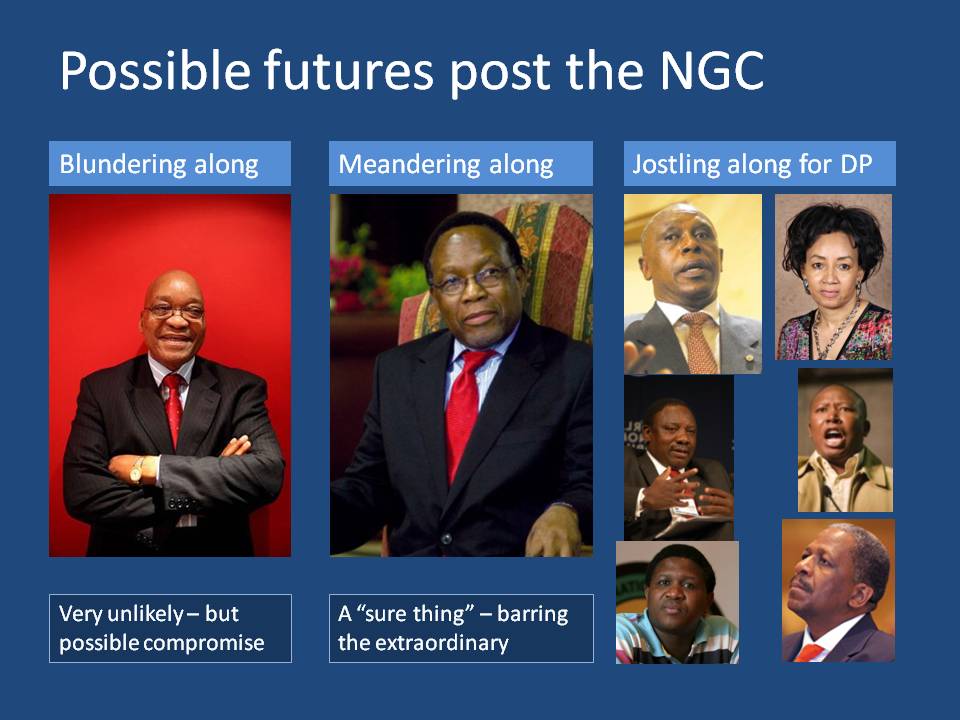
Pictures of a possible future

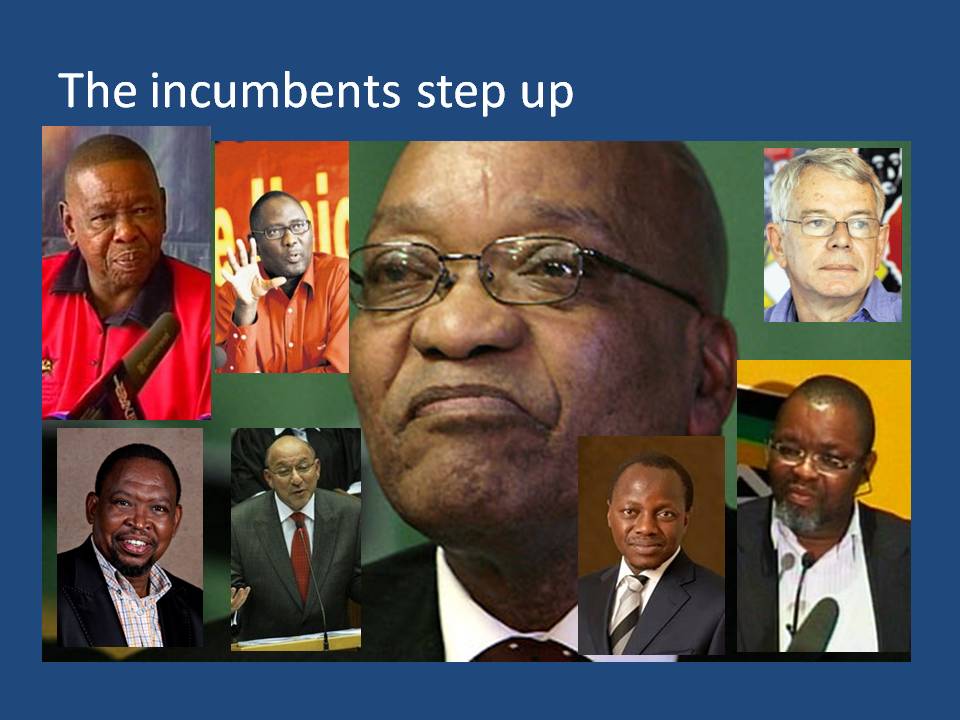
I occasionally publish slides that I have used for clients as part of my attempt to examine political and investment risks to them.

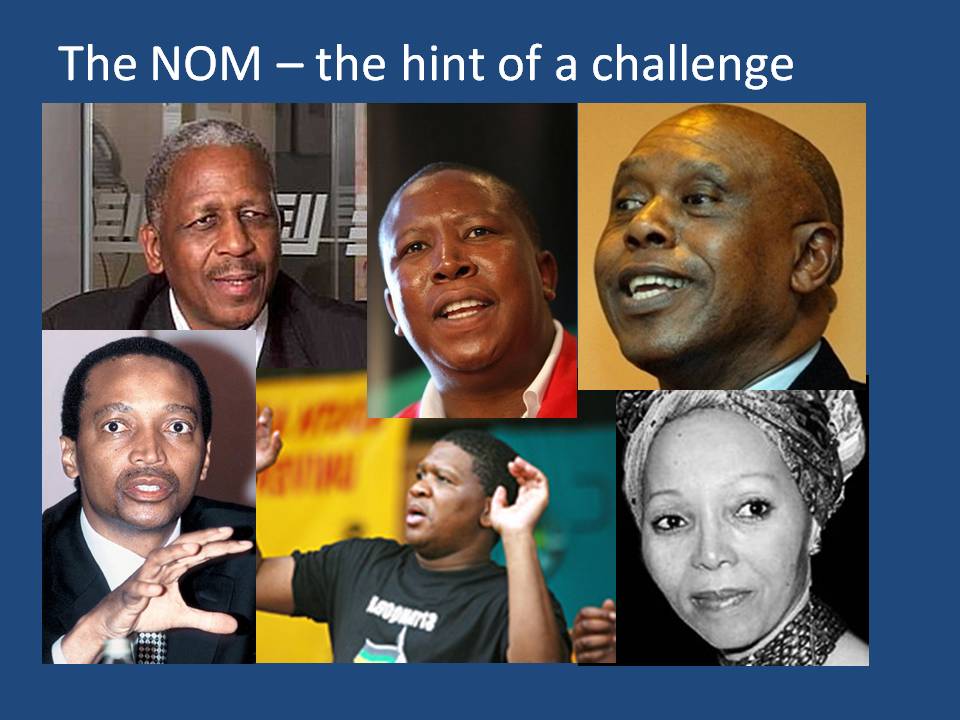
Below are 3 from a presentation I delivered soon after the ANC NGC.

See if you can identify all the people concerned – a sort of politics general knowledge test ( you know the ones: if you score 10 you are probably a CIA/MI5 agent; if you score 9, then get a life and stop obsessing about politics …. if you score 2 you are living in a special care facility etc.)

As an aid here is a link to Stalking horses at the NGC – the blog I posted at the time. To help refresh your memory ‘the NOM’ was meant to describe the group that had coalesced around the ANC Youth League’s call for the nationalisation of mines.

Suddenly it’s all sweetness and light?

It’s been a difficult week, and I started the following post on Monday soon after hearing the general tone of the press and analysts response to the cabinet reshuffle.

I wanted to publish while the accolades for Jacob Zuma were still glowing and, unfortunately for both the President and me, the corrective doubts and scepticism are starting to be discernible in the analysis that up until now has been characterised by the “a change is as good as a holiday” school of political commentary.


Anyway, this is what I wanted to say:

Jacob Zuma:

  • outwits some enemies at the ANC NGC,
  • announces (again) a process towards a (not very) New Growth Path,
  • (his Minister of Finance releases) the Medium Term Expenditure Framework which emphasises continuity,  and
  • he shuffles his cabinet

and suddenly he’s a visionary, man of action, seizing the nettle of corruption and there’s a new spirit of optimism skipping through the land.

It’s obviously exhausting to have to read the same old strands in our news media day in and day out: incompetence, lack of vision, cronyism and inability to overcome endemic conflict in the ruling alliance.

So I understand the need to seize on a sign, any sign, as the first swallow of summer, but I think a little restraint is called for.

What leads the official opposition to conclude that the cabinet reshuffle is first and foremost “a positive indication of renewed focus on accountability’, when the far more obvious explanation is Jacob Zuma is using the reshuffle as part of his own agenda to stay in office beyond 2014?

Jacob Zuma is no fool and those who forget that he has played inner-ring ANC politics as head of Mbokodo, the ANC internal intelligence organisation, will constantly be led to make mistakes of analysis. He did, after all, defeat the acknowledged master of palace politics, Thabo Mbeki – and if this was a swords and sorcery story we would understand that he now has the previous master’s powers at his disposal.

A whole range of benefits and protections accrue to Jacob Zuma and his backers from him remaining president of the country. But to remain president, he needs to use a cabinet reshuffle to do four things:

  1. He must ensure that his cabinet is seen to be busy with the job of  optimising delivery to the poorest South Africans (the constituencies he is talking to here are made up of the voting poor themselves and the various elites who feel threatened by those poor South Africans and who pay their taxes and various formal and informal levies towards the upliftment of the poor – and who cannot countenance that protection money being stolen or squandered by the political middle-man);
  2. Linked but separate is the need to be seen to be fighting against government corruption and cronyism. This is slightly difficult when one of the features of his presidency is the degree to which his own family is making oodles of money out of his good name, but a major cabinet reshuffle gives him an excellent opportunity to sacrifice the biggest and fattest offenders and offer them up to the uncritical daily media as grist to the mill of their learned analysis.
  3. Forming the cabinet allows him to woo individuals who belong to camps which oppose him. This is either in preparation for alligning with those camps around particular issues in future or it is part of an attempt to weaken the coeherency of the opposition.
  4. Finally cabinet posts and and especially the more amorphous post of deputy minister are excellent ways of building a corps of supporters to back him during future transitions.

Thus some of the major aspects of the reshuffle could be undertood as follows (and I quote myself from a recent research report);

The firing of General Nyanda

Zuma and the ANC has been under the cosh of public opinion – and negative opinion of Alliance leaders, particularly Cosatu’s Zwelinzima Vavi – for the tender abuse and rampant corruption of senior politicians. No-one represents this better (along with a very in-your-face approach to the ministerial car fleet) than the good General. Nyanda is powerful and wily, but his usefulness as an ally has gradually been outweighed by his usefulness as a sacrifice to prove that the President is serious about corruption. The fact that telecommunications policy has been a consistent political failure for the ANC (right back to the days of the awful but sweet Ivy Matsepe-Casaburri) makes it easier to throw Nyanda to the wolves.

Barbara Hogan

Barbara Hogan has been a growing problem for the ANC. Liked and respected by business and the media and largely regarded as competent, her incipient ideological rebellion has been deeply threatening to the ANC and since her criticisms of the refusal to grant a visa to the Dalai Lama the party has been looking for strategy to getting her out of the way before she does something really embarrassing. Also, the position of Minister of Public Enterprises is a real plumb. Hogan represents no power constituency in the ANC and therefore the ‘patronage resource’ of the position is wasted on her.  Public Enterprises is a massive area of political oversight.  Hogan was a gifted and thorough minister, but moving her out of this portfolio is not going to make much difference to government performance in this arena. Finally, she has conflicted with Nyanda (and Zuma) and removing Hogan and Nyanda at the same time allows Zuma to sell the act as ‘even-handed’. She will be missed.

Malusi Gigaba, Fikile Mbalula and Paul Mashitile

This is slightly more Byzantine, but the promotion of Malusi Gigaba to public enterprises and Fikile Mbalula to sports and recreation and Paul Mashitile to arts and culture (and to a lesser extent Ngoako Ramathlodi  to deputy in correctional services) is both an attempt to keep in with a key and potentially competing faction and also to place those competitors in positions that will be demanding and time consuming, but will not be a base from which to launch attacks. The leading figure in this faction is probably Tokyo Sexwale. Now all the key members are up to their necks in Cabinet jobs that will keep them out of trouble. At the same time Zuma may benefit by drawing them all into the heart of government, bound by its discipline and codes and directly under his authority. It is now only Julius Malema who is still outside the tent, with an independent base, able to make a noise and engage and challenge Zuma publically.

Constituency rewards

One of the ways to ensure power and influence is to woo particular and defined constituencies. ANC Women’s League stalwart Bathabile Dlamini to social development is an obvious example of wooing the voting block of the League. Also, the South African Democratic Teachers Union has already expressed its delight at the appointment of its previous General Secretary Thulas Nxesi as deputy in rural developement.

The slew of deputy ministers

In general the pushing up of cabinet numbers works to the benefit of Zuma. The more largesse he can dispense the more power he will have when it comes to the lead-up to the ANC’s centenary conference.  Each deputy appointment provides the opportunity to reward some, make promises of future greatness to others and bring potential enemies closer.

I am sure it would be possible to run a similar analysis on every appointment or shift and the guiding analysitical principles would prove fruitful.

An interesting point to note is that President Zuma has left untouched the key economic departments which are part of a broader alliance process and the security departments, which were the first areas he put firmly under his own control.

In conclusion let me reiterate: Zuma is great on tactics and strategy – it is the arena of principles that he leaves something to be desired. His presidency has not been a great advance on Thabo Mbeki’s, but, in general, his priorities have led him to appoint people better equipped for the tasks set for them.

The cabinet reshuffle has not significantly changed the overall capacity of this government , but it does leave the Nkandla team stronger than at any time since Polokwane and a second term for Jacob Gedleyihlekisa Zuma is looking more likely than ever.

… celebrity a razor in the body …*

My sister was a famous model and in that capacity was invited to judge the Miss World competition at Sun City in 1995.

She asked me to accompany her as her official partner for a whole weekend of glitzy celebration and judging.

My famous and beautiful sister Josie Borain who was the first major contract model with Calvin Klein


The event was interesting to me for a number of different reasons but the only aspect that might apply to a column on politics and investment risk is the astonishing effect that being treated as a celebrity can have on one’s moral and intellectual soul.

I had been living alone on a farm in the Southern Cape for 5 years when Josie invited me to accompany her to the competition.

I had spent the 1980’s involved in “the struggle” in various capacities. By 1990 I’d had enough and I left politics and my myriad comrades and friends as they got on with the business of negotiating the peace and then running the country.

Of course I had some contact from afar with previous friends, but those who had  moved into the ethereal realms of Mandela’s first cabinet seemed to have been lifted body and soul out of the social networks they had previously occupied .

I would only meet again those of my old friends who had become senior politicians in government a year and a half after the Miss World competition when I returned to ‘civilisation’ to become a father and take up a permanent position as a political analyst for a Cape Town based investment broker.

At the Miss World competition we stayed in the The Palace of the Lost City at Sun City (a big step for me because we had spent the 1980’s promoting the boycott of the resort that was built in the then bantustan of Bophuthatswana).

The point I wanted to make about all of this is that from early morning to late at night the organisers of the event and the hotel treated me as if I was a celebrity. It was a peculiar but not altogether unpleasant experience. I couldn’t walk out of my room without a dapper assistant type person reaching for my arm to accompany me to waiting  vehicles or parties of fabulously beautiful women sipping at drinks.

Every second of the day there was someone right beside me nodding with interest at everything I said and did. Everything was paid for. It was like being in a dream where the lights swirl around you and you are the centre of the attention of some vast organisation of doormen, waiters and compliant and beautiful people.

An air-conditioned limousine (there really is such a thing – it is not just a cliché in bad spy novels) delivered me to Jan Smuts airport for my trip back to the farm after the celebrations were finally over.

What I remember most vividly about the whole weekend was standing alone with my bag just in the entrance to the airport.

“Hello!” I might have thought shrilly to myself . “Excuse me? I’m here – where the hell is everybody?”

Two years later I met again, mostly in their formal capacities, my previous friends who had become ministers and deputy ministers, ambassadors and persons of similar august standing in society.

I was never shocked and surprised at the grandiosity and extraordinary pomposity most of them came to exhibit.

I have since sat around tables with men I had previously watched fight Apartheid police with their fists and feet and watched as they lean back from the table, eyes closed, their voices drawling as their massive new brains formulate positions that keep all of those present silent as the great man speaks.

I have sat with ambassadors at formal dinners where the guest are subjected to a reading by the said ambassador of  her extremely bad poetry. We all sit in silence and most nod in awed approval.

This is a different world they inhabit.

Their whole lives, every moment of the waking day, is spent surrounded by a system that takes them extremely seriously. They travel first class and they are met at the plane by luxury vehicles driven by people trained to give the impression that this is the most precious cargo they have ever carried.

Everyone they interact with confirms the lived reality that they are, in fact, a different kind of person: cleverer, more interesting and more valuable.

There is often a faux gentleness and compassion that goes along with this kind of celebrity. When someone with whom you might once have thrown stones at the police as you dodged through billowing clouds of tear gas puts her hand on your arm and looks into your eyes and says “we really appreciate the work you are doing” you don’t screw up your face and ask “what work?” You just nod.

I believe there is something intrinsically harmful to ourselves and our society in the way we elevate our politicians. I recommend taking every opportunity to deflate the individuals, prick the bubble that we have surrounded them with.

I do not think it is inevitable that politicians, ministers or even super models become pompous wind bags but I can name very few who have escaped the corroding effects of celebrity and power.

I still see Jeremy Cronin flying with real people on the plane and chatting like a normal human being (what will we do if that stalwart ever goes over to the dark side?)

And my lovely sister Josie seems to have escaped with her humility and charm intact – although I rather suspect that is because even as whole restaurants full of New Yorkers would break into spontaneous applause as she entered in the 1980’s she never quite lost the sense that there had been some huge and embarrassing mistake – one she was just too polite and sweet to correct.

*from the poem: Heron Rex by Michael Ondaatje in  The Cinnamon Peeler – Selected Poems – 1989 … my long time favourite collection of poetry.

Winning, losing and declaring a truce in the battle of ideas

Jacob Zuma’s decision to meet with Gareth Cliff and Woolworths’ decision to put Lig, Juig, Joy and Lééf back on the shelves makes me wonder about the rules of engagement in the battle of ideas in the age of celebrity and social media.

In the 1980’s those of us connected to the ANC in the ‘white left” were mostly engaged in the battle of ideas. In that war we witnessed one defeat from afar and experienced victory up close and personal – and believed it was ours.

First, watching from afar as one government lost the battle:

In Zimbabwe the signs that ZANU might be losing was the Catholic Bishops Conference starting to sound alarmed at what was happening in Matabeleland.

In South Africa as in Zimbabwe the Catholic Bishops Conference was friendly ground for national liberation movements in the battle of ideas – it was territory we had already won, so there were two ways of understanding what was happening:

  1. the Catholic Bishops Conference had been won over by the bad guys or;
  2. ZANU had become the bad guys.

Thankfully we were suspicious enough of ZANU and Mugabe to not be totally surprised as the Gukurahundi massacre gradually revealed itself. I regretfully suspect that had the situation been reversed (and our ally ZAPU had won to power) ‘some among us’ would be denying the atrocities to this day … but then, I am forced to believe that in those circumstances such atrocities would never have happened … hmm.

Putting aside that difficult conundrum … the victory we experienced up close and personal was our own over the Apartheid regime – or that was what we liked to think, anyway.

Another way of saying the Apartheid state and the National Party lost the battle of ideas is to say they lost influence over the middle ground that lay between them and the African National Congress.

We (the activists and supporters of the ANC) saw this as the fruit of our work in implementing the revolutionary injunction: “Isolate your most dangerous enemy from his potential friends!” – we were a tiresomely self-righteous lot much in love with clunky slogans, but anyway …

The National Party losing the middle ground was less a function of the work of those of us distributing awful translations of already awful ANC literature to bemused Afrikaans speaking white students at Stellenbosch and more a complicated interplay of factors as diverse and vast as the failing of the Soviet economy and the effects of sanctions on South African businesses.

But if the pamphlets (or even the establishment of  Nusas and End Conscription Campaign branches at the University of Stellenbosch) made little difference to the grand scheme of history the fact that such branches were set up in the National Party heartland and staffed and run by young Afrikaners was a crucial indicator of what was going on.  These were real hints of the shape of things to come – so to speak.

The ebbs and flows in the ideology and influence upon organisations and groups in the middle ground keeps a reliable scorecard of the broader contest.

The ANC in those days conceived of the middle ground as the organisations, forums and activities over which it could exert influence. It started with organisations and institutions which were very close to it (essentially under its discipline), through the newspapers and universities all the way to forums like the General Synod of the Nederduits Gereformeerde Kerk, within spitting distance of the Apartheid regime itself.

We are a long way from the 1980’s and the ANC that was then running its war from the wilderness is now in the fortress at the centre of its own heartland. It is not as threatened in its retreat as the National Party and the Apartheid state were by the mid-80’s, but the rumours of war are starting to be whispered in the corridors.

Like I said, the useful thing about the middle ground is that it is like a gauge of the state of play. You only need to cast your eye over the daily newspapers to realise that the ANC is gradually moving onto the defensive on important fronts in the war of ideas.

If you do have doubts, look at this extraordinary list of individuals and civil society groups that have signed in support of the Right To Know campaign in opposition to the Protection of Information Bill. All those organisations are not suddenly firm enemies of the ANC and the state … but they are drifting into opposition, a fact that is clearly starting to concern the ANC and government.

Another sign of the shifts in ‘civil society‘ is DJ Gareth Cliff feeling confident enough to attack government and President Jacob Zuma in deeply uncivil terms on his blog – its worth a read.

Jacob Zuma’s office has announced (astonishingly, I might say) it is seeking a meeting with Cliff to discuss his article.

In the same week the South African retail giant Woolworths reversed a decision to remove Christian magazines from the shelves of its stores – after an ongoing campaign that played itself out on Woolworths own facebook page.

At one level both Zuma and Woolworths live and die by the strength and popularity of their image. Perhaps they are just following that hoary old marketing maxim:  “the customer is always right”?

But I think that Zuma and Woolworths holding up the white flag in the battle of ideas is an important sign of things to come. Is presages a coming time when billions of rands and perhaps political power itself will be won and lost in the the feverish rebellions that sweep across the web.

The implicit hesitation by both Woolworths and the South African government is both healthy and wise. This is a new field of battle and the rules of engagement are uncertain. It is right to edge your way forward, using each brush with the enemy as an opportunity to learn something new about the terrain upon which the war will be won and lost.

Looking backwards and going forwards

I came across a long research note that I wrote in early 2007 exploring the impending succession process in the ANC to culminate at the Polokwane conference 7 months later.

So I was writing before the June 2007  National General Council during which Jacob Zuma’s resignation/suspension as ANC deputy president was overturned from the floor and it became clear that change was inevitable.

I thought I should upload the document onto this web log so that one day when some student decides to examine the accuracy or otherwise of the predictions of political analysts they’ve got some publicly available data to work with.

Also, it’s an interesting read – both because of how wrong and how right it was, but also because how defensive I was about Mbeki and how suspicious I was of Zuma. I regret the former but not the latter.

Click here for the whole document, but below are some highlights and lowlights:

Why I thought markets were nervous about a change in ANC leadership

All change is unsettling, but a South Africa without these  illustrious, high-minded leaders of global eminence and distinction (Mandela and Mbeki) might feel less of a sure thing and the fears that waned from 1994 may wax again with their departure and replacement by people’s whose names cannot be pronounced in London and New York.

My learned views on why the global context made the transition even scarier for investors

New and untested leadership of the ruling party and the country will enter the stage of history in a context of unexpected and growing global uncertainty. The inherently unsettling nature of the domestic political succession is amplified as an apparently natural and stable global order has revealed itself to be increasingly tricky, unstable and unpredictable.

The ending of the Cold War did not end history and the US did not come to represent a unipolarity around which democracy and stability could spread. Instead, the Washington Consensus has crumbled and the rise of China, Russia and India is in the process of rewriting the rules of global trade, economic governance and the structure of capital markets. The world’s major economic and military power extends itself and commits ever more of its myriad apparatuses, fashioned to achieve its national goals, to perplexing military campaigns. And while the cat’s away: the emerging world is experimenting with different forms of governance, including economic governance, that would have been unthinkable only ten years ago.

Leadership exceptionalism

… this country has developed a habit, possibly a mythology, of what I term “leadership exceptionalism”. In short this refers to the belief, erroneous or otherwise, that South Africa has achieved an unlikely stability primarily through the exceptional quality of leaders throughout the society – including on both sides of the Apartheid fence and in the churches, trade unions and business.

(It helps that I already thought this idea was rubbish.)

Getting it wrong about Polokwane (and one might ask: who’s the “our” in “our first case scenario”?)

Throughout the early stages of the transition contest it appeared that Zuma was the main contender and the person most likely to get the job – an outcome we will dispute below … It’s foolish to predict such a close run race so long in advance, but our first case scenario is one in which Zuma fails to become president of the ANC in 2007. If this is the case, the 2009 successor to Mbeki will not be known until the ANC goes through a specific nomination and election process for this position – probably starting in 2008.”

Why corruption was making the process so much worse (and, goodness, look how uncomfortable I was about criticising Mbeki)

‘True or false and for better or for worse;

  • the allegations of corruption against Jacob Zuma
  • the multiple and uncontested economic transactions and favours that passed between the ANC Deputy President and Shabir Shaik – now convicted of two counts of corruption and one of fraud
  • the widespread, but entirely untested, charge that President Mbeki has allowed the courts and prosecution authority to be used less to stop Zuma’s alleged corruption and more to prevent him ascending to the presidency in 2009

has stamped the succession process with the twin burdens of being a proxy for the fight against corruption and being tainted by the alleged misuse of state resources by the highest power in the land.

and I could’t hide what I thought of the challenger

Aside from the actual corruption allegations mentioned in 4.2, to put the icing on the  anxiety cookie, Zuma’s various statements and legal tribulations have portrayed a man who is:

  • a polygamist;
  • poorly educated,
  • apparently ready to play into ethnic divisions for political advantage,
  • undisciplined in his sexual behaviour,
  • homophobic
  • under the guise of “ Zulu traditionalism” unsettlingly cavalier towards women.
There’s lots about the left backing Zuma, but his own position was clear

This is not to suggest that Zuma is a leftist, worker friendly or naturally close to the SACP and Cosatu – in fact the very opposite might be true. The left backing of Zuma, which has caused bitter internal debates in the trade union movement and amongst the communists, must be understood as primarily an attempt to wield any likely candidate against those who represents the rightward drift of policy, namely Thabo Mbeki and his anointed successor.

The left was already taking a clear stand against corruption

Organisations of the left, but particularly the South African Communist Party, have been the most consistent moral watchdog in the Ruling Alliance. They have held government to account for tendencies of “cronyism” and the “compradorist and parasitic” nature of much of the emerging “bourgeois” elite which they argue is characterised by “primitive consumption”; they have insisted government focus on HIV/AIDS and expunge any denialism in its ranks, they have fought for a principled approach to the Zimbabwe situation, and, most importantly, they have presented themselves as the bastion against corruption within the state, government and business.

which made their backing of Zuma so difficult for me to swallow …

The decision (implicit or explicit) to back Zuma’s candidacy has deeply divided the left and soundly removed them from the moral high ground they had come to occupy. Those who won the debate to back Zuma – with the uncontested facts of his unhealthy relationship with the corrupt and fraudulent Shabir Shaik and his distasteful statements about HIV/AIDS, women and Zulu traditionalism already out there in the world – have cast the individuals and organisations of the left as opportunistic and willing to back any candidate from whom they can expect improved political access and influence. Given the idealism of much of the membership of the SACP and like minded groups, the opportunism of some of the left’s current leadership’s will probably prove to be their undoing.

Hmm, the sweet idealism of my youth …

That’s enough … there is lots more revealing stuff in there, including comments on every possible candidate. I will just add the comments I made then about Tokyo (because I believe they are true today) and then leave it up to you to read or dip into when it suits you.

On Tokyo Sexwale

Popular, ex-Robben Islander and exile; flamboyant – soldier adventurer type, trained in USSR for the ANC before his capture. After 1994 turned to business with a lot of flair (Mvelaphanda Holdings) and undoubtedly made the system work for him in a very successful way. He is probably the most charismatic character with the broadest appeal amongst this lot. He also has the ability to build a strong and loyal group around himself – hints of “cult of the personality”.. He is rich and flash enough for this to count against him. He has constantly denied that he may run but there are constant rumours that he is assembling a team to make a run for the top job.

Is the ANC really beyond redemption?

It is difficult not to imagine the tearing of some deep and important ligament in our body politic in the tone and content of this debate that starts in The Times, ostensibly between Pallo Jordan and Justice Malala and ostensibly about media freedom. The battle is joined – and complicated – by the ANC in its formal capacity in this unattributed article, by a reader’s reply to Justice Malala (K B Malapela’s article here) and a contribution by the redoubtable Paul Trewhela here.

My mother was taught at a Catholic convent in Johannesburg in the 40’s and part of the curriculum was a subject called “Apologetics”, which essentially means defending the faith and recommending it to outsiders. All of the contributions to this debate, to greater or lesser degrees, have the brittle quality of Apologetics. This is clearly not a debate designed to win over an opponent;  it is much more a debate designed to slag off the opponent – to influence perhaps separate audiences.

This does not mean that the opponents are all just political propagandists rolling out set pieces in an archaic ideological struggle. The anger, hurt and perhaps even fear are real and personal. After studying each spit and snipe, each appeal to history and every egregious character assassination (of which there are many) I find myself uncomfortably ambiguous about where my sympathies lie.

When we strip out all of the detail, at issue is the clash of these two broad assertions (this is definitely my formulation – the actual words or even ordering of arguments – will not necessarily be found in this form in any single contribution to the ‘debate)’:

  • The one view attacks Malala and defends the ANC – in the general context of supporting legislation to make the print media legally accountable. It goes something like this: ‘The ANC, admittedly imperfect and flawed, is the national liberation movement that led the struggle against Apartheid; the organisation whose members and supporters paid the overwhelmingly highest price in the struggle against Apartheid and it is currently the political party in which resides the main hope of building a South Africa free of Apartheid and its vestiges (which are still strongly present and primarily injurious to black South Africans). Given this truth, the depth and ferocity of Justice Malala’s attack on the organisation can only be explained by him having made a profession out of attacking the organisation for the benefit of a self-satisfied and confirmedly racist audience – or that he serves some darker and deeper purpose of enemies of South Africa.
  • The other view defends Malala and attacks the ANC – in the general context of opposing legislation that seeks to control the media. This argument goes something like this: “The ANC has no claim to an exclusive role in the struggle against Apartheid and in any case the ANC’s contribution to that struggle was always flawed and undermined by deeply anti-democratic (or Stalinist) traditions and brutal repression of internal dissent. Justice Malala is part of a tradition of journalism in South Africa that has fought government censorship and general government abuse of power. Abuse of power, in various forms, characterises the ANC government today and it is right, fitting and brave for Malala to continue to ‘speak truth to power’.

I was going to paraphrase each article and attempt to draw out each essence but it’s probably better that you do that for yourself.

But here, for those who are interested, are my considered opinions on the issues that I think lie at the heart of this debate.

Firstly, regimes can reach a point where the only strategic option is complete non-engagement; where the only way forward is the destruction of that regime and its replacement by an alternative. But it is ludicrous to argue that this is where we are in South Africa with regard to the ANC government. Much of our political commentary and journalism seems to be phrased in these terms – as if we are all revolutionaries now, beyond any hope or care of reforming the system. This view is both implicit and, to a lesser degree, explicit, in the words of Malala and Trewhela. I am all for gung ho evisceration (by written word) of corrupt and pompous politicians, but there is a not-so-subtle line between vigorous – even exuberantly irreverent – criticism and the argument that government per se is the problem and therefore cannot be part of the solution. Many aspects of this government’s performance are deeply disturbing – as is the seeming avalanche of cronyism in our political culture. But I am absolutely clear that a government that continues to command around 70% of national electoral support (primarily because that electorate perceives the government as the main heir to the mantel of national liberation movement) has got to be engaged with, has got to be encouraged to be “the solution” more than it is “the problem”. And anyway the ANC, government, Cabinet and ‘the state’ in all of its manifestations is not some undifferentiated monster that requires slaying. The most important debates that shape our future take place within the ANC and the government as much as they do in the national media or in Parliament. Who wins and who loses within the ANC remains a decisive question that we cannot abandon as “irrelevant”.

Secondly, the ANC’s claim to legitimacy based on its historical role as the leading organisation representing black South African’s aspirations for national determination and in opposing Apartheid is a false claim. That the ANC was the main formation thrown up by Apartheid oppression of black South Africans is indisputable and that legions of its supporters, leaders and members fought bravely and suffered deeply is equally indisputable. But how often in the world have we seen claims of historical suffering and historical struggle against oppression justifying present corruption and brutal repression? The ANC needs to hear the claims of some journalists and commentators that the ANC of today represents a radical discontinuity with that ANC of the past.  This is a legitimate assertion that can only be answered with specific claims to value based on present activities and achievements.

Too often the ANC’s claim to legend, previous heroism and fortitude, to banners and flags and songs, is the only answer it seems able to give to those who say it has become an unsalvageable cesspool of greed and self-interest.

The ANC needs to be reminded of the words of the great African revolutionary leader, strategist and philosopher, Amilcar Cabral (here I quote the first and last few sentences of this famous statement):

Always bear in mind that the people are not fighting for ideas, for the things in anyone’s head. They are fighting to win material benefits, to live better and in peace, to see their lives go forward, to guarantee the future of their children. . .

Tell no lies. Expose lies whenever they are told. Mask no difficulties, mistakes, failures.

Claim no easy victories…


Mantashe holds the line

Single heroes who defend narrow approaches to the precious citadel against massed ranks of Orcs, barbarians or Persians are much revered in mythology.

I would like to nominate Gwede Mantashe to stand briefly amongst their legendary ranks.

He stood up yesterday in front of the South African Democratic Teachers Union and said (as quoted in Independent Online):

Sadtu … has neither clarity nor commitment to the education of the black child in the eyes of the public. We continue to use them (children) as pressure points and cannon fodder in the bargaining process. During the strike white children in general and Afrikaans children in particular continued to learn, many of you know this, whose children are in Model C schools. The children of many teachers go to Model C schools. When they (the teachers) go on strike their children continue to learn.”

He was booed and heckled off the podium.

After the booing and heckling had finally died down and he was allowed back onto the podium he said:

When comrades heckle me, they want me to express views about them… if that’s the issue I would suggest that Sadtu in future does not invite me.

So let this heroic stand – flawed like the stands of all the greatest mythological heroes* – not go unnoticed and un-revered. It takes a special kind of discipline and courage to stand up in front of your allies and dress them down in the clear and unambiguous terms Mantashe used.

There is little question that the activities and failures of the South African Democratic Teachers Union is making a singularly negative contribution to South Africa’s progress. There are other failures in government and in society that contribute to the unfolding catastrophe that is our public education system, but the lousy return on the considerable capital we as a country invest in education is in no small part due to the actions and inactions of Sadtu members.

So bravo Gwede Mantashe, the halls of Valhalla await you … hopefully later, rather than sooner.

* Note: Even legendary heroes are not perfect, so we just have to ignore that ridiculous assertion that Afrikaans children were the the least affected as a group by the public sector strike.